Carlos Ignacio Jr Lugay, Yoshiki Kurata, Joseph Ramon Leofando, Janfil Mari Pamisal, Jeryl Salas (2022). An Analysis on the Effects of Different Types of Keyboards on Users’ Productivity and Hand Muscle Strain. In: Ergonomics In Design. AHFE Open Access, vol. 47, pp. 531–538. https://doi.org/10.54941/ahfe1001980
Musculoskeletal disorder (MSD) complaints are increasing as people are forced to do their daily tasks at home using computers, as evident with the limitations brought by the COVID-19 pandemic. The purpose of this study was to provide a comparative analysis on the efficacy of different types of keyboards in terms of typing speed, accuracy, and prevention of wrist/hand fatigue among keyboard operators to assist them in increasing work productivity and minimizing the risk of Carpal Tunnel Syndrome (CTS) or other hand injuries. To assess the pain level, typing speed, and accuracy, the participants were subjected to a 5-minute keyboard typing activity to test 4 different keyboards: standard, mechanical, foldable, and laptop. Through the Kruskal-Wallis H-Test, it has been found that mechanical keyboards are the optimal choice for all students and typing-related workers to increase their typing speed and accuracy and alleviate wrist/hand-related pain. Other than using a mechanical keyboard in the virtual workplace, it is also recommended that the users’ hands move freely and be elevated above the wrist rest while typing to enhance the wrist's mobility.
Carpal tunnel syndrome (CTS) is one of the most reported work-related musculoskeletal disorders due to posture-based issues and work-related factors (Necio et al. 2019; Shults et al 2020). Long hours of computer use give a higher risk of the upper extremity symptoms of work-related muscu- loskeletal disorders, evident with its high incident rates (Loh et al. 2018). Due to the prolonged computer use and working without breaks, young office workers have a relatively high prevalence of work-related wrist and hand issues, including clinically proven CTS (Feng et al. 2021). In addition, repetitive movements in keyboard typing harm people’s wrist and hands due to the excessive pressure on the nerves (Wheeler, 2019). Thus, (De Putter et al. 2012) mentioned that hand and wrist related injuries are one of the most expensive injuries, constituting an average of US$740 million annu- ally. Likewise, economic, and social pressures brought by musculoskeletal
disorders among working-age population are immense that employers spend at least US$103,000 for every 100 employees annually. In the United States alone, 29% of the recorded injuries resulting from days of work attributed to work-related musculoskeletal disorders (Daneshmandi et al. 2017).
Keyboard design has shown to influence wrist and hand postures that affects median nerve deformation (Yeap et al. 2017). The abnormal flexion- extension posture of the wrist joint, repetitive movements throughout the day, and use of vibratory items were tagged as potential causes for the deve- lopment of CTS (Bibi & Khan, 2019). Also, keyboard key spacing suggests comfortability and productivity based on the International Organization for Standardization (ISO). According to (Pereira et al. 2013), the optimal keybo- ard key spacing length lies between 17mm to 19mm, and touch typing may be a challenge for keyboard with key sizes less than 16 mm (Kim et al. 2014).
This paper investigates the effects of different keyboards on users’ pro- ductivity and hand muscle strain. Specifically, this study identifies which keyboard produces most words with fewer typographical errors in each time frame and which keyboard has the slightest wrist and finger discomfort when typing. The results of this study will benefit the working people considering that office workers that use computers constitute a good percentage of Phi- lippine labor (Philippine Statistics Authority, 2020). Moreover, the findings are expected to improve the keyboard design, which will enhance the task efficiencies of people and prevent the possibility of injuries.
METHODS
The researchers have collected the necessary data through actual data gath- ering from invited participants; however, due to the COVID-19 restrictions imposed in Metropolitan Manila, Philippines, only sixty-four participants have voluntarily participated in this study. The participants were provided with keyboards and asked to navigate the website application in the test con- ducted. The application includes a five-minute fixed timer and immediately starts when a person presses any key. With the test provided by the resea- rchers, the test subjects were asked to type a random text as fast as possible without stopping for the allotted five minutes. After the typing test, the par- ticipants are required to answer a pain level questionnaire using a Likert scale from 1 (no pain) to 5 (worst possible pain). Moreover, typing speed and accuracy results were automatically shown on the application. Most employers solely recognize certification results from a 5-minute typing test (Meshulam, 2019).
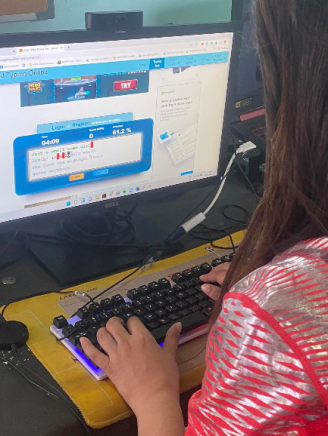
During the data gathering, the participants were provided time to practice the touch-typing method, as all participants do not have a background of typing-related jobs or experiencing musculoskeletal disorders symptoms on their hands, wrists and shoulders (see Figure 1). The manual typing test was performed using a computer and a stopwatch; thus, a typing test application was utilized in the study. Furthermore, this paper used the pain scale to deter- mine the pain level experienced by participants. It is a tool that physicians use to determine a patient’s level of discomfort as it can be used during a hospital stay, a doctor’s visit, physical activity, or post-surgery (Weatherspoon, 2018).
An Analysis on the Effects of Different Types of Keyboards 533
Figure 1: Picture of one participant doing the 5-minute typing test.Table 1. Variables used in the study.
Table available in the original PDF paper.
Types of tests Independent Dependent
Measurement Measurement
Variable Variables
Unit Instrument Wrist/hand
Pain Level Type of Keyboard
pain level
5-Point Likert Scale
Typing test application Typing Speed Type of Keyboard
Typing Speed Words Per Minute (WPM)
Typing test application Accuracy Type of Keyboard
Typing Accuracy
Percentage of Accuracy (%)
Typing test application
The independent variable used is thept different keyboards commonly used in the Philippines. The dependent variables are pain level (ordinal), typing speed (continuous), and accuracy (continuous) (see Table 1). The researchers used a comparative research design to observe the impact caused by the inde- pendent variable on the dependent variables. Since the factors involved were continuous and ordinal, the Kruskal-Wallis H test was used. Kruskal-Wallis H test (also known as the one-way ANOVA on ranks) is a nonparametric rank-based test used to discover statistically significant differences among groups of independent variables comprised of continuous and ordinal depen- dent variables [Lund, 2020]. As the test was done using one-way ANOVA, the parametric analyses for 2 to 9 groups were done by each group contai- ning more than 15 [Minitab, 2019]. In the experiment, four groups had four types of keyboards, each composed of 16 participants. Before starting the data gathering, all Kruskal-Wallis H test assumptions were met and further interpreted and analyzed using the SPSS 23 statistical software.
Table 2. Descriptive statistics of the study (N = 64).
Table available in the original PDF paper.
Variable N Minimum Maximum Mean Standard Deviation Pain Level 64 1 5 2.83 1.432 Typing Speed 64 28.00 75.00 44.9688 11.66458 Typing Accuracy 64 91.00 99.00 96.0938 1.87480
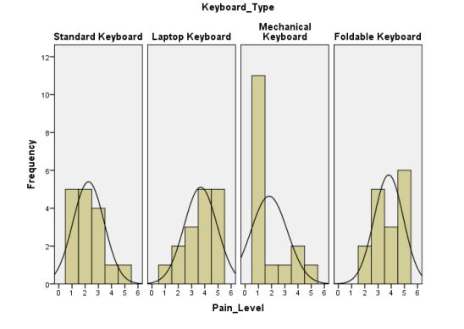
Figure 2: Histogram of pain level test.
RESULTS
The descriptive statistics shown in Table 2 show that the overall pain level mean is 2.83 with a standard deviation of 1.432. The overall typing speed mean is 44.9688, with a standard deviation of 11.66458. Lastly, the overall typing accuracy mean is 96.0938, with a standard deviation of 1.87480. The 64 respondents are grouped based on the 4 keyboard types (1 = Standard Keyboard, 2 = Laptop Keyboard, 3 = Mechanical Keyboard, 4 = Foldable Keyboard).
Based on Figure 2, the histogram of the pain level test showed the shape of distribution scores from all the keyboard types. Based on the normal curves presented, the forms are not similar across all the groups. With this, the Kru- skal Wallis H-test cannot compare the median of the keyboard types; thus, the mean ranks will be compared.
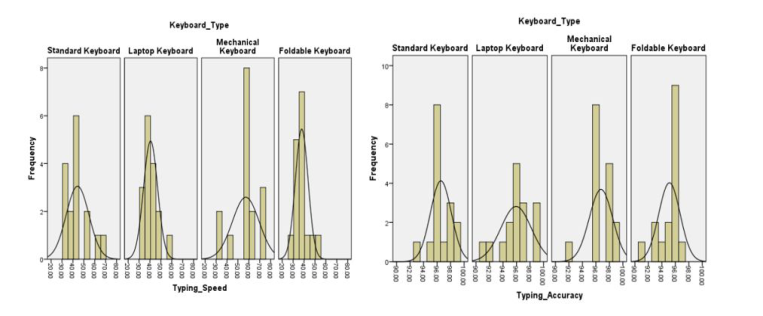
Figure 3 presents the histogram of typing speed test and typing accuracy test, and it showed the distribution scores shape from all the keyboard types considered. The shapes are not similar for all the groups from the normal curves. Therefore, the Kruskal Wallis H-test cannot compare the median of the keyboard types, which is the same as above, the mean ranks will be compared.
Table 3 summarizes the hypotheses tests performed by the researchers, the test used its significance value, and the decision based on the results. In determining for the hypotheses to be concluded, the significance values (p-values) will be utilized (Kurata & Matias, 2018; Kurata et al., 2015). Based on the results, the typing speed test (p-value = 0.000), typing speed
An Analysis on the Effects of Different Types of Keyboards 535
Figure 3: Histogram of typing speeding test and typing accuracy test.Table 3. Hypotheses test summary.
Table available in the original PDF paper.
Decision Null Hypothesis Test Significance Value
0.000 Reject the null hypothesis
Independent Samples Kruskal Wallis-H test
The mean ranks of the groups in the Pain level Test are the same.
0.000 Reject the null hypothesis
Independent Samples Kruskal Wallis-H test
The mean ranks of the Pain Typing Speed Test groups are the same.
0.037 Reject the null hypothesis
Independent Samples Kruskal Wallis-H test
The mean ranks of the groups in the Typing Accuracy Test are the same.
test (p-value = 0.000), and the typing accuracy test (p-value = 0.037) all are less than the alpha level of 0.05. Thus, it is concluded that the mean ranks of the groups across the pain level test, typing speed test, and typing accuracy-test differ from one another.
The mean rank of the types of tests done to the keyboard types used is summarized in Table 4. It is evident on the results that the lowest mean rank in the pain level is the mechanical keyboard (mean rank = 19.47), followed by the standard keyboard (mean rank = 25.19), foldable keyboard (mean rank = 41.91), and laptop keyboard (mean rank = 43.44) as the highest. It determines that the participants experience the slightest pain level in using the mechanical keyboard.
Second, typing speed has been measured by the researchers. The mech- anical keyboard garnered the highest mean rank with a value of 48.81, followed by the laptop keyboard, standard keyboard, and foldable keybo- ard with mean rank values of 31.63, 27.66, and 21.91, respectively. Hence, it is found out that most Filipinos can type faster using mechanical keybo- ards rather than other options available. Finally, the highest mean rank is
Table 4. Kruskal wallis H-test mean ranks for different keyboard type groups from pain level test, typing speed test, and typing accuracy test.
Table available in the original PDF paper.
Type of Test Keyboard Type Mean Rank Pain Level Standard Keyboard 25.19 Laptop Keyboard 43.44 Mechanical Keyboard 19.47 Foldable Keyboard 41.91 Typing Speed Standard Keyboard 27.66 Laptop Keyboard 31.63 Mechanical Keyboard 48.81 Foldable Keyboard 21.91 Typing Accuracy Standard Keyboard 36.47 Laptop Keyboard 31.81 Mechanical Keyboard 39.31 Foldable Keyboard 22.41
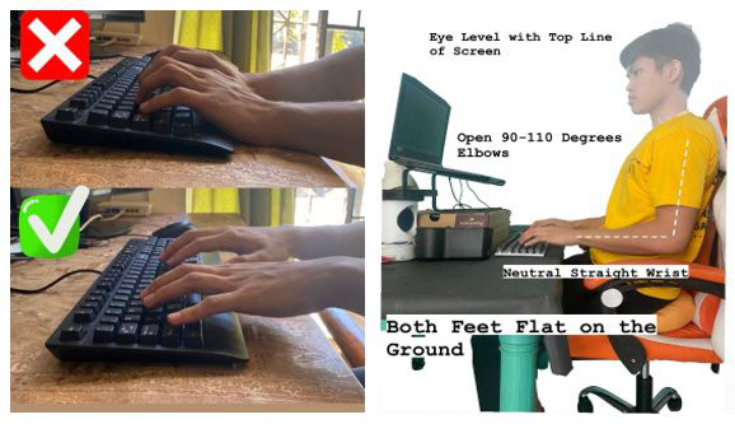
Figure 4: Proper hand and body posture while typing (Adapted from Muller, 2020).
the most optimal among the keyboards in determining the ideal typing accu- racy. From the results, the mechanical keyboard garnered the highest mean rank (value = 39.31), followed by standard keyboard (value = 36.47), laptop keyboard (value = 31.81), and foldable keyboard (value = 22.41). Overall, it has been found that the mechanical keyboard is the optimum keyboard across the three criteria considered in the study.
CONCLUSION
This paper investigates the effects of different keyboards on users’ producti- vity and hand muscle strain. Specifically, this study identifies which keyboard
An Analysis on the Effects of Different Types of Keyboards 537
produces most words with fewer typographical errors in each time frame and which keyboard has the slightest wrist and finger discomfort when typing. Based on the results, the mechanical keyboard type is the most preferable among the four types of keyboards available and based on the criteria used (pain level, typing speed, and typing accuracy). This type of keyboard may pose an excellent substitute for the available ergonomic keyboards in the market based on the criteria considered.
Along with considering the use of the mechanical keyboard, the researchers also recommend that the hand and body postures be improved while users are using a computer keyboard. [Muller, 2020] highlighted the measurements that computer users must apply while working (see Figure 4). In addition, users’ hand should move freely and be elevated above the wrist rest while typing to enhance the wrist’s mobility. Frequent short breaks also help the users relax their hands and reduce the risk of having wrist injuries [Health and Safety Executive 2018]. Finally, it is advisable that one avoid resting their wrists on the desk, as this puts strain on an individual’s tendons and reduces blood flow.
REFERENCES
Bibi, M., & Khan, B. (2019). Carpal Tunnel Syndrome and use of computer keyboard and mouse; a systematic review. Rehman Journal of Health Sciences, 1(2), 25–27. Retrieved from http://www.rjhs.pk/index.php/rehman-journal-of-health- science/article/view/15 Daneshmandi, H., Choobineh, A. R., Ghaem, H., Alhamd, M., & Fakherpour, A.
(2017). The effect of musculoskeletal problems on fatigue and productivity of office personnel: a cross-sectional study. Journal of preventive medicine and hygiene, 58(3), E252–E258. https://www.ncbi.nlm.nih.gov/pmc/articles/PM C5668935/ De Putter, C. E., Selles, R. W., Polinder, S., Panneman, M. J. M., Hovius, S. E. R., & van Beeck, E. F. (2012). Economic impact of hand and wrist injuries: health-care costs and productivity costs in a population-based study. Jbjs, 94(9), e56. Feng, B., Chen, K., Zhu, X. et al. (2021). Prevalence and risk factors of self-reported
wrist and hand symptoms and clinically confirmed carpal tunnel syndrome among office workers in China: a cross-sectional study. BMC Public Health 21, 57 https: //doi.org/10.1186/s12889-020-10137-1 Health And Safety Executive. (2018). Working safely with display screen equipment.
Available from: https://www.hse.gov.uk/msd/dse/work-routine.htm#article Kim, J. H., Aulck, L., Thamsuwan, O., Bartha, M. C., Johnson, P. W. (2014).
The Effect of Key Size of Touch Screen Virtual Keyboards on Productivity, Usability, and Typing Biomechanics. Human Factors. 2014;56(7):1235-1248. doi:10.1177/0018720814531784 https://journals.sagepub.com/doi/abs/10.1177/ 0018720814531784 Kurata, Y. B., Matias, A. C. (2018). Work-Related Factors Affecting Sustained Alert State Among Bank Security Personnel in the Philippines. In: Freund, L., Cellary, W. (eds) Advances in The Human Side of Service Engineering. AHFE 2017. Advances in Intelligent Systems and Computing, vol 601. Springer, Cham. https://doi.org/ 10.1007/978-3-319-60486-2_18
Kurata, Y. B., Bano, R. M. L. P., & Matias, A. C. (2015). Effects of Workload on Academic Performance among Working Students in an Undergraduate Engi- neering Program. Procedia Manufacturing, 3, 3360–3367. https://doi.org/https: //doi.org/10.1016/j.promfg.2015.07.497 Loh P. Y., Yeoh W. L., Muraki S. (2018) Impacts of Typing on Different Keyboard
Slopes on the Deformation Ratio of the Median Nerve. In: Bagnara S., Tartaglia R., Albolino S., Alexander T., Fujita Y. (eds) Proceedings of the 20th Congress of the International Ergonomics Association (IEA 2018). IEA 2018. Advances in Intelligent Systems and Computing, vol 820. Springer, Cham. https://doi.org/10. 1007/978-3-319-96083-8_33 Lund A. (2020). Kruskal-Wallis H Test using SPSS Statistics. Available from: https:// statistics.laerd.com/spss-tutorials/kruskal-wallis-h-test-using-spss-statistics.php= Meshulam D. (2019). Ace Your Employment Typing Test with Customized Word
Typing Preparation. Available from: https://www.jobtestprep.com/typing-test- practice Minitab (2019). Example of Kruskal-Wallis Test. Available from: https: //support.minitab.com/en-us/minitab-express/1/help-and-how-to/modeling-s tatistics/anova/how-to/kruskal-wallis-test/before-you-start/example/ Muller J. (2020). Proper typing posture according to ergonomist. Available from: https://ergonomictrends.com/proper-ergonomic-typing-posture-at-computer/ Necio, A. J. F., Batac, N. E. C., Odias, T. M. P., Ricafort, J. L. B., Salazar, R. R., &
Kurata, Y. B. (2019). Postural Analysis among Machinists Experiencing Work- related Musculoskeletal Disorders in the Philippines. IEEE International Con- ference on Industrial Engineering and Engineering Management, 2015, 59–63. https://doi.org/10.1109/IEEM44572.2019.8978765 Pereira A. et Al. (2013). The Effect of Keyboard Key Spacing on Typing Speed, Error, Usability, and Biomechanics: Part 1. Human factors. 55. 557- 66. 10.1177/0018720812465005. https://www.researchgate.net/publication /247154064_The_Effect_of_Keyboard_Key_Spacing_on_Typing_Speed_Error_U sability_and_Biomechanics_Part_1/citation/download Philippine Statistics Authority (February, 2020). 2017 Survey on Information and Communication Technology (SICT) - For Information Economy (Core ICT Indu- stries): Preliminary Results. Available from: https://psa.gov.ph/surveys/sict Shults J. et al. (2020). Can Typing Cause Carpal Tunnel Syndrome?. Available from:
https://www.jonathanshultsmd.com/can-typing-cause-carpal-tunnel-syndrome Weatherspoon, D. (2018). What is a pain scale, and how is it used. Available from: https://www.healthline.com/health/pain-scale Wheeler T. (November,2019). Carpal Tunnel Syndrome. Available from: https://ww
w.webmd.com/pain-management/carpal-tunnel/carpal-tunnel-syndrome Yeap Loh, P., Liang Yeoh, W., Nakashima, H., & Muraki, S. (2017). Impact of keyboard typing on the morphological changes of the median nerve. Journal of occupational health, 59(5), 408–417. https://doi.org/10.1539/joh.~17--0058-OA
LISTED IN THE AHFE DIGITAL BOOKSTORE CATALOGUE
Explore the complete digital volume
Ergonomics In Design
Read this individual research paper free through the original publisher, or explore the full digital proceedings book.
ISBN 978-1-958651-23-0
Explore this ISBN in the AHFE Bookstore ↗Listed in the July 2026 bookstore catalogue; search by ISBN to confirm current availability · Digital book purchase optional