Phoebe Nicole Arreola, Angel Gabriel Hernando, Jonelle Matthew Lugares, Gene Oliver Roxas, Yoshiki Kurata (2023). Effects of Online Gaming Behaviors on Filipino Students' Perceived Academic Performance through Multiple Regression Analysis. In: Training, Education, and Learning Sciences. AHFE Open Access, vol. 109, pp. 232–244. https://doi.org/10.54941/ahfe1003170
With the changes brought about by the COVID-19 pandemic, playing online games significantly increases as it lessens the stress and reduces the negative effects of self-isolation which cope with the problems encountered by most of the Filipino students. Several studies have shown that online games worsened the learning ability, attention issues, and lowered the academic performance of the students which shows the negative consequences in playing online games. This study aimed to identify the statistically significant factors affecting the perceived academic performance of Filipino students due to online gaming. A self-administered questionnaire was deployed among five hundred (500) Filipino online gamer students from across cities of Metropolitan Manila. Stepwise multiple regression analysis was utilized to determine the fittest predictor of academic performance. Results show that time spent playing online games during Weekdays (p-value= .001), Gender (p-value = .001), Number of subject loads (p-value=.005), Attendance (p-value= .001), Number of close friends (p-value= .001), and Career preferences of e-sports (p-value= .021) and Law (p-value= .047) are significant predictors of academic performance. Recommendations focuses on encouraging students to monitor their time spent playing online games on weekdays and weekends, avoid absences on class, practice group discussions and enroll on manageable units to improve their academic performance.
For the past few years, online games have been the activity of people to escape from their problems, relieve their stress, and for their own entertainment. Since the start of the global pandemic, COVID-19, physical distancing has become a societal restriction that drives people to consider leisure activities that could be done without the physical presence of other people, leading them to electronic gaming [Rozgonjuk et al., 2022]. Teenagers and adole- scents can stay up all night playing games without worrying about school and work due to the virtual class and work-from-home setup caused by the
Effects of Online Gaming Behaviors of Filipino Students’ Perceived Academic Performance 233
recent pandemic. The closing of schools, lockdowns, and staying-at-home has allowed gamers to increase their playing duration. There are adverse effects when a person is engaged in online games; this can affect their individual behavior, leading to personal issues [Columb et al., 2019]. Students in uni- versities who have an addiction to online gaming suffer excessive fatigue and daytime sleepiness, which can affect their academic performance [Ohayon & Roberts, 2021].
These students that have poor academic performance show significant cha- racteristics, these include lack of motivation and interest in learning [Wu & Xin, 2019]. As students tend to lean on the negative effects of online gaming, the researchers will focus on the positive result of gaming towards their lear- ning styles and school performance. This research would provide crucial information to the involved sectors to develop a deeper understanding of the effects of online gaming behaviors to the academic performance of the stu- dents. The study would also extract relevant data concerning gamers’ actual experience that would help provide practical recommendations that may be useful in the welfare of the students and the academe.
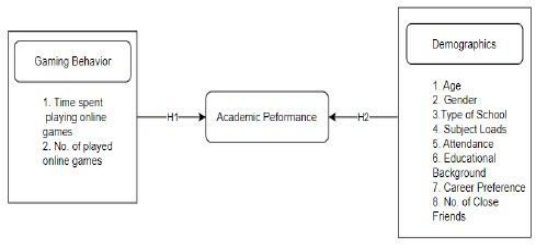
The framework (see Figure 1) presents the variables extracted from the related literature. Demographics include age, gender, type of school, subject loads, attendance (absences), education background, career preference, and number of close friends. Gaming behavior includes time spent playing online games (class days & weekends) and number of played online games. The researchers aim to find the relationship between the eleven (11) factors men- tioned above and conclusively determine if the identified factors significantly affect the dependent variables: Perceived Academic Performance. It shows the relationships of the twelve (12) hypotheses (see Table 1) to one another.
Figure 1: Conceptual framework.
METHODS
A self-administered survey was distributed among Filipino online gamer stu- dents from the National Capital Region, Luzon, Philippines, to determine the significant predictors of the academic performance of students playing games. The researchers gathered a total of five hundred (500) responses.
Multiple Linear Regression, specifically the backward Stepwise Method, was used to analyze the data considering that the study involves several inde- pendent variables, which determine the effects of online gaming behaviors of
Table 1. Summary of hypotheses.
Table available in the original PDF paper.
No. Hypotheses H1 Gaming habit does not affect Academic Performance H1.1 Time spent playing online games does not affect Academic Performance H1.2 No. of played online games does not affect Academic Performance H2 Demographics affect Academic Performance H2.1 Age does not affect Academic Performance H2.2 Gender does not affect Academic Performance H2.3 Type of School does not affect Academic Performance H2.4 Subject Loads does not affect Academic Performance H2.5 Attendance does not affect Academic Performance H2.6 Educational Background does not affect Academic Performance H2.7 Career Preference does not affect Academic Performance H2.8 No. of Close Campus friends does not affect Academic Performance
Filipino students towards perceived academic performance. This technique is a sequential process for fitting least squares models in which a single expla- natory variable is modified to fit into the model at each step. The researchers utilized SPSS to perform the calculations with the gathered data to measure the descriptive statistics in the study. The significance level of 0.10 was also used in the study to further know the significance predictors in the analysis.
RESULTS
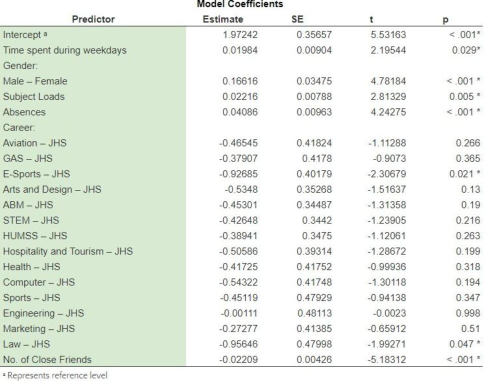
The final model in the stepwise multiple regression analysis shows that time spent playing online games during weekdays, gender, number of subject loads, number of close friends and career preferences of e-sports and law are signifi- cant predictors of academic performance. The values indicating an increase in semestral average translates to poorer academic performance as the grading system used in the analysis measures 1.0 as the highest to 5.0.
Value shows that for every hour increase of time spent in online gaming during class days, the semestral average of a student increases by 0.01984 on the average, holding all other factors constant, indicating poorer acade- mic performance. This result follows the study of Garcia et al. (2018) that online gaming negatively impacts students’ academic grades by significantly affecting assignments, quizzes, recitation, and examination results.
Moreover, the semestral average of a student increases by 0.16616 if they are male compared to a female holding all other factors constant, indicating a poorer academic performance. This result is consistent with the previous study of Alharajraf & Alasfour (2004) in which results showed a significant difference between male and female performance as evaluated by academic grade and that female achievement is higher than male achievement.
Results also show that for every additional subject load, the semestral average of a student increases by 0.02216 on the average, holding all other factors constant, indicating poorer academic performance. This finding con- tradicts the result of a previous study of Szafran (2001) that higher academic grades are typically attained by students who take more credits, however, it
Effects of Online Gaming Behaviors of Filipino Students’ Perceived Academic Performance 235
includes that registering for more loads of challenging courses results in lower grades.
Furthermore, for every additional absence, the semestral average of a stu- dent increases by 0.04086 on average, holding all other factors constant, indicating a poorer academic performance similar to the study of Guleker (2014). Attendance and performance had a significant positive correlation with one another in that the higher the attendance or the lesser the absence, the lower the probability of a failing mark.
Lastly, the result suggests that for every additional close campus friend, the semestral average of a student decreases by 0.02209 on the average, hol- ding all other factors constant, indicating better academic performance. This result confirms Braxton et al.’s (2013) hypothesis that student integration—as demonstrated by close campus friends in this study—is favorably connected to persistence. The study’s findings also found a positive relationship betw- een improvements in college grade averages and the presence of more close campus friends.
Model fit measures show that the final model can explain about 21% of the variation in semestral average. This includes the variables time spent online gaming during class days, gender, number of subject/course loads, number of absences, career preference, and number of close friends.
The normality tests resulted in a Kolmogorov-Smirnov p-value of 0.328 and test statistic of 0.0424. Since the value of the test statistic is less than the critical value of 0.05, the researchers do not reject the null hypothesis
Time spent during weekdays 1.1 0.906 Gender 1.07 0.936 Subject Loads 1.09 0.918 Absences 1.08 0.923 Career 1.01 0.986 No. of Close Friends 1.08 0.93
[Riffenburgh, 2006], concluding that the residuals are normally distributed. Hence, the assumption is satisfied.
The Heteroskedasticity test showed a p-value greater than 0.05 for Goldfeld-Quandt and Harrison-McCabe tests. After that, the research- ers cannot reject the null hypothesis because the p-value is not less than 0.05 and lacks sufficient proof to conclude that the regression model contains heteroscedasticity [Zach, 2020]. Therefore, the researchers conclude that the residuals are homoscedastic. Hence, the assumption is satisfied.
The result of the collinearity statistics shows values of VIFs no greater than 5 for all significant variables. According to Bhandari (2020), a VIF value of 1 means there is no correlation between the independent variables and a value greater than 5 indicates high multicollinearity. Therefore, there is no multicollinearity. Hence, the assumption is satisfied.
CONCLUSION
The findings in the study revealed that under the independent variables, Time spent playing online games during weekdays, Gender, Number of sub- ject loads, Number of close friends, and Career preferences of e-sports and
Effects of Online Gaming Behaviors of Filipino Students’ Perceived Academic Performance 243
law are significant in predicting the Academic Performance. Accordingly, the study suggests that to achieve high academic performance of students, edu- cational institutions should incorporate group discussions of students with their friends into their supplementary materials, as having more close fri- ends or people they interact with can improve their academic performance relative to their GPAs [Braxton et al., 2013]. Moreover, students should lessen their playing time during weekdays, as it affects their academic per- formance. Regarding the subject loads, students should only enroll in the proper load of their courses for them to efficiently handle their respon- sibilities in school [Lau, 2017]. Even though the findings of this study are encouraging, the researchers acknowledge that there are still several areas that might use improvement and additional research. Future research could try to apply several hypotheses related to academic achievement, and online gaming which will highlight a different set of factors important to this topic.
REFERENCES
Alharajraf, N. M. & Alasfour A. M. (2004). The Impact of Demographic and Academic Characteristics on Academic Performance. Retrieved from https://ww w.ccsenet.org/journal/index.php/ibr/article/view/33284. Bhandari, A. (2020). What is Multicollinearity. Retrieved from https://www.analytic
svidhya.com/blog/2020/03/what-is-multicollinearity/. Braxton, J. M., Doyle, W. R., Hartley III, H. V., Hirschy, A. S., Jones, W. A., & McLendon, M. K. (2013). Rethinking college student retention. John Wiley & Sons. Columb, D., Griffiths, M. D., & O’Gara, C. (2019). Online gaming and gaming
disorder: More than just a trivial pursuit. Irish Journal of Psychological Medicine, 39(1), 1–7. https://doi.org/10.1017/ipm.2019.31. Garcia, K., Jarabe, N., & Paragas, J. (2018). Negative Effects of Online Games on Academic Performance. Retrieved from https://sajst.org/online/index.php/sajst/a rticle/view/40. Guleker, R. (2014). The Effect of Attendance on Academic Performance. Retrieved
from https://www.mcser.org/journal/index.php/mjss/article/view/4614/4479. Lau, W. W. F. (2017). Effects of social media usage and social media multitasking on the academic performance of University Students. Computers in Human Behavior, 68, 286–291. https://doi.org/10.1016/j.chb.2016.11.043. Ohayon, M. M., & Roberts, L. (2021). Internet gaming disorder and comorbidi-
ties among campus-dwelling U. S. university students. Psychiatry Research, 302, 114043. https://doi.org/10.1016/j.psychres.2021.114043. Riffenburgh, R. H. (2006). Regression and Correlation Methods. Statistics in Medicine, 447–486. doi:10.1016/b978-012088770-5/50064-2. Rozgonjuk, D., Pontes, H. M., Schivinski, B., & Montag, C. (2022). Disordered
gaming, loneliness, and family harmony in gamers before and during the covid-19 pandemic. Addictive Behaviors Reports, 100426. https://doi.org/10.1016/j.abrep. 2022.100426. Szafran, R. F. (2001). The Effect of Academic Load on Success for New College Students: Is Lighter Better. Retrieved from https://link.springer.com/article/10.1023/ A:1018712527023.
Wu, B., & Xin, Y. (2019). Investigation and study on the causes of college students’ poor academic performances and intervention mechanism taking college students in Xi’an as an example. Proceedings of the 3rd International Conference on Cul- ture, Education and Economic Development of Modern Society (ICCESE 2019). https://doi.org/10.2991/iccese-19.2019.364. Zach (2020). How to Perform the Goldfeld-Quandt Test in R. Retrieved from
Read this individual research paper free through the original publisher, or explore the full digital proceedings book.
ISBN 978-1-958651-85-8
Explore this ISBN in the AHFE Bookstore ↗Listed in the July 2026 bookstore catalogue; search by ISBN to confirm current availability · Digital book purchase optional