Dinghau Huang, Yuling Pan (2023). The effects of Virtual Reality from different visual perspectives on empathy. In: Human-Centered Metaverse and Digital Environments. AHFE Open Access, vol. 99, pp. 1–9. https://doi.org/10.54941/ahfe1003925
Virtual Reality (VR), as a modern technology, can embody perspective-taking, making people see the world through the eyes of others. Many research has found that VR can be an effective medium to facilitate empathy; besides, some studies have investigated the underlying mechanism of empathy facilitation through VR devices. The current research examines whether the difference in visual perspective, which are represented as the first or third-person point of view, would affect the empathy facilitation of VR users.We invited forty people, separated into two groups as the first-person perspective group (1PP) and the third-person perspective group (3PP). The subjects were asked to watch the video through VR devices with same contents but from different points of view. The results indicated that there was no significant difference in empathy facilitation between the two groups. However, after dividing empathy into two dimensions, affective and cognitive empathy, the former showed a significant difference. Experiencing from the third-person perspective, the subjects aroused more emotions, such as guilty and compassion, thereby cultivating empathy toward the character of the video. Furthermore, for the feelings of the VR experience, the subjects of 1PP and 3PP displayed great disparity as well. Most of the subjects of 3PP subjectively considered the experience good, while the others felt neutral.
How to “put ourselves into other’s shoes” has been a topic widely discussed. As an emerging technology, Virtual Reality (VR) can present other people’s perspectives, allowing us to be in the world viewed by others (Milk, 2015). Therefore, VR has been considered as an effective medium to deliver story- telling experiences (Shin, 2018). Also, lots of studies have found that VR is a powerful tool to enhance people’s empathy and regarded it as an “empathy machine” (Farmer & Maister, 2017; Gerry, 2017; Herrera et al., 2018; Shin, 2018; Kandaurova & Lee, 2019). VR being a head-mounted display (HMD), the visual aspect is the primary cognition of the users (Mantovani et al., 2003; Kardong-Edgren et al., 2019). Past research has investigated the underlying mechanism of empathy facilita- tion through VR devices, such as different virtual embodiments and different fields of view (Herrera & Bailenson, 2021; Schutte and Stilinovi´c, 2017).
Some researchers have also suggested that people tend to take a specific visual perspective when observing things (Gander & Gander, 2021). How- ever, other studies claim that watching 360-degree videos through different kinds of media, not only by VR devices but also by computers or smartph- ones, can induce user’s immersive feeling (Bang & Yildirim, 2018; Bindman et al., 2018). Moreover, videos presented by VR with different fields of view, like 360-degree, 180-degree, and two-dimensional (2D), facilitate same amount of empathy (Aitamurto et al., 2018; Barreda-Ángeles et al., 2020). The above-mentioned contradiction may result from the design of the media or the factors of the subjects, which still needs to be discussed further.
VISUAL PERSPECTIVE Previous research focused on the effects of different user’s fields of view on empathy facilitation; however, few studies made further discussion about visual perspective, the effects of different points of view on empathy faci- litation. Speaking of visual perspective, first and third-person points of view are the concepts often discussed. The definition of these can be interpreted through the First-Person Methodologies presented by Varela and Shear in 1999. On the one hand, the first-person perspectives are the subjective expe- riences relating to cognitive and mental events, which associate with and demonstrate a “self” or “subject”. On the other hand, the third-person per- spectives, which associate with and represent the “outside” or “object”, are objective descriptions, meaning that self has no direct but indirect connection to the human agents (Varela & Shear, 1999).
The first-person point of view is like to experience with a person’s own eyes, while the third-person is like to observe outside from the situation (Gander & Gander, 2021). Visual perspective can be thought of as different narrative points of view as well as different viewing directions. Past resea- rch about visual perspective on VR mostly investigated the aspect of visual memory accuracy. It has been found that different visual perspectives have no different effects on memory accuracy or vividness but on user’s experie- nces. Studies have also suggested that the first-person perspective, comparing with the third-person, brings about more illusion of virtual body ownership (IVBO), which makes people project themselves on the virtual character and feel more sense of presence in the virtual world (Iriye & St Jacques, 2021).
EMPATHY The current study is to determine whether the difference in visual perspe- ctives, the first and third-person point of view, would affect the empathy facilitation of VR users. Empathy, as an ability to understand others and share their feelings (Smith, 2006), can improve interpersonal relationship, build social connections, enhance prosocial behaviors, and promote social development through cooperations (Decety, 2010; McCall & Singer, 2013; Cuff et al., 2016).
As for the intension of empathy, based on the previous studies, it does not have just single but multiple dimensions (Dziobek et al., 2011;
The Effects of Virtual Reality From Different Visual Perspectives on Empathy 3
Schwenck et al., 2012; Zaki & Ochsner, 2012). Specifically, empathy is commonly divided into two types: cognitive empathy and affective empa- thy (Strayer, 1990; Davis et al., 1996; Hoffman, 2001; Singer, 2006; Shen, 2010). People tend to utilize their own observation and imagination to under- stand, even predict, the behaviors and emotions of others (Smith, 2006). Cognitive empathy, also known as theory of mind or mentalizing, is these emotional reactions to perceive others’ experiences (Smith, 2006; Zaki & Ochsner, 2012; Bloom, 2017). It can also be defined as the ability to understand others’ points of view, or to find and know their intentions (Reniers et al., 2011; Schwenck et al., 2012).
Aside from cognitive empathy, there is another kind called affective empa- thy or emotional empathy, which people use to relate to others through emotional contagion. Some experts suggest empathy be more like an emotio- nal reaction which derives from people’s understanding of others’ emotional states, in order to keep up with their feelings and anticipatory behaviors (Eisenberg, 2000). Different from cognitive empathy, affective empathy can be seen as the ability for people to share others’ emotional experiences while identifying that these feelings do not belong to their own. (Reniers et al., 2011; Schwenck et al., 2012; Hadjikhani et al., 2014.)
METHOD
Our study examines the effects of different visual perspectives on VR. Before conducting the experiments, we have suggested a hypothesis that there would be a significant difference in empathy facilitation between watching VR through first and third-person points of view.
PARTICIPANTS AND PROCEDURE There were 40 Taiwanese college students in our experiment, 11 males and 29 females, all of whom have read and completed the informed consent form before participating in the project. We first asked the participants to finish a questionnaire to assess their empathy level as the pretest 48 hours before the experiment. According to the collected data, we separated the subjects into two groups: the first-person perspective group (1PP) and the third-person perspective group (3PP). They were then asked to watch a same video through VR devices but from different points of view based on the group they were designated to.
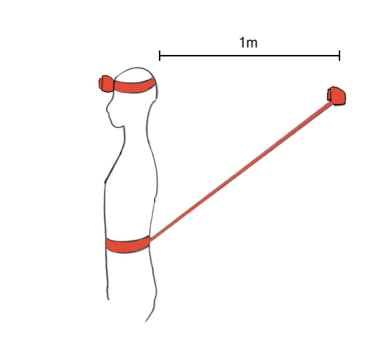
MATERIAL AND MEASURES For the video material used in our experiment, considering that all the par- ticipants were undergraduates, we decided the theme to be the daily life of a custodian in our school. School custodians are the people whom the parti- cipants are familiar with and see every day, but the life of a custodian is the thing they have barely ever experienced. The video was a 360-degree situated video filmed with two Insta 360 ONE RS’s, one of which was set up in front of the custodian’s forehead as the first-person point of view, while the other
4 Pan and Huang
equipped one meter directly behind the custodian’s eyes using a waistband and a selfie stick as the third-person point of view (Figure 1).
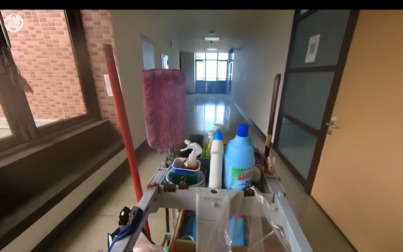
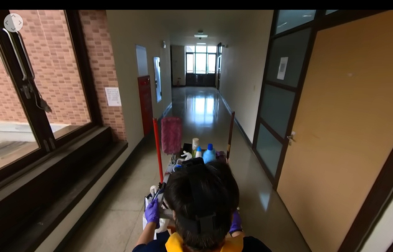
The video was filmed in one shot, five minutes long, and without any trimming or effects. The contents were about the daily work of a custodian, such as mopping the floor, cleaning the sink, washing and recycling the trash in the pantry room, and so on (Figure 2, 3).
Figure 1: The diagram of the placement of two cameras.Figure 2: An image captured from the video that 1PP watched.Figure 3: An image captured from the video that 3PP watched.
The Effects of Virtual Reality From Different Visual Perspectives on Empathy 5
For the indexes applied in our experiment, we used Interpersonal Reacti- vity Index (IRI) for the pretest (Table 1). The measure had four subscales, and each made up of six different items answered on a five-point Likert scale, which were 24 items for total. The items were devised to measure Fantasy, Perspective Taking, Empathic Concern, and Personal Distress, respectively (Davis, 1980).
Table 1. The descriptive statistical data of IRI.
Table available in the original PDF paper.
IRI Visual Perspective N Mean SD
First person 20 3.59 0.31 Third person 20 3.62 0.34 Total 40 3.61 0.33
We also designed a posttest questionnaire was to examine the subject’s familiarity of the material and the self-assessment of their VR experience after the experiment. The items included the familiarity with the situation in the video and the subjective rating of whether they empathized the character in the video. Besides, for the empathy measurement, we referred to the methods presented by Schutte and Stilinovi´c (2017). The items were based on IRI of Davis (1980), and were answered on a five-point Likert scale. The question- naire were comprised of eight items, four for cognitive empathy and another four for affective empathy, and the descriptions of each item were adjusted according to different groups. For the reliability analysis, the Cronbach’s α of the eight items was 0.82.
Table 2. The items of the posttest.
Table available in the original PDF paper.
Before the experiment, were you familiar with the job description of the custodian? Before the experiment, were you familiar with the working environment of the custodian? I consider it easier to facilitate empathy on VR than other media. I empathize with the custodian after watching the video.
I imagined myself to be in the custodian’s situation. (PT) I felt as if I were in the custodian’s shoes. (PT) I felt touched by the custodian’s situation. (EC) I felt sorry for the custodian. (EC) I tried to see things from the custodian’s point of view. (PT) I felt compassion for the custodian. (EC) I tried to take the perspective of the custodian. (PT) I felt protective towards the custodian. (EC) Note. EC = Empathy concern; PT = Perspective taking
RESULTS
We conducted an independent samples t-test to study the effects in visual per- spective on empathy facilitation through VR. Though the average empathy
6 Pan and Huang
score of the overall participants was 29.23 (SD = 4.10), our results indicated that there was no significant difference in empathy facilitation between 1PP and 3PP (t = −1.041, df = 38, p = .304), which includes perspective taking in cognitive empathy (t =−.128, df = 38, p = .898) and empathic concern in affective empathy (t = −2.016, df = 38, p = .051). Therefore, we par- ted the two types of empathy and analyzed them separately for the in-depth study. The results showed that there was still little difference in cognitive empathy facilitation, but two items about affective empathy facilitation sho- wed great disparity (Table 3). Specifically, the two items were “I felt sorry for the custodian (t = −2.915, df = 38, p = .034)” and “I felt compas- sion for the custodian (t = −2.276, df = 38, p = .029)”. We assumed that participants could arouse more emotions, such as guilty and compassion, by watching video from the third-person perspective, thereby cultivating empa- thy to the character in the video. Namely, the results were partly the same as our hypothesis.
Moreover, though the subject’s familiarity with the material showed little difference, the subjects of 1PP and 3PP had different results on the self- assessment of their VR experience. Specifically, the items were “I consider it easier to facilitate empathy on VR than other media (t = −2.308, df = 38, p = .027)” and “I empathize with the custodian after watching the video (t = −2.226, df = 38, p = .032)”. Most of the subjects of 3PP subjectively considered the experience good and easier to enhance their empathy com- paring with other devices; that is, they could empathize with the custodian more. From the participants’ feedback, we presumed that the probable cause may be dizziness, which the subjects of 3PP experienced relatively less than
Table 3. Independent samples t-test of 1PP and 3PP empathy scores toward each item.
Table available in the original PDF paper.
Independent Sample t-test Mean SD df F p
Affective empathy EC1 First person 3.25 1.16 38 −0.307 0.76 Third person 3.35 0.88 EC2 First person 2.70 0.73 38 −2.195 0.034* Third person 3.30 0.98 EC3 First person 3.10 0.31 38 −2.276 0.029* Third person 3.40 0.50 EC4 First person 3.75 0.72 38 −1.045 0.303 Third person 4.00 0.79 Cognitive empathy PT1 First person 4.00 0.73 38 0.59 0.559 Third person 3.85 0.88 PT2 First person 3.85 0.88 38 0 1 Third person 3.85 0.81 PT3 First person 3.95 0.76 38 −0.224 0.824 Third person 4.00 0.65 PT4 First person 3.95 0.60 38 −1.061 0.295 Third person 4.15 0.59
The Effects of Virtual Reality From Different Visual Perspectives on Empathy 7
those of 1PP. The less dizziness experienced in the experiment may make the subject immerse better in VR, which in turn strengthened the psychological effects of the participants.
CONCLUSION
Our research studied the effect on empathy facilitation of VR users from visual perspective. In general, VR surely could be an “empathy machine” from both first and third-person point of view, which corroborated the pre- vious studies and viewpoints (Farmer & Maister, 2017; Gerry, 2017; Herrera et al., 2018; Shin, 2018; Kandaurova & Lee, 2019). Meanwhile, there was statistically significant difference between the two visual perspectives in affe- ctive empathy facilitation. The results indicated that watching VR from the third-person point of view could bring up more emotional reactions and that users could have better feelings for the VR experience, in comparison to watching VR from the first-person point of view. Though we cannot assert the findings are completely in accordance with our hypothesis, these can be a basis for the further research as well as the design of similar experiments. Furthermore, the results suggest the improvement in the emotional conta- gion of a video filmed from the third-person point of view, which can be taken into consideration when creating visual content for video creators and salespeople.
ACKNOWLEDGMENT
We thank National Science and Technology Council (Grant No: NSTC 110- 2221-E-141-007-MY2) for supporting the current research.
Sense of presence, attitude change, perspective-taking and usability in first-person split-sphere 360 video. In Proceedings of the 2018 CHI conference on human factors in computing systems. Bang, E., & Yildirim, C. (2018). Virtually Empathetic?: Examining the Effects of Virtual Reality Storytelling on Empathy. In International conference on virtual, augmented and mixed reality (pp. 290–298). Springer, Cham. Barreda-Ángeles, M., Aleix-Guillaume, S., & Pereda-Baños, A. (2020). An “empathy
machine”or a “just-for-the-fun-of-it”machine? Effects of immersion in nonfiction 360-video stories on empathy and enjoyment. Cyberpsychology, Behavior, and Social Networking, Volume 23 No. 10. Bindman, S. W., Castaneda, L. M., Scanlon, M., & Cechony, A. (2018). Am I a bunny? The impact of high and low immersion platforms and viewers’ perceptions of role on presence, narrative engagement, and empathy during an animated 360 video. In Proceedings of the 2018 CHI conference on human factors in computing systems. Bloom, P. (2017). Empathy and its discontents. Trends in cognitive sciences, Volume
21 No. 1. Cuff, B. M., Brown, S. J., Taylor, L., & Howat, D. J. (2016). Empathy: A review of the concept. Emotion review, Volume 8 No. 2.
8 Pan and Huang
Davis, M. H. (1980). A multidimensional approach to individual differences in empathy. Davis, M. H., Conklin, L., Smith, A., & Luce, C. (1996). Effect of perspective taking
on the cognitive representation of persons: a merging of self and other. Journal of personality and social psychology, Volume 70 No. 4. Dziobek, I., Preißler, S., Grozdanovic, Z., Heuser, I., Heekeren, H. R., & Roepke, S.
(2011). Neuronal correlates of altered empathy and social cognition in borderline personality disorder. Neuroimage, Volume 57 No. 2. Eisenberg, N. (2000). Emotion, regulation, and moral development. Annual review of psychology, Volume 51 No. 1. Farmer, H., & Maister, L. (2017). Putting ourselves in another’s skin: Using the pla-
sticity of self-perception to enhance empathy and decrease prejudice. Social Justice Research, Volume 30 No. 4. Gander, P., & Gander, A. J. (2021). Visual perspective in imagination and memory of factual and fictional stories. Journal of Cognitive Psychology, Volume 34 No. 1. Gerry, L. J. (2017). Virtual reality as a tool to facilitate empathy: Embodied
simulations and perspective taking in the body of another. Unpublished. Hadjikhani, N., Zürcher, N. R., Rogier, O., Hippolyte, L., Lemonnier, E., Ruest, T., & Prkachin, K. M. (2014). Emotional contagion for pain is intact in autism spectrum disorders. Translational psychiatry, Volume 4 No. 1. Herrera, F., & Bailenson, J. N. (2021). Virtual reality perspective-taking at scale:
Effect of avatar representation, choice, and head movement on prosocial behavi- ors. new media & society, Volume 23 No. 8. Herrera, F., Bailenson, J., Weisz, E., Ogle, E., & Zaki, J. (2018). Building long-term empathy: A large-scale comparison of traditional and virtual reality perspective- taking. PLoS One, Volume 13 No. 10. Hoffman, M. L. (2001). Empathy and moral development: Implications for caring
and justice. Cambridge University Press. Iriye, H., & St. Jacques, P. L. (2021). Memories for third-person experiences in immersive virtual reality. Scientific reports, Volume 11 No. 1. Kandaurova, M., & Lee, S. H. (2019). The effects of Virtual Reality (VR) on charita-
ble giving: The role of empathy, guilt, responsibility, and social exclusion. Journal of Business Research, Volume 100. Kardong-Edgren, S. S., Farra, S. L., Alinier, G., & Young, H. M. (2019). A call to unify definitions of virtual reality. Clinical Simulation in Nursing, Volume 31. Mantovani, F., Castelnuovo, G., Gaggioli, A., & Riva, G. (2003). Virtual reality
training for health-care professionals. CyberPsychology & Behavior, Volume 6 No. 4. McCall, C., and Singer, T. (2013). Empathy and the Brain. Baron-Cohen et al Understanding Other Minds: Perspectives from Developmental Social Neuro-science. Oxford University Press. Milk, C. (2015). How virtual reality can create the ultimate empathy machine. TED
Talk. Website: https://www.ted.com/talks/chris_milk_how_virtual_reality_can_c reate_the_ultimate_empathy_machine Reniers, R. L., Corcoran, R., Drake, R., Shryane, N. M., & Völlm, B. A. (2011). The QCAE: A questionnaire of cognitive and affective empathy. Journal of personality assessment, Volume 93 No. 1. Schutte, N. S., & Stilinovi´c, E. J. (2017). Facilitating empathy through virtual reality.
Motivation and Emotion, Volume 41 No. 6. Schwenck, C., Mergenthaler, J., Keller, K., Zech, J., Salehi, S., Taurines, R., & Freitag, C. M. (2012). Empathy in children with autism and conduct disorder:
The Effects of Virtual Reality From Different Visual Perspectives on Empathy 9
Group-specific profiles and developmental aspects. Journal of Child Psychology and Psychiatry, Volume 53 No. 6. Shen, L. (2010). On a scale of state empathy during message processing. Western Journal of Communication, Volume 74 No. 5. Shin, D. (2018). Empathy and embodied experience in virtual environment: To what
extent can virtual reality stimulate empathy and embodied experience? Computers in Human Behavior, Volume 78. Singer, T., Seymour, B., O’Doherty, J. P., Stephan, K. E., Dolan, R. J., & Frith, C. D.
(2006). Empathic neural responses are modulated by the perceived fairness of others. Nature. Smith, A. (2006). Cognitive empathy and emotional empathy in human behavior and evolution. The Psychological Record, Volume 56 No. 1. Strayer, J. (1990). 10 Affective and cognitive perspectives on empathy. Empathy and
its development. Varela, F. J., & Shear, J. (1999). First-person methodologies: What, why, how. Journal of Consciousness studies, Volume 6 No. 2–3. Zaki, J., & Ochsner, K. N. (2012). The neuroscience of empathy: progress, pitfalls
and promise. Nature neuroscience, Volume 15 No. 5.
LISTED IN THE AHFE DIGITAL BOOKSTORE CATALOGUE
Explore the complete digital volume
Human-Centered Metaverse and Digital Environments
Read this individual research paper free through the original publisher, or explore the full digital proceedings book.
ISBN 978-1-958651-75-9
Explore this ISBN in the AHFE Bookstore ↗Listed in the July 2026 bookstore catalogue; search by ISBN to confirm current availability · Digital book purchase optional