Matteo Zallio, Oliver Korn (2023). Perceptions on Digital, Virtual Environments and the Metaverse. An Exploratory Study with Younger Users. In: Human-Centered Metaverse and Digital Environments. AHFE Open Access, vol. 99, pp. 44–55. https://doi.org/10.54941/ahfe1003930
Digital, virtual environments and the metaverse are rapidly taking shape and will generate disruptive changes in the areas of ethics, privacy, safety, and how the relationships between human beings will be developed. To uncover some of some of the implications that will impact those areas, this study investigates the perceptions of 101 younger people from the generations Y and Z. We present a first exploratory analysis of the findings, focusing on knowledge and self-perception. Results show that these young generations are seriously doubting their knowledge on the metaverse and virtual worlds – regarding both the definition and the usage. It is interesting to see only a medium confidence level, considering that the participants are young and from an academic environment, which should increase their interest in and the affinity towards virtual worlds. Males from both generations perceive themselves as significantly more knowledgeable than females. Regarding a fitting definition, almost 40% agreed on the metaverse as a “universal and immersive virtual world that is made accessible using virtual reality and augmented reality technologies”. Regarding the topic in general, several participants (almost 40%) considered themselves sceptics or “just” users (38%). Interestingly, generation Y participants were more likely than the younger generation Z participants to identify themselves as early adopters or innovators. In result, the considerable amount of “mixed feelings” regarding digital, virtual environments and the metaverse shows that in-depth studies on the perception of the metaverse as well as its ethical and integrity implications are required to create more accessible, inclusive, safe, and inclusive digital, virtual environments.
The concept of the metaverse, a virtual shared space that is created by the convergence of virtually enhanced physical reality and physically persistent virtual space, has been around for decades. The term itself was coined by the science fiction author Neal Stephenson in his 1992 novel Snow Crash where he described a virtual world where people could interact with each other and virtual objects and environments in real-time (Stephenson, 1992). In the years
Perceptions on Digital, Virtual Environments and the Metaverse 45
following the publication of Snow Crash, the idea of the metaverse began to gain traction as the internet and virtual reality technology advanced. The development of massively multiplayer online games and virtual worlds, such as Second Life, further popularized the concept of the metaverse and laid the foundation for its future development.
In 2003, the San Francisco-based company, Linden Labs created Second Life, a digital, virtual environment where avatars, defined as digital copies of human beings, could create and live in a digital life (Linden Labs, 2003). Although this dates back as many as twenty years from 2023, this still is one of the most recurrent examples people think of when talking about the metaverse – as a digital immersive world where avatars perform social interactions. A more recent powerful vision of the metaverse has been pre- sented in the 2018 film Ready Player One by Steven Spielberg. This vivid portrayal of a society dominated by a commonly shared virtual space shows how the gaming industry provided a fertile ground for the metaverse and its correlated applications. Since the growth of online gaming, several gaming companies, including Roblox, Active Worlds, Epic Games and many others developed fully digitalized virtual environments where users can create ava- tars and immerse themselves by actively playing games with others or with AI-based NPCs (non-player characters) or “bots”.
In contrast to the roots in science fiction and the early attempts in the gaming industry, there currently are technologies that allow designers to create hyper-realistic digital content. In addition, as a result of the socie- tal transformation, social media, and the common use of online meeting platforms, users might be ready to embark on shared virtual spaces if these provide the right benefits. However, is the metaverse, or the re-branding of Facebook as Meta, really “a radical business model innovation or [rather an] incremental transformation”? (Kraus et al., 2022).
In this position paper, we use an online survey to investigate younger persons’ views regarding the knowledge and perception of the metaverse and digital, virtual environments. These are the individuals who could be some of the first users and early adopters of new virtual spaces. Given the younger generations heightened sensitivity regarding diversity or language cues, it is especially important to consider the ethical and integrity guideli- nes for creating accessible, inclusive, safe, and inclusive digital environments (Zallio & Clarkson, 2022). We examine the challenges and opportunities and consider ways how such environments can be designed to promote positive interactions and experiences for future users.
STATE OF THE ART: POTENTIALS AND LIMITATIONS OF NEW DIGITAL ENVIRONMENTS The metaverse, among many definitions, is currently known as “a set of digital spaces, including interconnected immersive 3D experiences” (Meta, 2022). It allows people to be virtually represented by avatars in a digital environment where they can connect, socialize, work, and explore scenarios or 3D immersive spaces with others who are not physically present. There are different nuances that currently characterize the metaverse as it can provide
46 Zallio and Korn
new sensorial experiences by adding a third dimension, new haptics, sen- sory, and cognitive feedback, and even more to what people can currently experience in two dimensions with smartphones, tablets, computers, and other mainstream consumer electronics. Digital, virtual environments, inclu- ding the metaverse, have the potential to revolutionize the way people live, work, and interact with one another. These virtual spaces offer limitless possibilities for innovation, collaboration, and connection, and have the potential to transform industries and change the way we experience the world (Dwivedi et al., 2022). One of the most interesting aspects of digital, virtual environments is their ability to bridge geographical barriers and bring people together from all corners of the globe. Through virtual reality, people can travel to and explore new places without ever leaving their own homes or explore touristic attractions or facilities in advance to make the most out of their visit in the real-world (Israel et al., 2020). They can also participate in immersive experiences and events, such as concerts and conferences, that may not be accessible to them in the physical world (Meta, 2022). They can create familiarity by sharing social virtual reality for joint sports or even for “falling asleep together” (Maloney & Freeman, 2020). However, as Görlich points out, “these virtual spaces are limited—sometimes to several million people (massively multiuser), but never so large that the entire population of a big country or even the whole world could participate”(Görlich 2022). This shows how the notion of global accessibility is still restricted to a comparati- vely small part of privileged users who have access to the required technology and are not subject to governmental restrictions.
In addition to providing new opportunities for entertainment and soci- alization, digital environments also have the potential to improve the way people work and do business. Although there still are some issues with cyber- sickness, most products can be presented in virtual reality comparatively well (Israel et al., 2019). Virtual offices and meeting spaces allow for more effici- ent and effective collaboration, and virtual storefronts can provide access to a global market for small businesses (Forbes, 2022). Just like in the real-world, accessibility is an important consideration in the design and development of environment which are potentially used by millions of users: ensuring that these are accessible to users of all abilities is essential for creating inclusive and welcoming spaces (Zallio & Clarkson, 2022). There are several aspects of accessibility to be considered when designing the metaverse’s user inter- faces (UI) and user experiences (UX). This includes making sure that virtual spaces are easy to navigate and use, and that controls are intuitive and strai- ghtforward. It may also be necessary to provide options for users with visual or mobility impairments, such as the ability to enlarge text or use alternative input methods. Another aspect of accessibility in the metaverse is the ability to access virtual spaces and experiences with a wide range of devices and technologies. This may include support for different types of headsets and controllers, as well as the use of assistive technologies such as screen readers. Ensuring accessibility in the metaverse is essential for creating inclusive and welcoming virtual environments that are accessible to users of all abilities (Zallio & Clarkson, 2022).
Perceptions on Digital, Virtual Environments and the Metaverse 47
A further aspect to consider is about ethical considerations that arise in the context of the metaverse. These considerations relate to issues such as privacy, consent, identity, and the impact of virtual experiences on individu- als and society. One major ethical concern in the metaverse is privacy. Virtual environments often involve the collection and use of personal data, and it is important to ensure that this data is handled responsibly and in accorda- nce with privacy laws and regulations. Consent is another important ethical consideration in the metaverse. In digital, virtual environments, it is impor- tant to obtain the consent of users before collecting or using their data, or before exposing them to certain experiences or content. This is particularly important in the case of sensitive or potentially triggering material. Identity is another ethical issue that arises in the metaverse. Indeed, it is important to understand how users construct and experience their self and interact with others’ selves in virtual spaces, especially if representations evolve towards higher levels of embodiment (Freeman & Maloney, 2020).
Allowing users to create and assume new identities is a tool for empo- werment, but it is important to ensure that these identities are not used to deceive or harm others (Zallio & Clarkson, 2022). Overall, the ethical impli- cations of the metaverse are complex and multifaceted; it is important for designers and developers to carefully consider them when creating virtual environments. To understand the potential of this technology and its appli- cations, a report from the Gartner reported that by 2026 a quarter of people living on Earth will be spending at least an hour a day in the Metaverse and that 30% of the organizations in the world will have products and services ready for the metaverse (Gartner, 2022).
METHOD
Previous research highlighted how the metaverse and digital, virtual environments can be understood by people belonging to different age groups (Liu et al. 2020; Zallio & Clarkson, 2022; Zahid & Campbell, 2022). Based on these findings, this study explores the challenges regarding the educatio- nal and learning aspects of the concept of the metaverse and digital, virtual environments through an online survey run in early 2023. This method redu- ces bias towards the opinions of influential individuals and allows to reach a statistical findings within a reasonable timeframe (Keeney et al., 2006). The method was framed across five stages: recruitment, sampling participants, developing the survey, running the study, analysing data, and depicting the results.
Participants were recruited through email invitations and mostly belonged to academic institutions. The initial audience consisted of more than 250 individuals and a final sample was around 110 participants from Germany who are representative of the population of interest.
A survey instrument, such as an online questionnaire, was designed to gather data on participants’ perceptions and attitudes towards the meta- verse and digital virtual environments. The survey was framed around three major areas: demographic information, knowledge and awareness and perce- ption and potential around the metaverse and digital, virtual environments.
48 Zallio and Korn
Data would be collected using the survey instrument, anonymously in accor- dance with the GDPR and ethics procedures from the University of Cam- bridge and Offenburg University. Participants were given unlimited amount of time to complete the survey.
Data analysis was performed mostly by using descriptive statistical techni- ques, offering an idea of how far apart the most extreme response scores are, median and standard deviation explaining the average amount of variability in the dataset and variance, the average of squared deviations from the mean. Variance reflects the degree of spread in the data set.
Finally, the results highlight the perception of this cohort of participants regarding the use and future adoption of the metaverse and digital, virtual environments.
RESULTS
Demographic data is an important aspect of the survey as it allows for a better understanding of the characteristics of the population. By collecting informa- tion on factors such as age, gender, and education, it is possible to gain insight into how these characteristics may influence the attitudes and perceptions of the participants. Additionally, by understanding the demographic makeup of the sample, it is possible to identify subgroups within the sample that may have unique characteristics or experiences and analyse the data accordingly. A breakdown of the age groups was developed through the segmentation of participants by generations groups. Generation refers to all the living beings in a group that are born or start to exist at about the same time and are related to one that existed at an earlier point in time (Cambridge, 2023).
In the sample size the three generations (in future abbreviated as “gen”) mainly identified were gen X, Y, and Z. Gen X is defined by its demographic location straddling earlier Baby Boom and later Millennial generations born between the mid-1960s and the early-1980s (Katz, 2017). Gen Y is a compri- ses young adults born between 1981 and 1995. They are generally referred as the children of the Baby Boomers (Goldgehn, 2004). Gen Z is the cohort following Millennials and preceding Gen Alpha and refers to the generation born between 1996 and 2012 (Mahapatra et al., 2022).
Out of 111 valid respondents, 51 belong to gen Z with a mean age of 22.1 years (SD = 2.1 y). Another 50 subjects belong to gen Y with a mean age of 30.5 y (SD = 4.6 y). We also received nine responses from persons from gen X with a mean age of 47.6 y (SD = 4.6 y) – and one baby boomer aged 63. Since we focus on gen Y and Z, we excluded subjects from gen X and the baby boomer from the bulk of this analysis. Regarding gender identity, out of 51 participants from gen Y, there were 25 males, 25 females and one non-binary person. In gen Z group there were 30 males, 19 females, and one non-binary person. In conclusion, the genders were fairly evenly spread across the population sample.
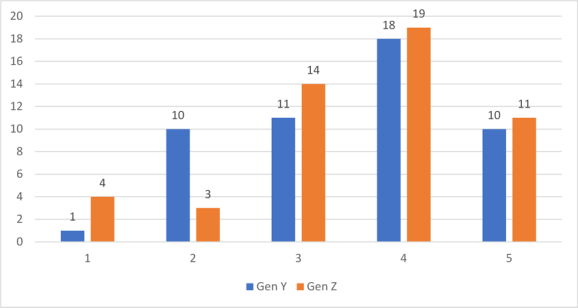
The survey’s first statement “I know what digital, virtual worlds and the metaverse are and what they are used for” aimed to discover the users’ level of knowledge. The responses were collected through a Likert scale question, ranging from 1 to 5 (strongly disagree to strongly agree) which
Perceptions on Digital, Virtual Environments and the Metaverse 49
allow respondents to better quantify their perceptions through numerical data.
Out of the population sample of 101 individuals from gen Y and Z the mean value was M = 3.6 (SD = 1.1). The mean for gen Y was M = 3.5 (SD = 1.1), for gen Z it was M = 3.6 (SD = 1.1). Thus, both generations are almost identically not knowledgeable enough regarding what virtual worlds and the metaverse are and what they are used for (see Fig. 1). On a sidenote, for gen X and the baby boomer the mean was M = 4.0 (SD = 0.6), which is a significantly higher value t(15) = −1.872, p <.04, demonstrating at least a higher confidence. Indeed, the correlation between perceived competence and age is positive, although low with r = 0.09. Considering that the age of the respondents is quite low and their interest in digital, virtual environments is commonly higher than that of older generations, their medium confidence level (neither agree, nor disagree) is rather low. When looking at gender, it is not surprising that the male gender’s self-perception regarding knowledge on technical aspects is above the females’: in gen Z, females rate their knowledge with M = 3.2 (SD = 1.3) and males with M = 4.0 (SD = 0.7), which is a highly significantly higher value t(38) = −2.925, p <.01. In gen Y, females rate their knowledge with only M = 2.8 (SD = 1.0) and males with M = 4.0 (SD = 0.9).
Figure 1: The histogram (numbers on the x-axis are Likert-scale values) shows that respondents from gen Y and Z largely agree in their self-assessments on knowledge.
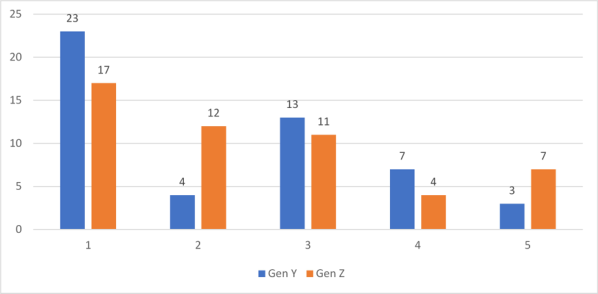
Again this is a highly significantly higher value t(37) = 4.192, p < 0.0001, this time even more so, as the females from gen Y score themselves 0.4 points lower on the scale than their more knowledgeable (or more self-confident?) younger counterparts in gen Z. Another question focused on what defini- tion best describes the understanding of digital virtual environments and the metaverse. Five potential definitions were given, and the following ratings were recorded.
Clearly, with almost 40% of the respondents, statement 1 best reflects the participants understanding. However, while almost half of the respondents from gen Y could agree with this definition, it was only a good third of the
50 Zallio and Korn
younger gen Z (see Fig. 2). The latter preferred the second statement: with 23.5% it was second popular for the younger generation while only 8.0% of the older generation chose that option. This is the largest difference between the generation in this area of the survey. In result, option 2 in total only ranks third with less than 16%. We hypothesize that gen Z’s heightened prefere- nce of groups (“collective”, “shared”) accounts for this change. Statement 3
Figure 2: The diagram (numbers on the x-axis correspond to the definitions in Table 1) shows that there is considerable disagreement between gen Y and Z on the definition of digital, virtual environments and the metaverse in all statements except the third one.Table 1. Participants’ level of agreement with five definitions of digital, virtual environments and the metaverse (n = 101).
Table available in the original PDF paper.
No. Definition Total Gen Y Gen Z Diff.
Equations and mathematical formulas are available in the original paper PDF.
1 A universal and immersive virtual world that is made accessible using virtual reality and augmented reality technologies.
2 A collective shared virtual space, which enriches reality with virtual elements.
3 A tool to empower users to work, socialise, and play, as well as make new sensory and cognitive experiences.
4 A digitally enriched reality including non-fungible and infinite elements not limited by conventional physics.
5 An approach that crosses the physical and digital divide between “real” and virtual realities.
Perceptions on Digital, Virtual Environments and the Metaverse 51
Table 2. Participants’ self-perception regarding digital, virtual environments and the metaverse (n = 92).
Table available in the original PDF paper.
No. Description of role Total Gen Y Gen Z Diff.
1 An enthusiast innovator, somebody who has been using the metaverse and its technologies (e.g., VR and AR devices, etc.) and who is fully aware of the disruptive future potential.
2 An early adopter, somebody who believes in the metaverse and its potential and is aware of the opportunities and challenges.
3 A potential user, somebody who is intrigued by the potential of the metaverse and its technologies but still has not figured out the purpose, how to use it and when to use it.
4 A sceptic, somebody who has no particular interest in the metaverse or feels not knowledgeable enough regarding the scenarios of use and potentials.
ranks second in total with almost 24% of the respondents. Here the genera- tional differences in preference are low. The opposite is true for the final two statements. Statement 4 (almost 11% in total) was preferred by gen Y with 14.0% versus only 7.8% in gen Z. Potentially the younger generations is less interested in the financial aspects of digital worlds like non fungible tokens (NFC). Statement 5, instead, was preferred by 14% of gen Z respondents and only 6% of gen Y respondents. Again, the idea of crossing boundaries might especially appeal to younger persons.
Notwithstanding that a commonly agreed definition does not appear to be established yet, the results indicate that most persons from generations Y and Z perceive the metaverse and digital, virtual environments as a “universal and immersive virtual world that is made accessible using virtual reality and augmented reality technologies”.
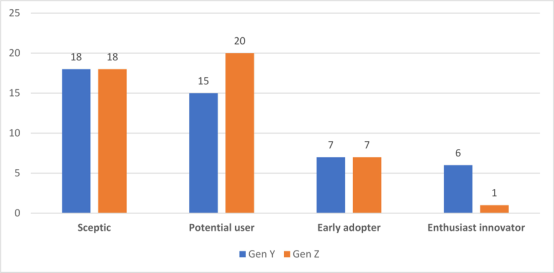
Another set of statements looked at future opportunities and self- perception: participants had to rate how they see themselves in respect to digital, virtual environments and the metaverse. Four alternatives were given.
It is surprising to see how many persons from the young generations con- sider themselves sceptics (almost 40%) or “just” users (38%) – in sum more than three quarters of the respondents. Modesty or careful curiosity seem to be the dominant mindsets. Furthermore, gen Y participants are more likely to see themselves as early adopters or innovators than the younger gen Z
52 Zallio and Korn
participants (see Fig. 3). While there is no difference in the number of “early adopters”, a surprising 14% of gen Y considers themselves “enthusiast inno- vators” while there are only 2.2% from gen Z who dare to call themselves that. Among this group of seven, there is only one female.
Figure 3: The diagram shows that respondents from gen Z are more cautious than those from gen Y regarding their role in digital, virtual environments and the metaverse.
CONCLUSION AND FUTURE WORK There is no doubt that new immersive and virtual technologies are sha- ping completely new paradigms that trigger new behavioural reactions across human beings – in different parts of the world, but currently still mainly in the technologically advanced industrial countries. With this preliminary study we explored the sentiment and views of a pool of 101 participants from the generations Y and Z.
Regarding the perceived knowledge of digital, virtual environments and the metaverse, with M = 3.5 (SD = 1.1), for gen Z and M = 3.6 (SD = 1.1) for gen Y, the two generations are almost identically sceptical. Considering the relatively young age and the above-average interest in digital, virtual envi- ronments as persons from the academic environment this medium confidence level is rather low. There are several causes that trigger this low level of kno- wledge, which have to be investigated with further studies. Regarding gender, males from both generations perceive themselves as highly significantly more knowledgeable than female. Especially female from gen Y are self-critical, scoring themselves 0.4 points lower than their younger counterparts in gen Z.
Regarding the best definition of digital, virtual environments and the meta- verse, almost 40% of the respondents from generations Y and Z perceived the metaverse and digital, virtual environments as a “universal and immer- sive virtual world that is made accessible using virtual reality and augmented reality technologies”. However, this definition was more popular in gen Y than in gen Z. The latter also liked the definition as “a collective shared vir- tual space, which enriches reality with virtual elements” – with 23.5% it was second popular for the younger generation while only 8.0% of the gen Y chose that option. We hypothesize that some of the differences are due to gen
Perceptions on Digital, Virtual Environments and the Metaverse 53
Z’s heightened preference of groups and fluidity, however more studies and investigation needs to be done to validate this assumption.
In regard to their perception of how close to the topic of the metaverse and digital, virtual environments are, several participants (almost 40%) con- sidered themselves sceptics or “just” users (38%). This result might appear surprising and it was also remarkable that gen Y participants are much more likely to consider themselves early adopters or innovators than the younger gen Z participants.
As a conclusion, there still is a considerable amount of mixed feelings regar- ding digital, virtual environments and the metaverse. Considering that we focussed on the younger generations, who potentially use these technologies most, a meagre 22.9% of “early adopters” and “enthusiast innovators” in comparison to 39.1% of sceptics shows that the level of knowledge of what people could do with the metaverse and how they can use digital, virtual environments it is still underdeveloped. Especially the younger gen Z seems to resonate with terms emphasizing groups, collectiveness, and fluidity. The common lack of knowledge, scepticism or caution should strongly motivate the community to create studies, develop awareness, and design new stra- tegies to develop accessible, inclusive and safe digital, virtual environments and a metaverse guaranteeing the respect of ethical and integrity principles for the wellbeing of all human beings.
Additional studies that the group is currently developing in collabora- tion with the Digital Education Futures Initiative (DEFI) at the University of Cambridge and the Metavethics Institute will explore in more depth the intergenerational differences in the perception virtual worlds and intera- ction therein and derive guidelines and principles for a better design and development of such environments.
ACKNOWLEDGMENT
Dr. Matteo Zallio ideated the study, wrote the introduction, the state of the art, a draft of the results and discussions and future implications. Prof. Dr. Oliver Korn ran the study, co-wrote the introduction and related work, results and discussions and future implications. In the data gathering, he was suppor- ted by three master students: Alexandra Berger, Thomas Huck, and Jennifer Pana. This study was supported by the Sustainable Ethics for Inclusive Digital Environments (SEIDE) initiative at the Digital Education Futures Initiative at Hughes Hall, University of Cambridge.
REFERENCES
Dwivedi, Y. K., Hughes, L., Baabdullah, A. M., Ribeiro-Navarrete, S., Giannakis, M., Al-Debei, M. M., Dennehy, D., Metri, B., Buhalis, D., Cheung, C. M. K., Conboy, K., Doyle, R., Dubey, R., Dutot, V., Felix, R., Goyal, D. P., Gustafsson, A., Hinsch, C., Jebabli, I., Janssen, M., Kim, Y.-G., Kim, J., Koos, S., Kreps, D., Kshetri, N., Kumar, V., Ooi, K.-B., Papagiannidis, S., Pappas, I. O., Polyviou, A., Park, S.-M., Pandey, N., Queiroz, M. M., Raman, R., Rauschnabel, P. A., Shirish, A., Sigala, M., Spanaki, K., Wei-Han Tan, G., Tiwari, M. K., Viglia, G., & Wamba, S. F. (2022, 2022/10/01/). Metaverse beyond the hype: Multidisciplinary
54 Zallio and Korn
perspectives on emerging challenges, opportunities, and agenda for research, pra- ctice and policy. International Journal of Information Management, 66, 102542. https://doi.org/https://doi.org/10.1016/j.ijinfomgt.2022.102542 Forbes. (2022). Metaverse Vs Multiverse: How To Tell Apart The ‘Parallel Universe’ Concepts We Can’t Stop Talking About. https://www.forbes.com/sites/jamiecart ereurope/2022/02/07/metaverse-vs-multiverse-how-to-tell-apart-the-two-mind -bending-concepts-we-cant-stop-talking-about/ Freeman, G., & Maloney, D. (2021). Body, Avatar, and Me: The Presenta-
tion and Perception of Self in Social Virtual Reality. Proceedings of the ACM on Human-Computer Interaction, 4(CSCW3), 239:1-239:27. https://doi.org/10. 1145/3432938 Görlich, D. (2022). “Societal XR—A Vision Paper”. ParadigmPlus, 3(2):1–10.
https://doi.org/10.55969/paradigmplus.v3n2a1 Goldgehn, L. A. (2004, 2004). Generation Who, What, Y? What you need to know about generation Y. International Journal of Educational Advancement, 5(1). (HENRY STEWART PUBLICATIONS). Israel, K., Buchweitz, L., Tscheulin, D. K., Zerres, C., & Korn, O. (2020). Captivating
Product Experiences: How Virtual Reality Creates Flow and Thereby Optimize Product Presentations. In F. F.-H. Nah & K. Siau (Hrsg.), HCI in Business, Government and Organizations (S. 354–368). Springer International Publishing. https://doi.org/10.1007/978-3-030-50341-3_28 Israel, K., Zerres, C., Tscheulin, D. K., Buchweitz, L., & Korn, O. (2019). Presenting Your Products in Virtual Reality: Do not Underestimate Cybersickness. In F. F.-H. Nah & K. Siau (Ed.), HCI in Business, Government and Organizations. ECommerce and Consumer Behavior, 206–224. Springer International Publishing. https://doi.org/10.1007/978-3-030-22335-9_14 Katz, S. (2017). Generation X. A Critical Sociological Perspective. Generations: Jour-
nal of the American Society on Aging, 41(3), 12–19. https://www.jstor.org/stable/ 26556295 Keeney, S., Hasson, F., & McKenna, H. (2006). Consulting the oracle: ten lessons from using the Delphi technique in nursing research. Journal of Advanced Nursing, 53(2), 205–212. https://doi.org/10.1111/j.1365-2648.2006.03716.x Kraus, S., Kanbach, D. K., Krysta, P. M., Steinhoff, M. M. & Tomini, N. (2022). Face-
book and the Creation of the Metaverse: Radical Business Model Innovation or Incremental Transformation? International Journal of Entrepreneurial Behavior & Research, 28(9):52–77. https://doi.org/10.1108/IJEBR-12-2021-0984 Linden Labs. (2003). Retrieved February 09 from https://www.lindenlab.com/about Liu, Q., Wang, Y., Tang, Q., & Liu, Z. (2020). Do You Feel the Same as I Do?
Differences in Virtual Reality Technology Experience and Acceptance Between Elderly Adults and College Students. Frontiers in Psychology, 11. https://www.fr ontiersin.org/article/10.3389/fpsyg.2020.573673 Mahapatra, G. P., Bhullar, N., & Gupta, P. (2022). Gen Z: An Emerging Phenomenon. NHRD Network Journal, 15(2), 246–256. https://doi.org/10.1177/ 26314541221077137 Maloney, D., & Freeman, G. (2020). Falling Asleep Together: What Makes Activities
in Social Virtual Reality Meaningful to Users. Proceedings of the Annual Sympo- sium on Computer-Human Interaction in Play, 510–521. https://doi.org/10.1145/ 3410404.3414266 Meta. (2022). How will Metaverse change your world? Episode 5 of let me explain has answers. Retrieved February 9 from https://www.facebook.com/business/ne ws/let-me-explain-episode-metaverse
Perceptions on Digital, Virtual Environments and the Metaverse 55
Stephenson, N. (1992). Snow crash. Publisher Bantam Books. Zahid, I., M & Campbell, A., G. (2022). Metaverse as Tech for Good: Current Progress and Emerging Opportunities (SSRN). Zallio, M., & Clarkson, P. J. (2022). Designing the Metaverse: A study on Inclusion,
Diversity, Equity, Accessibility and Safety for digital immersive environments. Telematics and Informatics, 101909. https://doi.org/https://doi.org/10.1016/j.tele. 2022.101909
LISTED IN THE AHFE DIGITAL BOOKSTORE CATALOGUE
Explore the complete digital volume
Human-Centered Metaverse and Digital Environments
Read this individual research paper free through the original publisher, or explore the full digital proceedings book.
ISBN 978-1-958651-75-9
Explore this ISBN in the AHFE Bookstore ↗Listed in the July 2026 bookstore catalogue; search by ISBN to confirm current availability · Digital book purchase optional