Taihe Huang, Takuma Kano, Nao Takizawa, Takumi Ohashi, Miki Saijo (2025). Enhanced Fall Prevention in Nursing Facilities: Assisting Caregivers through Data-Driven Selective Monitoring and Notification. In: Healthcare and Medical Devices. AHFE Open Access, vol. 171, pp. 21–31. https://doi.org/10.54941/ahfe1006187
Falls in nursing homes predominantly occur when elderly residents are unwatched, a situation exacerbated by critical workforce shortages in Japan where 69.3% of facilities report caregiver deficits. Our research develops a selective monitoring system that strategically targets high-risk residents through three phases: targeting (identifying risk using body temperature data), monitoring (detecting risky activities in fall-prone locations), and intervening (providing multi-channel feedback). We took an approach to predict the potential occurrence of fall accidents, as well as caregivers' intuitive "sense of risk", achieving practical results despite the former proving challenging due to data imbalance. We believe the prediction of ‘sense of risk’ could serve as a valuable proxy that translates caregivers' tacit knowledge into actionable monitoring protocols in resource-constrained environments. The system delivers notifications through alarm lamps, audio instructions, and smartphone alerts to facilitate timely intervention. Future work will focus on enriching understanding of caregivers' risk assessment, implementing near-miss reporting, and expanded usability testing. This selective approach demonstrates technology's potential to augment human caregiving by focusing on resources where most needed in aging societies.
Japan faces an unprecedented demographic challenge with its elderly population (aged 65+) reaching 29.0% of the total population (Cabinet Office of Japan, 2022). This aging trend has created substantial demand for nursing care while simultaneously facing critical workforce shortages, with 69.3% of Japanese nursing facilities reporting insufficient caregiving staff (Care Work Foundation, 2023). The disparity is projected to worsen, with nursing facility service demand expected to increase by 30% by 2040 (Ministry of Health, Labour and Welfare of Japan, 2023).
Falls represent one of the most serious risks in eldercare facilities, with unintentional injuries being the fifth leading cause of death among older adults (Rubenstein, 2006). Previous research in Saijo Lab. indicates 60%
of falls in a nursing facility occurs when residents are left unwatched – an unavoidable situation in understaffed facilities.
Traditional approaches to fall prevention include universal monitoring systems, physical restraints, or constant supervision. However, these methods present significant limitations: universal monitoring generates excessive false alarms leading to “alarm fatigue” (Lewandowska et al., 2020), physical restraints compromise dignity and autonomy, and constant supervision is unfeasible in resource-constrained environments.
Our research addresses this care gap by developing a selective monitoring and notification system that operates in three phases:
1. Targeting: Identifying high-risk residents using easily collectible daily data. 2. Monitoring: Detecting risky activities in high-risk zones. 3. Intervening: Providing timely notifications to users, caregivers, and surroundings.
By focusing on selective rather than universal monitoring, our system optimizes limited caregiving resources while respecting residents’ autonomy. The system was developed and evolved through data collecting, interviews, and observations, testing at 3 local nursing homes in Saitama, Japan.
RELATED WORK AND SYSTEM EVOLUTION Our research team has been working on an assisting system for nursing home operations for several years and the concept of the system and its specifications has evolved through literature and action research.
Existing Fall Prevention Technologies and Limitations Current technological interventions for fall prevention encompass three categories: wearable devices, environmental monitoring systems, and predictive analytics. Wearable devices equipped with motion sensors (Yee et al., 2019; Mrozek et al., 2020) offer continuous monitoring but fundamentally operate on hindsight detection, identifying falls only after they occur, and face significant acceptance barriers among elderly users. Less intrusive environmental monitoring systems such as bed sensors and pressure- sensitive floor mats (Mezghani et al., 2017; Balaguera et al., 2017) address acceptance concerns, but available products of this kind often generate too frequent alarms and might contribute to alarm fatigue among caregivers. Predictive analytics approaches attempt to identify potential falls through analysis of various patient data (Parsons et al., 2022), yet their effectiveness depends on comprehensive clinical data often unavailable in facilities with limited digitization.
A fundamental limitation across these technologies is their universal rather than selective application. Universal monitoring systems generate excessive alerts that overwhelm staff, potentially causing critical warnings to be overlooked. Furthermore, many solutions fail to accommodate the operational constraints of Japanese nursing facilities, where healthcare record
Enhanced Fall Prevention in Nursing Facilities: Assisting Caregivers 23
digitization remains incomplete and complex interfaces challenge staff with limited digital literacy (Cao and Takafuji, 2024).
System Evolution Our current system evolved from Tsu-shin Kai-shin v1, initially developed to reduce accident risks and caregiver burden through seat pressure sensors that detected standing movements and triggered a dialogue system for staff notification. The initial version encountered three typical critical limitations like other current solutions: communication failures (residents not responding to the dialogue system), detection inaccuracies (both false positives from normal repositioning and false negatives from slow movements), and intervention timing issues (notifications arriving after residents had already stood).
Tsu-shin Kai-shin v2 represents a fundamental shift from behavior detection to zone monitoring, driven by the observation that falls typically occur in predictable locations when residents attempt activities without assistance. Key improvements include:
Replacing seat sensors with door handle pressure sensors.
Implementing multi-channel feedback including dialogue-based deixis.
Adopting selective monitoring based on risk profiling.
This evolution reflects our deeper understanding of nursing facility operational realities and prioritizes solutions that operate within existing constraints rather than adding complexity.
The Need for Selective Monitoring Selective monitoring fundamentally differs from universal approaches by focusing resources on specific high-risk residents and activities rather than attempting to observe all residents continuously. In Japanese nursing facilities we studied with staff-to-resident ratios exceeding 1:6, continuous supervision for all residents is physically impossible. While experienced caregivers naturally prioritize attention based on subtle risk cues, this experiential knowledge remains explained and non-collective between staff. Additionally, selective monitoring addresses ethical concerns by preserving resident autonomy and maintaining a more home-like environment for lower- risk individuals while ensuring appropriate oversight for those at elevated risk.
SYSTEM DESIGN AND IMPLEMENTATION Design Requirements
Through field research conducted at Japanese nursing homes, we identified several critical requirements:
1. Affordability: The system must operate with minimal additional hardware, utilizing existing infrastructure and data collection processes. 2. Operational Integration: The solution should seamlessly integrate into caregivers’ existing workflows.
3. User Inclusivity: The interface ideally must accommodate varying levels of technological literacy and cognitive capability. 4. Selective Monitoring: Rather than universal surveillance, the system should prioritize residents with elevated risk profiles. 5. Collaborative Intervention: The approach should facilitate cooperation between technology, caregivers, residents, and the broader facility environment to ensure a most effective intervention.
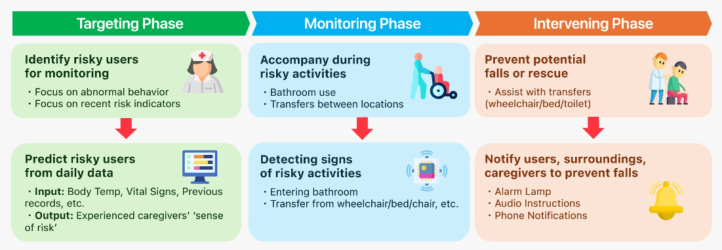
System Workflow Our system operates through three interconnected phases: targeting, monitoring, and intervening. These phases were defined to reproduce and compensate the original fall prevention process in nursing facilities conducted by human caregivers. Figure 1 illustrates the basic content of the 3 phases when performed by human caregivers or the system. Additionally, it is worth noting that we do not expect the automated process by system to replace that by human, but the two to work collaboratively.
1. The targeting phase identifies residents with elevated fall risk using daily vital signs monitoring data. By analysing patterns in body temperature, we identify subtle indicators of potential instability without increasing data collection burdens. 2. The monitoring phase focuses on detecting high-risk activities in specific zones. As our field research identified bathroom usage as particularly high-risk, the current system employs pressure sensors on bathroom door handles to detect entry attempts without compromising privacy. 3. The intervention phase delivers notifications through multiple channels:
For residents: Visual feedback (pulsing yellow light) and personalized audio guidance.
For caregivers: Smartphone notifications prioritized by risk level.
For the environment: Visual/audio alerts to notify nearby individuals who might notify/assist (indirect intervention).
Figure 1: 3 phases of the fall prevention workflow conducted by human caregivers or the designed system.
Enhanced Fall Prevention in Nursing Facilities: Assisting Caregivers 25
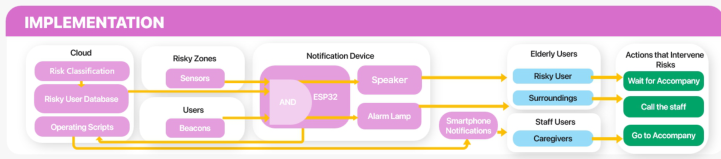
Technical Implementation and Intervention Design The system employs an ESP32 microcomputer as its core processor, complemented by a DAC-amplifier with speaker, thin film pressure sensors on door handles, and multicolor LED indicators. Resident identification occurs via Bluetooth Low Energy beacons attached to mobility aids or personal items, with risk data managed through cloud-based databases for real-time updates.
The intervention strategy implements multi-stakeholder communication through three channels: personalized audio messages using AI-generated caregiver voices addressing residents by name, gentle pulsing yellow lights for visual caution indicators, and priority-based mobile notifications to staff via cloud APIs. This coordinated approach enables different stakeholders to work collaboratively based on their proximity to potential incidents, ensuring timely intervention for accident prevention.
Figure 2: Technical workflow of the designed prototype.Table 1: Different feedback types of the system, their targets and expected outcomes.
Table available in the original PDF paper.
Feedback Type Target Expected Outcomes Audio Elderly User/ Notice and Wait / Notify
Surroundings
Staff Visual Elderly User/
Notice and Wait/Notify
Surroundings/Staff
Staff/Notice and Intervene Informational Staff Notice and Intervene
Collected Data and Prediction Algorithm We obtained anonymized datasets from two nursing facilities comprising 193,614 body temperature records, 61,181 blood pressure readings, 61,875 pulse measurements, 84,732 blood oxygen readings, and 166 incident reports (February 2022–June 2024). Only body temperature was utilized for algorithm implementation due to its consistent measurement intervals. Additionally, we collected 180 “sense of risk” reports documenting caregivers’ intuitive assessments of residents at elevated fall risk.
We developed two prediction approaches: 1. Direct accident prediction using documented incidents; 2. Sense of risk prediction based on caregivers’ intuitive assessments. To address significant data imbalance
(accidents representing only 0.086% of data points), we implemented downsampling/upsampling techniques and engineered indicators related to suboptimal physical condition, including abnormal temperature, recent admission, and temperature variation metrics. Both approaches were trained using Logistic Regression, Random Forest, and Support Vector Machine models. Parameters used in each model are listed as Table 2:
Table 2: Prediction algorithm training parameters.
Table available in the original PDF paper.
Model Name Parameters Value Ranges Logistic Regression Regularization Strength [0.01, 0.1, 10, 100] Regularization Type [‘l1’, ‘l2’] Algorithm [‘liblinear’] Random Forest Number of Decision Trees [50, 100, 200] Maximum Depth of Decision
[None, 10, 20, 30]
Trees
Min Samples Split [2, 5, 10] Support Vector
Regularization Strength [0.1, 1, 10, 100]
Machine
Kernel Type [‘linear’, ‘rbf’] All tests are conducted on Google Collaboratory with Python 3.10.12, TensorFlow 2.13.0, NumPy 1.23.5.
EVALUATION AND RESULTS Technical Performance Results
For accident prediction, nonlinear models (Random Forest and SVM) significantly outperformed the linear Logistic Regression model, with PR- AUC values of 0.536 and 0.544 compared to 0.400. The Random Forest and SVM models achieved notably high recall values for the positive class (0.94), indicating strong ability to identify residents at risk of falls. However, the precision for the positive class remained modest (0.39), suggesting some tendency toward false positives.
For predicting caregivers’ sense of risk, all models performed more consistently, with PR-AUC values between 0.567–0.587. This suggests that the information derived from data align more closely with caregivers’ intuitive assessments than with actual accident occurrences despite both suffering extreme data imbalance.
Implications: Both accident and ‘sense of risk’ prediction show a usable but suboptimal accuracy (with the latter being better), which is mostly likely to due to the extreme imbalance of data. However, advantages of ‘sense of risk’ lie in the easiness to acquire data and optimize data collection, making it better fitted to this prediction methodology. This indicates the need for evidence of the importance of ‘sense of risk’ in fall prevention, or the correlation between it and actual accident occurrences.
Enhanced Fall Prevention in Nursing Facilities: Assisting Caregivers 27
Stakeholder and User Feedback We conducted initial usability testing with four elderly residents (ages 88-99) using wheelchairs to evaluate the intervention components, of which results are listed in Table 5. Key findings included:
1. Visual Feedback Effectiveness: Visual feedback showed higher recognition rates (75% on first attempt, 100% after instruction) compared to audio feedback (50% on first attempt, with varying levels of understanding after instruction). 2. Learning Effect: The improvement in recognition after instruction demonstrates that brief training sessions could significantly enhance system effectiveness. This may also indicate the expected outcome of feedback—waiting for staff could be strengthened as a habit, even some residents might not fully understand the feedback itself. 3. Complementary Notification Strategy: The results validate our multi- channel approach, as no single feedback method was universally effective. The combination of visual and audio feedback provides redundancy that addresses varying sensory capabilities among elderly users.
Table 5: Usability tests results conducted in collaborating nursing facilities, comparing elderly residents’ interaction capability with the system before and after staff’s instruction.
Table available in the original PDF paper.
Recognize Audio
Recognize Recognize Audio User (Age) Recognize FB on 1st Visual FB on 1st Attempt?
Attempt?
FB After Instruction?
Visual FB After Instruction?
A (88) Yes Yes No Yes, but barely understood B (95) Yes Yes Yes, but barely Yes, but not fully
understood understood C (93) Yes Yes Yes Yes D (99) No Yes No Yes, but barely
understood
Besides, Stakeholder interviews with facility managers revealed strong support for the selective monitoring approach. They particularly appreciated the system’s use of existing data collection processes and the prioritization of high-risk residents. One facility manager noted: “Experienced caregivers develop an intuition about which residents need closer attention. A system that can help share that intuition across staff would be invaluable.” Areas identified for improvement included the need for more universal or multiple patterned design to apply to more environments.
FUTURE WORK AND CONCLUSION Enhanced Data Collection of ‘Sense of Risk’ Learning Samples
A promising direction for future work involves more sophisticated collection and analysis of caregivers’ “sense of risk” data. Continuous collection of “sense of risk” data will allow for ongoing model refinement, with particular attention to how qualitatively derived features impact accuracy. Furthermore, we propose employing qualitative research methods including contextual inquiry, questionnaires, retrospective interviews, to further extract the tacit knowledge that experienced caregivers develop but rarely articulate. These approaches would help identify the environmental and behavioral cues caregivers unconsciously process, informing both improved questionnaire design and feature engineering for more accurate prediction models.
Boosting Learning Data Through System Engagement Like all design cycles in product development, we postulate that improved learning data can be collected for the prediction model through human- computer collaboration, which could be achieved by the engagement of the current system in nursing home operation. This mainly includes:
1. Complementary ‘sense of risk’ by humans and computers: Once data imbalance is resolved by further data collection, we could start implementing the current system into operation, where we could ask caregivers to provide complementary answers of ‘sense of risk’ which might belong to some pattern that the algorithm has yet to cover. We hope that this can lead to a more comprehensive dataset for training, and continuous refinement of the prediction model. 2. Effectiveness Measurement Through Near-Miss Reporting: We have plans for extended usability analysis, targeting not only elderly users but also caregivers as users to see how the system would improve or alternate both stakeholders’ daily actions. One simple method to measure the effectiveness of the final output of intervention is through near-miss reports, of which number illustrates the discovery rate of falls and is currently very low in the nursing home we studied. If a bigger number of near-miss reports emerge, we may tell that the system is doing something either preventing the accidents or getting them noticed. Moreover, near- miss accidents might as well have equal correlations to an inferior physical condition as actual accidents, which might provide new data to
Enhanced Fall Prevention in Nursing Facilities: Assisting Caregivers 29
build prediction models, or as a bridge to study the correlation between ‘sense of risk’ and actual accidents.
Other Future Assessments Operational Impact Assessment: Through longitudinal observation and staff interviews, we will examine how the system changes workflow patterns and resource allocation. Key metrics will include response time to alerts, staff satisfaction, and perceived workload.
User Acceptance Among Residents: A larger-scale study with 20–30 residents will assess acceptance, comprehension of feedback, compliance with guidance, and psychological impacts on sense of autonomy.
CONCLUSION
This research demonstrates a selective approach to fall prevention, leveraging easily collectible data and focusing on high-risk scenarios, showing the direction to provide a feasible solution for resource-constrained nursing facilities. By partially automating experienced caregivers’ risk assessment processes, our system extends the reach of limited staff while respecting the residents’ autonomy.
The performance comparison of our models in predicting caregivers’ sense of risk and actual accident records underscores the value of incorporating human expertise into technological solutions. Rather than attempting to replace caregiver judgment, our approach augments and distributes this expertise throughout the facility. We believe future work including iterative data collection and training and evaluation using near-miss reports could provide valuable insight on how to reshape the operation to enhance fall prevention in real-world settings.
Furthermore, our implementation addresses the practical constraints of resource constrained actual nursing facilities, including limited digitization, budget restrictions, and staffing shortages. The multi-channel notification strategy engages not only caregivers but also residents and their surroundings, enabling multiple stakeholders to team up with each other and the computer to create a collaborative approach to fall prevention and thus achieve maximum possible operational efficiency. As populations continue to age worldwide, the gap between eldercare needs and available resources will likely widen. Selective monitoring represents a promising approach to addressing this gap by optimizing the allocation of limited resources while maintaining quality of care.
ACKNOWLEDGMENT
This research was conducted under the approval of the ethical committee of the Institute of Science Tokyo (approval number A23398) and was financially supported by Kingrun Co., Ltd. We express our sincere gratitude to the facility and company staff who contributed significantly to this study, particularly Mr. Hagimoto, Mr. Kanno of Kingrun Co., Ltd. The authors also wish to thank elderly participants who participated in the study for
their time and feedback. We further acknowledge the support of members of Saijo Laboratory and Ohashi Laboratory, Institute of Science Tokyo. This work utilized Anthropic’s Claude for initial drafting, which was thoroughly reviewed, edited, and supplemented by the authors. We therefore assume full responsibility for the final content of this publication.
REFERENCES
Balaguera, H. U. et al. (2017) ‘Using a medical intranet of things system to prevent bed falls in an acute care hospital: A pilot study’, Journal of Medical Internet Research, 19(5). doi: 10.2196/jmir.7131. Cabinet Office of Japan (2022). Annual Report on the Ageing Society FY2023.
Available at: https://www8.cao.go.jp/kourei/whitepaper/w-2023/zenbun/ 05pdf_index.html. Cao, R. and Takai, I. (2024) ‘Current Status and Challenges of Care Robot Implementation in Small and Medium-sized Elderly Care Facilities: Findings from a Questionnaire Survey [Translated from Japanese]’, Osaka Economic University Journal, 75(1), pp. 99–119. doi: 10.24644/keidaironshu.75.1_99. Care Work Foundation (2023) Survey Report on Care Labor Conditions in
Care Facilities. Available at: https://www.kaigo-center.or.jp/content/files/report/ 2023r01_chousa_jigyousho_kekka.pdf. Kang, S. et al. (2019) ‘Survey on the demand for adoption of internet of things (iot)-based services in hospitals: Investigation of Nurses’ perception in a Tertiary University Hospital’, Applied Nursing Research, 47, pp. 18–23. doi: 10.1016/ j.apnr.2019.03.005. Kano, T. (2025) ‘Development of an Accident Risk Notification System for Private
Nursing Homes Using Easily Obtainable Data Focusing on Risk Estimation [Translated from Japanese]’. Kosse, N. M., Brands, K., Bauer, J. M., Hortobagyi, T. and Lamoth, C. J. (2013).
Sensor technologies aiming at fall prevention in institutionalized old adults: A synthesis of current knowledge. International Journal of Medical Informatics, 82(9), pp. 743–752. Lewandowska, K. et al. (2020) ‘Impact of alarm fatigue on the work of nurses in an intensive care environment—a systematic review’, International Journal of Environmental Research and Public Health, 17(22), p. 8409. doi: 10.3390/ ijerph17228409. Mezghani, N. et al. (2017) ‘Context aware adaptable approach for fall detection
bases on Smart Textile’, 2017 IEEE EMBS International Conference on Biomedical & Health Informatics (BHI), pp. 473–476. doi: 10.1109/bhi.2017.7897308. Ministry of Health, Labour and Welfare of Japan (2023) Reference Material 2 of the 220th Nursing Care Benefits Subcommittee, Social Security Council. Available at: https://www.mhlw.go.jp/content/12300000/001131788.pdf. Mrozek, D., Koczur, A. and Małysiak-Mrozek, B. (2020) ‘Fall detection in older
adults with mobile IoT devices and machine learning in the cloud and on the edge’, Information Sciences, 537, pp. 132–147. doi: 10.1016/j.ins.2020.05.070. Parsons, R. et al. (2022) ‘Inpatient fall prediction models: A scoping review’, Gerontology, 69(1), pp. 14–29. doi: 10.1159/000525727. Rubenstein, L. Z. (2006) ‘Falls in older people: Epidemiology, risk factors and strategies for prevention’, Age and Ageing, 35(suppl_2), pp. ii37–ii41. doi: 10.1093/ageing/afl084.
Enhanced Fall Prevention in Nursing Facilities: Assisting Caregivers 31
Takagi, S. (2022) ‘Development and Implementation of an Accident Prevention Support System in Elderly Care Facilities [Translated from Japanese]’. Takizawa, N. et al. (2023) ‘Enhancing daily posture correction: Testing a feedback-
based assistive technology for individuals with physical disabilities’, AHFE International [Preprint]. doi: 10.54941/ahfe1004372. Yee, L. M. et al. (2019) ‘Internet of things (IoT) fall detection using wearable sensor’, Journal of Physics: Conference Series, 1372(1), p. 012048. doi: 10.1088/1742- 6596/1372/1/012048.
LISTED IN THE AHFE DIGITAL BOOKSTORE CATALOGUE
Explore the complete digital volume
Healthcare and Medical Devices
Read this individual research paper free through the original publisher, or explore the full digital proceedings book.
ISBN 978-1-964867-47-2
Explore this ISBN in the AHFE Bookstore ↗Listed in the July 2026 bookstore catalogue; search by ISBN to confirm current availability · Digital book purchase optional