Tingyi S. Lin, Yue Luo (2023). Health Communication: An Investigation on Emoji, Perceived Visual Informativeness and Social Media Engagement. In: Human Factors and Systems Interaction. AHFE Open Access, vol. 84, pp. 76–86. https://doi.org/10.54941/ahfe1003592
Compared with traditional channels of information dissemination, social media allow users to explore, to reveal and to share all kinds of information via web, reinforcing word spreading effect with such online interactivities. Convincing health information often contains clear data, distinct hierarchies and strong visual appeal. This study investigated how the application of emoji and design complexity affects social media engagement and the level of perceived visual informativeness of health information. We conducted an online experiment with a 2 (emoji: with versus without) X 2 (information design complexity: high versus low) between-subjects research. A total of 277 subjects participated in this study. Results show that, firstly, health information with emoji leads to higher social media engagement and perceived visual informativeness. Secondly, high complexity information was more convincing in terms of increasing perceived visual informativeness. Thirdly, a significant interaction effect was found on perceived visual informativeness between emoji and the design complexity of health information. In addition, visual symbols, such as emoji, are more meaningful in health information with higher design complexity than those without visual intervention or low complexity. The evidence from this study provides strategies for making visual information in health more persuasive and engaging.
Online communication has reached an unprecedented level. Social media have acted as a catalyst for public health communication in the context of pandemic such as COVID-19, Monkeypox, and others. It is widely acknow- ledged that providing effective and efficient health information for the public is a crucial means to control the spread of these infectious diseases (King, 2015). Social networking applications and sites allow users to follow messa- ges, to send requests, and to push notifications via dynamic communication means. Compared with traditional channels of information dissemination, social media enable users to explore, to reveal and to share all kinds of information via websites, reinforcing word spreading effect with such online
interactivities. Undoubtedly, social media have become an important chan- nel of disseminating public health information. Governments and public health advocacy organizations often use social media to post information of health communication to motivate people to adopt healthy behaviors, or to ameliorate their unhealthy behaviors (Heldman et al., 2013).
Emoji is a diagrammatical symbol developed to complement the lack of non-verbal cues in CMC. In social media, the public usually adopt emoji to complement texts, substitute for words and punctuation or enhance emotion (Povine et al., 2007). At the present stage, emoji has been widely studied and used in multiple fields including health communication (Langdon et al., 2021; Lin & Luo, 2023; Lotfinejad et al., 2020; Sick et al., 2020). Since visual characteristics such as emoji can effectively affect people’s attention, under- standing, perception and behaviors, emoji might stimulate users to increase their threshold of perceived visual messages. This indicates that emoji might have influence on the interaction willingness of social media users. Also, the usage of the emoji of microbe ( ) and masked face ( ) showed a significant increase in online communication in the beginning of COVID-19 outbreak (Broni, 2021). It is thought-provoking that whether emoji have positive influ- ence on health communication on social media and it is worthy of academic study on how to use emoji to effectively communicate health information on social media. In this article, we use an experimental approach to examine the effectiveness of social media engagement and health communication from a visual design perspective. This study develops a definition of social media engagement for visual health communication efforts and discusses the fea- sibility and importance of emoji to enhance the visual perception of health communication. A clear understanding of the effects of emoji application in social media can help us to improve the design and the communication of health information, and to provide theoretical references and practical suggestions.
THEORETICAL BACKGROUND AND HYPOTHESES DEVELOPMENT Emoji and Health Communication in Social Media
Good use of social media can make information communication dynamic, effective, and efficient. Many public health organizations have included social media into their services and switched from traditional to digital commu- nication (Heldman et al., 2013). Social media engagement illustrates the reflections and measurement of how much users interact with online con- tent, including like, comments, shares, and other various interactivities on the platform (Li & Xie, 2020; Fernández-Luque & Bau, 2015; Heldman et al., 2013). Previous studies have investigated the effectiveness and the meaning of using social media in health promotion and disease prevention. Murray et al. (2005) conducted a Meta-analysis of health communication indicating that social media can improve the health knowledge, social support, health behaviors and clinical results of users. Chou et al. (2013) also claim that investigations on the effects of social media in public health intervention are urgently required. Especially with rapid technological change and the deep
78 Lin and Luo
penetration of internet connectivity among people, further actions need to be taken for effective health communication.
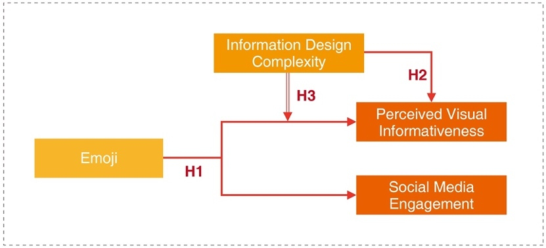
Many symbols are created to represent facial expressions. More and more attentions are paid to the emoji influence on science and health related themes (Lotfinejad et al., 2020). These influences are a result of the visual appeal, expressiveness, and usability of emoji, as well as the proven use of these fea- tures for healthcare communication. Emoji plays a role of improving perceive risk, self-protection efficacy and preventive behavior intention in health com- munication during the pandemic (Lin & Luo, 2023; Lin & Luo, 2022). Szeto et al. (2022) summarized emoji in healthcare communication before and during the COVID-19 pandemic. Other studies also found good use of emoji has positive effects in pediatric health care (Sick et al., 2020; Jaeger et al., 2018), adult emotional and psychological assessment (Marengo et al., 2019; Ricard et al., 2018), medication compliance (Langdon et al., 2021; Waughtal et al., 2021), and public health tracking and interventions (Huesch et al., 2017; Al-Rawi et al., 2020; Van Dam et al., 2019). Current threats and ongoing outbreaks are forcing many people to virtual formats and tele- medicine as safer alternatives (Szeto et al., 2022). Huesch et al. (2017) also discovered that many health tweets triggered people’s interaction using emoji. People nowadays obtain medical and health information than traditional rea- ding sources due to public awareness raising by the Internet and social media (Fernández-Luque & Bau, 2015). The application of emoji in health com- munication not only is feasible and applicable, but also can be utilized and re-utilized to meet the needs because of their potential popularity (Szeto et al., 2022). Based on above evidences, we boldly presume emoji’s multiple roles in health communication: H1: In terms of improving PVI and social media engagement, health infor- mation with emoji is more convincing than if emoji are not applied to health information.
Information Design and Complexity Numerous studies have been investigated into fields such as information design, visual complexity, and design complexity. The aim of information design is meaning making so recipients can take action on goals (Yi & Lin, 2018). Visual complexity is the amount of visual elements and principles that are displayed (Lindgaard et al., 2006; Pieters et al., 2010) and it can be mea- sured by the number of visual variations (Tuch et al., 2009) such as line, shape, color, value, form, texture, and space. However, design complexity is a more subjective guarantee of structural change in order to overcome the shor- tcomings of the visual complexity approach. Pieters et al. (2010) positioned design complexity to be the organization and application of design princi- ples and the amount of visual information. As a matter of fact, information design often involves the combination of graphics, images, typography, and other design elements. Designers combine basic elements (e.g., color, graph- ics, layout design, etc.) to create a visual effect that is aggregated into more complex, higher-order design factors and interpreted by the audience (Orth & Malkewitz, 2008). Based on the above three concepts, we define Information
Health Communication: An Investigation 79
Design Complexity as: the state of and the intricate degree of visual repre- sentation in colors, schemes, hierarchical levels, and other visual elements. However, medical and health knowledge is often difficult to be understood by the general public due to a certain degree of professionalism. The mission of information design and its complexity control is to transform the know- ledge of disease prevention and treatment to help the public understand the content even if they do not have professional medical knowledge (Yi & Lin, 2018). In health communication, then, the complexity of information design may allow a way to detect recipients’ understanding of the information, their attitudes, and their subsequent behavioral intentions.
As the key to accessing online health information, the visual complexity of the information is interpreted through a holistic view which reflects the initial impression of the online health messages and significantly influences users’ evaluation (Tuch et al., 2012; Lavie & Tractinsky, 2004). Lazard and Mackert (2014) proofed that design complexity should be regarded as an influential variable for health communicators since the first impression of the representation can effectively reach users, and it can be a persuasive design strategy. Above studies all suggested that in the process of health communica- tion, the receivers’ evaluation and perception of messages can be considered in information design (Pieters et al., 2010). Thus, the complexity of informa- tion design is an important variable for designers and health communicators to interpret health information in the process of health communication. In this study, the design complexity variables of health information were measu- red in terms of the visual hierarchy and visual richness of information design, while ensuring the same amount of information. We therefore developed the second hypothesis as: H2: Compared to low design complexity, health information with high design complexity is more effective in enhancing perceived visual informati- veness (PVI).
Perceived Visual Informativeness (PVI) Researchers and public health professionals have long used visual features to communicate health in print and multimedia messages (King et al., 2014). The perception of information design affects how people interpret and pro- cess information, which in turn has an impact on the effectiveness of the information (Jensen et al., 2012; Cho & Boster, 2008). Perceived Visual Infor- mativeness (PVI) is a framework that complements existing image research in health communication and seeks to advance research in the field tow- ards a more theoretical understanding of specific types of visual messages (King et al., 2014). King (2015) further claimed that PVI is able to predict an individual’s intention to perform health-related behaviors, such as skin self-examination. PVI is also proved to be helpful in creating positive attitu- des and intentions about clinical trial participation (Occa et al., 2021). The establishment of PVI helps to predict the effectiveness of people’s perceived information and thus further anticipate the effectiveness of the actual infor- mation (Dillard et al., 2007). These experiments show the importance of PVI variable in health communication and public health research studies.
80 Lin and Luo
Figure 1: Conceptual overview and framework of the study.
Visual elements contain various visible components such as color, image, and font (Gerend & Sias, 2009; Juni & Gross, 2008; Seo, 2020). These components may alter the effectiveness of functional communication through various visual stimuli rather than plain text (Houts et al., 2006). Seo (2020) proves in a Meta-analysis of visual persuasion that health-related visual sym- bols can increase the persuasiveness of a piece of information. This result echoes Dual Coding Theory that our memory has two channels that pro- cess verbal and non-verbal stimuli, with which suggesting different types of stimuli assist recipients encode information more effectively (Paivio, 2014). In this study, we proposed emoji, as non-verbal stimuli, are more likely to increase users’ interests and interactivity. The third assumption was: H3: The effect of emoji application on PVI depends on the level of information design complexity.
Figure 1 represents the conceptual framework of this study.
METHODS AND MATERIALS In order to investigate our three hypotheses, we conducted an online expe- riment with a 2x2 between-subject design. Emoji were manipulated to be present or absent, and information design complexity was manipulated (high versus low level). A seven-point Likert scale is used in this investigation. There were 277 subjects (145 females and 132 males) with age ranging from 17–59 years old (M = 25.55, SD = 5.556) responded via Credamo online panel. Around 84.1% of participants held a bachelor’s degree (or higher).
We designed four Facebook posts as stimuli for this online experiment. Each post contains the same title, epidemic data on the day of the experi- mental test, and newsletters from various regions. Four emoji ( , , , ) as visual supplements were placed at the end of the title and the text, whereas the text was the same without emoji in the control condition. Two more emoji ( and ) were added to complement the stimulus text and mea- sure the information design complexity in order to extend our two previous studies (see Lin & Luo, 2023; Lin & Luo, 2022). Differ from the low design complexity information that presented with different font weights texts, high
Health Communication: An Investigation 81
design complexity information in this study contains more visual hierarchy, different colours, and various font sizes and styles.
Two manipulation checks were conducted in this study: 1) show or hide emoji, and 2) the complexity level of sample information high and low. The value of a dependent variable depends on recipients’ evaluation on PVI, which was adapted from the study of King et al. (2014). A total of 11 checking items on visual elements were included to see if they were explanatory, clear, comprehensive, eligible, informative, understandable, indispensable, inspi- ring, impressive, worth remembering, and preferable than text (α = 0.923). Higher scores indicated greater perceived visual informativeness. A three- item scale adapted from Alt (2018) was used to evaluate respondents’ SME with this type of health information. The items contain whether the partici- pant reads, comments or likes such information via social media and shares it with others (α = 0.763). Higher scores indicate more willingness to interact with health information.
RESULTS AND DISCUSSION
Manipulation Checks Manipulation checks were conducted on emoji (with or without) and infor- mation design complexity (high or low level) in health information using a series of Independent Sample t-tests. The results showed that subjects in the emoji condition recognized the presence of emoji in the information (M = 4.85, SD = 2.018, p = 0.00) whereas subjects in the health information without emoji (M = 2.63, SD = 2.054) could not. Also, subjects who recei- ved information with high design complexity (M = 4.36, SD = 1.916) were more likely to perceive design complexity than subjects in the low-complexity condition (M = 3.84, SD = 1.782, p = 0.02). These manipulation checks therefore provided evidence of construct validity.
Main Effects The results indicated that the application of emoji in health information had a significant main effect (F (1,275) = 28.881, p = 0.000, η2 = 0.095) in answering RQ1. Compared with health information without emoji, subje- cts were more likely to increase social media engagement in conditions with emoji (Memoji = 5.315, SD = 1.223 versus Mno emoji = 4.467, SD = 1.404). This result supports H1. According to the results of two-way ANOVA, there is a significant main effect of emoji in response RQ2 (F (1,273) = 5.858, p = 0.016, η2 = 0.021). The presence of emoji in health information perfor- med better than their absence for increasing people’s PVI (Memoji = 5.053, SD=0.098 versus Mno emoji = 4.695, SD = 0.111). On the other hand, infor- mation design complexity only had a marginally significant effect on the PVI (F (1,273) = 3.845, p = 0.051, η2 = 0.014). These results support H2. The main effect of emoji performance on both SME and PVI holds validity (see Table 1). In sum, the application of emoji can increase perceived visual informativeness and can influence users’ willingness to interact with health information in social media.
82 Lin and Luo
Table 1. Between-subject effect test related to research questions 1–3.
Table available in the original PDF paper.
Source DF MS F P Partial η2 Emoji 1 49.672 28.881 0.000** 0.095
Social media engagement (SME)
1 5.136 3.845 0.051+ 0.014
Emoji 1 7.825 5.858 0.016* 0.021 Information Design complexity
Perceived visual informativeness (PVI)
1 20.457 15.315 0.000** 0.053
Emoji x Information Design complexity
*p < 0.05, **p < 0.01.
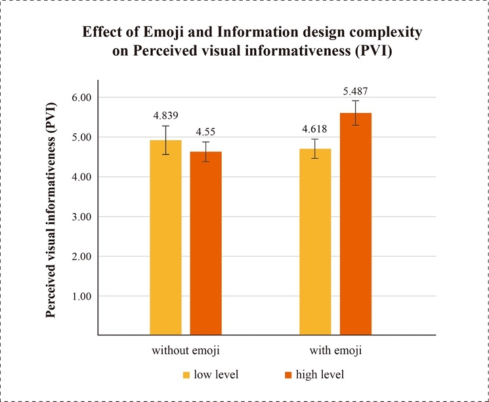
Interaction Effects Besides main effect of emoji and information design complexity, we also found a significant interaction effect between emoji and information design complexity on recipients’ PVI (F(1,273) = 15.315, p = 0.000, η2 = 0.053) (see Table 1). Emoji has a significant impact on receiving health information with high design complexity. In the conditions of high design complexity, recipients who received information with emoji were more likely to perceive visual informativeness than those who received information without emoji (Memoji = 5.487, SD = 0.154 versus Mno emoji = 4.55, SD = 0.121). On the contrary, for those subjects who received health information with low complexity, the presence of emoji had no effect. That emoji only increa- sed participants’ PVI in the context of health information with high design complexity supports H3 (see Figure 2).
Figure 2: Conceptual overview and framework of the study.
Health Communication: An Investigation 83
CONCLUSION
Internet is rapidly expanding and is being used for health purposes by a great number of people. A better understanding of social media can strengthen greater decision-making capacity to health departments and health commu- nication organizations. Good use of emoji can provide effective and efficient conversations for health communication on social media due to their fast tra- vel through internet and ease of understanding via visual expression (Szeto et al., 2022; Boender et al., 2022).
In the current study, we used an online experiment to examine the role of emoji in health communication on social media. We compared the effects of using and not using emoji for health messages on social media communi- cation, and investigated users’ perception in relation to information design complexity. We found that health information with emoji on social media increased users’ SME and PVI. This result illustrates that emoji can play mul- tiple roles in health communication on social media. The public often prefer effective visual content in tweets. Those visual elements can reinforce attitude building and behavioral changing for better health promotion (Szeto et al., 2022; Huesch et al., 2017). This result also reinforces the need for visual stra- tegies for health information communication during the pandemic to engage the public and to shape their visual memory and decisions (Lin & Luo, 2023; Lin & Luo, 2022; King & Lazard, 2020). We also found that the moderating role of information design complexity can determine PVI between the inte- raction of emoji and information design complexity. Emoji had a significant effect on health information with high design complexity, but had no signifi- cant effect on messages with low design complexity. That is to say, recipients can perceive more visual information when emoji are simultaneously shown on social media messages with high design complexity. This finding again echoes core ideas of Dual Coding Theory (Seo, 2020; Paivio, 2014). Health information with both verbal and non-verbal messages are more persuasive than those with a single type of message because verbal and non-verbal mes- sages interweave each other and influence people’s perceptions. However, unlike the combination of textual and visual information, emoji and text can form cohesive narratives so as to create fluent reading experiences. This research helps health communication practitioners and information designer to better understand how emoji could be a useful visual communication ele- ment on social media. To better examine the moderating effect of information design complexity, three or more levels can be manipulated in the near future.
ACKNOWLEDGEMENT
This research was supported by National Science and Technology Council [MoST 111-2410-H-011-033-MY2].
REFERENCES
Al-Rawi, A. et al. (2020) ‘COVID-19 and the Gendered Use of Emojis on Twitter: Infodemiology Study’, Journal of medical Internet research, 22(11), pp. e21646–e21646. doi: 10.2196/21646.
84 Lin and Luo
Alt, D. (2018) ‘Students’ Wellbeing, Fear of Missing out, and Social Media Engagement for Leisure in Higher Education Learning Environments’, Current psych- ology (New Brunswick, N. J.), 37(1), pp. 128–138. doi: 10.1007/s12144-016- 9496-1. Boender, T. S., Louis-Ferdinand, N. and Duschek, G. (2022) ‘Digital Visual Commu-
nication for Public Health: Design Proposal for a Vaccinated Emoji’, Journal of medical Internet research, 24(4), pp. e35786–e35786. doi: 10.2196/35786. Broni K. (Feb 16, 2021) Vaccine emoji comes to life. Emojipedia. URL: https://blog.emojipedia.org/vaccine-emoji-comes-to-life/ [accessed 2022-12-08]. Cho, H. and Boster, F. J. (2008) ‘First and Third Person Perceptions on Anti- Drug Ads Among Adolescents’, Communication research, 35(2), pp. 169–189. doi: 10.1177/0093650207313158. Chou, W. S. et al. (2013) ‘Web 2.0 for health promotion: reviewing the cur-
rent evidence’, American journal of public health (1971), 103(1), pp. e9–e18. doi: 10.2105/AJPH.2012.301071. Dillard, J. P., Shen, L. and Vail, R. G. (2007) ‘Does Perceived Message Effectiveness Cause Persuasion or Vice Versa? 17 Consistent Answers’, Human communication research, 33(4), pp. 467–488. doi: 10.1111/j.1468–2958.2007.00308.x. Fernández-Luque, L. and Bau, T. (2015) ‘Health and social media: perfect storm of information’, Healthcare informatics research, 21(2), pp. 67–73. doi: 10.4258/hir.2015.21.2.67. Gerend, M. A. and Sias, T. (2009) ‘Message framing and color priming: How subtle
threat cues affect persuasion’, Journal of experimental social psychology, 45(4), pp. 999–1002. doi: 10.1016/j.jesp.2009.04.002. Heldman, A. B., Schindelar, J. and Weaver, J. B. (2013) ‘Social Media Engagement and Public Health Communication: Implications for Public Health Organizations Being Truly “Social”‘, Public health reviews, 35(1), pp. 1–18. doi: 10.1007/BF03391698. Houts, P. S. et al. (2006) ‘The role of pictures in improving health communication:
A review of research on attention, comprehension, recall, and adherence’, Patient education and counseling, 61(2), pp. 173–190. doi: 10.1016/j.pec.2005.05.004. Huesch, M. et al. (2017) ‘Frequencies of Private Mentions and Sharing of Mammography and Breast Cancer Terms on Facebook: A Pilot Study’, Journal of medical Internet research, 19(6), pp. e201–e201. doi: 10.2196/jmir.7508. Jaeger, S. R. et al. (2018) ‘Emoji questionnaires can be used with a range
of population segments: Findings relating to age, gender and frequency of emoji/emoticon use’, Food quality and preference, 68, pp. 397–410. doi: 10.1016/j.foodqual.2017.12.011. Jensen, J. D. et al. (2012) ‘Why are Tailored Messages More Effective? A Multiple Mediation Analysis of a Breast Cancer Screening Intervention’, Journal of communication, 62(5), pp. 851–868. doi: 10.1111/j.1460–2466.2012.01668.x. Juni, S. and Gross, J. S. (2008) ‘Emotional and Persuasive Perception of Fonts’,
Perceptual and motor skills, 106(1), pp. 35–42. doi:10.2466/pms.106.1.35–42. King, A. J. (2015) ‘A Content Analysis of Visual Cancer Information: Prevalence and Use of Photographs and Illustrations in Printed Health Materials’, Health communication, 30(7), pp. 722–731. doi: 10.1080/10410236.2013.878778. King, A. J. and Lazard, A. J. (2020) ‘Advancing Visual Health Communica-
tion Research to Improve Infodemic Response’, Health communication, 35(14), pp. 1723–1728. doi: 10.1080/10410236.2020.1838094. King, A. J. et al. (2014) ‘Perceived Visual Informativeness (PVI): Construct and Scale Development to Assess Visual Information in Printed Materials’, Journal of health communication, 19(10), pp. 1099–1115. doi: 10.1080/10810730.2013.878004.
Health Communication: An Investigation 85
Langdon, K. J. et al. (2021) ‘Feasibility and acceptability of a digital health intervention to promote engagement in and adherence to medication for opioid use disorder’, Journal of substance abuse treatment, 131, pp. 108538–108538. doi: 10.1016/j.jsat.2021.108538. Lavie, T. and Tractinsky, N. (2004) ‘Assessing dimensions of perceived visual aesth-
etics of web sites’, International journal of human-computer studies, 60(3), pp. 269–298. doi: 10.1016/j.ijhcs.2003.09.002. Lazard, A. and Mackert, M. (2014) ‘User evaluations of design complexity: The impact of visual perceptions for effective online health communication’, Interna- tional journal of medical informatics (Shannon, Ireland), 83(10), pp. 726–735. doi: 10.1016/j.ijmedinf.2014.06.010. Li, Y. and Xie, Y. (2020) ‘Is a Picture Worth a Thousand Words? An Empirical Study
of Image Content and Social Media Engagement’, Journal of marketing research, 57(1), pp. 1–19. doi: 10.1177/0022243719881113. Lin, T. S., and Luo, Y. (2022). ‘Evaluating Intertwined Effects of Emoji and Message Framing to Vaccine Communication Strategy’, In International Conference on Human-Computer Interaction (pp. 35–48). Springer, Cham. Lin, T. S. and Luo, Y. (2023) ‘Health persuasion through emoji: How emoji interacted
with information source to predict health behaviors in COVID-19 situation’, SSM - population health, 21, pp. 101343–101343. doi: 10.1016/j.ssmph.2023.101343. Lindgaard, G., Fernandes, G., Dudek, C., & Brown, J. (2006). Attention web designers: You have 50 milliseconds to make a good first impression! Behaviour & information technology, 25(2), 115–126. Lotfinejad, N. et al. (2020) ‘Emojis in public health and how they might be used for
hand hygiene and infection prevention and control’, Antimicrobial resistance & infection control, 9(1), pp. 27–27. doi: 10.1186/s13756-020-0692-2. Marengo, D., Settanni, M. and Giannotta, F. (2019) ‘Development and preliminary validation of an image-based instrument to assess depressive symptoms’, Psychiatry research, 279, pp. 180–185. doi: 10.1016/j.psychres.2019.02.059. Murray, E. et al. (2004) ‘Interactive Health Communication Applications for
people with chronic disease’, Cochrane database of systematic reviews, (4), pp. CD004274–CD004274. Occa, A. et al. (2021) ‘Untangling interactivity’s effects: The role of cognitive absorption, perceived visual informativeness, and cancer informa- tion overload’, Patient education and counseling, 104(5), pp. 1059–1065. doi: 10.1016/j.pec.2020.10.007. Orth, U. R., Campana, D. and Malkewitz, K. (2010) ‘Formation of Consumer Price
Expectation Based on Package Design: Attractive and Quality Routes’, Journal of marketing theory and practice, 18(1), pp. 23–40. doi: 10.2753/MTP1069- 6679180102. Paivio, A. (2014). ‘Mind and its evolution: A dual coding theoretical approach’, Psychology Press. Pieters, R., Wedel, M. and Batra, R. (2010) ‘The Stopping Power of Advertising: Mea-
sures and Effects of Visual Complexity’, Journal of marketing, 74(5), pp. 48–60. doi: 10.1509/jmkg.74.5.048. Ricard, B. J. et al. (2018) ‘Exploring the Utility of Community-Generated Social Media Content for Detecting Depression: An Analytical Study on Insta- gram’, Journal of medical Internet research, 20(12), pp. e11817–e11817. doi:10.2196/11817. Seo, K. (2020) ‘Meta-Analysis on Visual Persuasion– Does Adding Images to Texts Influence Persuasion?’, ATHENS JOURNAL OF MASS MEDIA AND COMMUNICATIONS, 6(3), pp. 177–190. doi: 10.30958/ajmmc.6–3-3.
86 Lin and Luo
Sick, J. et al. (2020) ‘The Meaning of Emoji to Describe Food Experiences in Pre- Adolescents’, Foods, 9(9), p. 1307. doi: 10.3390/foods9091307. Szeto, M. D. et al. (2022) ‘Emojis and Emoticons in Health Care and Dermatology Communication: Narrative Review’, JMIR dermatology, 5(3), pp. e33851–e33851. doi: 10.2196/33851. Tuch, A. N. et al. (2009) ‘Visual complexity of websites: Effects on users’ experience,
physiology, performance, and memory’, International journal of human-computer studies, 67(9), pp. 703–715. doi: 10.1016/j.ijhcs.2009.04.002. Tuch, A. N. et al. (2012) ‘The role of visual complexity and prototypicality regarding first impression of websites: Working towards understanding aesthetic jud- gments’, International journal of human-computer studies, 70(11), pp. 794–811. doi: 10.1016/j.ijhcs.2012.06.003. Van Dam, L. et al. (2019) ‘Can an Emoji a Day Keep the Doctor Away? An
Explorative Mixed-Methods Feasibility Study to Develop a Self-Help App for Youth With Mental Health Problems’, Frontiers in psychiatry, 10, pp. 593–593. doi: 10.3389/fpsyt.2019.00593. Waughtal, J. et al. (2021) ‘Nudge me: tailoring text messages for prescription adherence through N-of-1 interviews’, Translational Behavioral Medicine, 11(10), pp. 1832–1838. Yi M. and Lin, T. S. (2018) ‘A Decade Development of Academic Research on
Information Design: 2007-2017’, Journal of Design, 23(4), pp. 45–68.
LISTED IN THE AHFE DIGITAL BOOKSTORE CATALOGUE
Explore the complete digital volume
Human Factors and Systems Interaction
Read this individual research paper free through the original publisher, or explore the full digital proceedings book.
ISBN 978-1-958651-60-5
Explore this ISBN in the AHFE Bookstore ↗Listed in the July 2026 bookstore catalogue; search by ISBN to confirm current availability · Digital book purchase optional