Hiroshi Sasaki, Kenji Watanabe, Ichiro Koshijima (2023). Analysis of Cybersecurity Risk for Factory Systems. In: Human-Centered Design and User Experience. AHFE Open Access, vol. 114, pp. 331–337. https://doi.org/10.54941/ahfe1004251
As the digitization of factory systems progresses and the number of digital connections between factories increases, cybersecurity risks throughout the supply chain also increase. In fact, there have been many cases where factories have stopped due to damage from ransomware. For large companies, it is possible to secure the budget and personnel for cybersecurity, including outsourcing. However, almost all small and mediums enterprises (SMEs) are facing with the difficulties to secure them. In this paper, we used a web diagnostic tool for simple risk assessment of factory systems using the checklist for understanding the rough risk posture in the appendix of " The Cyber/Physical Security Framework for Factory Systems" formulated by the Ministry of Economy, Trade and Industry in November 2022. After analyzing the evaluation results and interviews with 170 companies collected through the survey, we analyzed the common challenges for promoting security measures for the factory systems of SMEs. In previous works, several cybersecurity guidelines for industrial control systems in a factory have already been published such as IEC 62443 series, NIST Cybersecurity Framework. However, it is too time consuming and difficult for SMEs to utilize them because these guidelines have over 100 requirements and need specialized people who understand both cybersecurity and industrial control systems well. Therefore, we have developed an easier risk assessment tool based on only 32 requirements. The tool was cogitated to visualize the rough risk posture of factory systems by scoring (20%-100%) the achievement of each requirement. We also gave the risk weight to each for adjusting the difference of the effectiveness for the risk mitigation in our previous work (under peer review). As a web tool survey result, more than 80% of SMBs found it inadequate to mitigate cybersecurity risks. We categorized the cybersecurity risks into the four pillars which are “People”, “Process”, “Technology” and supply chain risk management of assets in the factory system (FA SCM). We saw some common results in each category below: “People”: No awareness of executives, stakeholders, no governance and organization, no collaboration between IT and factory organizations, no educational contents for mitigating the risk in the factory. “Process”: No risk assessment, no assets management for factory systems, no security policy and rule, no procedure and back up asset for incident response. “Technology”: Some countermeasures are installed such as firewall, endpoint security solutions, but not managed well, no network segmentation, no log management, well done for physical security. “FA SCM”: No management for system integrators and asset vendors, no procedures for mitigating the cybersecurity risk for procurement of FA assets. We also found out “People” factor is the root obstacle because no dedicated people for cybersecurity in a factory organization causes the insufficient risk mitigation of the other three categories. If SMEs need the people in charge, it is essential for the executives to commit the investment for human resources. We plan to analyze the results more and build the standardized approach for cybersecurity for factory systems of SMEs in the future work.
As the digitization of operational technology (OT) in factories has caused more susceptible to cyberattacks in recent years. Have been increasing the
cases where cyberattacks targeting information systems affected factories.
Especially in the last few years, several factories shut down due to mal- ware infection of information systems related to production. For example, a cyberattack on an automotive parts supplier in Japan caused that major
automobile manufacturer relying on the supplier shut down all the domes- tic factories for a day. It is a symbolic example showing a supply chain with
strengthened digital connections induces that a cyberattack on a member of the chain can affect not only the company itself but also its business partner.
In response to the situation, the importance of cybersecurity measures has recently come to be recognized even in factories. However, the organization responsible for cybersecurity measures at factories is not clear, and there are no personnel with knowledge.
In addition, an increasing demand for carbon-neutral business happens globally, and factories are moving to visualize CO2 emissions in produc- tion and share it in the supply chain. As the number of data connections
between factories increases in this way, factory cybersecurity measures become an “etiquette” for business participation. This is because the pres- ence of vulnerable players in the supply chain will cause damage to other businesses.
Despite the increasing importance of cyber security in factory systems, many companies continue to be unable to say that their measures are suf- ficient. The reason for this is that the degree of risk of the factory system is not known and it is not possible to judge how much investment should be made.
PRIOR RESEARCH
This research aims to take the first step in promoting cybersecurity mea- sures for factory systems by visualizing the security risks associated with the current state of factory systems and presenting a simple risk assessment method that can be used to secure budgets and human resources. purpose. In this paper, based on the information collected by the web diagnostic tool using this risk assessment method, common issues in cybersecurity measures for factory systems were derived.
The following standard and framework are known as prior research on cybersecurity risk assessment for factory systems.
The most well-known international standards are ISA/IEC 62443 series, mainly focused on the security of industrial control systems. IEC 62443-2-1 is used for cybersecurity management system for Industrial Automation and Control System (IACS) (IEC, 2009). IEC 62443-3-3 which has 128 Items is often used by the requirement of OT system procurement along its security level in plant automation industry (IEC, 2013). Many prior efforts are known for utilizing the standard (IEC, 2020) (Leander et al. 2019).
The NIST Cybersecurity Framework (CSF) is also a very popular and voluntary framework to help organizations manage and reduce cybersecu- rity risk (NIST, 2014). The framework provides a set of guidelines and best practices (108 items) that organizations can use to assess their cur- rent cybersecurity posture, identify gaps and weaknesses, and develop a plan for improving cybersecurity. Many prior efforts on NIST CSF were known (Goel et al., 2020) (Krumay et al., 2018).
The Cybersecurity Evaluation Tool (CSET) is a software tool to help orga- nizations assess and improve their cybersecurity posture (CISA, 2023). CSET is specifically designed for industrial control systems, used in CI sectors. It provides recommendations for improving the organization’s cybersecurity program, based on industry best practices and standards such as NIST CSF and ISA/IEC 62443.
CSET is designed to be flexible and customizable. It can be used by orga- nizations of all sizes and types. The tool is free to download and use and is regularly updated to reflect changes in cybersecurity threats and best prac- tices. some prior efforts on CSET were known (Chaula et al., 2020).
These previous studies are already very useful for organizations that have established management system and secure budgets in factory systems. How- ever, it is too time consuming and difficult for SMEs to utilize them because
Analysis of Cybersecurity Risk for Factory Systems 333
METHOD
these guidelines have over 100 requirements and need specialized people who understand both cybersecurity and industrial control systems well.
In this study, we utilized the checklist for posture assessment of the appendix E of the “The Cyber/Physical Security Framework for Factory Sys- tems (draft) Version 1.0” as the basic tool (Table 1) (METI, 2022). The reason is that the burden of implementing 32 items is relatively low. In addition to the easy-to-understand three basic classifications of “people”, “processes”, and “technology”. In addition, it also mentions the recent security issue of “supply chain management of factory assets (FA SCM)”. The four categories make it easy to use to visualize risks rather than the previous works.
For the 32 items in this checklist, we can input 6 options (Table 2) shown in the guidelines and score the risks (20% to 100%) of 4 categories and over- all results. Developed web diagnostic tool. This tool is designed to visualize the high-level risk posture of factory systems by scoring (20% to 100%) the degree of achievement of each requirement. A risk-scoring methodology is presented in the other paper (under peer review).
Table 2. Selection items for checklist (METI, 2022).
Table available in the original PDF paper.
By releasing the web tool on the public, we obtained the input results from 225 sites (the number of factory bases to be diagnosed) from June 2022 to July 2023. The results are aggregated and utilized for risk analysis of the factory system. In addition, for several factory sites, detailed interviews were conducted regarding the input content. We have identified common challenges and issues in the four categories.
Selection Item
Not applicable Not Implemented Partially Implemented Implemented Implemented, control procedures are documented and automated, and measures are periodically reviewed’ Implemented, control procedures are documented and automated, and reviewed as needed
RESULT
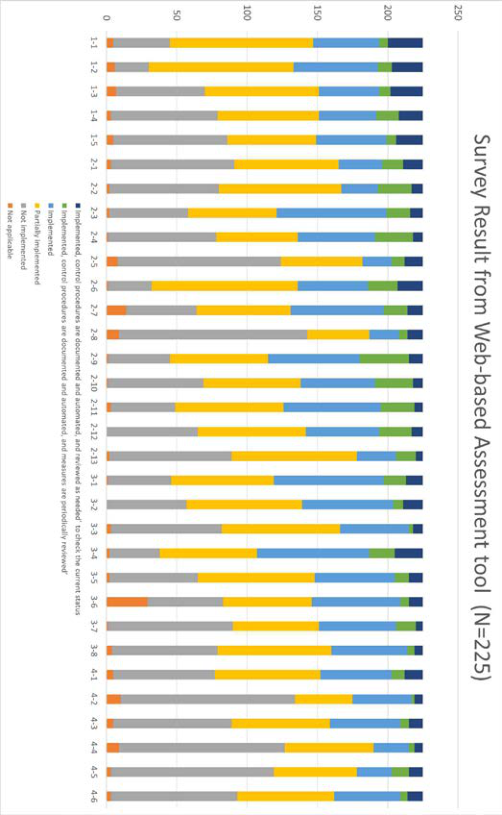
As a web tool survey result, more than 80% of factory sites found it inad- equate to mitigate cybersecurity risks. To see more details of the situation, the survey result for 225 sites obtained is shown (Fig. 1). Firstly, more than 50% of the responses for all items other than physical security item (3-4) were “Not implemented” or “Partially implemented”, indicating that overall measures are inadequate.
From the follow-up interviews of over 10 factory sites, we summarized some common results in each category below:
Table 1. Selection item for checklist (METI, 2022).
Table available in the original PDF paper.
“People”: No awareness of executives, stakeholders, no governance and organization, no collaboration between IT and factory organizations, no educational contents for mitigating the risk in the factory.
Analysis of Cybersecurity Risk for Factory Systems 335 “Process”: No risk assessment, no assets management for factory systems, no security policy and rule, no procedure and back up asset for incident response.
“Technology”: Some countermeasures are installed such as firewall, end- point security solutions, but not managed well, no network segmentation, no log management, well done for physical security.
CHALLENGE AND DISCUSSION
“FA SCM”: No management for system integrators and asset vendors, no procedures for mitigating the cybersecurity risk for procurement of factory assets.
Table 3. Checklist items by subcategory.
Table available in the original PDF paper.
From the survey results and interviews, we found out “People” factor is the root obstacle because no dedicated people for cybersecurity in a factory orga- nization causes the insufficient risk mitigation of the other three categories. If a factory site needs the people in charge of cybersecurity, it is essential for the executives to commit the investment for human resources.
To analyse the results more deeply, we grouped the items and organized them into 12 subcategories (Table 3). For example, the “Governance” sub- category is a collection of items related to the organizational structure and division of roles indicated by checklist items 1-1, 1-2, 1-3, and 1-4. For each subcategory, we calculated the ratio of “insufficient measures” (“Not imple- mented” + “Partially implemented”) (Table 4). As a result, “Periodic assess- ment”, “Incident response”, “Supplier management”, and “Procurement Process Management” exceed 70%, and it is considered that these measures have not progressed. All of four subcategories require cross-organizational activities, and it is considered that measures tend to be delayed due to the insufficient resources of the cybersecurity organization on the factory site.
Table 4. Ratio of insufficient measures of each subcategory.
Table available in the original PDF paper.
Figure 1: Survey result from web-based assessment tool.
Analysis of Cybersecurity Risk for Factory Systems 337
CONCLUSION
In this study, to understand the current state of security risks in factory sys- tems, we used the checklist of Japanese government guidelines and conducted a web survey of factory systems from 225 factory sites. We found out more than 50% of the responses for all items other than physical security item are insufficient, indicating that overall measures are inadequate. Some common results derived from the follow-up interviews shows the “People” factor is the root obstacle of the insufficient measures. It is reinforced by the deeper analysis which shows top four insufficient subcategories (over 70%) need cross-organizational activities.
ACKNOWLEDGEMENTS
As future research topics, we will examine methods to easily proceed with risk assessment and develop a standard approach and specific measures for each subcategory to reduce security risks in factory systems.
This research was supported by Fortinet Japan G.K. to co-work web-based survey and respondent interviews. Authors would like to thank the peer reviewers for their valuable comments for improving the quality of the manuscript.
REFERENCES Chaula, J.A. and Luwemba, G.W., (2020). Security control assessment of supervisory
control and data acquisition for power utilities in Tanzania. European Journal of Engineering and Technology Research, 5(7), pp.785–789. CISA. (2023). The Cybersecurity Evaluation Tool (CSET) v11.5:
https://www.cisa.gov/downloading-and-installing-cset https://github.com/cisagov/cset Goel, R., Kumar, A., Haddow, J. (2020). Prism: a strategic decision framework for
cybersecurity risk assessment. Information & Computer Security 28(4), 591–625 IEC. (2009). Security for industrial automation and control systems - Part 2-1:
Security Program Requirements for IACS asset owner (IEC/ISA 62443-2-1:2009). Geneva, Switzerland: International Electrotechnical Commission. IEC. (2013). Security for industrial automation and control systems - Part 3-3: Sys-
tem security requirements and security levels (IEC/ISA 62443-3-3:2013). Geneva, Switzerland: International Electrotechnical Commission. IEC. (2020). Quick start guide: an overview of ISA/IEC 62443 standards. ISA global
cybersecurity alliance. Krumay, B., Bernroider, E.W. and Walser, R., (2018). Evaluation of cybersecurity
management controls and metrics of critical infrastructures: A literature review considering the NIST Cybersecurity Framework. In: Secure IT Systems: 23rd Nordic Conference, NordSec 2018, Oslo, Norway, 28–30 November 2018, Proceedings 23, pp.369–384. Leander, B., Čaušević, A. and Hansson, H., 2019. Applicability of the IEC 62443 standard in
Industry 4.0/IIoT. In: Proceedings of the 14th International Conference on Availability, Reliability and Security, pp.1–8. METI., Study Group for Industrial Cybersecurity Working Group 1 (Systems,
Technologies and Standardization) Factory sub-working group. (2022). The Cyber/Physical Security Framework for Factory Systems (draft) Version 1.0: https://public-comment.e-gov.go.jp/pcm/download?seqNo =0000236565 NIST. (2014). Framework for improving critical infrastructure cybersecurity (NIST
CSF). Gaithersburg, MD: National Institute of Standards and Technology
LISTED IN THE AHFE DIGITAL BOOKSTORE CATALOGUE
Explore the complete digital volume
Human-Centered Design and User Experience
Read this individual research paper free through the original publisher, or explore the full digital proceedings book.
ISBN 978-1-958651-90-2
Explore this ISBN in the AHFE Bookstore ↗Listed in the July 2026 bookstore catalogue; search by ISBN to confirm current availability · Digital book purchase optional