Mario Hirz, Stefan Lippitsch (2023). Automated charging of electric cars for improving user experience and charging infrastructure utilization. In: Usability and User Experience. AHFE Open Access, vol. 110, pp. 171–179. https://doi.org/10.54941/ahfe1003189
The number of electric cars on the roads is steadily increasing and it is expected that the markets of battery-electric vehicles will experience an accelerated growth during the upcoming years. One challenge for a successful employment of electric mobility represents the provision of sufficient charging points for large fleets. In this context, public charging systems play an essential role to provide access for a broad range of users. Standard technology today is manual charging by plug-in and plug-off the charging cables. This has drawbacks in view of safety, user comfort and limited access of persons with disabilities. In addition, cars are parked for a longer duration at charging stations so that they block access for other electric cars, and manual charging does support future automated driving and parking vehicles.The proposed article introduces a selection of automated charging technologies for cars and discusses their strengths and weaknesses for application in public areas. This includes inductive charging, conductive charging from the vehicle underbody and conductive charging by use of standard connectors. Based on a value analysis, robot-supported conductive charging by use of standard connectors is selected as the preferred solution for automated charging processes under consideration of investment costs, avoidance of specific vehicle adaptations and easy customer handling. The potentials of this technology to enhance existing charging infrastructure are discussed based on an existing research prototype of a robotic automated charging station. The discussion comprises aspects of charging system integration in urban and sub-urban infrastructure, operational boundary conditions as well as requirements for safe and reliable system usage. In addition, an outlook is given to the operational integration of automated driving and parking cars and the automated charging system with the target to optimize the operational load of the charging infrastructure, e.g. in public parking areas. One main target of investigation represents the enhancement of user experience during the automated charging process. This includes the provision of smooth user interaction by a smart phone application and on-site interfaces, the guidance of the car to the right parking position, as well as provision of information about the actual charging status and billing data. In this way, the article introduces a comprehensive approach of automated robot-based charging of electric cars with the target to improve both user experience and the effectiveness of charging infrastructure utilization.
AUTOMATED CHARGING TECHNOLOGIES Manual charging by use of standard connectors is largely applied for ele- ctric cars today, but automated charging technologies have great potential to improve both, user experience and charging infrastructure utilization.
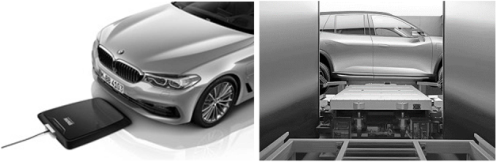
Figure 1: Examples of inductive charging (BMW wireless charging, 2022), left, and battery swapping (Nio, 2022), right.
In the following, different automated charging technologies are introduced and evaluated in view of their potential use in public charging facilities, with a focus on private customers. It has to be stated that for commercial vehicle fleets a varying weighting of the discussed performance criterial might lead to different evaluation results.
Inductive Charging Inductive charging enables wireless power transfer and is derived from the basic principle of a transformer, where energy transfer is enabled via two oppositely positioned coils. Advantages of this technology include contactless charging and high comfort, because no manual operation is necessary for connection. There is a low risk of unintended damage or vandalism because the system does not involve freely movable cables - just flat plates at the sta- tion and in the vehicle. Weaknesses of inductive charging include high system costs at both ends, vehicle and infrastructure, as well as reduced charging effi- ciency because of the air gap between the coils. Maximum charging power is limited due to restricted coil size and the occurring electromagnetic radi- ation. Some manufacturer see potential in this technology because of great comfort, e.g., BMW (Figure 1 (BMW Wireless Charging, 2022)), but the high costs hindered large-scale applications so far.
Battery Swapping Systems In battery swapping stations, the empty battery is decoupled from the vehi- cle and replaced by a fully charged unit. The battery exchange process takes just some minutes and the vehicle is ready to go. In the station, the battery is recharged, checked for proper functionality and then provided for imple- mentation in another vehicle. In this way, battery swapping seems to be an attractive alternative to rigidly mounted vehicle-internal batteries. The tech- nology has been tested in the automotive industry since several years, e.g., (Nio, 2022; Wired, 2021), Figure 1. Challenges and limitations of this tech- nology include high investment costs and the necessity to provide a number of pre-charged batteries in the stations. The cars are to be designed for battery swapping, which requires stiff vehicle structures as well as a specific layout of the batteries. For charging fleets of various cars, the battery swapping system has to manage different battery sizes and -formats to support all vehicle types involved.
Automated Charging of Electric Cars for Improving User Experience 173
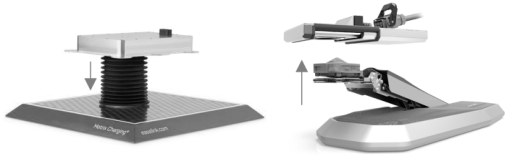
Figure 2: Underbody coupler charging system of Easelink (Easelink Matrix Charging, 2022), left, and Volterio (EV-institute, 2022), right.
Conductive Charging Conductive charging enables electric connection by use of cables or specifi- cally designed conducting elements. Due to the direct flow of electricity, high power can be transferred with very good efficiency. In general, conductive charging technologies distinguish between underbody coupler and so-called side-coupler.
Conductive Underbody Coupler Underbody coupler consist of a movable or fixed charging device that is pla- ced on the charging station’s floor and a movable or fixed opposite unit mounted at the car’s underbody. When charging, the vehicle is placed in the charging station in a way that both units are aligned within a pre-defined tole- rance area. Linking is established by motion of the connector at the movable unit onto the fixed unit. Figure 2 shows two exemplary underbody coupling systems, (Easelink Matrix Charging, 2022; Volterio Automatic Electric Char- ging, 2022). Underbody couplers have the advantage of robustness and safe operation, because there are no cables hanging around. However, the inte- gration efforts for both, car and infrastructure are relatively high. In case of technologies with moveable stationary units, the robotic kinematics and con- trol is complex. The design of moveable units in the vehicles is challenged by limited installation space, additional power transfer and control systems.
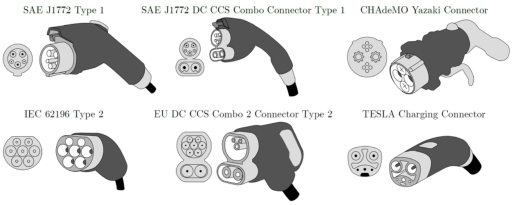
Conductive Side Coupler Manual conductive side charging by use of cables and plugs is the most com- mon method today. Different standardized interfaces are applied in the car industry, as exemplarily shown in Figure 3. A relevant advantage represents the possibility to use standardized charging interfaces for both manual and robot-supported charging. This avoids efforts for additional interfaces and systems in the cars and enables automated charging for all types of electric vehicles.
Standardized interfaces provide several advantages, such as compatibility, certification for predefined charging voltage and current as well as broad availability of systems and components. In the present work, the Combined Charging System (CCS) Type 2 system (Phoenix Contact, 2022) is exem- plarily considered in more details. This interface enables both AC and DC charging, and that with a wide power range. Besides transfer of energy, the
174 Hirz and Lippitsch
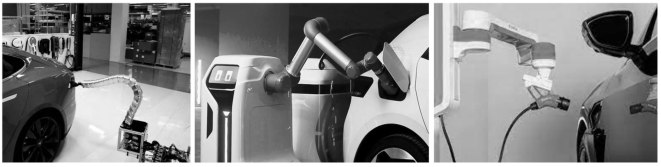
Figure 3: Selection of standardized charging interfaces in automotive applications (EV- Institute, 2022).Figure 4: Selection of prototype systems for conductive side coupling. Left: Tesla char- ging snake (Tesla, 2016); middle: VW charging robot (Volkswagen AG, 2022); right: Kuka Carla connect (Kuka AG, 2021).
interface also allows communication and data exchange between charging station and vehicle.
While conductive standard interfaces are developed to provide a safe and reliable charging connection by manual operation, they are not designed for automated robot-controlled plugging. This brings several challenges for the development of automated charging systems, because some design details of the connectors hinder smooth automated plug-in and plug-out processes. Exemplary, pre-positioning of plug and socket is not supported by markers or lights, so that an automated charging device has to operate with highly accurate vision systems, which are able to deal with different surface- and light- conditions. The shapes of plugs and sockets of standardized interfaces are not optimized for automated fitting. For example, there are no tapered or conical wall shapes that would support self-centring effects. In addition, some cars are equipped with specific protective devices that have to be hand- led by the robotic system. In this way, the development of an automated robot-controlled charging system represents a challenging task and requi- res to integrate a precise sensor system for position detection and control in combination with an accurate robotic actuation system for proper manipu- lation during plug-in and plug-out sequences. Due to the high complexity, no serial production system has been introduced so far. However, different car manufacturer and supplier have published their research and development activities in this field during the past years, e.g., Volkswagen (2022), Tesla (2016), Kuka robotics (2021), Fig. 4.
Automated Charging of Electric Cars for Improving User Experience 175
Table 1. Evaluation of different automated charging technologies.
Table available in the original PDF paper.
Conductive side-charging
Inductive charging
Battery swapping
Conductive underbody charging Infrastructure costs −− −− − − Vehicle integration efforts − −− − ++ Safety and reliability ++ + + +/− Flexibility for different vehicles − −− − ++ AC / DC power capability − ++ + ++ Power transfer efficiency − ++ ++ ++ Operation and maintenance ++ − + + Technology availability & maturity ++ ++ − −−
Technology Evaluation The different introduced technologies are evaluated regarding their potential use in public charging facilities with a focus on private customers. Evaluation criteria include infrastructure investment and operational costs, efforts of vehicle system integration as well as safety and reliability. In addition, the flexibility of the technology for application at different vehicle types, classes and sizes is compared. Important criteria represent electric characteristics in view of AC / DC power capabilities and transfer efficiency. Finally, aspects of operation and maintenance as well as technology maturity are evaluated, see Table 1.
Inductive charging technologies convince with high safety and relatively low efforts for operation and maintenance, but they are expensive and have a comparably low power transfer efficiency. Battery swapping technologies come with high costs for infrastructure and vehicle integration, are only appli- cable for prepared cars and require high operational efforts. On the other hand, the system is in serial application today and allows high power tran- sfer rates at good efficiency values. Conductive underbody charging is on prototype status today in small fleet trials. It enables high power transfer efficiency, but requires efforts for infrastructure and vehicle implementation. The technology is not very flexible, because only specifically prepared cars can be charged. Finally, conductive side-charging with standard connectors seems to be the most advantageous technology, because all electric cars can be charged without vehicle-related modifications. As it is with conductive char- ging, high power transfer and efficiency can be reached. Challenges represent the infrastructure installation, which involves a complex robotic system, and the limited technology maturity as there are no series solutions on the market to date. The robotic system is not protected under the vehicle, and movable parts might be in the reach of persons. In this way, a comprehensive safety concept is to be developed to avoid injuries, damage, and misuse.
As a result of the present assessment, the conductive charging technology with standardized interfaces reaches the highest scores. Convincing streng- ths of this technology include the applicability for a fleet with very different types of vehicles, the possibility to use proven interfaces from the automo- tive sector, low electrical losses and electromagnetic radiation in operation
176 Hirz and Lippitsch
as well as high safety and reliability of the technology. In addition, state- of-the-art charging converters can be applied and installation, operation and maintenance can be conducted with reasonable effort. With the target to inve- stigate this technology, to learn more about challenges of development and implementation and to evaluate their potential in more detail, a prototype charging station has been developed.
AUTOMATED CONDUCTIVE SIDE-CHARGING STATION The research charging system consists of a fully automated 6-axis robot, a vision-based sensor system and a specifically developed charging connector. The system is patented (Walzel et al., 2022) and has been introduced in several publications, e.g., (Walzel et al., 2019; Miseikis et al., 2017).
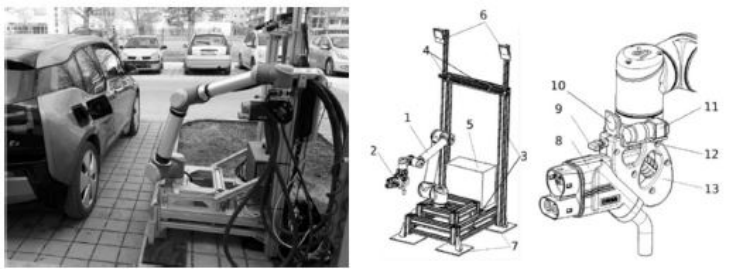
Figure 5 shows a picture (left) and a general setup of the automated char- ging system including a detailed model of the robot head tool (right). The station consists of robot (1), head tool (2), frame (3), cameras (4, 11), light-emitting diodes (6, 10), robot control box (5), base plates (7), charging connector (8), adapters (12, 13) and actuators (9). As a basis for the prototype serves the collaborative robot UR10-CB3 (Universal Robots, 2017) (1). Col- laborative safety features of this robot allow people to be in the working area without the need of a specific safety fence. Cameras (4, 11) are responsible for vehicle position and charging inlet pose detection. The process of vision system position and orientation, as well as the field of view of the cameras has been specifically developed to enable accurate position control of the robotic system.
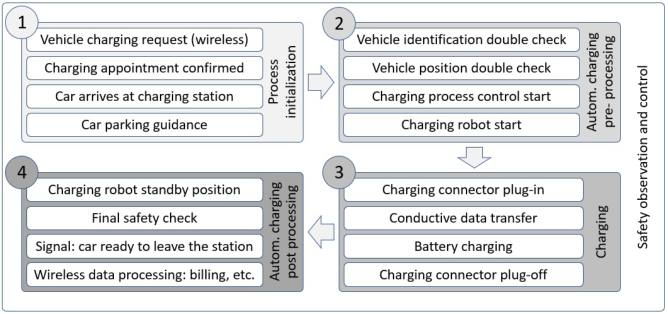
Figure 6 shows the operational sequences of the automated charging pro- cess. Step 1 includes communication sequences via smart phone app. This starts with a charging request set by the driver and making an appointment for charging. Once the car arrives at the charging station at the defined date and time, detailed information about vehicle identifiers, battery status, pros- pective energy demand, etc., is exchanged and expected charging duration and costs are communicated. In step 2, a vision-based double check is condu- cted to make sure that the right car is on spot and no damages or irregularities are visible. The driver is supported to position the car in the charging station by screens and light signs. Once all checks are clear, the robotic system starts
Figure 5: Picture (left) and scheme (right) of the automated conductive charging system.
Automated Charging of Electric Cars for Improving User Experience 177
Figure 6: Main sequences of an automated conductive side-coupler charging process.
with several motion steps of the plug-in process. Based on visual position determination of the car’s charging connector interface, the robot arm plugs in the charging cable and the process of battery charging starts (step 3). Stan- dardized data communication, e.g., according to IEC 63110-1 (n.d.), IEC 63119-1 (n.d.), and ISO 15118 (2022), is directly provided between car and charging station to ensure safe and efficient process control. At the end of the charging process, or in case of a manually activated interrupt placement, the connector is plugged-off and the system goes into standby position (step 4). Finally, the driver is informed via screens and the smart phone app that the car is ready to leave the station. All information about charging process, transferred amount of energy, billing, potential benefits, etc., are delivered by the communication software.
Satisfying user experience plays a major role in the development of smooth automated charging processes. In this context, the communication via ele- ctronic devices, e.g., smart phone, has to be provided in a comprehensive and easy to handle way. A flexible application structure opens the opportunity to involve different charging infrastructure provider and to avoid complex stan- dardization processes. In the future, relevant functions might be also provided by infotainment systems in the cars. In addition to wireless communica- tion, the driver is supported by screens and light signals on spot, e.g., when entering the charging station. If desired, the car can be left alone during char- ging. Information about expected charging duration and potential activities around the charging station, e.g., coffee shop, entertainment, business loun- ges, support the driver and passengers in planning their stay. A significant enhancement of charging-related user experience is expected in a few years, when the cars are able to park autonomously. User will be able to leave the car in front of a parking house, shopping centre or office building and go to their businesses. In the meantime, the car will autonomously drive to a parking spot and, in case of charging demand, it can automatically register for charging. Once the charging station is free, the car will drive to the sta- tion and, after finished charging, back to the parking place. This process can be combined with different services, e.g., car wash, tyre pressure control. All
178 Hirz and Lippitsch
these services are not available today, but under development, e.g., (Mercedes Benz and Bosch Driverless Parking System, 2022; Audi media center, 2022).
In view of infrastructure utilization, the combination of automated par- king and charging offers great potentials for improvement. Without access for non-operative staff, charging stations can be placed and designed in an opti- mized way. Occupancy and efficiency can be improved significantly, because the vehicles leave the charging stations automatically after finished charging. In addition, comprehensive planning and management of station utilization is enabled based on large data of the vehicle fleet, automated registration pro- cesses as well as detailed information of vehicle specifications, e.g., charging demand, maximum charging power.
CONCLUSION
Automated charging of electric vehicles represents an important upcoming technology to enable effective operation, safe and reliable charging processes and maximum comfort. Considering emerging self-driving vehicles, auto- mated charging is mandatory to enable holistic management of electric car fleets. A detailed study of the different electric charging technologies showed, that automated conductive charging by use of standardized charging interfa- ces provides the greatest potential for successful implementation in public charging stations. Based on a research prototype charging station, a compre- hensive process has been introduced that covers all sequences of the charging process. This includes registration, approaching the vehicle to the charging station, detection and identification of car and charging socket, automated plug-in process, charging sequence as well as automated plug-off and vehicle exit. In addition, communication between user, vehicle, charging station and data management supports comprehensive fleet management. Especially in combination with future self-driving and -parking cars, automated charging technologies show great potential for improving both user experience and the effectiveness of charging infrastructure utilization.
ACKNOWLEDGMENT
The authors want to express their acknowledgement to the project par- tners BMW AG, MAGNA Steyr Engineering, KEBA AG, Austrian Society of Automotive Engineers and the Institute of Computer Science and Engineering at the University of South Florida for the excellent cooperation. Thanks also go to the Austrian Research Promotion Agency and the Austrian Federal Ministry of Transport, Innovation and Technology for financial support of the research.
REFERENCES
Audi media center: “Automated Valet Parking at the IAA 2021”, web-link: https://www.audi-mediacenter.com/en/audimediatv/video/customer-experie nce-usecase-automated-valet-parking-at-the-iaa-2021-5723, date of access 20221205. BMW Wireless Charging, web-link: www.bmw.de, date of access 20221117.
Automated Charging of Electric Cars for Improving User Experience 179
Easelink Matrix Charging, web-link: https://easelink.com, date of access 20221205. EV-Institute: “Plug-In Around the EV-World”, web-link: https://ev-institute.com/ images/, date of access 20221117. IEC 63110–1 “Protocol for management of electric vehicles charging and discharging
infrastructures”, International standard, ISBN 978-2-8322-3868-4. IEC 63119-1: “Information exchange for electric vehicle charging roaming service”, International standard, ISBN 978-2-8322-5829-3. ISO 15118: “Road vehicles - Vehicle to grid communication interface”, web-
link: https://www.iso.org/obp/ui/#iso:std:iso:15118:-1:ed-2:v1:en, date of access 20221205. Kuka AG - Charging Assistant Carla Connect Charges Electric Cars” web-link: ww w.023jjzs.com/nezbb1/z7nzw3.html, date of access 20210305. Mercedes Benz and Bosch Driverless Parking System, homepage of Mercedes Benz: https://group.mercedes-benz.com/innovation/product- innovation/autonomous-driving/intelligent-park-pilot.html, date of access 20221205. Miseikis J., Ruther M., Walzel B., Hirz M., Brunner H.: “3D vision guided robotic
charging station for electric and plug-in hybrid vehicles”, Cornell University, 2017, arXiv:1703.05381. Nio - The Current State of EV Battery Swapping, web-link: www.nio.com/blog/ current-state-ev-battery-swapping, date of access 20221205. Phoenix Contact, Technical data of Phoenix Contact Charging Equipment, web-link:
www.phoenixcontact.com, date of access 20221205. Tesla: “Charger prototype finding its way to Model S”, web-link: www.youtube.co m/watch?v=uMM0lRfX6YI, date of access 20160806. Universal Robots: “Technical Data Universal Robot UR10”, web-link: https://www.
universal-robots.com, date of access 20170703. Volkswagen AG: “Volkswagen lets its charging robots loose”, web-link: www.volk swagenag.com/en/news/, date of access 20221205. Volterio Automatic Electric Charging, web-link: www.volterio.com, date of access
20221205. Walzel B., Hirz M., Brunner H., Kreutzer N.: “Robot-Based Fast Charging of Electric Vehicles”, SAE Paper 2019-01-0869, 2019, https://doi.org/10.4271/2019- 01-0869. Walzel B., Hirz M., Brunner H.: “Method for automatically establishing a plug-
in con-nection in order to charge electric vehicles”, Patent US2022363151A1, 2022–11-17. Wired: “Better Place Unveils an Electric Car Battery Swap Station” web-link: www.
wired.com/2009/05/better-place/, date of access 20210305.
LISTED IN THE AHFE DIGITAL BOOKSTORE CATALOGUE
Explore the complete digital volume
Usability and User Experience
Read this individual research paper free through the original publisher, or explore the full digital proceedings book.
ISBN 978-1-958651-86-5
Explore this ISBN in the AHFE Bookstore ↗Listed in the July 2026 bookstore catalogue; search by ISBN to confirm current availability · Digital book purchase optional