Nina Rußkamp, Claas Digmayer, Eva-Maria Jakobs (2023). Co-Creation-Based Framework for the Agile Development of AI-Supported CAM Systems. In: Human Aspects of Advanced Manufacturing. AHFE Open Access, vol. 80, pp. 43–56. https://doi.org/10.54941/ahfe1003507
Digital transformation processes in the course of industry 4.0 affect computer-aided manufacturing (CAM) in two ways: The acceleration of production and innovation cycles shortens the time to carry out CAM-planning tasks; simultaneously, an increasing product individualization raises the complexity of CAM-planning tasks and quality requirements for the planning results. Thus, CAM users need to solve complex CAM-planning tasks in increasingly shorter time frames. Efforts to meet the quality requirements nonetheless lead to overload and frustration of the user [1], [2]. To overcome this challenge, the R&D project CAM2030 aims to develop a new generation of CAM systems that integrates innovative technologies (artificial intelligence, cloud computing, and evolutionary algorithms) to make CAM-planning processes more efficient for the CAM planner. The innovation process requires a novel methodology that involves the stakeholders’ different perspectives, esp. the users’ preferences and needs, and brings them into compliance. This paper presents a co-creation-based framework for the agile development of AI-supported system components. The framework intends to continuously support the innovation process of complex software systems in a highly interdisciplinary team working collaboratively under remote conditions. The framework was developed successively in line with the project’s progress over two years. The resulting framework describes a multi-level and partly iterative approach that covers the following stages of the innovation process: (i) the elicitation, specification, and prioritization of requirements for AI-supported CAM systems, their user interface, and CAM user training; (ii) the design of an interactive prototype for selected parts of the user interface; (iii) the prototype testing; and (iv) the iteration of (i) to (iii) as well as the refinement of their output. The approach applies and adapts co-creation methods for use in online workshops. The research activities focused on the development, implementation, and evaluation of the single workshop concepts, partly complemented by studies investigating topics such as user expectations and requirements concerning new features and the system introduction. The main characteristics of the workshops are their interdisciplinary composition of participants, their conduction under remote conditions, and the mix of methods and tools to support collaboration in each stage of the innovation process [3], [4].The framework application shows a high potential to support the development of AI-supported CAM systems in creating a shared vision of the individual stages of the innovation and the innovation process as a whole. The framework helps to: (i) understand and reflect the user’s needs and preferences, (ii) align different and partly controversial perspectives, and (iii) identify and overcome sticking points of the system development. The project shows that the innovation and development process benefits from the active involvement of end users (workers and companies), the continuity of interdisciplinary exchange, and iterative testing. Limitations arise from the restricted application scope of the framework (innovating automated CAM system components for the CAM parameter optimization by well-educated CAM planners in German SMEs). Future research should consider the reconciliation of innovation processes with day-to-day business in manufacturing companies and the framework’s transferability to other application contexts. Acknowledgments: This research and development project is funded by the German Federal Ministry of Education and Research (BMBF) within the “Innovations for Tomorrow’s Production, Services, and Work” Program (funding number: 02J19B081) and implemented by the Project Management Agency Karlsruhe (PTKA). The authors are responsible for the content of this publication.References:[1] Hehenberger, P. (2020). Computerunterstützte Produktion: Eine kompakte Einführung. Berlin: Springer.[2] Jakobs, E.-M., Digmayer, C., Vogelsang, S. and Servos, M. (2017). Not Ready for Industry 4.0: Usability of CAx Systems. In: Ahram, T. and Falcão, C., eds Advances in Usability and User Experience. AHFE 2017. Advances in Intelligent Systems and Computing, 607th ed. Cham: Springer, pp.51-62. [3] Piller, F. T., Ihl, C. and Vossen, A. (2010). A typology of customer co-creation in the innovation process. SSRN Electronic Journal, 4. [4] Rußkamp, N., Digmayer, C., Jakobs, E., Burgert, F., Schirmer, M., Niewöhner, S. (2022). New ways to design next-generation CAM systems. An integrated approach of co-creation and process modeling. In: Waldemar Karwowski and Stefan Trzcielinski (eds) Human Aspects of Advanced Manufacturing. AHFE (2022) International Conference. AHFE Open Access, vol 66. AHFE International, USA. http://doi.org/10.54941/ahfe1002682
Digital transformation processes in the course of industry 4.0 are accom- panied by the acceleration of production and innovation cycles as well as an increasing product individualization. In the field of computer-aided
manufacturing (CAM), this comes along with increasing task complexity and rising quality requirements for CAM-planning processes. Thus, CAM users need to solve complex CAM-planning tasks in increasingly shorter time fra- mes. Time pressure impairs the quality of the CAM process planning for complex tasks, which, in turn, entails overload and frustration for the CAM user. The R&D project CAM2030 aims at developing a new generation of CAM systems that integrate innovative technologies (artificial intellige- nce (AI), cloud computing (CC), and evolutionary algorithms (EA)) to make CAM-planning processes more efficient and to relieve the user. The project focuses on the automation of the CAM-planning process, particularly the CAM parameterization.
The system’s development is embedded in an iterative innovation process that follows the principles of agile systems engineering. The main research focus is the impact of the integration of AI on (i) the CAM system design (especially the user interface), (ii) the user (e.g., acceptance, knowledge and skills, work organization), and (iii) the introduction of the new software generation to the CAM planners. The project consortium is highly interdi- sciplinary; it comprises experts from industry and academia covering fields such as mechanical engineering, computer science focusing on artificial intel- ligence and evolutionary algorithms, user interface design, human-centered work design, and technical communication.
Key challenges of the innovation process are bridging the gap between disciplines and perspectives as well as continuously involving the user. This paper presents a co-creation-based framework for developing AI-supported CAM systems addressing these challenges. It aims to identify the potential and limitations of co-creation methods to accompany and promote innovation processes for industry 4.0.
STATE OF THE ART Artificial intelligence (AI) and software engineering approaches are connected in two ways: AI can be integrated (i) into software engineering (SE) proces- ses (AI as part of a software development method) or (ii) into the software system itself (AI as part of the product). Mostly, the literature focuses on AI- based methods (case i). Integrating AI into SE methods aims to automate and facilitate software-engineering steps (e.g., requirements engineering, Dalpiaz and Niu 2020). So far, less considered is case (ii) and the question of how conventional software engineering can be applied to the development of AI- based systems and how far SE methods need to be adapted to meet AI-specific challenges (Martínez-Fernández et al. 2022).
Most studies on challenges and SE frameworks for AI integration are limi- ted to the early innovation phases; they mainly focus on the requirements engineering process. The further the development process progresses, the less it is examined (Villamizar et al. 2021). Recurring challenges concern tru- stworthiness, transparency, explainability, and data handling. To meet these challenges, the software engineering framework has to bridge three gaps: a skill gap between software engineers and data scientists, the data gap caused
Co-Creation-Based Framework for the Agile Development of AI-Supported CAM Systems 45
by the disparity between available and desired data, and the engineering gap between prototyping and full lifecycle support (Belani et al. 2019).
There is little research on how user requirements can be integrated into the software development process, e.g., with regard to user-based requirements for the user interface as well as AI-related information and training needs. In particular, there are hardly any models that serve an integrative framework to accompany the development process and actively involve user-centered needs (but, e.g., Csiszar et al. 2020; Oliveira et al. 2019; Margetis et al. 2021; Hartikainen et al. 2022). One approach that systematically integrates the user’s perspective in the innovation process is co-creation. According to Piller et al. (2010: 9), customer co-creation is “an active, creative and social process, based on col- laboration between producers (retailers) and customers (users).” Co-creation facilitates gathering information (i) about customer and market needs, e.g., motives and preferences of the users of a new product or service (need infor- mation) and (ii) (technological) solution possibilities (solution information) (Piller et al. 2010). There is a wide range of co-creation methods to gain need and solution information. Piller et al. (2010) typology methods and their use based on three dimensions:
The stage in the innovation process. It specifies the point in time at which customer input is embedded in the innovation process. While front-end co- creation at an early innovation stage deals with generating and selecting new ideas and concepts, back-end co-creation focuses on designing and testing products later in the process.
The degree of collaboration. It depends on the number of collabora- ting partners and the structure of their relationship (a dyadic collabo- ration between company and customer vs. network-based collaboration involving customer communities).
The degrees of freedom. They are determined by the type of collaboration task. Predefined tasks limit the customer’s autonomy in the co-creation process; open tasks give customers more freedom.
Oliveira et al. (2019) present an example of a co-creation approach. The approach focuses on the requirements elicitation for AI-based systems used by workers on the shop floor. User involvement is seen as means to create a software solution that exploits and supplements the workers’ potential, meets the workers’ needs, is acceptable, and facilitates committing to changing wor- king environments and practices. The approach comprises workshops with end-user organizations, developer workshops, multidisciplinary workshops, and a final analysis. It applies methods such as story maps, interviews, use case diagrams, and activity diagrams. Lessons learned during the co-creation process led to five recommendations: (i) Nominate a “champion” in the end- user organization that represents the end-users and works as a multiplier. (ii) Differentiate between the conceptualization and implementation phase; communicate openly with end-users what is (not) realizable. (iii) In advance, make all stakeholders aware of the necessity to continuously contribute to a high level of communication and frequent interaction in the multidisciplinary
team. (iv) Set short expiration dates for delivering artifacts, implementation tasks, etc. (v) The co-creation process should be accompanied by a team of facilitators that remains consistent throughout the process.
To our knowledge, the development of AI components for the manufactu- ring industry is less investigated than other AI application cases. In particular, methodological approaches that consider AI-specific challenges in later inno- vation phases are missing. Overall, there is a need for studies that examine the potential and limitations of co-creation approaches to close knowledge gaps and align the perspectives of the stakeholders involved in the innovation process.
FRAMEWORK DEVELOPMENT The co-creation-based framework was developed from 2020 to 2022. The development took place alongside the innovation process. It considered the following requirements:
The framework should support the entire innovation process. The system development steps are predefined (e.g., requirements analysis, imple- mentation, and testing) and determine the content and methods of the framework approach. The approach must be flexible and adaptable to changes in the project plan.
The framework must be compatible with agile project management as applied in the CAM2030 project (e.g., four-week sprints). The studies’ preparation, implementation, and evaluation are oriented on the agile scheme.
The framework design is based on a co-creation approach (Piller et al. 2010; Tandi and Jakobs 2019). Where useful, co-creation methods are complemented by other methods.
The framework must work in remote working conditions. Pen and paper must be replaced by digital tools. To ensure low-threshold participation by all project actors, preference should be given to collaboration tools that are free, easy to use, and accessible without registration.
A major challenge is to bridge knowledge gaps and align actor-specific perspectives while dealing with uncertainties due to new technologies: It is assumed that relearning and rethinking processes on the part of the CAM users are necessary, which contradicts the acceptance of the system. The technical implementation of AI-supported features is complex and, the- refore, can harbor unexpected pitfalls and limitations for a user-oriented design.
The framework development comprised the selection and design of compo- nents (co-creation workshops, partly complemented by studies investigating user expectations and requirements concerning new features and the system introduction), their interleave, and the refinement of the framework. The workshop concepts were developed iteratively by technical communication experts. The development included the selection and combination of meth- ods and their adaptation to the project use case. The resulting workshop concepts are tripartite: (i) workshop preparation: the definition of aims and
Co-Creation-Based Framework for the Agile Development of AI-Supported CAM Systems 47
tasks; production of workshop materials, selection of digital tools and for- mats; the definition of groups (number, composition, size) for teamwork and roles of the workshop leader team (e.g., moderator vs. facilitator); and the selection and information of participants, (ii) workshop execution: intro- duction, workshop tasks, and summary of the needs for action, and (iii) follow-up analysis: consolidation and visualizing of workshop results. An essential part of the framework development was the evaluation of the work- shops. The participants were asked to give feedback on how productive they perceived the workshop and its output. The feedback was collected at the end and/or after the workshop. The workshop leader team evaluated the workshops based on (i) the workshop concept (suitability of methods and tools), (ii) its implementability (shortcomings and improvement potential), and (iii) the workshop output (quality of the results and their contribution to the innovation process). Lessons learned were used for further refinement.
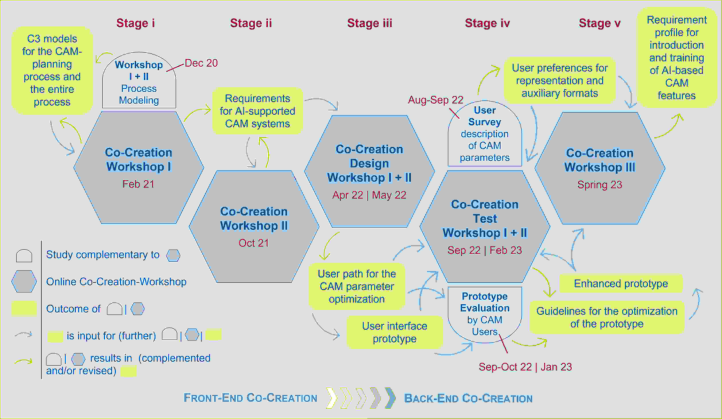
CO-CREATION-BASED FRAMEWORK FOR THE DESIGN OF NEXT-GENERATION CAM SYSTEMS The co-creation-based framework is a multi-level and partly iterative approach. It covers the following stages of the innovation process: (i) the modeling of the as-is condition of the CAM-planning process as well as the elicitation of requirements for AI-supported CAM systems, their user interface, and CAM user training; (ii) requirements specification and prio- ritization; (iii) the design of an interactive prototype for selected parts of the user interface; (iv) the prototype testing; (v) the system introduction; and partial iteration. In stages (i) and (iv), the framework combines co-creation workshops with other formats (workshops, user surveys, and prototype eva- luations). The co-creation workshops in stages (i) and (ii) support front-end co-creation; the co-creation workshops in stages (iii), (iv), and (v) support back-end co-creation. Figure 1 gives an overview of the framework as a whole. All workshops are conducted and recorded via the web-conferencing system Zoom. Google Docs was used to collect ideas and document results collaboratively. Partly, additional tools were applied (the digital whiteboard Mural, the prototyping tool Figma, and Google Forms as evaluation forms). A basic principle is that all stakeholders involved in the innovation process are represented in the workshop teams. The workshops are led by technical communication experts and, to some extent, supported by human-centered work design experts. The workshop participants are experts in the fields of industry- and research-related applications of CAM systems, software deve- lopment focusing on artificial intelligence and evolutionary algorithms, and user interface design. The following subsections present each innovation stage in detail: (i) goals, (ii) methods used and combined, and (iii) method evalu- ation focusing on the potential and limitations of the applied co-creation methods in relation to the innovation process. The graphics give an ove- rview - on the left: the date and sequence of workshops and related studies; in the middle: topics, tasks, participants, tools of the workshops, and the workshop-related studies; on the right: outcomes.
Figure 1: Co-creation-based framework for the design of next-generation CAM systems.
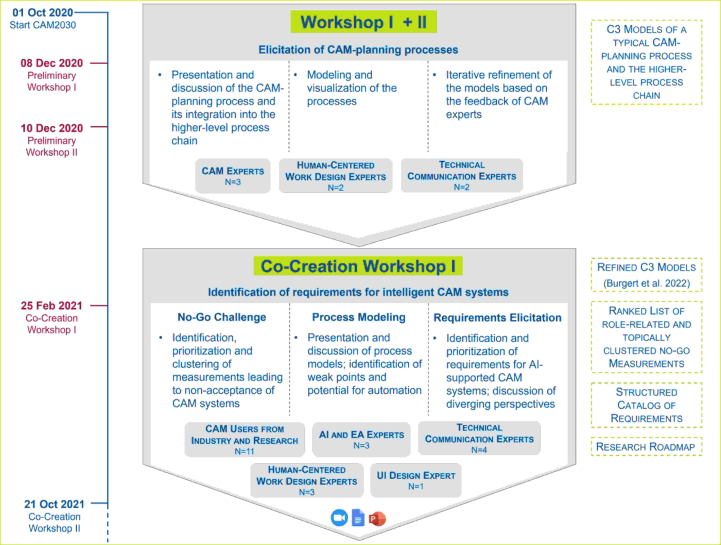
Innovation Stage I: Process Modeling and Requirements Elicitation Goal: The first stage consists of two preliminary workshops and a co-creation workshop. The preliminary workshops are supposed to deliver models of a typical CAM-planning process and its embedment into the higher-level pro- cess chain. The models are a prerequisite for the preparation and conduction of the co-creation workshop. The goal of the co-creation workshop is to create a shared understanding of the status quo of CAM-planning proces- ses and, based on this understanding, to identify automation potential and requirements for next-generation CAM systems (see Figure 2).
Methods: The preliminary workshops used process modeling methods based on the graphical notation C3 (cooperation, communication, and coordination; Killich et al. 1999; Nielen 2014). The co-creation work- shop adapted and combined co-creation methods with C3 process modeling (Rußkamp et al. 2022). The workshop started idea generation with a no-go challenge (an open task with a high degree of freedom). Role-specific groups competed (developers vs. users from industry vs. users working in research institutes vs. researchers) in thinking ‘outside the box’ (requirements elicita- tion reverse). They worked separately in breakout sessions while recording their results in a shared document. The group that generated the most ideas won the challenge. The challenge was linked to a ranking task; each group presented its top-three no-go design features in the plenum (time limit: 90 seconds). Workshop facilitators clustered the results in the workshop break as input for the requirements elicitation. The process modeling and the requi- rements elicitation were based on discussions in heterogeneous groups to facilitate the identification of divergences in role-related perspectives.
Method Evaluation: The most significant potential of integrating co- creation and process modeling methods lies in developing a consistent level of
Co-Creation-Based Framework for the Agile Development of AI-Supported CAM Systems 49
Figure 2: Co-creation workshop I and preliminary workshops (innovation stage i).
knowledge concerning the CAM-planning process. In addition, co-creation allows for a shared understanding of role-specific needs and requirements for AI-supported CAM systems. Limitations concern time constraints, missing live adaptability of process models, lack of icons, e.g., to mark automa- tion potential in the C3 notation, as well as ineffective methods and tools for consolidating results. These weaknesses led to restrictions in the visual representation of insights into the CAM-planning process and its optimiza- tion needs. Recommendations to enable synchronous collaboration and gain a holistic view of results are (i) expanding the workshop length, (i) extending the C3 notation, and (iii) using whiteboarding tools.
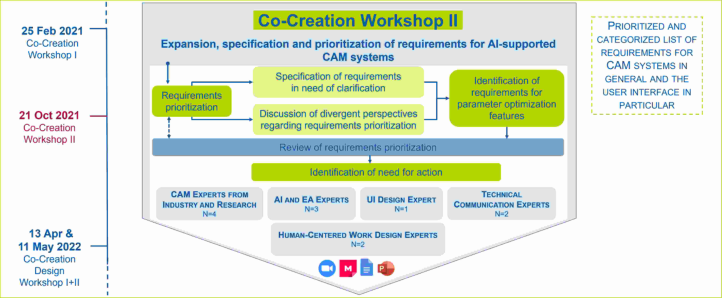
Innovation Stage II: Requirements Prioritization and Specification Goal: The second co-creation workshop builds upon the first. It aims to prioritize and specify the requirements identified in the first co-creation work- shop and to complete the requirements by focusing on the user interface (see Figure 3).
Methods: The prioritization of requirements was implemented as dot voting. The requirements identified in the first workshop were topically clu- stered and presented on an interactive whiteboard. Each participant was given nine colored points (three blue, green, and red points) to mark the requirements as follows: A blue point stands for “clarification of the requi- rement needed”, a green one for “one of the most important requirements” and red for “requirement cannot be realized in the project”. The participants
Figure 3: Co-creation workshop II (innovation stage ii).
were asked to label the points with their role, e.g., user, developer, or resea- rcher, to survey differences in priority setting depending on the participants’ perspectives. The prioritization served as preparation for the specification of requirements. All requirements marked with a blue point were discussed regarding the following aspects: What is the need for clarification? Can the open questions be resolved immediately? Yes: What is the solution? No: By whom, when, and how will the problem be addressed? Answers to those que- stions were documented in a shared text file. At the end of the workshop, the requirements prioritization was reviewed and adjusted.
Method Evaluation: The dot voting helped get a quantifiable and role- specific ranking of requirements in identifying open issues within a short time. The blue mark of the requirements needing clarification eased the entry in the requirements specification. The extensive documentation facilitated the identification of unsolved problems and the planning of the next steps. One limitation of the workshop was the superiority of the developer’s per- spective. Consequently, the discussion partly strayed from the subject matter and drifted into technical implementation details.
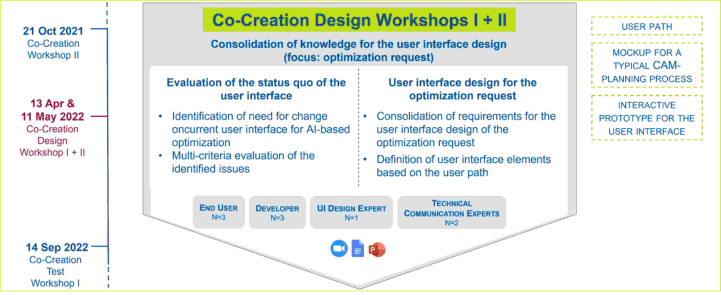
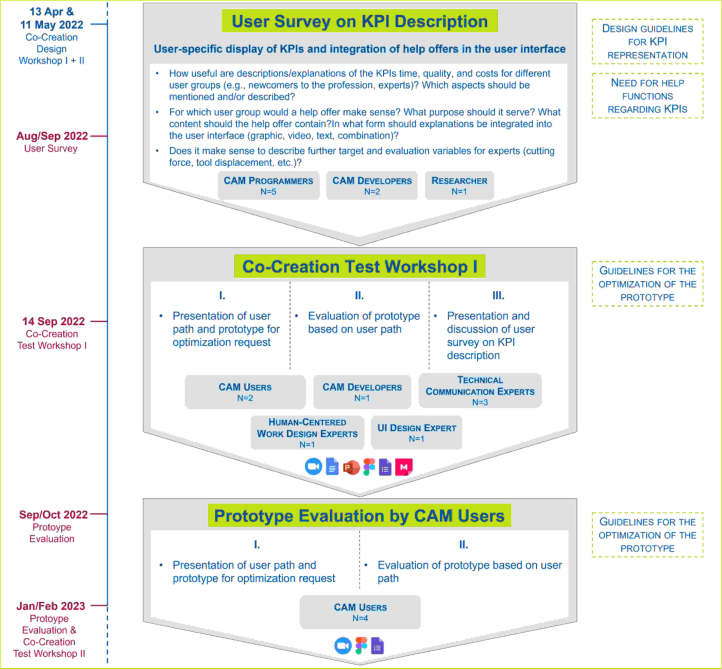
Innovation Stage III: Prototype Development Goal: The co-creation design workshops mark the cross-over from the conce- ptual and requirements-centered phase to the implementation phase and, thus, from front-end to back-end co-creation. They serve the consolidation of knowledge about the status quo of the CAM parameterization, the need for action regarding its AI-supported optimization, and their effect on the user interface. Figure 4 summarizes the workshops’ key aspects.
Methods: The co-creation design workshop was split into two sessions that took place a month apart from each other. The first session aimed to specify roles, tasks, and schedules for the user interface design. The warm-up task was to define three hashtags within three minutes that expressed the partici- pants’ expectations and goals for the workshop. Each participant presented the hashtags within 50 seconds. Between the sessions, the workshop partici- pants’ task was to identify the need for changes in the CAM parameterization
Co-Creation-Based Framework for the Agile Development of AI-Supported CAM Systems 51
Figure 4: Co-creation design workshops I and II (innovation stage iii).
and to make a multi-criteria evaluation for each envisioned change regarding the cognitive relearning requirements of the user, the error-proneness, and the technical feasibility. Furthermore, they designed a typical user path for the AI-supported CAM parameterization. In the second session, the meanw- hile worked out results were presented, discussed, and refined, as well as the further need for action derived.
Method Evaluation: Distinguishing feature of the co-creation design work- shop was its bipartite conduction. The first session helped to clarify the allocation of roles and tasks and to create a shared vision of the next steps. The time between the two sessions enabled the participants to work on diffe- rent tasks (according to the pre-negotiated responsibilities) individually (e.g., free choice of time and tools). In addition, developing results in advance saved time for the second session. The time allotment benefitted the discussion and perspective alignment. The hashtags defined in the warm-up supported the division; they facilitated the further discussion of responsibilities for the user interface design and served as a topic reminder at the beginning and as a benchmark for the performance evaluation at the end of the second session. Limitations resulted from the fact that the workshop participants attached little importance to some tasks and did not deal with them independently. This applies especially to the multi-criteria evaluation.
Innovation Stage IV: Prototype Testing Goal: The prototype testing aims at eliciting feedback, particularly from CAM users, on the user interface prototype for the CAM parameter opti- mization request. In addition to weaknesses of the prototype and suggestions for its improvement, the demand for integrated help functions and training requirements are identified. The prototype testing comprises a pre-survey, a co-creation test workshop, and subsequent prototype testing among industry- related CAM users (see Figure 5). Prerequisites for this innovation stage are the user path and interactive prototype developed in stage iii.
Methods: The pre-survey was conducted in the form of a questionnaire. The questionnaire combines single-choice, multiple-choice, and free-text que- stions regarding requirements for the representation of key performance indicators (KPIs). The co-creation-test workshop started with a presentation of the user path and the prototype. It comprised single-work tasks (explora- tive testing and evaluation of the prototype) and group work (discussions of pre-survey results and the prototype). For the prototype evaluation, Google Forms was used. The evaluation form combined single-choice and free-text questions on, i.a., the overall impression of the prototype, selected interface snippets for a typical CAM-planning scenario, and training needs. In the subsequent prototype testing, the video recording of the presentations, the prototype evaluation form, and a task description for testing the prototype were made accessible for CAM users who could not attend the workshop. The prototype refinement and testing require multiple iterations. In the second iteration, the workshop and the prototype testing were conducted in reverse order (but the prototype presentation was pre-produced); the pre-survey has been omitted.
Method Evaluation: The workshop participants appreciated the combina- tion of single-work tasks and group work. The single-work tasks allowed
Co-Creation-Based Framework for the Agile Development of AI-Supported CAM Systems 53
the participants to familiarize themselves with the prototype at their own pace and evaluate the prototype anonymously. During the group discussion, conversely, critical challenges of prototype development could be identified and discussed from different perspectives. This two-stage evaluation gave extensive insights into core issues and optimization potential for further pro- totype design. A limiting factor was the CAM users’ little willingness to participate in the workshop. User feedback could be obtained with the help of the follow-up survey; however, repeated reminding was necessary to get users to evaluate the prototype. Reversing the order of individual prototype evalua- tion and interdisciplinary discussion as applied in the second testing iteration could not increase the number of participants. The results confirm assumpti- ons in the literature (e.g., Nielsen 1994) that feedback from five users suffices to get substantial hints for further software development. More important than the number is that giving feedback iteratively accompanies the software development.
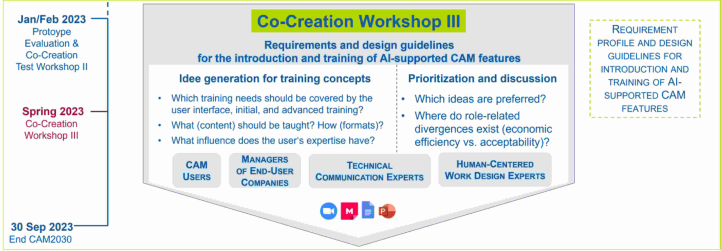
Innovation Stage V: Introduction and Training Requirement Profile Goal: Stage v focuses on the introduction of AI-supported CAM systems. It builds upon requirements for training and system-immanent user aids identified in earlier innovation stages. The co-creation workshop aims to elicit requirements for introduction and training and to merge them into a requirement profile (see Figure 6). The profile is a primary prerequisite for the later development of training and introduction material. For this purpose, the profile must support the adaption by companies for different contexts (branches, work organization, company size) as well as for the requirements of different target groups and work tasks.
Methods: The co-creation workshop starts with an idea generation task (see innovation stage i). Role-specific groups (end-users vs. mana- gers of end-user companies) in generating ideas for the design of CAM training concepts. In the plenum, the requirements are evaluated using dot voting (see innovation stage ii) and discussed regarding divergences in perspectives.
Figure 6: Co-creation workshop III (innovation stage v).
CONCLUSION AND OUTLOOK A key challenge in developing AI-based CAM systems in the manufacturing industry is understanding the dynamics of the innovation process, the reth- inking of CAM planning processes required by the integration of AI, and the effects on the user.
The proposed framework opens up a new view of the innovation pro- cess for AI-based systems. It helps to: (i) understand and reflect the user’s needs and preferences, (ii) align different and partly controversial perspecti- ves, and (iii) identify and overcome sticking points of the system development. Overall, the innovation and development process benefits from the active involvement of end users (CAM planners and companies), the continuity of interdisciplinary exchange, and iterative testing.
Future research should consider the reconciliation of innovation processes with day-to-day business in manufacturing companies and the framework’s transferability to other application contexts.
LIMITATIONS Limitations arise from the restricted application scope of the framework within the R&D project CAM2030; only one component of the CAM- planning process (the CAM parameterization) is automated deliberately. The automatization of the whole process might arouse additional topics and pro- blems that require other or additional methods. The online research process accompanying the system development requires that all stakeholders deliver just in time (often not feasible in practice). The studies have been conducted with well-educated CAM planners working in German SMEs. Transferring the approach to other cultures might require adaptation for CAM planners with less professional skills.
ACKNOWLEDGMENT
This research and development project is funded by the German Federal Ministry of Education and Research (BMBF) within the “Innovations for Tomorrow’s Production, Services, and Work” Program (funding number: 02J19B081) and implemented by the Project Management Agency Karlsruhe (PTKA). The authors are responsible for the content of this publication.
REFERENCES
Belani, H., Vukovi´c, M. and Car, Ž. (2019). Requirements Engineering Challenges in Building AI-Based Complex Systems. In: 2019 IEEE 27th International Require- ments Engineering Conference Workshops (REW) 23–27 September, Jeju Island, South Korea, pp. 252–255. Available from: https://doi.org/10.1109/REW.2019. 00051 [accessed 5 October 2022]. Burgert, F. L., Schirmer, M., Harlacher, M. and Mütze-Niewöhner, S. (2022). Partici-
pative elicitation and modeling of a CAM planning process for the manufacturing of complex components using the K3 notation. Aachen: Institute of Industrial Engineering and Ergonomics, RWTH Aachen University. Available from: https: //doi.org/10.18154/RWTH-2022-01188 [accessed 31 January 2023].
Co-Creation-Based Framework for the Agile Development of AI-Supported CAM Systems 55
Csiszar, A., Hein, P., Wächter, M., Verl, A. and Bullinger, A. C. (2020). Towards a user-centered development process of machine learning applications for manufacturing domain experts. In: 2020 Third International Conference on Artificial Intelligence for Industries (AI4I) 21–23 September, Irvine, CA, USA [online], pp. 36–39. Available from: https://doi.org/10.1109/AI4I49448.2020. 00015 [accessed 14 December 2022]. Dalpiaz, F. and Niu, N. (2020). Requirements engineering in the days of artificial
intelligence. IEEE software, 37(4), pp. 7–10. Available from: https://doi.org/10. 1109/MS.2020.2986047 [accessed 27 December 2022]. Hartikainen, M., Väänänen, K., Lehtiö, A., Ala-Luopa, S. and Olsson, T. (2022).
Human-Centered AI Design in Reality: A Study of Developer Companies’ Practi- ces. In: Nordic Human-Computer Interaction Conference (NordiCHI ‘22) 10-12 October, Aarhus, Denmark. NY, NY, USA: Association for Computing Machinery, pp. 1–11. Available from: https://doi.org/10.1145/3546155.3546677 [accessed 9 December 2022]. Killich, S., Luczak, H., Schlick, C., Weissenbach, M., Wiedenmaier, S. and Ziegler, J. (1999). Task modelling for cooperative work. Behaviour & Information Technology, 18(5), pp. 325–338. Margetis, G., Ntoa, S., Antona, M., Stephanidis, C. (2021). Human-centered
design of artificial intelligence. In: Salvendy, G. and Karwowski, W. (eds) Hand- book of Human Factors and Ergonomics. Hoboken, New Jersey, USA: Wiley, pp. 1085–1106. Available from: https://doi.org/10.1002/9781119636113.ch42 [accessed 9 December 2022]. Martínez-Fernández, S., Bogner, J., Franch, X., Oriol, M., Siebert, J., Trendowicz, A., Vollmer, A. M. and Wagner, S. (2022). Software Engineering for AI-Based Systems: A Survey. ACM Transactions on Software Engineering Methodology [online], 31(2), pp. 1–59. Available from: https://doi.org/10.1145/3487043 [accessed 4 October 2022]. Nielen, A. (2014). Systematik für die leistungs- und zuverlässigkeitsorientierte
Modellierung von Arbeitsprozessen mit kontrollflussorientierten Notationssyste- men. Aachen: Shaker. Nielsen, J. (1994). Estimating the number of subjects needed for a thinking aloud test. International journal of human-computer studies, 41(3), pp. 385–397. Oliveira, M., Bettoni, A., Coscia, E., Torvatn, H. (2019). Applying Co-creation Pri-
nciples to Requirement Elicitation in Manufacturing. In: Stephanidis, C. (eds) HCI International 2019 – Late Breaking Papers. HCII 2019. LNCS, vol 11786. Cham: Springer, pp. 54–61. Available from: https://doi.org/10.1007/978-3-030-30033- 3_5 [accessed 20 October 2022]. Piller, F. T., Ihl, C. and Vossen, A. (2010). A typology of customer co-creation in the innovation process. SSRN Electronic Journal, 4. Rußkamp, N., Digmayer, C., Jakobs, E., Burgert, F., Schirmer, M., Niewöhner, S.
(2022). New ways to design next-generation CAM systems. An integrated appro- ach of co-creation and process modeling. In: Waldemar Karwowski and Stefan Trzcielinski (eds) Human Aspects of Advanced Manufacturing. AHFE (2022) International Conference. AHFE Open Access, vol 66. USA: AHFE Internatio- nal. Available from: https://doi.org/10.54941/ahfe1002682 [accessed 31 January 2022]. Tandi, M. and Jakobs, E.-M. (2019). Two Heads are Better than One: Co-Creation as a Resource for User Interface Design of CAx Systems. In: 2019 IEEE Interna- tional Professional Communication Conference (ProComm) 23–26 July, Aachen, Germany, pp. 71–78.
Villamizar, H., Escovedo, T. and Kalinowski, M. (2021). Requirements Engineering for Machine Learning: A Systematic Mapping Study. In: 47th Euromicro Confere- nce on Software Engineering and Advanced Applications (SEAA) 1-3 September, Palermo, Italy, pp. 29–36. Available from: https://doi.org./10.1109/SEAA53835. 2021.00013 [accessed 4 October 2022].
LISTED IN THE AHFE DIGITAL BOOKSTORE CATALOGUE
Explore the complete digital volume
Human Aspects of Advanced Manufacturing
Read this individual research paper free through the original publisher, or explore the full digital proceedings book.
ISBN 978-1-958651-56-8
Explore this ISBN in the AHFE Bookstore ↗Listed in the July 2026 bookstore catalogue; search by ISBN to confirm current availability · Digital book purchase optional