Lorena Niebuhr, Eva-Maria Jakobs (2023). Perspectives of Commuters on Electric Vehicles, Charging Infrastructure, and Communication Measures. In: Human Factors in Transportation. AHFE Open Access, vol. 95, pp. 47–59. https://doi.org/10.54941/ahfe1003791
The German government's climate protection targets from 2021 require changes in the transport sector. By 2030, the transport sector must reduce its emissions from 164 to 95 million metric tons of CO2 [1]. One of the measures to save CO2 emissions is to replace vehicles with combustion engines with those powered by electricity from renewable energy sources.In Germany, the diffusion of battery electric vehicles (BEVs) has increased from 4500 in 2012 to 840,645 in 2022 [2]. However, the widespread use must further be promoted. Commuters are a major BEV user group. They account for about one fifth of German passenger traffic [3]. Although they represent an important group, only few studies address their perception of electric vehicles and charging infrastructure [4]. This paper presents an interview study addressing commuters and their perspective on BEVs, charging infrastructure. Commuters were asked about their views on BEV use, including the reasons that led them to use BEVs, their expectations of BEVs, charging infrastructure and charging management, as well as the need for communication measures and change to motivate more commuters to switch to BEVs. The study was conducted in 2022. The interview guideline consists of 33 questions. It focuses on usage motives and barriers, requirements concerning BEV design, charging costs, and expectations for the expansion of charging infrastructure. Participants were given a questionnaire on demographic data, their occupation and commuting behavior (means of transport, distance to workplace, type of roads used). The interviewees are commuters who already own an electric vehicle (n=20) or plan to purchase a BEV (n=11). Seven are female, 24 are male. The average age is 42 with a span of 24 to 64 years. Data were recorded as audio files, transcribed, and analyzed qualitatively as well as quantitatively using content analysis methods.Results show that commuters prefer charging at home. Workplace charging is the second most important option. Yet, they see the need for an area-wide expansion of the charging infrastructure in the public space and the increase of DC charging options. Here, they are calling for more and better accessible public charging stations. To ensure that they use the service, charging fees must become more transparent - billing must be simple and clear. Digital support needs to be updated and standardized. Commuters perceive the provision of information on BEVs and charging infrastructure as sufficient, yet reporting should be more transparent and neutral. This involves the planned expansion of the charging infrastructure, sufficiency of power supply, and technical aspects of BEVs such as their real world range.The broad implementation of electromobility requires concepts that take the needs of the target group into account (similar to [5]). In further studies, employers should be interviewed about BEVs regarding the obstacles of setting up charging infrastructure. This way, appropriate measures can be taken to increase the willingness to offer and use workplace charging. Transparent and complete communication between all stakeholders must be ensured throughout the transformation process to promote the diffusion of this innovation.[1] Bundesregierung (2021). https://www.bundesregierung.de/breg-de/themen/klimaschutz/climate-change-act-2021-1936846[2] Statista (2022). https://de.statista.com/statistik/daten/studie/265995/umfrage/anzahl-der-elektroautos-in-deutschland/[3] Agora (2022). https://www.agora-verkehrswende.de/veroeffentlichungen/pendlerverkehr-in-deutschland/[4] Wolbertus, R., Jansen, S., Kroesen, M. (2020). Stakeholders’ perspectives on future electric vehicle charging infrastructure developments. Future. Vol 123. https://doi.org/10.1016/j.futures.2020.102610[5] Niebuhr, L., Jakobs, E.-M. (2020). Stakeholder Profiles of Commercial Electric Vehicle Users. Similarities and Differences between Taxi Companies and Care Services. Spatial Research and Planning, Vol. 78, 5. https://doi.org/10.2478/rara-2020-0030
With its energy transformation, Germany is pursuing the ambitious goal of contributing to achieving climate goals. Part of the energy transition is the transport transition, i.e., the conversion of the transport sector from fossil fuels to electricity from renewable energy sources. By replacing vehicles with internal combustion engines with vehicles powered by electricity from rene- wable energy sources, CO2 emissions will be reduced. Electric mobility, in combination with electricity from renewable energy sources, is considered a key technology. Given the high levels of air pollution and CO2 emissions caused by transportation, there is a strong need for rethinking. However, the willingness to switch to battery electric vehicles (hereafter BEVs) has been too low. All stakeholders need to support the socio-technological transfor- mation process intended by the transport transition (Renn, 2015). So far, this has only been the case to a limited extent. The German government plans to provide one million charging points for ten million registered electric vehicles by 2030. One promising area of application is commuting.
This paper presents an interview study investigating commuters’ perspecti- ves on BEVs and charging infrastructure. Commuters were questioned about their views on BEV use, including the reasons that led them to use BEVs, their expectations of BEV design, charging infrastructure and management, and the need for communication to motivate more commuters to switch to BEVs.
This study is part of the joint project “ALigN - Expansion of charging infra- structure by targeted grid support”. The aim of the project is the expansion of the charging infrastructure in the German city of Aachen. The expansion targets companies willing to offer charging to employees and customers or that want to transform their commercial fleet to BEVs. The development of solutions that consider the diversity of the resulting target groups – in this case, commuters – requires a good understanding of their needs in terms of BEV design, charging infrastructure, and charging management at the place of work as well as communication measures to support the transformation process and broad adoption of the technology.
STATE OF THE ART In Germany, many employees commute every day or several days a week. In 2019 more than 19 million commuters were counted. Approximately 60 percent of all people in Germany who are subject to social insurance contri- butions are commuters (Agentur für Arbeit, 2021). The most common means of transportation to get to work is by car (68 %), followed by public transport (13.7 %), cycling (10.5 %), and walking (6.7 %) (Statistisches Bundesamt, 2022). They account for about one-fifth of German passenger traffic (Agora, 2022). Commuters are a potentially major BEV user group. Although they represent an important group, there have been few studies examining when and under what conditions commuters would be willing to switch to BEVs (Wolbertus et al., 2022).
In a field test, Ensslen et al. (2018) investigate the user acceptance of electric vehicles used by commuters. They find a clear correlation between
Perspectives of Commuters 49
environmental attitudes and the acceptance of electric vehicles. A particular need for research is seen in contexts where people use electric cars more regu- larly than in the form of a company or fleet vehicle, e.g., for daily commuting. Identified barriers to adoption refer to a limited range and lack of charging infrastructure. Based on a field test, the authors concluded that range and charging infrastructure-related problems are viewed more critically in pri- vate electric car use than in organized carpools. After initial inconveniences, e.g., during the charging process, the participants gained increasing routine and confidence in the technology during the project.
Charging options can be classified into public charging (e.g., at parking lots), private charging (e.g., at the place of residence or the workplace), and semipublic charging (e.g., at the supermarket). Home charging is the most attractive for most users, and public charging with normal charging power is the least attractive (Anderson, 2016). Charging at home and charging at work are the most popular and most frequently used charging options (Linne- mann and Nagel, 2020). Charging at work is an affordable, accessible, and convenient option. At the workplace, the employees’ vehicles are typically parked for at least 8 hours during a workday. Powell et al. (2022) even urged policymakers to promote daytime charging options, such as workplace char- ging, to relieve and stabilize the grid as BEVs become widespread. A study by NPM (2021) found that although the company parking lot is the second most important charging location, many owners never or rarely charge at their employer (almost 65 % of BEV drivers) because the employer does not provide charging facilities. This may strongly influence the intention to use a BEV for potential BEV users (Adenaw and Krapf, 2022).
The observation of workplace charging, the derivation of a potential need for charging management, and the development of a charging etiquette were examined by El Banhawy and Price (2015). They studied the users’ beha- vior by measuring charging actions and interviewed users in an early study about the use of workplace chargers at a British university. Given varying charging preferences, their results show that a user-centered approach is nee- ded. A design guide for an integrated workplace charging system is needed, and a participatory workshop for BEV users (employees) and providers is suggested to enable engagement and community action. Employers may also need to establish creative workplace charging etiquette guidelines (charging management).
Tal et al. (2020) also conclude that workplace charging is necessary. How- ever, while employees welcome the increased availability of charging options through the concept of parking lot swapping, the associated time limit on charging duration hinders the likelihood of charging at work.
METHODOLOGY
The exploratory study combines two methods: Questionnaire and a gui- ded in-depth interview. The qualitative study aims to obtain information on decision motives, behaviors, requirements, preferences, and perceptions of opportunities and risks (Krips, 2017). The questionnaire collects demo- graphic data, information on occupation, commuting behavior (mode of
50 Niebuhr and Jakobs
transport, distance to work, type of roads used), and BEV use (motives and barriers to use, requirements for BEV design, charging costs, and expectations for the expansion of charging infrastructure). The interview guide includes six topics (33 questions): (1) attitudes toward BEVs, (2) requirements for BEV design, (3) requirements for the expansion of charging infrastructure and locations, (4) charging infrastructure and charging management on company premises, (5) future use of BEVs in the company, and (6) information needs for switching to BEVs.
Participants were selected based on two criteria: (i) they are commuters and own a BEV, or (ii) they are commuters and plan to purchase a BEV. The interviews were conducted in late 2021 and early 2022 using the Zoom web conferencing system. The sample includes 31 commuters. Almost two-thirds own an electric vehicle (n = 20); one-third plan to buy one (n = 11). Seven participants are female, and 24 are male. Their age varies between 24 and 64 years (average age: 42 years). The interviews were recorded (average length of 38 min), transcribed, and anonymized. Data were analyzed qualitatively (content analysis). The deductively and inductively formed category system consists of 6 super categories and 225 sub-subcategories. In the following, the results are illustrated by typical user comments.
RESULTS
To better understand commuters and their perspectives on BEV use, they are characterized in terms of housing, road use, and charging patterns. In addition, motivations for BEV purchase, design preferences, charging infrastructure design preferences, and workplace charging management pre- ferences are presented. Information needs were also derived and outlined in the final section.
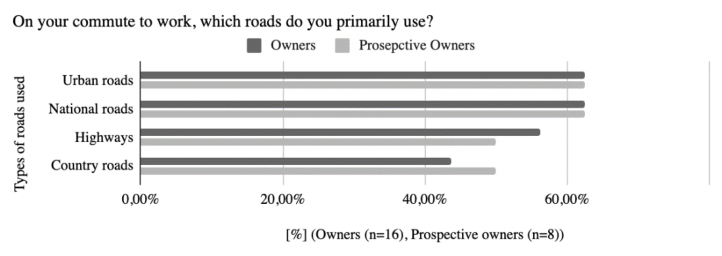
Driver Profile Participants were asked how they lived, the length of their commute, what roads they used to get to work, how interested they were in e-mobility, and how they rated their knowledge about e-mobility. They were also asked about their preferred charging options and charging at work. Overall, the median distance traveled to work is 21 km. The most frequently used roads to get to work are urban and national roads, while country roads are used less frequ- ently (see Figure 1). The road use behavior of the surveyed groups (owners, prospective owners) is about the same.
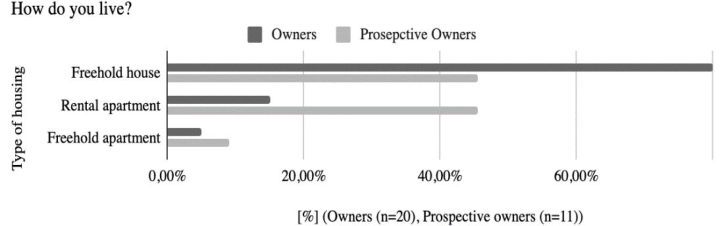
The groups differ significantly in where they live. For example, 80% of BEV owners report living in a home they own. This contrasts with prospective owners, who are more likely to live in a rented property (see Figure 2).
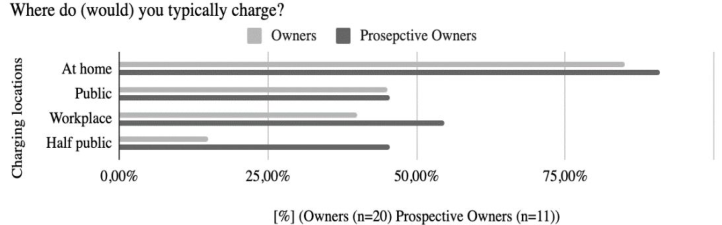
BEV owners and prospective BEV owners were asked which charging loca- tion they prefer to use or would prefer to use if they were to own a BEV. The preferred charging location for both groups is at home, which aligns with Anderson et al. (2016) and NPM (2021) findings. The option to charge at the workplace is wanted by over 50 percent of the prospective owners. How- ever, only 40 percent of the BEV owners surveyed charge their BEV at their
Perspectives of Commuters 51
Figure 1: On your commute to work, which roads do you primarily use? Owners (n = 16) and potential owners (n = 8); (multiple answers possible).Figure 2: How do you live? Owners (n = 20) and potential owners (n = 11).Figure 3: Where do/would you typically charge? Owners (n = 20) and potential owners (n = 11); (multiple answers possible).
place of work. The least favored charging option is charging at the half public charging infrastructure (see Figure 3).
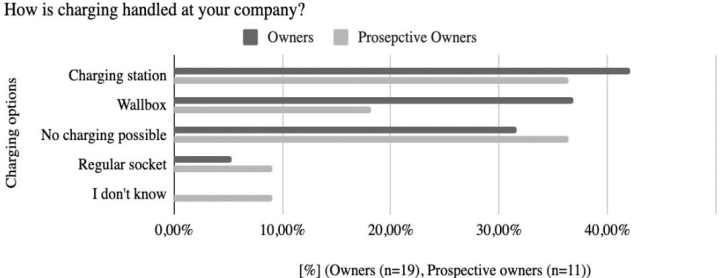
When asked about charging options at work, most respondents said that charging at work is impossible because their employer does not support it. This is similar to the findings of NPM (2021), which also report the need for, but lack of, workplace charging infrastructure. Employers that provide charging options do so in the form of charging stations or wall boxes (see Figure 4).
52 Niebuhr and Jakobs
Figure 4: How is charging handled at your company? Owners (n = 19) and potential owners (n = 11); (multiple answers possible).
As part of the survey, participants were also asked about their interest in e-mobility. Overall, the participants describe themselves as interested in e-mobility. The BEV owners rate themselves as more interested in e-mobility than those who do not own a BEV yet. Interviewees rated their knowledge as high when asked to rate their knowledge. Most (45 %) owners rate their knowledge as very high (n = 9). Most prospective owners (45 %) rate their knowledge as average.
Acquisition Motives The interviewees were asked why they had purchased or planned to purchase a BEV. A second question asked owners how satisfied they were with their purchase decision. All owners confirmed that the purchase decision was a good one. They are (very) satisfied with their vehicle.
The purchase criteria vary. The most frequently cited motive is to con- tribute to environmental protection. Consistent with previous studies, BEVs are considered environmentally friendly, but battery production is still cri- tical (NPM, 2021). In addition, respondents want to increase their use of renewable energy, reduce CO2 emissions, and reduce nitrogen oxide emissions.
“For us, the main focus is that it is an environmentally friendly tech- nology, and we would like to set up our living situation so that we can charge the car almost completely with solar power.” Owner_f61 Another motive is to use the energy produced at home with a photovoltaic (PV) system to charge the electric vehicle. Some interviewees already own PV systems. They acquired a BEV to make better use of their electricity. Another motivator is the lower cost over the EV’s lifetime of use, the so-called total cost of ownership (TCO), compared to conventional vehicles.
The third most frequently mentioned reason is a high level of financial sup- port. Currently, not only is the purchase price of BEVs subsidized in Germany, but BEV drivers are also exempt from vehicle tax for ten years (NPM, 2021). Finally, another purchase criterion that respondents rated as very important
Perspectives of Commuters 53
is the availability of charging infrastructure at home or work. In particular, free charging at the workplace is seen as a strong motivator.
“So, the diesel cannot keep up with the BEV; that is how it is. No, because I cannot fill up the diesel at my company for free.” Owner_m36 Another frequently mentioned purchase motive relates to the perceived high level of driving comfort. Here, the BEVs’ quietness due to the absence of engine noises was mentioned first and foremost, and the BEV’s preheating through parking heaters available as standard was mentioned second. The fun of driving a BEV, particularly justified by the high acceleration, is also a frequently mentioned purchase motivator.
“Driving fun, I would say now in retrospect, yes, but before I definitely did not know that, how much fun it just is [...] so after we test drove it once, we said: ‘Yes, we want that, because that is really a great thing’.” Owner_f61 A large proportion of owners mentioned that they lease their BEVs. This is justified by the aging of the battery, the rapid technological development, and the need to get used to different processes in everyday life. There needs to be more confidence and experience with the technology.
“However, I did have some reservations. I did not buy it; I leased it. Therefore, if I am unhappy with it or the technology advances faster, I can trade it in after four years. I have a four-year lease.” Owner_m58 BEVs are perceived as an environmentally and, in particular climate- friendly transportation option. Subsidies and the option to charge at home or work strongly influence purchase intentions, possibly even more so than the availability of public charging infrastructure.
“So, the diesel can’t keep up with the BEV, that’s how it is. No, because I can’t fill up the diesel at my company for free.” Owner_m36 Another frequently mentioned purchase motive relates to the perceived high level of driving comfort. Here, the BEVs’ quietness due to the absence of engine noises was mentioned first and foremost, and the BEV’s preheating through parking heaters available as standard was mentioned second. The fun of driving a BEV, which is particularly justified by the high acceleration, is also a frequently mentioned purchase motivator.
A large proportion of owners mentioned that they lease their BEVs. This is justified by the aging of the battery, the rapid technological development, and the need to get used to different processes in everyday life. There is a lack of confidence and experience with the technology.
“However, I did have some reservations. I did not buy it, I leased it. Precisely for that reason, if I’m not happy with it or the technology adva- nces faster, I can trade it in after four years. I have a four-year lease.” Owner_m58 BEVs are perceived as an environmentally and climate-friendly transpor- tation option. Subsidies and the option to charge at home or work appear to
54 Niebuhr and Jakobs
have a strong influence on purchase intentions, possibly even more so than the availability of public charging infrastructure.
BEV Design During the interviews, the participants were asked to describe what they would consider the perfect BEV. Many participants have stated that BEVs have continued to evolve positively regarding technical aspects and availa- ble models in recent years. However, the most crucial point for improve- ment is the range, charging time, and costs. Most participants want to see longer-ranged BEVs and increased battery capacity.
“Yes, then I would say the range again and again. That would have to be higher to plan more relaxed.” Owner_m58 Another area for improvement in future BEVs is reducing charging time, which is another top priority for the participants.
“Charging from zero to 80 percent should take no more than ten minutes.” Owner_m53 In addition to charging speed, the condition and longevity of the batteries are also considered. Batteries should be able to be used for extended periods without loss of performance. They should also be lighter and less sensitive to low temperatures. Some respondents also suggest that electric vehicles, overall, should cost less. Notably, the desire for lower prices is expressed mainly by respondents who do not yet own a BEV. They emphasize that sub- sidies must be in place as long as the purchase price is high. At the same time, all car manufacturers are urged to reduce the price of BEVs, including long-range BEVs, so that more people can buy electric vehicles. These require- ments are consistent with the findings of the NPM (2021) study. Even though many respondents see positive developments in terms of technical aspects and model availability, they would still like to have a wider choice of brands and models.
“There should be more choices of models. There is a relatively good choice at the moment, but still not as much as with combustion engines.” Owner_m53 Charging Infrastructure and Charging Management
The results show that home and the workplace are the preferred charging locations. This is due to the perceived benefits of convenience and cost savings. At home, charging is perceived as the most convenient due to the physical proximity of the charging option. At work, charging is perceived as efficient. All respondents who charge at work can do so for free. They report that this has a particularly positive effect but sense that the billing will change.
“I tried to find somebody responsible for it, how to charge, or if you could just come and charge. There was just the statement: ‘Yeah, I do not know, I do not know right now, just do it, just charge.’ And I plugged
Perspectives of Commuters 55
it in. I charged, free. I have only done it once now, once, twice. I do not know.” Prospective owner_w29 The acceptance of using semipublic (e.g., at the supermarket) and public charging infrastructure is lower than for home and workplace charging due to higher costs and a need for uniformity in the charging process and billing. However, interviewees consider their charging situation (mostly home char- ging) sufficient. Interviewees are, therefore, ambivalent about the need for a significant expansion of the general infrastructure, and no clear opinion can be derived. This is consistent with the observations of NPM (2021) that, at the moment, the individual charging needs of the majority are being met, but the public charging infrastructure is insufficient.
“So, right now, it is like this: The charging infrastructure is sufficient for the electric cars we have now, but the curves are taking a different course. Electromobility and sales of electric cars are increasing rapidly, and the charging infrastructure is also increasing, but it cannot keep up with this pace [...].” Owner_m53 More charging infrastructure is needed to meet the demand for charging in the case of a significant increase in future BEV numbers. The interviewees see it, especially as a way to enable people who do not have the option of home charging to use BEVs.
Charging Management at the Workplace Rather than having to move their car during the working day to allow access to other employees, respondents prefer to have a higher number of char- ging points. Nevertheless, there is a fundamental willingness to re-park, as interviewees are willing to share charging points. However, as the latter is not favored, this could lead to a higher probability of non-use. In addition, owners do not charge their vehicles daily, so not everyone would likely use the workplace charging infrastructure daily. Respondents expressed a desire for a certain level of charging management for workplace charging and demanded digital support. This can be an internal system, such as an intranet website or smartphone application. The digital support should include similar functions to available charging apps, such as charging point reservation, charging cost billing, and occupancy status display. Companies could set up charging point reservations so that, for example, vehicles can be charged in the morning and afternoon during specific time frames, and a change of parking can take place during the lunch break. In addition, a unified billing system should be included if charging cannot be offered for free. The payment should be pro- cessed through a stored account. Alternatively, credit card billing could be offered at the charging point. A cost overview could be provided where users can see the current price of electricity, and the charging costs per month or year could also be included. The digital support should show free and occu- pied charging points. At the same time, it could be used to report faults at individual charging points or to send out end-of-charge reminders.
In addition, companies should always communicate information about the company’s charging infrastructure promptly and involve users at an early
56 Niebuhr and Jakobs
stage. For example, a needs assessment for the charging infrastructure could be conducted in the company to ensure proper planning during installation.
Information Needs One interest of the study was understanding how information can support the transition to BEVs. Participants were asked how they received informa- tion on the subject (formats, channels), what information they needed when considering a purchase, and what they expected from the information. Most interviewees actively search for information (like Dudenhöffer, 2015). All respondents actively obtain information from digital sources such as online journals, forums, and social media (mainly YouTube).
“YouTube is my main source of information in the specific field of electric mobility [...].” Owner_m53 Print media is also a source of information about BEV, especially new- spapers and books. Automotive magazines and journals are mentioned in addition to general daily newspapers. Oral sources, such as friends and family, are perceived to be important in the formation of opinions.
While most respondents feel well informed about BEVs, they are not yet fully satisfied with the information they have received and how they have received it through the various channels. Most interviewees said they would like to access information more quickly. There has also been criticism of the lack of transparency, particularly about battery production and disposal. The interviewees believe that both the positive and the negative aspects should be addressed. They hope this will lead to a more positive view of BEVs. However, some participants have the impression that the way BEVs are portrayed in the traditional media is too negative and would like more neutral coverage.
“And I also think that some of the reporting is very colored, so you might get the impression: ‘No, guys, you should probably not go there because somehow it is not that good yet.”’ Owner_w61 The interviewees would also like bundled information on where they can charge and where new charging stations are planned. Charging infrastru- cture planning processes should be more participatory. One source should also exist where all information is presented in a bundled form. For this pur- pose, the interviewees suggested apps and information portals from cities, municipalities, or directly from the federal government.
“This can also be specifically promoted with the appropriate search terms so that the important, neutral information from the government can be found quickly and not slip to page two or three because of all the advertising and information but should be found on the first page of a search query because it is public and neutral.” Prospective owner_m52 Participants would like to see testimonials with realistic experiences and usage documentation, preferably in video format on social media such as YouTube. This shows the need for user group-specific information, which ali- gns with research findings on more specific groups (see Niebuhr and Jakobs,
Perspectives of Commuters 57
2020). In terms of desired sources, it should be ensured that interested per- sons have easy access to transparent information if they are actively seeking it, e.g., through government-run websites.
CONCLUSION
Commuters are a very interesting target group for transforming the mobility sector. Their top motivations for buying or switching to BEVs are envi- ronmental benefits, cost savings, and driving enjoyment. BEVs with longer ranges, better battery performance, and fast charging capabilities are crucial to accelerating the transition to electric mobility. Financial support for the purchase of vehicles and the installation of charging infrastructure should also be continued. The results show that the surveyed commuters were not generally dissatisfied with the current charging infrastructure. Nevertheless, there is still a need for a significant expansion of charging options across all areas. The study shows that the intention to use BEVs strongly depends on the availability of charging infrastructure at the residence. Reliance on (half-) public charging infrastructure is (still) perceived as a barrier to BEV use. The availability of workplace charging stations could help overcome this barrier, according to the results of this study. It allows people to charge during the workday, and residents can also use it after work hours. There is a need for charging management at the workplace along with digital support for its coordination.
The study indicates that BEV owners are well-informed concerning e-mobility. In all cases, the purchase of a BEV was based on a well-informed decision. On the other hand, there is a great need for information from those considering a purchase. The need for information is primarily focused on technical information, funding opportunities, and formats. Preferred formats are case studies from daily life (video - YouTube) and aggregated information on government-run websites.
Further studies should clarify how companies can be motivated to support the transition to e-mobility by providing convenient charging facilities at the workplace. In addition, further action is needed to equip apartment buildings with charging facilities for tenants. Overall, the transformation process will only succeed if all the players involved cooperate and enter dialogue with each other to clarify options for action that are acceptable from the point of view of both employees and employers. This requires new, innovative methods.
LIMITATIONS One limitation of this study arises from the time it was conducted. During the Covid-19 pandemic, many employees worked from home. As a result, their mobility patterns and especially commuting patterns changed. Thus, in some cases, answers related to the scenario where participants regularly commuted to work. Another limitation is the small size of the sample.
58 Niebuhr and Jakobs
ACKNOWLEDGEMENT
The project is funded by the German Federal Ministry of Economic Affairs and Climate Action (Project: ALigN. Subproject: Investigation of technical, economic, and communication concepts for the sustainable expansion of the charging infrastructure. 01MZ18006G). The responsibility for the content of this publication lies with the authors.
REFERENCES
Adenaw, Lennart. Krapf, Sebastian (2022). Placing BEV Charging Infrastructure: Influencing Factors, Metrics, and Their Influence on Observed Charger Utiliza- tion. World Electr. Vehicle Journal, Volume 13 No. 4. Agentur für Arbeit (2021). Pendleratlas. https://statistik.arbeitsagentur.de/DE/Navig
Lenz, Barbara. Steck, Felix (2016). LADEN2020: Concept to build up demand- oriented charging infrastructure in Germany from today until 2020. Berlin. https: //edocs.tib.eu/files/e01fb17/881663425.pdf. Bundesnetzagentur (2022). Elektromobilität. Öffentliche Ladeinfrastruktur. https://www.bundesnetzagentur.de/DE/Fachthemen/ElektrizitaetundGas/EMobili taet/start.html. Die Bundesregierung (2021). Climate Change Act 2021. https://www.bundesregier ung.de/breg-de/themen/klimaschutz/climate-change-act-2021-1936846. Dudenhöffer, Kathrin (2015). Akzeptanz von Elektroautos in Deutschland und
China. Eine Untersuchung von Nutzungsintentionen im Anfangsstadium der Innovationsdiffusion. Wiesbaden: Springer Fachmedien. El Banhawy, Eiman Y., Price, Blaine A. (2015). Understanding the Social Practice of EV Workplace Charging. Ensslen, Axel. Wohlfarth, Katharina. Jochem, Patrick. Schücking, Maximilian and
Fichtner, Wolf (2018). Nutzerakzeptanz von Elektrofahrzeugen: Berufspendlerfa- hrgemeinschaften als Anwendungsfall, Umweltpsychologie Volume 22 No. 1. Krips, David (2017). Stakeholdermanagement. Berlin, Heidelberg: SpringerViehweg. Linnemann, Marcel. Nagel, Christoph (2020). Elektromobilität und die Rolle der Energiewirtschaft. Wiesbaden: Springer Fachmedien. Niebuhr, Lorena. Jakobs, Eva-Maria (2020). Stakeholder Profiles of Commercial
Electric Vehicle Users. Similarities and Differences between Taxi Companies and Care Services, Spatial Research and Planning Volume 78 No. 5. NPM (Nationale Plattform Zukunft der Mobilität) (2021). Kundenakzeptanz als Schlussel fu¨r den Markthochlauf der Elektromobilität, Arbeitsgruppe 2, Bunde- sministerium fu¨r Verkehr und digitale Infrastruktur (BMVI) (Ed.). Powell, Siobhan. Vianna Cezar, Gustavo. Min, Liang. Azevedo, Inês M. L. and
Rajagopal, Ram (2022). Charging infrastructure access and operation to reduce the grid impacts of deep electric vehicle adoption, Nature Energy Volume 7 No. 3. Renn, Ortwin (2015). Akzeptanz und Energiewende. Bürgerbeteiligung als Voraussetzung für gelingende Transformationsprozesse. In: Jahrbuch für Christliche Sozialwissenschaften. Statista (2023). https://de.statista.com/statistik/daten/studie/265995/umfrage/anzahl
-der-elektroautos-in-deutschland/.
Perspectives of Commuters 59
Statistisches Bundesam (2022), Berufspendler. https://www.destatis.de/DE/Themen/ Arbeit/Arbeitsmarkt/Erwerbstaetigkeit/Tabellen/pendler1.html. Tal, Gil. Chakraborty, Debapriya. Jenn, Alan. Lee, Jae Hyun and Bunch, David
(2020). Factors Affecting Demand for Plug-in Charging Infrastructure. An Analy- sis of Plug-in Electric Vehicle Commuters. Davis: UC Office of the President. University of California Institute of Transportation Studies. Wolbertus, Rick. Jansen, Steven and Kroesen, Marten (2020). Stakeholders’ perspectives on future electric vehicle charging infrastructure developments, Future Vol 123 No. 4.
LISTED IN THE AHFE DIGITAL BOOKSTORE CATALOGUE
Explore the complete digital volume
Human Factors in Transportation
Read this individual research paper free through the original publisher, or explore the full digital proceedings book.
ISBN 978-1-958651-71-1
Explore this ISBN in the AHFE Bookstore ↗Listed in the July 2026 bookstore catalogue; search by ISBN to confirm current availability · Digital book purchase optional