Lei Zhong, Jiaxuan Xu (2026). Designing Intelligent Parenting Assistive Products for People with Hearing Impairments. In: Universal Design and Design for Inclusion. AHFE Open Access, vol. 209, pp. 26–39. https://doi.org/10.54941/ahfe1008016
Due to hearing loss and the particularity of parenting scenarios, the deaf community faces parenting difficulties in areas such as infant care, safety monitoring, parent-child communication, and early education. This study aims to enhance the sense of security, autonomy and quality of parent-child interaction among the hearing-impaired in parenting, and to provide better humanistic care and parenting assistance to hearing-impaired families. Using case analysis and literature review methods, this study systematically dissects the behavioral patterns, emotional demands, and environmental interaction characteristics of hearing-impaired parents during the parenting cycle from a user-centered perspective. The study constructs a design framework centered on visual, tactile, and intelligent feedback. The framework integrates multimodal information transformation technology, context-aware interaction mechanisms and accessibility design concepts. Guided by the framework for designing child-assisted products for hearing-impaired parents, this study developed an intelligent child-assisted product with cross-sensory perception of infant status, visual alerts for emergencies, and two-way communication between parents and children on a daily basis. This study not only provides efficient parenting support tools for hearing-impaired parents, but also opens up new theoretical and practical directions for the design of accessible products, which is of great significance for promoting the construction of an inclusive society and practicing the concept of technology for good.
China has a huge number of hearing-impaired people, with a total of 27.8 million. Hearing-Impaired Parents face unique communication and perception challenges in parenting, and traditional parenting products fail to meet their needs. Systematic design studies for parenting support for them are relatively scarce (Lu, 2025). Existing research has mostly focused on accessibility design for individuals with hearing impairments or emotional design for universal parenting products, with few explorations of a deep integration of the two (Shi, 2023). With the development of the Internet of Things and multi-sensory interaction technologies, it has become possible to compensate auditory information through channels such as vision and Received February 6, 2026; Revised April 1, 2026; Accepted April 20, 2026; Available online July 20, 2026
Designing Intelligent Parenting Assistive Products for People With Hearing Impairments 27 touch, which provides new opportunities for the design of intelligent assisted parenting products (Chen, 2024).
This study aims to explore how to empower hearing-impaired parents through product design, relieve their parenting stress, enhance their confidence and efficacy in parenting, and promote family harmony and the healthy development of children (Gao, 2024).
This study presents a framework for the design of child-assisted products for hearing-impaired parents and guides the design of intelligent assistive products. By expanding from the physical environment to dynamic, emotional services through accessibility design, it aims to bridge the sensory gap of auditory and verbal expression and effectively respond to the fundamental needs of specific user groups. By integrating multimodal perception with emotional interaction, the framework guides design to transform auditory information such as a baby’s crying and emotional state into visual or tactile cues, enabling hearing-impaired parents to immediately and accurately understand their baby’s needs, thereby enhancing the effectiveness and confidence of parenting engagement. Smart assistive products are not only functional tools, but also important nodes for promoting parent- child interaction in hearing-impaired families. This provides an empirical perspective on how technology empowers vulnerable groups and builds inclusive societies (Shi, Zhang, Hang et al., 2024).
Based on the findings presented above, a comprehensive design framework for child-assisted products targeting hearing-impaired parents is proposed through inductive reasoning and systematic synthesis. This framework encompasses visual, tactile, and intelligent design strategies—complemented by robust technical support—as well as secondary adaptive strategies to ensure broad coverage across diverse user contexts and real-world usage scenarios.
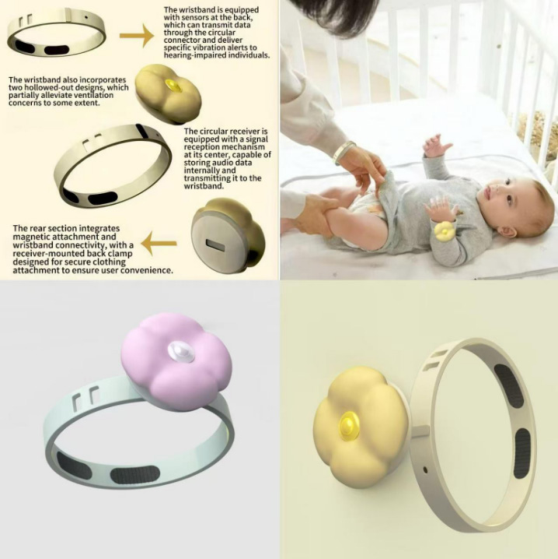
Leveraging this framework, an assistive product was developed comprising two core components: an infant-worn signal receiver and a parent-worn tactile bracelet. Grounded in the sensory profiles of individuals with hearing impairment and informed by multimodal perception theory, the system employs algorithmic signal processing to translate infant crying and movement patterns into distinct, perceptually discriminable vibration cues. Additionally, its integrated digital memory function enables longitudinal tracking and recording of developmental milestones, thereby compensating for auditory information loss while simultaneously facilitating precise caregiving and nurturing familial bonds.
METHOD AND RESULTS Research on the Parenting Needs of Hearing-Impaired Parents
This study employs a hybrid research methodology that integrates literature review, user research, and case analysis to establish a systematic research pathway—“theoretical exploration → user insight → design practice”—with the dual objectives of (1) developing design pathways for intelligent assistive parenting products tailored to hearing-impaired parents, and (2) conducting targeted design validation for specific product prototypes.
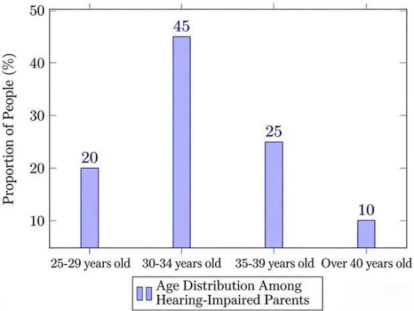
28 Zhong and Xu The study commenced with a comprehensive literature review to systematically synthesize three critical domains: (1) the parenting needs of individuals with hearing impairments; (2) prevailing design trends in existing parenting products; (3) the current state of assistive technology applications in parenting contexts. This synthesis provided both theoretical grounding and innovation-oriented foundations for subsequent design work. Key search terms, including “hearing-impaired group,” “barrier- free design,” and “intelligent parenting assistive products”, were used to retrieve relevant scholarly publications from academic databases such as Google Scholar, Web of Science, and CNKI. After initial screening based on titles and abstracts to exclude off-topic articles, 13 high-relevance publications underwent in-depth thematic analysis. Using content analysis, the study extracted key insights across three interrelated categories: (1) a multidimensional framework characterizing the parenting needs of hearing-impaired parents; (2) functional attributes and inherent design limitations of extant parenting products; and (3) practical applications and technological affordances of assistive technologies. By distilling need dimensions, product features, and theoretical developments from the literature, this phase established a robust conceptual foundation for the remainder of the study. Secondly, the research adopted an online ethnographic survey approach to systematically collect firsthand accounts—including parenting experience narratives, reflections, and descriptive posts—shared by hearing-impaired parents across social media platforms, dedicated deaf and hard-of-hearing communities, and specialized parenting forums. This qualitative data collection enabled deep exploration of the concrete challenges, emotional demands, and everyday difficulties encountered by hearing-impaired parents in their parenting practices.The group of Hearing-Impaired Parents is mainly concentrated in young adults aged 25 to 40, with 30 to 35 being the core age group. In terms of the degree of hearing loss, most parents have severe or very severe hearing loss, but are generally equipped with assistive devices such as hearing AIDS or cochlear implants. The occupational distribution is diverse, covering technical, service and freelance occupations, but there are certain limitations in overall income levels and access to social resources. Their parenting stage is mainly focused on infants and toddlers from 0 to 6 years old and preschool children, which is a critical period for children’s language and cognitive development, and precisely the stage when hearing- impaired parents face the most concentrated communication challenges.
The group relies heavily on visual and tactile modalities, with sign language, written language, and body language serving as the primary modes of communication within the family. Hearing aids are also critically important for this population; however, individuals often struggle to promptly detect their infant’s cues or changes in condition during caregiving. Consequently, many wear hearing aids for extended periods, a practice that can adversely affect their physical and mental well-being. Furthermore, insufficient rest resulting from these challenges compromises their occupational performance.
Figure 1 presents the age distribution of parents with hearing impairments. As shown, the 30–34-year-old age group constitutes the largest proportion, which aligns closely with their peak childbearing years and the life stage at which they typically become new parents.
Figure 1: Age distribution among hearing-impaired parents.
Hierarchy of Needs Using case analysis and content analysis, based on retrieved article content and the profiling of hearing-impaired parents, the triangulation method was employed to cross-validate findings and hierarchically synthesize parental needs. This process yielded a four-tiered needs framework specific to hearing- impaired parents in the context of parenting, thereby providing a clear, evidence-informed orientation for product design.
The first tier centers on ensuring the fundamental safety and accessibility of parenting activities, particularly through real-time, accurate detection and alerting of critical environmental sounds (e.g., infant crying, abnormal household noises), which constitutes the foundational prerequisite for establishing trust and confidence in caregiving. Building upon this foundation, the second tier addresses the enhancement of parenting efficiency and communication: products must support hearing-impaired parents in interpreting infants’ non-verbal cues, for instance, by decoding hunger- related signals embedded in the frequency, intensity, and duration of crying.
The third tier reflects salient emotional and belonging needs. Product design should actively foster parent–child emotional bonding: leveraging visual and tactile feedback mechanisms, hearing-impaired parents can more intuitively perceive their child’s physiological states and emotional fluctuations, thereby reinforcing their sense of engagement, competence, and fulfillment in caregiving.
Finally, the fourth and highest tier culminates in self-actualization, empowering hearing-impaired parents through assistive tools to overcome communication barriers, cultivate robust parenting self-efficacy, and realize personal value and meaningful social roles throughout the caregiving journey.
30 Zhong and Xu Grounded in this hierarchical needs framework, and informed by multimodal perception theory and emotional design theory, a comprehensive product design strategy is formulated. Table 1 summarizes the four-tiered needs hierarchy for hearing-impaired parents alongside the corresponding product design strategies.
Table 1: Hierarchical structure of hearing-impaired parents’ needs and corresponding product design strategies.
Table available in the original PDF paper.
Core Content Product Design Strategy
Hierarchy of Needs Safety and Accessibility Requirements Ensure a safe parenting environment and barrier-free access to essential parenting information.
High-reliability hazard alerts (e.g., infant crying, smoke detection) and visualization or haptic translation of critical information.
Performance and Communication Requirements
Enhance the efficiency of parent– child interactions and optimize the quality of both internal and external communication.
Assistance in recognizing and interpreting nonverbal behaviors; Multimodal support for family communication; A bridging interface for accessing external information.
Emotional and Social Belonging Needs
Foster strong emotional bonds between parents and children, and cultivate a sense of familial belonging and social support.
Emotional feedback regarding parent– child interaction quality, shared family documentation of parenting experiences, and collaborative memory creation.
Self- Actualization Needs
Personalized records of parenting skills development, constructive positive feedback, and community-identity- based incentives.
Build confidence through evidence-based parenting practices and fulfill both personal purpose and societal responsibilities.
Analysis of Existing Products Using the case analysis method, four representative cases were selected to identify prevailing product design trends. The case selection criteria were as follows: (1) products specifically designed for and widely adopted by parents with hearing impairments; (2) solutions that are broadly accessible to individuals with hearing loss; and (3) products demonstrably capable of addressing the core needs of hearing-impaired parents. Based on this analysis, three foundational design principles are proposed. The study integrates prior theoretical frameworks with empirical user insights and employs both product system design thinking and emotional design methodologies to rigorously evaluate the functionality, usability, and emotional resonance of emerging parenting assistance products.
In the current market, parenting support tools tailored for hearing-impaired parents remain in an exploratory phase. Existing solutions predominantly fall into two categories: generic parenting aids or isolated assistive technologies targeting single-point functional compensation. General-purpose smart
Designing Intelligent Parenting Assistive Products for People With Hearing Impairments 31 parenting devices, such as wearable monitors and home surveillance systems, offer basic monitoring capabilities; however, their interaction paradigms are largely optimized for hearing users and inadequately address the distinct perceptual and alert-reception requirements of individuals with hearing impairments. Meanwhile, mainstream assistive technologies for the Deaf and hard-of-hearing community typically emphasize visual or tactile translation of environmental sounds and real-time mediation of spoken communication. Yet these tools are seldom embedded within, or systematically aligned to, the multifaceted, context-sensitive workflows inherent to parenting tasks (Zhang, & Zhang, 2025).
Here are four representative parenting assistive products and methods commonly adopted by individuals with hearing loss, as identified in this study:
1. eahorse Daddy Camera This camera enables parents with hearing loss to detect their infant’s crying and rolling movements, albeit with a slight delay, thereby supporting timely assessment of the child’s condition and location. It helps alleviate psychological stress associated with concerns about inadequate supervision due to auditory limitations, and reduces the need for repeated, unguided trips to the nursery caused by an inability to hear the baby’s vocalizations. 2. Wearing Hearing Aids During Sleep Using hearing aids while sleeping allows parents with hearing loss to remain responsive to their infant’s cries during rest. However, prolonged overnight use may lead to cerumen accumulation (earwax buildup) and compromise sleep quality. Moreover, device malfunction or damage would significantly impair this critical auditory support mechanism. 3. Enlisting In-Home Elderly Caregivers Relying on a hearing-capable older family member can effectively mitigate parenting-related stress and provide timely assistance—such as responding to or resolving infant-related issues, when auditory cues are missed. Nevertheless, this option is not universally available, as some families lack an elderly caregiver who is both willing and able to assist. 4. Smart Bracelets Capable of Infant Cry DetectionCertain commercially available smart bands (e.g., vivo Band or Mi Band) offer infant cry detection functionality, triggering smartphone notifications to alert hearing-impaired parents. While beneficial for this specific purpose, these devices possess limited functionality and are not designed to address the broader range of challenges faced by hearing-impaired parents in daily childcare.
While these solutions alleviate parenting stress for deaf and hard-of- hearing parents to a certain extent, they exhibit the following limitations: (1) Limited functionality—most systems focus exclusively on infant cry
detection, thereby failing to address the multifaceted demands spanning the entire parenting journey.
conceived for hearing users and lack deep adaptation to the perceptual preferences and embodied experiences of deaf users. (3) Insufficient attention to users’ emotional well-being and psychological needs—there is a notable absence of systematic consideration of affective experience and psychosocial support in current designs.
These findings provide empirical grounding for this study’s identification of three core design dimensions—“visual,” “tactile,” and “intelligent”—in constructing the proposed design framework.
Design Framework for Child-Assisted Products for Hearing-Impaired Parents Therefore, this study centers on the holistic contextual and lived experiences of hearing-impaired parents in parenting. It integrates theories of multisensory compensation and emotionalized design to develop systematic, intelligent assistive product design strategies, strategies that are centered on hearing- impaired parents and explicitly tailored to their cognitive and perceptual characteristics.
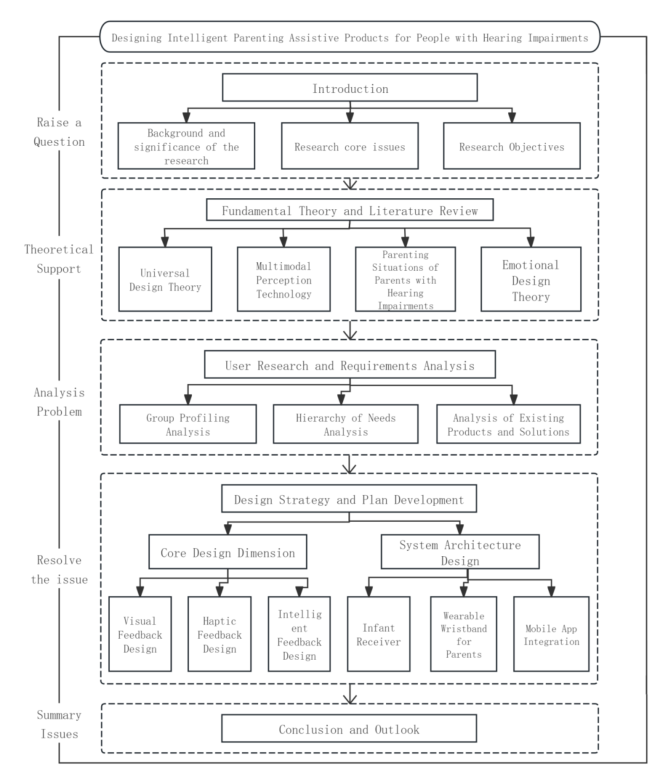
Drawing upon findings from literature review, user research, and case analysis, we establish the design research framework illustrated in Figure 2. This framework is fundamentally user-centered, grounded in users’ actual perceptual capabilities, behavioral patterns, and psychological needs. It synthesizes interdisciplinary theoretical foundations, including accessibility design, multimodal perception, emotionalized design, and human–computer interaction, to guide the development of an intelligent assisted parenting system. Crucially, the core objective extends beyond merely substituting for auditory function; rather, it aims to establish a collaborative feedback network that synergistically integrates visual cues, tactile feedback, and intelligent data analysis. This network compensates for hearing limitations while simultaneously enriching and deepening the emotional bond between parent and child.
Within this framework, theoretical exploration serves as the foundational pillar for the entire design process. The principle of accessibility design ensures equitable and inclusive product experiences, mandating that all interactions be fully independent of auditory input. Multimodal perception theory informs the strategic translation of information: infant-related auditory signals are systematically converted into salient tactile vibrations and intuitive visual interface elements. Finally, emotionalized design elevates functional utility to the affective dimension—prioritizing the alleviation of parental anxiety, strengthening confidence in caregiving competence, and fostering deeper emotional connection between parent and child.
Under the guidance of this framework, the product’s specific architecture becomes clearly defined. It comprises three integrated components: a smart receiver positioned adjacent to the infant, a tactile wristband worn by
Designing Intelligent Parenting Assistive Products for People With Hearing Impairments 33 caregivers, and a mobile application that unifies data analytics, visualization, and longitudinal recordkeeping.
The infant-side receiver is equipped with high-sensitivity acoustic and motion sensors capable of capturing both infant vocalizations and ambient soundscapes. Leveraging advanced signal-processing algorithms, it classifies crying episodes, distinguishing among hunger, drowsiness, discomfort, and other physiological states, and simultaneously monitors gross motor activity, such as rolling or limb movement. All captured data undergo real- time on-device processing and are wirelessly synchronized to the caregiver’s wristband and the mobile application.
The caregiver wristband delivers context-aware haptic alerts through precisely modulated vibration patterns, varying in rhythm, duration, and intensity, to convey distinct infant needs. This design ensures timely, intuitive, and non-disruptive notification, even when caregivers are asleep or engaged in other tasks.
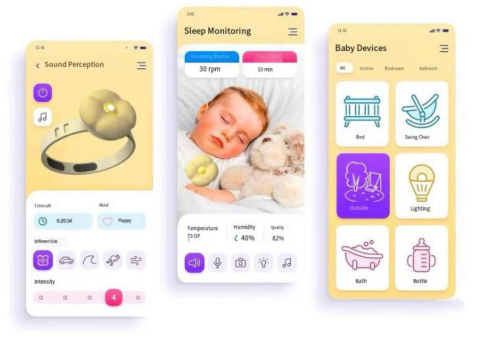
Concurrently, the mobile application provides comprehensive visual feedback and intelligent decision support. Its interface presents cry waveforms, classified type tags, and chronological timelines in an intuitive, information- dense layout. Crucially, it correlates daily caregiving logs, including feeding, diaper changes, and soothing interventions, with real-time physiological and behavioral data, thereby constructing a traceable, longitudinal “digital memory” of early development. This capability represents a significant innovation: it empowers deaf and hard-of-hearing parents to systematically document, reflect upon, and iteratively refine their caregiving practices, transforming emotionally grounded care into structured, analyzable, and pedagogically valuable insights. Most importantly, the continuously accumulated dataset constitutes a rich digital footprint of the child’s growth trajectory, embedding familial narratives, preserving shared moments, and enabling the intergenerational transmission and deepening of affective bonds within the digital domain.
The entire design process follows a systematic, end-to-end methodology, spanning theoretical modeling, user-centered research, and iterative prototyping. The design strategy is anchored in three core dimensions: visual, tactile, and intelligent. Specifically, the visual interface delivers comprehensive historical data visualization and real-time system state analysis; the tactile channel conveys critical alerts with immediacy and contextual salience; and the intelligent algorithm continuously enhances recognition accuracy and scene-aware adaptability. The final product embodies a holistic, multi-layered support architecture: (1) a technical foundation layer comprising advanced signal processing and robust wireless communication; (2) a user adaptation layer enabling barrier-free interaction and fully customizable settings; and (3) a scene coverage layer ensuring seamless performance across diverse environmental conditions.
Figure 2: Design framework roadmap.
Design of Child-Rearing Assistance Products for Deaf Services Based on the three core design dimensions of the aforementioned framework, the visual feedback module translates hazardous sound detection into intuitive light-based visual cues; the tactile feedback module converts acoustic information into precisely calibrated vibrational stimuli; and the intelligent feedback module transforms parental sign language or text input into infant- appropriate audiovisual outputs—leveraging sensory compensation to mitigate the auditory limitations experienced by Deaf and Hard-of-Hearing (DHH) parents.
This study targets critical challenges arising from auditory perception deficits in the parenting practices of DHH parents, specifically, their difficulty in detecting infant crying in real time and heightened risks associated with movement-related safety hazards. Grounded in user-centered design principles, the work holistically addresses perceptual, behavioral, and psychological
Designing Intelligent Parenting Assistive Products for People With Hearing Impairments 35 needs of DHH parents. Drawing upon multidisciplinary foundations, including ergonomics, sensor technology, wireless communication, and data analytics, the research culminates in the development of an intelligent assistive parenting system. Although DHH parents often exhibit enhanced visual and tactile acuity, their auditory impairment impedes timely recognition of infants’ emotional shifts and emergent safety threats—potentially compromising infant physical and psychological well-being. Consequently, purpose-built assistive tools are essential to effectively bridge this sensory gap.
The product comprises an infant-end receiver and a parent-end wearable bracelet. The infant-end receiver is equipped with a highly sensitive microphone and an advanced signal processing unit, enabling precise identification of distinct crying patterns, as well as significant physical movements such as rolling over and kicking. The parent-band integrates embedded vibration actuators and intelligent microchips, delivering real-time tactile alerts via vibration, effectively addressing use cases where parents are temporarily away from the infant or asleep. Leveraging proprietary signal conversion algorithms, the system translates the frequency and intensity of the infant’s cries into differentiated vibration patterns, empowering hearing- impaired parents to intuitively interpret the baby’s needs, including hunger, discomfort, and drowsiness—and respond with timely, context-appropriate care informed by lived experience.
The product features an innovative digital memory function, seamlessly integrated with a companion mobile application. It records, in real time, the infant’s cry waveforms, movement classifications, timestamps, and other relevant physiological and behavioral status data. Additionally, it enables parents to log caregiving insights and emotional reflections. These digitally preserved memories not only provide robust data support for hearing-impaired parents to systematically accumulate parenting expertise and refine caregiving competencies, but also serve as meaningful developmental archives for the child—preserving familial bonds across generations—while simultaneously ensuring infant safety, health, and holistic well-being.
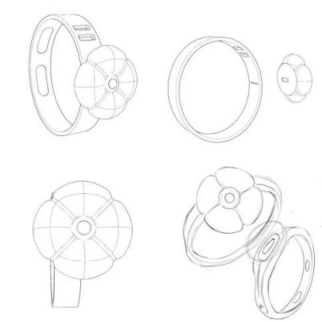
Figure 3: Sketched design.
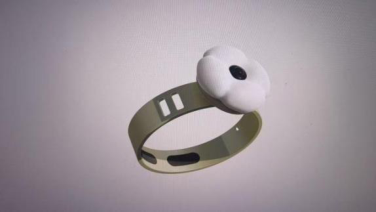
36 Zhong and Xu Based on the initial sketch, Rhino—a professional 3D modeling software— is employed to translate the design concept into a precise, parametric 3D model. Subsequent refinement focuses on critical functional and aesthetic details, including the geometry and positioning of connection ports (e.g., between the receiver and bracelet), wall thickness optimization, surface continuity, and high-fidelity modeling of structural and decorative elements.
Figure 4: 3D modeling.
Import the 3D model into KeyShot—a professional virtual rendering software—to generate high-fidelity visualizations that accurately convey both the overall aesthetic and fine details of the product and its associated mobile application. This process ensures harmonious integration of form, proportion, surface texture, and material properties.
Based on the unique parenting challenges and fundamental needs of hearing-impaired parents, this study systematically designs intelligent assisted parenting products. To address the information reception barriers that hearing-impaired parents encounter during child-rearing, the study advances innovations at both the core design dimension level and the system architecture level of intelligent parenting assistance solutions.
At the core architecture level, the study proposes a tripartite feedback framework—comprising visual feedback design, tactile feedback design, and intelligent multimodal feedback design—to effectively alleviate the parenting dilemmas faced by hearing-impaired parents.
At the system architecture level, it establishes a three-tiered structural framework: the technical support layer, the user adaptation layer, and the scenario coverage layer. Building upon this architecture, an integrated intelligent assisted parenting product system tailored specifically for hearing- impaired parents is developed.
This design transcends the limitations of conventional single-function substitution approaches, aiming instead to foster an immersive, inclusive, and participatory parenting environment. It holistically integrates the everyday life contexts and interaction patterns characteristic of hearing-impaired families—balancing functional efficacy with human-centered care—to deliver intelligent solutions that seamlessly support family life and strengthen intimate parent–child engagement. Ultimately, the system empowers hearing- impaired parents and contributes meaningfully to the development of an inclusive, accessible, and supportive parenting ecosystem. The research theme is highly aligned with the AHFE 2026 “Universal Design and Design for Inclusion” track, particularly focusing on persons with disabilities—hearing- impaired individuals, as well as those with cognitive, neurological, physical, language, and visual impairments.
ACKNOWLEDGMENT
This research was funded by the Tianjin Municipal Art Science Planning Key Project, Research on the Construction and Development of Tianjin’s “Mountains, Sea, Rivers, Buildings, and Lively Atmosphere” Cultural Tourism Belt (Project No.: B24002).
REFERENCES
Bonello, M., Farrugia, P., 2023. Towards a multi-perspective based ontology to develop smart wearables for paediatric habilitation 20, 170–181. Cairang, Z., Liu, P. F., Ma, G. X., 2024. A Comprehensive Review of Infant Emotion
Recognition 60, 32–45. Chen, X. W., 2024. Research on the Design of Non-Linguistic Sound Information Communication for Individuals with Hearing Impairments 14, 80–82. El Morr, C., Singh, D., Sawhney, V., Fernandes, S., El Lahib, Y., Gorman, R., 2024.
Exploring the Intersection of AI and Inclusive Design for People with Disabilities. 316, 556–559. https://doi.org/10.3233/SHTI240475 Gao, X. J., 2024. The Relationship Between Parenting Stress and Anxiety in Young Children with Hearing Impairments: The Moderating Role of Effortful Control 22, 640–644. Garg R, Sengupta S., 2020. He Is Just Like Me: A Study of the Long-Term Use
of Smart Speakers by Parents and Children, in: Proceedings of the ACM on Interactive, Mobile, Wearable and Ubiquitous Technologies. Presented at the ACM, ACM Journals, pp. 1–24. Kim ChoulWoo, Kim Dongyun, Lee Hyundo, Park Hanseong, Kwon Giung, Park Eunju, Lim Hankyu, 2017. Design and Implementation of Application for the Hearing Impaired People, in: 21st International Conference on Circuits, Systems, Communications and Computers. Presented at the MATEC Web Conf., EDP Sciences, Korea. https://doi.org/10.1051/matecconf/201712504007 Kumar L A, Renuka D K, Rose S L, 2022. Deep learning based assistive technology
on audio visual speech recognition for hearing impaired 3, 24–30. Lin, Z. , Liang, H., 2024. The paradox of ‘positive energy’ (zheng nengliang): the complex affective realities of people with hearing impairments in china’s service industry 39, 3190–3211. https://doi.org/10.1080/09687599.2023.2255733 M C Chaithra, P Manjula, 2024. Speech perception outcomes in hearing-impaired
individuals with microphone & receiver in the ear (M&RIE) hearing aids. 281, 3813–3820. https://doi.org/10.1007/S00405-024-08632-X Padmanandam K, Rajesh M V, Upadhyaya A N, 2022. Artificial Intelligence Biosensing System on Hand Gesture Recognition for the Hearing Impaired 1–13. https://doi.org/10.4018/IJORIS.306194 Senaha, T., Midorikawa, R., Baba, T., Asaka, T., 2025. Bridging the auditory
gap: AR smart glasses for real-time speech-to-text and directional audio visualization for the hearing-impaired 14, 279–282. https://doi.org/10.23919/ COMEX.2025XBL0042 Shi, F., 2023. Research on Product Design Methodology for Information Accessibility Enhancement in Domestic Environments for Hearing-Impaired Adolescents. Beijing Institute of Fashion Technology, China. https://doi.org/10.26932/d.cnki. gbjfc.2023.000230 Shi, H., Zhang, S., Hang, X., Zhang, S., Wei, G.-y., Liu, J., Liu, L., 2024. Design
of an Intelligent Crib for Hearing-Impaired Families 51, 34–38. https://doi. org/10.19968/j.cnki.hnkj.1003-5168.2024.24.007
Designing Intelligent Parenting Assistive Products for People With Hearing Impairments 39 Suud J, Suliman F H, Shahari K H, 2025. Enhancing Safety: A Smart Baby
Monitoring System for Deaf Parents 4, 31–38. Yu, C., Yongchang, L., Shi, W., 2025. Employment Communication Pathways for Design Students with Hearing Impairments: A Case Study of Visual Communication Design 8. https://doi.org/10.31058/J.AD.2025.86013 Zhang, D., Zhang, W.Y., 2025. Wristwatch Guardianship: A Study on Mediatized
Care for Children with Hearing Impairments 86-100+120-121. https://doi. org/10.20050/j.cnki.xwdx.2025.04.002 Zhang, L.-m, Du, L., Li, Z., Jia, Y., Jiang, H., Zhao, Y., 2024. Trends in the Design of Intelligent Assistive Products for Addressing Parental Stress Crises 53–57. Zheng, C., 2025. Research on Interactive Design Practice Based on Barrier-Free
Perspective:-- Taking Braille Reading and Writing Learning Machine as an Example 10, 31–35. https://doi.org/10.54097/GN1MHE97
LISTED IN THE AHFE DIGITAL BOOKSTORE CATALOGUE
Explore the complete digital volume
Universal Design and Design for Inclusion
Read this individual research paper free through the original publisher, or explore the full digital proceedings book.
ISBN 978-1-964867-85-4
Explore this ISBN in the AHFE Bookstore ↗Listed in the July 2026 bookstore catalogue; search by ISBN to confirm current availability · Digital book purchase optional