Peiqi Yi, Yunzhu Hu, Xiaoxue Zhang, Hui Wang, Xin He (2022). Myopia Prevention Game Interface Design Based on Children's Cognition. In: Human Factors in Virtual Environments and Game Design. AHFE Open Access, vol. 50, pp. 150–155. https://doi.org/10.54941/ahfe1002072
This paper is based on the cognitive characteristics of Chinese children. Through literature review and user study, we understand that children prefer pictures and videos for information acquisition, and they are more concerned with saturated colours. What’s more children are more willing to experience and interact in action. Therefore, this article addresses the above characteristics, takes the prevention of children's myopia as the application scenario, and combines the most common information media that children currently come into contact with, to design a game interface that is suitable for children's cognitive characteristics. The design runs in the form of a game that can make children willing to interact and willing to accept the treatment of myopia prevention. And using a smartwatch, which is commonly used by Chinese children as an information medium, saturated colours and cute, rounded design elements are used to ultimately design the game interface. Finally, the paper combines interviews and research with children to understand that the design meets the cognitive and aesthetic needs of children and has gained their approval.
Cognitive style, mainly “refers to the habitual and fairly stable psychological tendencies that individuals develop in the organization of cognition, showing a preference for a particular way of processing information in the cognitive process” (Peng and Zhang, 2004). Swiss psychologist Jean Piaget’s theory of child psychology divides children’s cognitive development into four sta- ges: sensory-motor stage (0-2 years old), preoperational stage (2-7 years old), concrete operational stage (7-11 years old), and formal stage (11 years old and above) (Wang, 2017).
The subjects of this study were Chinese children aged 7 to 11 years old, and Chinese children in this age group have the following chara- cteristics: (1) Color cognition and imagination characteristics, children in this stage are more sensitive to the cognition of color representations; (2) Graphic representational cognition characteristics, children in this stage like to express the world they know by drawing; (3) Graphic matching
Myopia Prevention Game Interface Design Based on Children’s Cognition 151
type of recognition characteristics, this is the age (4) Learning in action, which is an important feature of children’s stepwise growth at this stage (Yang and Zhang, 2021).
In addition to understanding children’s cognitive preferences, the author also interviewed and observed 10 children aged 7 to 10 years from China and summarized several preferences for learning styles: (1) Love fun, they prefer learning in the form of games; (2) Need to meet the motivation to learn, the form of learning should interest children; (3) Love the sense of achievement and satisfaction, the form of reward mechanism can motivate children to learn further.
GAME INTERFACE DESIGN SUITABLE FOR CHILDREN’S COGNITIVE CHARACTERISTICS According to literature research and user research, we understand that children’s cognition is different from adults’ cognition, and has distinctive differences. How to help children complete boring and important tasks in a way that is acceptable to them has become a concern for the author. There- fore, combining the above cognitive style and learning preference, we made the following design.
Application Background According to the National Visual Health Report (Li, 2015) released, the num- ber of myopia sufferers among the total population over 5 years old in China ranged from 437 million to 487 million in 2012, and the number of people with high myopia ranged from 29 million to 30.4 million; it is expected that by 2020, the prevalence of myopia among the population over 5 years old will increase to 50.86%-51.36%, and the total number of sufferers will be more than 700 million, close to the total population of the United States. The total number of people with myopia will be more than 700 million, nearly twice the total population of the United States, and the number of people with high myopia will be 40 million to 51.55 million. Based on the above back- ground, the author takes “myopia prevention among Chinese children” as the background and starting point of the design, and uses it to design myopia prevention measures that meet children’s interests.
Currently, there are a variety of medically proven treatment options for developed myopia, but none of them can cure myopia at its root. To prevent and treat myopia, it is important to find an effective prevention program for myopia and to address the problem at the source. According to literature research (Jones, et al., 2007), the author found that there are many perso- nal factors that form myopia, divided into two categories: congenital factors and acquired factors, among which acquired factors, prolonged exposure to insufficient light is the main cause of myopia. Therefore, we, together with Dr. Xu Wenlong, founder of Wuxi Item Health Technology Co., Ltd, plans to combine technology and design to help children get out of the room and make them love outdoor sports to achieve light supplementation and myopia prevention. And how to achieve that is the focus of this design.
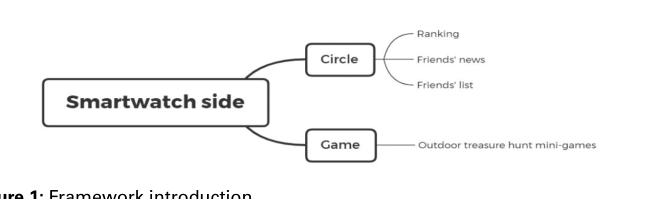
Figure 1: Framework introduction.
Application Equipment The application medium used in this design is: children’s smartwatch - an electronic product that Chinese children generally have the most contact with. Children’s smartwatch, also known as: children’s positioning watch, children’s phone watch, children’s safety watch, and its basic functions are mainly positioning, calling, and range (Zhang, 2020). In terms of user scale, according to statistics, the user scale of children’s smartwatches in China was 30.92 million in February 2018 and reached 46.3 million as of Febru- ary 2019, an increase of 49.7% year-on-year, and the growth trend tends to be stable (Zhang, 2020). This data also confirms the popularity of children’s smartwatches in China, so the author chose it as the application medium of this design to achieve greater popularity of this design.
Design Overview This design combines the psychological and cognitive characteristics of chil- dren, using children’s favorite forms, children’s favorite graphic features, and children’s favorite colors as the entry point of the design, with myopia pro- tection as the background and children’s smart watches as the information medium. It is hoped that children will accept the originally boring content and stick to it through the form that they like. Next is a demonstration of this design strategy.
Product Framework First is the product framework. The main functions of this design are divided into: circles and games. The circle mainly satisfies the social function, and the game function is to realize the main function of myopia prevention. The “circle” includes: ranking, friends’ news, and friends’ list, while the game function is an outdoor “treasure hunting game” to help children go outdoors and receive sunlight.
As children prefer interesting forms, this design adopts a game format to make children willing to come out of the room and receive light. At the same time, the function of adding friends can meet the social nature and let chil- dren play with their peers to enhance user stickiness. The leaderboard design allows healthy competition among children and promotes children to achieve daily light replenishment in a long period of time.
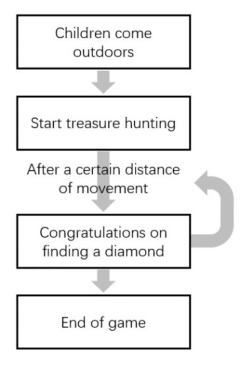
Figure 2 shows the flow of the game. The whole game is not complica- ted, so it is easy for children to understand and accept independently. And
Myopia Prevention Game Interface Design Based on Children’s Cognition 153
Figure 2: Game flow chart.
in the process of the game can be harvested “diamond” rewards and hono- rary titles, rewards can be competed with friends to meet the child’s sense of achievement, satisfaction, to attract children to continue to play.
The way to add friends is to use a vibrating watch to see the similar devices around you and then add them. This way makes the whole product smaller and more suitable for use on the smartwatch side, and also enhances the social aspect.
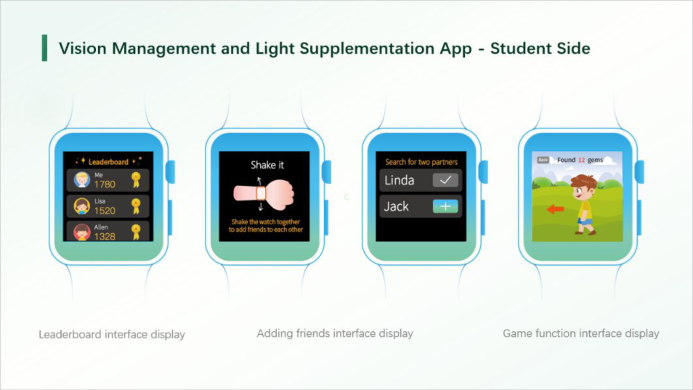
Visual Representation In addition to the overall frame design, visual design is also an important factor. Figure 3 shows the effect of part of the interface design, including the interface display of ranking, the interface display of shaking to add fri- ends, and the interface display of mini-games. The interface model adopts the general model framework of Chinese children’s smartwatches, and the main interface uses black as the base color, with some green, yellow and blue as accents.
Through literature research and user research, we found that children pre- fer bright colors. And in the general perception, green and blue represent health and nature, so the main colors used in this design are green and blue, plus some yellow for embellishment. At the same time, the colors used are generally more saturated, in order to attract the interest of children.
Considering that children prefer a juvenile cartoon style to a minimalist, mature style. Therefore, we use flat cartoon elements as the main style to meet the visual preference of children and also help children understand the content shown independently.
User Experience Feedback After I showed and communicated the interface rendering and framework flow to 10 Chinese children aged 7-10, we got satisfactory answers. Eight of them said that they would be more willing to go outside for sports if the
Figure 3: Interface design rendering.
game was implemented. Two other children said it would be better if the fea- tures were more innovative. Overall, the design strategy meets the cognitive characteristics of the children and achieves the expected functional effects.
CONCLUSION
Through researching the cognitive characteristics of Chinese children, we learned that children aged 7~11 years old prefer picture format, highly satu- rated colors, and are more willing to experience and interact in action. The design takes the prevention of myopia in children as the application scenario, combines the most common information media that children are currently exposed to, uses flat cartoon style and high saturated colors to make children willing to interact and accept the treatment of myopia prevention, realizes the childishness of boring content and meets the cognitive characteristics of children.
There are many designs for children on the market, but how to really adapt to the age group of children, so that children really accept and willing to use for a long time, it is more necessary for designers to understand the cognitive characteristics and aesthetic preferences of children. In this paper, we start from the perspective of Chinese children aged 7~11 years old, and make a content design for a specific background, hoping to see the big picture with the small, and through this design thinking method, we can reasona- bly deduce to design for other age groups and other nationalities, so as to be people-oriented and to help the targeted user groups to a greater extent.
ACKNOWLEDGMENT
We would like to thank the 10 children from Wuhan, China for their inte- rview support. We are also grateful for the platform support from Huazhong
Myopia Prevention Game Interface Design Based on Children’s Cognition 155
University of Science and Technology in Wuhan, China, and the assistance of Ms. He Xin.
REFERENCES
Jones, L. A., Sinnott, L. T., Mutti, D. O., M, G. L., Moeschberger, M. L., Zadnik, K., (2007). Parental history of myopia, sports and outdoor activities, and future myopia. Invest Ophthalmol Vis Sci, 48(8), pp. 3524–32. Peng, D.L. and Zhang, B.Y., (2004). Cognitive Psychology. Hangzhou: Zhejiang
Education Publishing House. Li, L. (2015). National Health Vision Report. Beijing: Peking University Press. Wang, L., (2017). Research on Graphic Language Design Ba-sed on Children’s Cognitive Psychology. Chengdu: South-west Jiaotong University. Yang, J. and Zhang J.M. (2021). Research on the design strategy of museum inte-
ractive experience based on children’s cognition. Packaging Engineering, 42(8), 57–62. Zhang, X., (2020). China’s children’s smartwatch industry market status and competitive landscape analysis in 2020, the manufacturers in the competition towards differentiation, [online] Available at: <https://www.huaon.com/story/512088 > [Accessed 10 February 2022].
LISTED IN THE AHFE DIGITAL BOOKSTORE CATALOGUE
Explore the complete digital volume
Human Factors in Virtual Environments and Game Design
Read this individual research paper free through the original publisher, or explore the full digital proceedings book.
ISBN 978-1-958651-26-1
Explore this ISBN in the AHFE Bookstore ↗Listed in the July 2026 bookstore catalogue; search by ISBN to confirm current availability · Digital book purchase optional