Luyu Wang, Ying Huang, Xin He (2022). Design of a Help-Seeking Companion Robot for Elderly People Living Alone. In: Human Factors in Aging and Special Needs. AHFE Open Access, vol. 38, pp. 190–196. https://doi.org/10.54941/ahfe1001680
In recent years, the degree of aging on a global scale has intensified, and at the same time, “living alone” has become the norm for older people. Elderly people living alone not only have their children away from home, but they are also widowed. They are a more vulnerable group than the empty-nest elders. They often face triple barriers of physical, psychological and cognitive impairment, and are therefore often trapped in a difficult and lonely life. Therefore, in order to meet the needs of elderly people living alone to communicate with others and eager to solve life problems, this design hopes to build a small help-seeking companion robot based on the principles of emotional design and to dig deeper into the user’s spiritual satisfaction and emotional resonance. This design uses literature Data search method, network survey method, questionnaire interview method, market research method have conducted an in-depth understanding of the elderly living alone, companion robots, youth groups, etc., and determined the product positioning, use process, styling design and APP UI design.This design includes a robot end for the elderly living alone and an APP end for the youth group. The robot end mainly uses voice interaction to reduce the difficulty of using intelligent search and help the elderly in social activities, and to build a new form of communication between the elderly living alone and the elderly living alone, and between the elderly living alone and the youth group. The project is designed to meet the practical and spiritual needs of the elderly living alone, thus enhancing social stability and spiritual civilisation.
At present, the number of elderly people living alone is growing. According to research, this group usually faces the triple barriers of physical, psycho- logical and cognitive. Therefore, when faced with life difficulties, they often fall into the dilemma of isolation and helplessness. In addition, driven by the three factors of “economic development”, “nursing staff shortage” and “policy support”, the market prospect of companion robots for the elderly is increasingly broad. After investigation, the current research on compa- nion robots for the elderly mostly focuses on solving the physiological needs of the elderly or improving user experience, and a small number of resea- rches focus on the innovation of business models or appearance, but lack of solutions for the living difficulties of the elderly living alone and increasing communication between the elderly living alone and others. Guided by the
Design of a Help-Seeking Companion Robot for Elderly People Living Alone 191
principles of emotional design, this research deeply explores the emotional appeals of the elderly living alone, with the help of relevant knowledge of pro- duct design, UI design, etc., using literature search method, network survey method, questionnaire interview method, market research method and other related sciences method, to create a companion robot for the elderly who live alone, and design a related APP, so as to build a bridge of communication between the elderly living alone and others.
EMOTIONAL DESIGN OVERVIEW The human brain activity is divided into three levels: the innate part is the visceral level; the operation part that controls the daily behavior of the body is the behavior level; the thinking part of the brain is the reflection level (Norman, D. 2010)
The visceral level is a level of feedback that people give to the moment an event occurs, that is, “what you see is what you hear” (Junyan Li, 2021). The visceral level is the starting point of emotional processing. In the design of the visceral level, it is usually reflected in the intuitive feeling of the shape, color, material, etc. to the user, which is the user’s initial impression of the product. Most human activities belong to the behavior level, and the beha- vior level is not conscious, but is a subconscious response together with the visceral level (Yameng Pan, 2019). Behavior layer design focuses on the rea- lization of functions. An excellent behavior layer design has four elements: function, comprehension, ease of use, and feeling. Designers are required to pay attention to “people-oriented” and design products that users really need. The level of reflection is a higher level of consciousness, which is the fusion of human emotion and thought. The reflective layer design is usually closely related to the meaning and use of information, culture, and products (Norman, D. 2010). This research takes emotional design as the criterion, so that the product has the attractiveness of the visceral level, the function of the behavior level, and the strategy of the reflection level.
USER GROUP CHARACTERISTICS ANALYSIS Analysis of the Physiological Status of the Elderly Living Alone
With the increase of age, the physical function of the elderly living alone generally declines, mainly manifested as: audio-visual-touch sensory function decline, joint inactivity, organ function decline, movement and learning speed slow down, operation ability and reaction speed decrease, not easy adapt to new environments and situations, prominent sleep problems, etc (Yulan Ding, 2011). In view of the above physiological characteristics of the elderly living alone, attention should be paid to more convenient interaction forms, the selection of appropriate colors and materials, the reduction of learning costs and the difficulty of use, and the use of portable designs when necessary.
Analysis of the Psychological Status of the Elderly Living Alone Due to the long-term separation of the elderly living with their children, the quality of life of the elderly who live alone is significantly reduced due to the
Figure 1: Elderly companion robot design.
loss of their children’s help and care. In addition, the deterioration of the phy- sical functions of the elderly living alone also has a negative impact on their social life. (Jia Li.et al. 2021) The above dilemma has caused many psycholo- gical problems for the elderly living alone: one is that the elderly living alone are prone to depression and depression; the other is that the elderly living alone are prone to behavior deviation. If these negative emotions are allo- wed to grow and develop, there will be irreversible consequences. In view of the above psychological characteristics of the elderly living alone, attention should be paid to improving the quality of life of the elderly in the design of robots, while increasing the communication between the elderly living alone and others, and reducing negative emotions such as loneliness and depression.
DESIGN STATUS AND EXISTING PROBLEMS OF ELDERLY COMPANION ROBOTS This research starts from two types of listed products and conceptual design products, in which products (a)-(f) are representative listed products; produ- cts (g)-(i) belong to excellent conceptual designs that have won international awards product (see Figure 1). On the visceral level, it is found that the nine products are mostly small and medium-sized, neutral colors, and mostly use electronic screens, bionic shapes and rigid materials; on the behavior level, it is found that most of the current elderly companion robots consciously adopt the interactive design suitable for the elderly. the interaction is more convenient and smooth. At present, the functions of companion robots for the elderly can be roughly divided into three types: one is the body assi- stance robot represented by product (g), which is mostly used to help the elderly with inconvenient mobility to carry out physical rehabilitation trai- ning; The second is the interactive monitoring robot represented by product (a), which mainly has functions such as health monitoring, remote monito- ring, and voice and video interaction; the third is the emotional companion robot represented by product (e), which usually has two-way two-way inte- raction, physical interaction and other emotional functions; in the design of the reflection layer, the emotional companion robot represented by product (e) is more warm, so that the product and the user have an emotional bond.
The design of the elderly companion robot is mixed, the quality gap is large, the homogeneity of some functional designs is serious, there is a lack of innovation points, and the competitiveness is small. A considerable num- ber of elderly companion robot products are poorly positioned, which is not conducive to obtaining user value and commercial value. In addition, the exi- sting designs are generally not in place in terms of emotionality, which cannot
Design of a Help-Seeking Companion Robot for Elderly People Living Alone 193
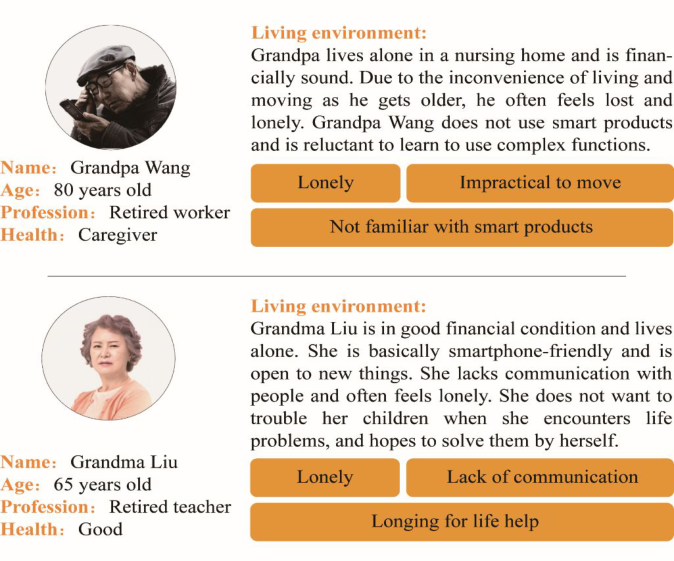
Figure 2: Personas.
increase the frequency of communication between the elderly and others, and it is difficult to truly alleviate the loneliness of the elderly.
USER ROLE BUILDING In this study, the interview method was used to conduct in-depth interviews with eight elderly people living alone. In the interview outline, the interview objectives of “in-depth understanding of the five basic parameters of the name, gender, occupation, physical and mental health, and living conditi- ons of the elderly living alone” were clarified, and “gender” was used as the basis for user classification, and a detailed interview outline was produced around the interview objectives, and then Conduct interviews, and finally, based on Alen Cooper’s “seven-step persona method”, organize and analyze the interviews to produce personas (see Figure2).
DESIGN PRACTICE Product Definition
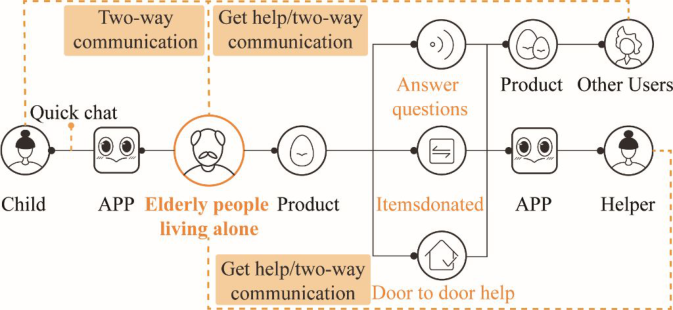
This product is centered on the elderly who live alone who are eager to com- municate with others and who are eager to solve life dilemmas independently. It builds a bridge of communication between the elderly living alone and oth- ers through robots and the corresponding APP (See Figure 3). This product can provide assistance to the elderly living alone in the form of online Q&A,
Figure 3: Product positioning map.
item donation, and door-to-door assistance through intelligent voice intera- ction, enhance the communication between the elderly and others, and reduce the sense of loneliness and helplessness faced by the elderly.
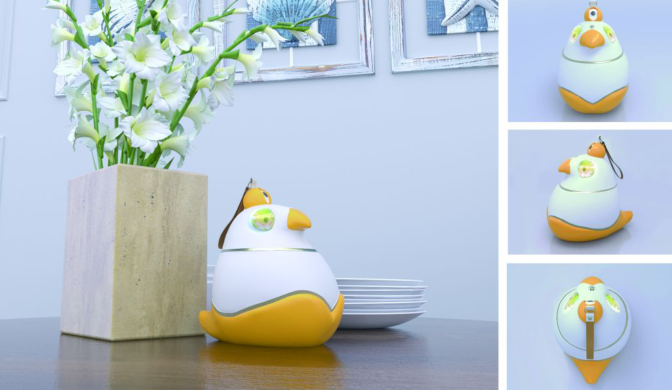
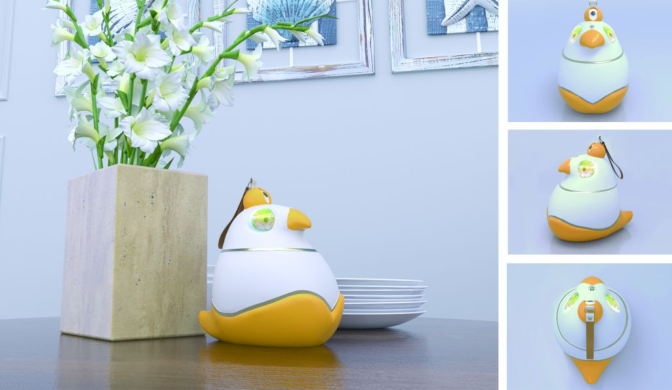
Visceral Layer Design This study adopted the questionnaire survey method, and collected 18 valid questionnaires, of which 67% were women and 33% were men, and the ages were concentrated between 60 and 74 years old. Based on the results of the questionnaire, in terms of color matching, yellow and white, yellow gives people a sense of warmth and happiness, and white gives people a sense of simplicity and simplicity. In addition, orange is a long-wave color, which is easy for the elderly to distinguish (Xuejun Bai. et al. 2020); in terms of shape, the bionic design is adopted to extract the shape of birds, which is round, cute and easy to accept; in terms of material, the use of plastic and rubber enhances the overall sophistication and modernity of the product.
Behavioral Layer Design The first is portability: this product adopts a lightweight design, with a length, width and height of 105 × 120 × 150 (unit: mm). The second is convenient interaction: this product abandons the touch interaction mode of traditional robots, and instead focuses on voice interaction, and cooperates with dialect recognition and onomatopoeia functions to build an interaction framework. The third is functional and practical: this product provides three functions of “online answering questions”, “material donation” and “door-to-door help” for the elderly living alone. The online Q&A function supports the elderly to obtain answers from databases, other product users, and APP users; the door- to-door help function can solve the action-based help of the elderly living alone; the item donation function can support the elderly living alone in need to accept requests from APP users items donated. In addition, this product can also help children to monitor the physical condition of elders living alone in real time, chat quickly, and make emergency calls (See Figure 4).
Design of a Help-Seeking Companion Robot for Elderly People Living Alone 195
Reflective Layer Design The first is a high degree of two-way interactivity: in addition to intelligent dialogue with the elderly living alone, this product also appropriately incor- porates some physical interactions, such as the movement of the head and eyes, which is conducive to a deeper emotional bond with the elderly living alone. The second is to increase communication: this product builds an online or offline communication bridge between the elderly living alone and others through robots and the corresponding APP to meet social needs. The third is clothing design with cultural heritage: the needs of elderly users are closely related to the cultural context in which they live. The product design for the elderly living alone can properly integrate cultural factors such as local folk art to enhance the elderly living alone, enhance the identity of the elderly living alone with the product. (Wei Guo. et al. 2018) Therefore, this study is based on the four seasons of spring, summer, autumn and winter, combining the elements of Chinese classical Hanfu, and designed four sets of serialized replaceable clothing for this product to enhance the sense of belonging of the elderly living alone to this product (see figure 5).
CONCLUSION
Based on the principle of emotional design, this research starts from the visce- ral level, behavior level and reflection level, and comprehensively builds a help-seeking companion robot for the elderly living alone. Then robot can
help the elderly living alone to solve their life difficulties and relieve the nega- tive emotions such as loneliness of the elderly living alone. Due to time and space limitations, the design results of this research have not been further verified and optimized, but this research will continue to improve and ite- rate. It is believed that the number of companion robots for the elderly living alone will continue to increase in the future, and it is hoped that this research can give some inspiration and guidance to future design.
ACKNOWLEDGMENT
My sincerest thanks to everyone who helped with this research!
REFERENCES
Jia Li, Na Qi. (2021). Research on Design of Robots Accompanying Empty Nesters Based on Emotional Computation. industrial design, 2021(11), pp. 26–28. Available from: CNKI [accessed 01 February 2022]. Junyan Li. (2021). Application on Human-computer Interaction Emotional Design in
the Field of Design Artificial Intelligence. Software, 42(12), pp. 34–37. Available from: CNKI [accessed 01 February 2022]. Norman, D. (2010). Desing Psychology. 1nd ed. Beijing: CITIC Pess Group. Wei Guo, Xia Deng, Yang Cao. (2018). Product Design Based on Solitary Elderly People. Packaging engineering, 39(02), pp. 166–169. Available from: CNKI [accessed 01 February 2022]. Xuejun Bai, Jin Yu, Lizhu Qin, Haibo Yang. (2020). Cognitive Aging of the
Elderly Population and Interaction Interface Design of Elderly Products. Packa- ging engineering, 41(10), pp. 7–12. Available from: CNKI [accessed 01 February 2022]. Yameng Pan. (2019). Research on the Emotional of Visual Language on MT User Interface. Master’s thesis. Qingdao University. Yulan Ding. (2011). Ergonomics. 4nd ed. Beijing: Beijing Institute of Technology
Press. 8
LISTED IN THE AHFE DIGITAL BOOKSTORE CATALOGUE
Explore the complete digital volume
Human Factors in Aging and Special Needs
Read this individual research paper free through the original publisher, or explore the full digital proceedings book.
ISBN 978-1-958651-14-8
Explore this ISBN in the AHFE Bookstore ↗Listed in the July 2026 bookstore catalogue; search by ISBN to confirm current availability · Digital book purchase optional