Felisa Carmella Dizon, Justine Ann Esguerra, Joseph Angelo San Gabriel, Ramon Gabriel Gomez, Carlos Ignacio Jr Lugay (2022). Factors Affecting Organization's Impression in Hiring Persons with Disability in the Manufacturing Industry. In: Human Factors in Aging and Special Needs. AHFE Open Access, vol. 38, pp. 80–87. https://doi.org/10.54941/ahfe1001667
Persons with Disabilities (PWD) are those with long-term impairments such as physical, mental, intellectual, and sensory disablement according to the United Nations Convention on the Rights of Persons with Disabilities. In the Philippines, a total of 1.44 million people live with disabilities and as of 2013, only 57.1% of them are employed. Moreover, 10.8% of the employed PWDs belong to the manufacturing sector. However, even with these numbers, people cannot deny that there are still companies who do not consider hiring PWDs even though studies show this may give benefits to them. With that, this study aims to determine the effects of age, sex, educational attainment, skills, and the type of impairment to an organization’s impression in hiring PWDs in the manufacturing industry. The researchers identified ‘Company Impression’ as the dependent variable in the study, where its independent variables are the demographic factors such as ‘Age’, ‘Sex’, and ‘Educational Attainment’, ‘Skills’, and ‘Type of Impairment’. In order to collect sufficient data to be analyzed in the study, survey questionnaires were handed out to HR recruitment employees of manufacturing companies in the Luzon island. A Structural Equation Model analysis was utilized in order to determine how the independent variables affect the dependent variable. Moreover, to ensure the accuracy and precision of the results, several softwares for data analysis was utilized such as the MS Excel and SPSS AMOS.
Persons with disabilities or the PWDs are those people with long-term physical, mental, intellectual, or sensory impairments that hinders one to perform activities to their full and effective capabilities, as defined by the Department of Health. Globally, there are 15% of the total population who have an impairment. This data is expected to rise as the population increases also due to the rapid transmission of chronic diseases. In the Philippines, the only available data in the Philippines Statistics Authority
Factors Affecting an Organization’s Impression in Hiring Persons with Disability 81
(PSA) is in the year 2010, where 1.44 million people were said to have disabilities.
In the Philippine Republic Act 7277, titled as the Magna Carta for Disabled Persons, it states that the senate shall give its support to their full extent to the improvement and total well-being of PWDs. It is also stated that private corporations hiring at least 100 employees, are encouraged to have at least 1% of all of its positions available to persons with disabilities while 1% of both the regular and irregular positions in the government agencies should be dedicated to them. However, equal opportunities among the abled and disable are still to be looked upon.
Moreover, in the manufacturing industry, accounting for 23.8% of the total GDP as of the third quarter of 2016, the total employment genera- ted by the top 10 manufacturing establishments reached 1.3 million in 2017 according to the PSA. Relating to that, the manufacturing industry also had the highest percentage of PWD employment where 3, 504 PWDs were hired in 2018. Even with this number, it cannot be denied that some companies in the said industry have no intentions of hiring PWDs. However, in a study conducted by Seva (2020), it has been concluded that the disability of PWDs does not affect performance if the tasks are disseminated well.
This paper identifies the factors affecting the company’s impression when hiring PWDs in the manufacturing industry. The study focuses on the Human Resource Department whose main role in the company is to conduct the recruitment, interviewing, and selection process of employees.
The objective of this study is to determine whether the age, sex, educational attainment, skills, and type of impairment of PWDs affect an organization’s impression when hiring PWDs, and to provide information and suggestions to different manufacturing companies in order for them to consider PWDs as their potential employees.
PERSONS WITH DISABILITIES IN THE PHILIPPINES MANUFACTURING INDUSTRY With the increasing number of PWDs in the Philippines, based on the Census of Population and Housing in the year 2010, this contributes to the decrease of GDP since the employment rate of PWDs to the industries is still dra- stically low. The local government has been promoting the law, RA 7277, that PWDs should fully participate in industries and have equal employment opportunities. With this, the Government of the Philippines aims to support the improvement of the well-being of the PWDs. Furthermore, the Depar- tment of Labor (DOLE) has created local projects explicitly for PWDs to address their unemployment rate.
PWDs are typically unemployed or have a low background in education. However, there are campaigns that encourage companies and organizations to look past the disability and see the potential contributions that PWDs can impart in the workplace such as in the manufacturing industry. Manu- facturing industry is the most significant sector for innovation, long-term employment, and the like. Compared to other industries, the Manufacturing industry has the highest effect on the economy. Moreover, Manufacturing
has the highest percentage of PWDs employed according to PSA. According to the International Labor Office, organizations have discovered that PWDs have good characteristics of productivity and reliability. With this, employing PWDs will improve a company’s overall workforce morale and diversity, as well as its reputation among employees, the society, and customers. Thus, giving them the opportunity to have a decent and sustainable job will not only be a huge benefit to them, but also to the economy. However, some employers are still less interested in PWD applicants, even though they have extensive work experience, and their condition has no direct impact on their work results. Training and development of employees including the PWDs is very important, that is why some organizations have implemented training pro- grams for them to raise awareness and develop each employee. Despite having the positive experiences of hiring PWDs, a study revealed that employers are less interested in PWD applicants even though they are well-experienced in the work field and their disability does not have a direct effect on their work performance.
METHODS
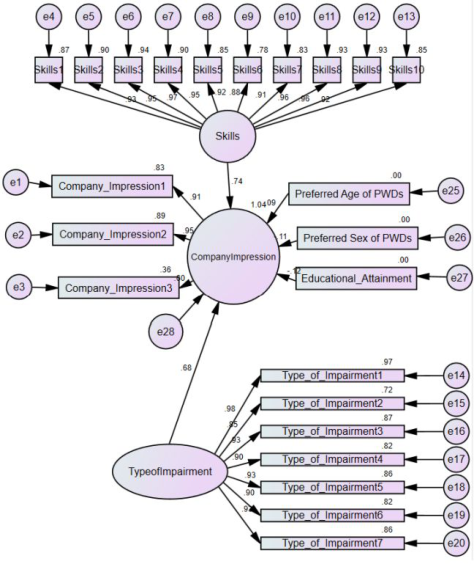
In analyzing the data that was obtained, the researchers used a structural equation model (SEM) type of research to determine how the independent factors affect the dependent variables. As shown on the figure below, the researcher identified that the costliness, productivity and negative impact to be the dependent variable, while age, sex, educatinal attainment, skills and type of impairment to be the independent variables. Survey questions were utilized in collecting the data and information needed to achieve the objectives of the study. The respondents of the study are the employees of the Human Resource Department (HRD) of large-scale manufacturing firms within Luzon, Philippines.
RESULTS
Skills The results show that Skill had the highest significant direct effect on the Company Impression (β: 0.739; p = 0.004). This implies that if the PWD acquires the different skills mentioned on the constructs, it would positively affect the company impression. The different skills could be categorized as soft skills (Skills 1 to 5) and hard skills (Skills 6 to 10). Based on the results, it was seen that all types of skills were considered significant.
According to Patacsil and Tablatin (2017), soft skills such as leadership, teamwork and communication skills were the most relevant factors conside- red by a company. This means that these are the skills most needed by the employees including the PWDs for them to be an effective employee in the work environment. Hence, if the PWDs possess the different skills mentio- ned on the constructs, they will be most likely to be hired by the companies. Moreover, the skills factor also has indirect effects on the company impres- sion in which the highest indirect effect in relation to company impression is the productivity of the PWDs (β: 0.699, p = 0.004). This signifies that PWDs
Factors Affecting an Organization’s Impression in Hiring Persons with Disability 83
Figure 1: SEM AMOS input.
are not as productive as those abled employees. Followed by another com- pany impression regarding cost (β: 0.674, p = 0.004). Skills have an indirect effect on the compensation cost of PWDs because the more companies beli- eve that skills are an important factor, the higher the cost will be. Lastly, skills have the least indirect effect on the impact of the PWDs in the work environ- ment (β: 0.441, p = 0.003). Therefore, as the company strongly believes that skills are important, it also implies that PWDs have a positive impact in the work environment increasingly, at the same time.
Type of Impairment The type of impairment of the PWDs is the second most significant direct effect influencing the company impression towards hiring PWDs (β: 0.676; p = 0.001). This implies that the type of impairment of a PWD is highly inclined on the company impression hence if the impairment hinders the employment, there is a higher possibility of not hiring the PWD.
Moreover, the types of impairment of the PWDs also have indirect effe- cts on the impression of the companies. The company impression with the highest indirect effect from the type of impairment is the productivity of the people with disabilities (β: 0.639; p = 0.001). In addition to this, as the company believes that the type of impairment factor is important, the PWD will not be as productive as those abled employees. This is because the type of impairment definitely affects the performance of the PWD to do work.
Furthermore, the second highest indirect effect affecting company impres- sion is the compensation cost of PWD employees (β: 0.616; p = 0.001). Companies are aware that the more the PWDs have impairment, the compen- sation cost of PWDs will also increase. This has been proven by Gatchalian et al. (2014), in which according to the study, companies are highly concer- ned about the possible counterproductive effects of PWD employment. This factor also covers the company impressions about the increase in cost, the dif- ficulty of training PWDs and the possible absence, punctuality and turnover problems PWDs may pose to the job. In line with this, there are several cost- related problems that must be considered, such as the expenses of making the whole workplace accessible for workers with disabilities which would incur higher expenditures, and the price of premium health insurance or compensa- tions (Kaye et al., 2011). Consequently, as the company considers the type of impairment of the PWD, the company perceives that the compensation cost of PWDs will be higher. Lastly, the company impression with the least indi- rect effect from types of impairment is the impact of the PWDs to the work environment (β: 0.403; p = 0.001). As the company develops its certainty that type of impairment is an important factor, the impact of the PWDs in the work environment will be negative.
Age Age factor is the third and least significant considerable factor affecting the company impression (β: 0.086; p = 0.001). In comparison to skills and the types of impairment of the PWDs, age is still considered as a factor but does not have heavy weight as seen in the standardized direct effect results. The results are associated with the Republic Act No. 10911, which proh- ibits discrimination against any individual in employment on account, all organizations, companies must observe and promote equal opportunities in regards to employment. It also promotes hiring of individuals only on the basis of their abilities, knowledge, skills, and qualifications not including the person’s age.
Thus, this shows an indirect effect between age and company impression. Firstly, Age has the most indirect effect on the productivity of the PWDs affe- cting company impression (β: 0.081, p = 0.002). Age has an indirect effect on the productivity of the PWD employees affecting company impressions. This implies that the age and work productivity are directly proportional. As an employee ages, the more likely it is for them to decline in terms of work efficiency. According to a study of Murman (2015) in line with the impact of age in work performance, it has been proven that there are measurable changes in cognition that occur with aging. These changes are declines in cognitive tasks which require an individual to instantaneously respond or transform information to make a decision, including measures of speed of processing, working memory, and executive cognitive function. Followed by another company impression regarding cost (β: 0.078, p = 0.002). Age has an indirect effect on the compensation cost of PWDs, due to the fact that as PWD employees get older, based on a study about how aging affects the immune system, aging employees are more likely to get sick and recover slowly from
Factors Affecting an Organization’s Impression in Hiring Persons with Disability 85
illness and injuries (Pagán, 2016). Lastly, age has the least indirect effect on the impact of the PWDs in the work environment (β: 0.051, p = 0.002). Therefore, as the company slightly believes that age is an important factor, it shows that PWDs can have either positive or negative impact in the work environment.
Sex and Educational Attainment Sex and educational attainment are not considered as factors (β: -0.106, p = 0.003; β: -0.117, p = 0.001 respectively). Based on the results, these factors have a significant negative-direct effect towards the company impres- sion. Therefore, sex and educational attainment would not be factors to consider in hiring PWDs. This is also the reason why there is a negative indirect effect of sex and educational
attainment toward company impressions regarding how costly are PWDs to be hired (β: -0.096, p = 0.003; β: -0.107, p = 0.001 respectively), the productivity of impaired employees compared to abled employees (β: -0.1, p = 0.003; β: -0.111, p = 0.001 respectively) and the impact of the people with disabilities to the work environment (β: -0.063, p = 0.002; β: -0.07, p = 0.001 respectively).
In 2019, the International Labour Organization (ILO) launched the “Cen- tenary Declaration for the Future of Work”, where Social Dialogue will play a significant role on the 2030 Agenda for Sustainable Development, promoting Gender Equality. It aims to ensure that there will be no bias or discrimina- tion in hiring and paying the employees. Furthermore, educational attainment should also not be considered as a factor in hiring PWDs. According to the study of Carlson and McChesney (2015), their data showed a correlation between salaries and educational attainment level. They concluded that the higher the educational attainment, the higher the associated average salary. Therefore, educational attainment would be directly proportional towards salary and thus, is not considered an important factor compared to skills and type of impairment. This also supports why there is an indirect effect of educational attainment to company impression.
Overall, the results from this study prove that companies do not consider sex and educational attainment as factors, due to the fact that the organi- zations are highly inclined with the skills and the type of impairment of the PWDs. The unconsidered factors will not matter as long as the PWDs have the capability to perform the given work and they possess the skills required for the work.
CONCLUSION
To provide summarization on the outcomes of the study, the factors: age, sex, educational attainment, skills, and type of impairment of PWDs have an effect on the impressions of the Manufacturing Industries when hiring them as employees. The researchers were able to determine the results which show that the factors these companies in the industry give importance to are the skills, type of impairment, and age of PWDs. Furthermore, factors such as the sex and educational attainment are not given too much of importance
and do not create much of a difference, they were still considered as effects when it comes to the hireability of the PWDs. In relation to this, based from the hypotheses established by the researchers, all assumptions are accepted, whereas; H1: Sex has an effect on company impression H2: Age has an effect on company impression H3: Educational Attainment has an effect on company impression H4: Skills has an effect on company impression H5: Type of Impairment has an effect on company impression
REFERENCES
(n.d). Persons with Disabilities. Retrieved March 2021 from https://tinyurl.com/rw cuzfc4 (n.d) Republic Act No. 10911. Retrieved November 3, 2021 from https://tinyurl.co
m/464vk8pn (1992). Philippines – Magna Carta for the Disabled. Retrieved March 2021 from https://tinyurl.com/xxz47dhc (2010) About 16 per thousand of the country’s population had disability. Retrieved
March 2021 from https://tinyurl.com/dsu96eka (2013). Persons with Disability in the Philippines (Results from the 2010 Census).
Retrieved April 25, 2021 from https://tinyurl.com/dsu96eka (2017). 2015/2016 Integrated Survey on Labor and Employment- Part I (Modules on Employment; Occupational Shortages and Surpluses; and Training of Workers). Retrieved April 28, 2021 from https://tinyurl.com/2x3rv8mb. (2017). The Philippine Manufacturing Industry Profile. Retrieved April 27, 2021
form https://tinyurl.com/wjsbjszz (2019). RA 11228 – An Act Providing For The Mandatory Philhealth Coverage For All Persons With Disability (PWDs), Amending For The Purpose Republic Act No. 7277, As Amended, Otherwise Known As The “Magna Carta For Persons With Disability”. Retrieved April 29, 2021 from https://tinyurl.com/k63bw3f9 (2020). The Contribution of Social Dialogue to Gender Equality. Retrieved November 3, 2021 from International Labour Organization https://tinyurl.com/ cpm2xv7z Aldaba, R. (2014). The Philippine Manufacturing Industry Roadmap: Agenda
for New Industrial Policy, High Productivity Jobs, and Inclusive Growth, 2-3. Retrieved March 2021 from https://tinyurl.com/samd39ca Carlson, R., McChesney, C. (2015). Income Sustainability Through Educational Attainment. Retrieved November 3, 2021 from https://tinyurl.com/ez9ju9tp Gatchalian, E., Bulahao, J., Boyayao, F., Cataina, M., Cumilang, J., Dulnuan,
J., and Salaguban, P. (2014). Dimensions of Filipino Employers’ Attitudes in Hiring Persons with Disability. Retrieved March 2021 from https://tinyurl.com/ ms66akdw International Labor Office (2010). Disability in the Workplace: Company Practices.
Retrieved April 29, 2021 from https://tinyurl.com/5bczxm4a International Labor Office (2016). Including Persons with Disabilities in Technical and Vocational Education and Training. Retrieved April 29, 2021 from https: //tinyurl.com/yy3pbasx Kaye, S., Jans, L., and Jones, E. (2011). Why Don’t Employers Hire and Retain
Workers with Disabilities?. Retrieved November 3, 2021 from https://tinyurl.co m/4wn6yuv5
Factors Affecting an Organization’s Impression in Hiring Persons with Disability 87
Murman, D. (2015). The Impact of Age on Cognition. Retrieved November 3, 2021 from https://tinyurl.com/a5wb7ym6 Pagán, C. (2016). How Aging Affects Your Immune System. Retrieved November 3,
2021 from https://tinyurl.com/4629uww Patacsil F. and Tablatin C. (2017). Exploring the Importance of Soft and Hard Skills as Perceived by It Internship Students and Industry: A Gap Analysis. Retrieved November 3, 2021 from https://tinyurl.com/y34ydp4u Seva, R. (2020). A Productivity Assessment of PWD Employees in a Philippine
Company. Retrieved April 29, 2021 from https://tinyurl.com/u6njwpp9
LISTED IN THE AHFE DIGITAL BOOKSTORE CATALOGUE
Explore the complete digital volume
Human Factors in Aging and Special Needs
Read this individual research paper free through the original publisher, or explore the full digital proceedings book.
ISBN 978-1-958651-14-8
Explore this ISBN in the AHFE Bookstore ↗Listed in the July 2026 bookstore catalogue; search by ISBN to confirm current availability · Digital book purchase optional