David Moscoso - Montenegro, Luis Serpa-Andrade (2022). Playful Approach Methods for Children with Special Educational Needs based on Interactive Connected Devices. In: Human Factors in Aging and Special Needs. AHFE Open Access, vol. 38, pp. 166–172. https://doi.org/10.54941/ahfe1001677
Children who have some kind of disability or learning problem usually require more time and different methods in the process of acquiring new knowledge and skills compared to children who has any condition. The playful approach has been a consistent way to address these special educational needs, often with the use of tools such as toys, interfaces or devices in order to adapt or assist their learning process. The evolution of these educational tools has been noticeable especially in recent years with the addition of latest advancements in technology providing very helpful resources for both students and teachers, a new paradigm has appeared and has opened a lot of possibilities. A key point is the data acquiring and processing to monitor and adapt the path of the learning progress. This study presents the state of the art of the methods used to implement the playful approach with interactive connected devices.
Children with special educational needs are often private of the joy of lear- ning or freely expressing their creativity since constantly need help during school activities and due to the fact that not everyone have access to differen- tiated assisted education where teachers have a relevant preparation, and the academic curriculums include instructional practices and expected learning outcomes revised by professionals in this area.
It is important to notice advancements in this field, through the years has increased diagnosing and attending children with some learning disorder by dedicated programs and the efforts for recognizing their legal status by which government mandates grant access to this kind of programs (Torgesen, 2004) (McLeskey, 2011). However, there’s still a gap to reach those children in need of developing all their potential, this gap started to be filled with addi- tional resources based on information and communication technologies that can provide effective solutions in helping not just to learn but also to teach, serving students as well as teachers and parents. One of the essential featu- res of special education for students with learning disabilities is to monitor
Playful Approach Methods for Children with Special Educational Needs Based 167
progress, identifying and understanding the critical factors associated with progress in academic areas such as reading, memory and math, doing diffe- rent activities that adapt to their needs and obtaining feedback (Vaughn and Linan_Thompson, 2003).
Playful approach on education includes the use of terms that although may seem clear in general or by context at first glance its worth to review their definitions to clarify them and achieve a broader perspective. Firstly it is important to define what is a game, it can be simply defined as “a system in which players engage in an artificial conflict, defined by rules, that results in a quantifiable outcome” (Salen and Zimmerman, 2004), another expres- sion used often is game-based learning, it refers to a type of game play with defined learning outcomes (Shaffer et al. 2005), and finally gamification that is defined as the use of game elements, such as incentive systems, to moti- vate players to engage in a task they otherwise would not find attractive (Salem and Zimmerman, 2004).
The role of playful approach and its effectiveness on learning environments has been subject of research for many years, developing existing theory and backing it in many cases with empirical support. The most cited arguments for game-based learning are, motivation, through features like incentive stru- ctures (e.g. stars, points and trophies) and game mechanics that learners find interesting, engagement, fostering cognitive engagement of the lear- ner with the learning mechanic, this can be accomplished in a cognitive, affective, behavioral and sociocultural way, adaptability, facilitating lear- ner engagement making a game adaptive, customizable or personalized in a way that reflects his or her specific condition, graceful failure, lowering consequences of failure in games encourage risk taking an trying new things (Plass, 2015).
Play can have a great impact as a tool for early stimulation, learning and training different functions not just in academic spectrum but in daily life activities. In this task is important the role not just of experts but parents too in a guided playful learning and a proactive cooperation between them, an interaction that also include the child, asking about his/her opinion specially in cases of severe disability (Brodin, 2005).
LEARNING DISABILITIES AND SPECIAL EDUCATIONAL NEEDS Through the years there’s been a debate to define a learning disability spe- cially from a legislation perspective and the methods for identifying the individuals who need assistance from the educational system (ASHA, 1991). The most accepted and widespread definition is provided by the National Joint Committee on Learning Disabilities (NJCLD, 1983), after some minor changes published in 2016, this definition states: “Learning disabilities is a general term that refers to a heterogeneous group of disorders manifested by significant difficulties in the acquisition and use of listening, speaking, reading, writing, reasoning, or mathematical abilities. These disorders are intrinsic to the Individual, presumed to be due to central nervous system dysfunction, and may occur across the life span. Problems in self-regulatory behaviors, social perception, and social interaction may exist with learning
168 Moscoso-Montenegro and Serpa-Andrade
disabilities but do not by themselves constitute a learning disability. Although learning disabilities may occur concomitantly with other disabilities (for example, sensory impairment, intellectual disabilities, emotional disturba- nce), or with extrinsic influences (such as cultural or linguistic differences, insufficient or inappropriate instruction), they are not the result of those conditions or influences.” (NJCLD, 2016).
Learning disabilities (LD) encompasses a wide variety of learning problems at different levels, although categorizations exist, it’s important to note that every case has distinguishing factors that have to be considered to foster child competences, acquire knowledge and develop skills.
LD are often grouped in existing literature based on school-area skill set (Kemp et al. 2020):
Dyslexia, a reading disability in which a person has trouble understanding written words or the relationship between sounds, letters and words.
Dyscalculia, a mathematical disability in which a person has difficul- ties sequencing and organizing numbers as well as solving arithmetic problems.
Dysgraphia, a writing disability in which a person finds it hard to form letters and words or to organize thoughts on paper.
Other types of learning disabilities impact areas not directly based on school skills (Kemp et al. 2020) (LD Online, 2021):
Dyspraxia, a sensory integration disorder in which a person has problems with movement and coordination whether it is fine motor skills or gross motor skills, hand-eye coordination is often mentioned.
Dysphasia/Aphasia, a language disability which involves the ability to produce and understand spoken language.
Auditory and Visual Processing Disorders, sensory disorders in which a person has difficulty understanding language despite normal hearing and vision, it has to do with auditory and/or visual processing.
Non-Verbal Learning Disabilities, a neurological disorder which origina- tes on the right side of the brain, causing problems with visual-spatial organizational memory.
Although not classified as learning disabilities, there are some conditions or behavioral disorders that affect concentration or make learning more of a challenge (Kemp et al. 2020):
Attention Deficit Hyperactivity Disorder (ADHD), children with AHDH have problems controlling their behavior, staying focused, following instructions, staying organized and completing tasks.
Autism, children with autism spectrum disorders may have trouble com- municating, reading body language, interacting with other children and making eye contact.
The differentiated instructional approaches for students with LD are gene- rally characterized as being more explicit, carefully designed and focused on
Playful Approach Methods for Children with Special Educational Needs Based 169
a specific area of instructional need. The attributes of effective especial edu- cation can be summarized as follows (Vaughn and Linan_Thompson, 2003):
Controlling task difficulty, providing examples and problems in a sequ- ence that matches task difficulty with student abilities and emerging skills.
Teaching students in small, interactive groups is related to increased achievement.
Promoting metacognitive strategies (e.g., self-questioning, thinking aloud while reading, writing, or working on a scientific or mathematical pro- blem) are instructional features linked to improved results.
Direct and explicit instructional practices are associated with improved academic outcomes.
Higher order processing skills and problem solving can facilitate the inte- gration of knowledge and skills as students address increasingly complex problems and projects, especially in math and science.
Learning when, where, and how to apply strategies helps students develop plans of action to guide their learning.
Ongoing progress monitoring of specific skills is associated with effective outcomes in academic areas.
The building blocks of reading and writing (e.g.,phonemic awareness, wri- ting speed) are essential for improving outcomes in reading and writing.
The process of writing and the organizational and mechanical aspects of writing contribute to improved outcomes in writing.
The teacher and students who provide ongoing and systematic feedback assist students with LD in repairing misunderstandings in reading and writing.
THE PLAYFUL APPROACH AND TECHNOLOGY From the plethora of assistive technological tools existing today, created to tackle the difficulties that special education implies, we can identify three main categories, the first uses existing general purpose hardware like tablets to run learning apps, the second uses special hardware to assist a specific need identified by its creators and consulted with experts in order to make it more effective in working sessions, a third category is a combination of the two previous, in which devices like controllers or any type of gadget interacts with screen content, like a videogame, creating an immersive environment beneficial specially to eye-hand coordination.
Screen-Based Learning Media “Doing Good Deeds”(Soares et al. 2017) is an example of screen-based game, focused on children with SEN that runs on a web environment which has two ways to play, creating sequences and identifying the right sequence, presen- ting two characterized contexts: school and general environment where the undertaking good actions is encouraged. The interface includes the creation of a virtual character or Avatar by the user to improve his/her confidence and the process of interaction with the computer.
170 Moscoso-Montenegro and Serpa-Andrade
Specialized Hardware Devices Innovation done by embedding technological systems with small dimensions into an artefact increases its utility and is a step forward to achieve a toy that is proper adapted to the child limitations.
Educational Robotics (ER) is an emerging technology. In the research done by (Conchinha et al. 2015) the authors set a methodology for playful learning based on robotics using the Lego® Mindstorms® NXT® educational kit, which includes building bricks, motors, touch sensors, sound sensors, light sensors, ultrasonic sensors, batteries, axles, cables and illustrated manual assembly of robotic models and guides for programming them. Children have the resources two build humanoid-robots, shaped animal robots, cars, mach- ines or freely creating new things. The building process of robots reinforce the importance of trial and error in participants who feel challenged when they make mistakes (Conchinha et al. 2015).
Hybrid Systems Another great example of hybrid systems is “BeeSmart” (Amado et al. 2017) a gesture-based video game to support eye-hand coordination and the acqui- sition of literacy skills for children with down syndrome. Here the authors implement an advanced method of gesture tracking done with child’s fore- finger, using a special sensor, so the child is drawing around pictograms and words at distance of a screen that displays the visual interface and the strokes with reasonable latency.
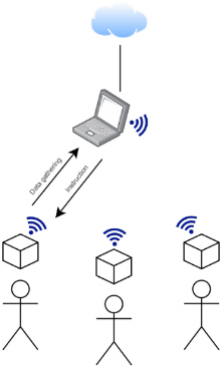
USING CONNECTED DEVICES In figure 1 it is presented a basic scheme of the principle of ICT on special education, each child can interact with a device preferably battery powe- red and including wireless communication, a master device (e.g., computer, tablet or smartphone) can connect to these tools to set instructions, program games or send messages, in the other direction devices send data about the user’s performance while doing the programmed activities usually through the use of different sensors like buttons, microphones, camera or touch screen in the case of screen-based products. The master device could store, orga- nize, process and generate statistics or push it forward to a server in the cloud to make it. The results are useful in diagnosing the child competences, providing feedback in order to adjust game difficulty or speed and finally monitoring progress on every topic. In this closed loop cycle intervene multi- disciplinary teams including professionals in pedagogy, psychology, language therapy, physical therapy and also technicians, software developers and engi- neers. Examples of proposals of this type with authors’ own perspective and contribution can be found in the research by (Bermeo-Zambrano et al. 2020) where a methodological model that uses expert systems and collaborative vir- tual environments is presented, the goal is to support educational inclusion for children with or without disabilities and special needs, validation is car- ried out with 30 professionals on special education from different areas and achieving reported acceptance rate of 80% (Bermeo-Zambrano et al. 2020).
Playful Approach Methods for Children with Special Educational Needs Based 171
Figure 1: Playful tools communicating wirelessly.
CONCLUSION
Special educational needs are present in almost every primary and elementary classroom with children dealing with a specific condition, learning disor- der or deficiency, many of them have a physical or mental impairment what makes an effective educational service even a bigger challenge. The playful approach faces this problem promoting a joyful and interactive mechanism for learning and combined with technological tools can noticeably improve the quality of educational process becoming an important tool for both teachers and students.
Specific equipment for children with SEN has been developed by many researchers, technicians, teachers and neuropsychologist in order to provide them opportunities and accessibility improvement.
REFERENCES
Amado Sanchez V.L., Islas Cruz O.I., Ahumada Solorza E.A., Encinas Monroy I.A., Caro K., Castro L.A. (2017) BeeSmart: A Gesture-Based Videogame to Support Literacy and Eye-Hand Coordination of Children with Down Syn- drome. In: Dias J., Santos P., Veltkamp R. (eds) Games and Learning Alliance. GALA 2017. Lecture Notes in Computer Science, vol 10653. Springer, Cham. https://doi.org/10.1007/978-3-319-71940-5_4 American Speech-Language-Hearing Association. (1991). Learning disabilities:
issues on definition [Relevant Paper]. Available from www.asha.org/policy. Bermeo-Zambrano F., Gonzílez-Arias K., Gálvez-Quezada J., Robles-Bykbaev V. and Leon-Pesantez A. (2020). “A methodological model based on expert systems to support the educational inclusion of children with special educational needs,” 2020 IEEE World Conference on Engineering Education (EDUNINE), pp. 1–5, doi: 10.1109/EDUNINE48860.2020.9149469. Brodin Jane (2005) Diversity of aspects on play in children with profound mul-
tiple disabilities, Early Child Development and Care, 175:7-8, 635–646, DOI: 10.1080/0300443042000266222
172 Moscoso-Montenegro and Serpa-Andrade
Conchinha C., Osório P. and de Freitas J. C. (2015) “Playful learning: Educational robotics applied to students with learning disabilities,” 2015 Inter- national Symposium on Computers in Education (SIIE) pp. 167–171, doi: 10.1109/SIIE.2015.7451669. LD Online. (2021) “What is a Learning Disability?”. Available at: http://www.ldonline.org/ldbasics/whatisld (Accessed: 01 March 2022) Kemp, G., Smith, M., Segal, J. (2020) Learning Disabilities and Disorders. Avai-
lable at: https://www.helpguide.org/articles/autism-learning-disabilities/learning- disabilities-and-disorders.htm (Accessed: 01 March 2022) Louis Rice (2009) Playful Learning, Journal for Education in the Built Environment, 4:2, 94–108, DOI: 10.11120/jebe.2009.04020094 McLeskey, J. and Waldron, N.L. (2011), Educational Programs for Elementary Stu-
dents with Learning Disabilities: Can They Be Both Effective and Inclusive?. Learning Disabilities Research & Practice, 26: 48-57. National Joint Committee on Learning Disabilities. (1983). Learning Disabilities: Issues on Definition. A Position Paper of the National Joint Committee on Lear- ning Disabilities, January 30, 1981. Learning Disability Quarterly, 6(1), 42–44. https://doi.org/10.2307/1510862 National Joint Committee on Learning Disabilities (2016). “"What are LD?”.
Available from https://njcld.org/ld-topics/ Plass, JL, Homer, BD & Kinzer, CK 2015, ’Foundations of Game-Based Learning’, Educational Psychologist, vol. 50, no. 4, pp. 258–283. https://doi.org/10.1080/00461520.2015.1122533 Salen, K., & Zimmerman, E. (2004). Rules of play: Game design fundamentals.
Cambridge, MA: MIT Press. Shaffer, D. W., Halverson, R., Squire, K. R., & Gee, J. P. (2005). Video games and the future of learning (WCER Working Paper No. 2005-4). Madison: University of Wisconsin–Madison, Wisconsin Center for Edu- cation Research (NJ1). Soares F., Carvalho V., Silva J., Pereira A. P., Moreira F., and Matos D. (2017). “Tech-
nology and special educational needs: Let’s play “Doing Good Deeds!”,” 2017 IEEE Global Engineering Education Conference (EDUCON), pp. 1482–1487, doi: 10.1109/EDUCON.2017.7943044. Torgesen, J.K. (2004). Learning Disabilities: An Historical and Conceptual Overview. Vaughn, S. and Linan-Thompson, S. (2003) ‘What Is Special About Special Education for Students with Learning Disabilities?’, The Journal of Special Education, 37(3), pp. 140–147. doi: 10.1177/00224669030370030301.
LISTED IN THE AHFE DIGITAL BOOKSTORE CATALOGUE
Explore the complete digital volume
Human Factors in Aging and Special Needs
Read this individual research paper free through the original publisher, or explore the full digital proceedings book.
ISBN 978-1-958651-14-8
Explore this ISBN in the AHFE Bookstore ↗Listed in the July 2026 bookstore catalogue; search by ISBN to confirm current availability · Digital book purchase optional