David Moscoso - Montenegro, Luis Serpa-Andrade (2022). Interactive Die as an Educational Tool for Children with Special Educational Needs. In: Design for Inclusion. AHFE Open Access, vol. 45, pp. 199–203. https://doi.org/10.54941/ahfe1001886
The die as we know is a small, throwable object with marked sides that can rest in multiple positions. Although there’s variations, the most common form of die is a cube with dots marked on each side with the aim of generating random numbers in tabletop games. This notion can be extended to the pedagogic field making use of recent technologies in connected embedded systems. This article presents the design and proof of concept of an interactive die as an educational tool for children with SEN. The die consists of a RGB LED matrix for each of its six sides so it can display any kind of low-resolution symbols like numbers, letters, arrows or multicolor patterns presented in the form of animations, additionally includes an IMU to obtain the cube orientation and user tap detection when selecting the presented option on top side, audible and haptic feedback
Traditional human computer interaction using PC mouse or keyboard, is not well suited for children who find difficulties, tangible computing can better support more independent exploration and experimentation for hete- rogeneous school groups of students with intellectual disabilities (Alper, 2012). The utilization of Information and Communication Technology (ICT) is not an unfamiliar thing and has reached almost every aspect of human life, including aspects of education and learning. The use of ICT has become a fundamental requirement in supporting the effectiveness and quality of the educational process, especially in supporting creativity and accuracy in the development and utilization of learning media. The need to develop learning media is not only necessary for public schools, but also for Special Education Needs (SEN), which is to educate and prepare children with special needs to be able to live independently in the society. SEN is an educational unit that aims to help learners who bear a physical and/ or mental disabilities to be able to develop the attitudes, knowledge and skills needed as individuals and members of society in the conduct of reciprocal relationship with their
social and cultural environment as well as to develop skills in the workplace or embark on further education (Saginari, 2015).
In this paper we present a new approach for a cube shaped, adaptive, tan- gible educational tool for children with special educational needs (SEN). This interactive die can represent symbols (e.g., letters, numbers, figures) in a RGB LED matrix on each side, senses its current orientation and tap detection by the user to select one of the options displayed, thus allowing to implement a variety of multichoice games to enhance learning in different areas, inclu- des wireless communication to enable data transferring with external devices and wider playful environments. The platform differs from related proposals using a cheaper fabrication technique, possibility of adding more features and being highly customizable.
RELATED WORK
Cube-shaped educational devices do not represent a new idea, the simple geometry, ease of use, the familiar notion of dice where each side has a different symbol we can recognize, enhanced by embedding computing capa- bilities within the object, may constitute a useful learning tool with a playful approach.
“LightSight” is a high-contrast illuminated dice that wiressly communi- cates with a dedicated game running on a tablet. The child has to match the patterns as displayed by the app selecting the side which has the correct shape and the associated color. The way the child interacts with the dice is rolling it and pushing an illuminated shape that acts also as a button. The concept aims to provide a playful way for children with cerebral visual impairment (CVI), which causes difficulties in their perception and processing informa- tion, to train their vision and related motor and cognitive skills through this simple and interactive toy. It is said to be useful for children up to 6 years (Salihodžic et al. 2018).
“Cueebe” (Fikar et al. 2018) is a cube-shaped stand-alone tangible toy focused on early intervention for visually impaired children allowing the- rapists to work with them to foster general development, to improve their learning, and to train sensory skills. It can detect colors and project them onto its surface in order to “magnify” those colors becoming a supportive tool in a playful manner. The way it works is sensing the color from the underlaying surface and replicating it trough an array of RGB LED-lights, the bottom of the cube acts as a button so the child can place their hands on top of the device and push it to update the color that is shown by acti- vating the sensor. In terms of dimensions, the Cuebe is a handheld artifact considering the children target group with 6x6x7 centimeters.
In (Terrenghi et al. 2006) it is presented a tangible learning appliance of this kind, a general learning platform with a playful interface consisting of a cube augmented with an embedded hardware platform controlling accelerometers, a small display on each of the six faces and a speaker inside. The actual function implemented by the authors is a multiple-choice test system where in each step in the child working session a question appears on one side of the cube (e.g., top display), the others show randomly distributed answers
Interactive Die as an Educational Tool for Children with Special Educational Needs 201
with just one that is correct, the user rotates the appliance to the side with the right answer and shake it to make the selection. Similarly, can act as a vocabulary trainer, a vocable that is to be translated is displayed on top and possible translations are shown on the other sides, to select the correct one the user shakes the cube. One of the most noticeable flaws (mentioned in the article) is that, although it is possible to determine which face of the cube is on top and sense longitudinal movement (e.g., shaking) it cannot determine orientation, that means, for example, the impossibility to sense rotation in the plane parallel to the ground.
“IQube” is a “learning cube, interactive, tangible and playing platform for children” (Stancovici et al. 2011), it can be used as a standalone learning tool or it can be associated with other cubes, this interaction between multiple devices is its most distinguishable feature compared to others and it is done using internal infrared sensors to monitor the cube position relative to its peers. The platform is based on a low-power microcontroller, has a LCD display on each side of the cube, includes an accelerometer, a vibrating motor, a buzzer and a RGB led for indicating status and position. All the devices communicate to one another and to a central node by using XBee wireless communication forming an ad-hoc network, in this way the central node can send images, change color of the cubes, announce game completion or failure as well as to receive cube’s position or current displayed image. The games tested are those that require multiple matching, like word matching or picture association, rotating the cubes and putting them in the correct order.
PROPOSED INTERACTIVE DIE Based on our review of similar cube-shaped or dice, interactive playing plat- forms we can say that although valuable contributions to enhance learning experience for children with and without special educational needs, any of them integrates all the characteristics we consider it requires to become an effective tool, these characteristics primarily are:
Usability
Adaptability
Scalability
Low cost
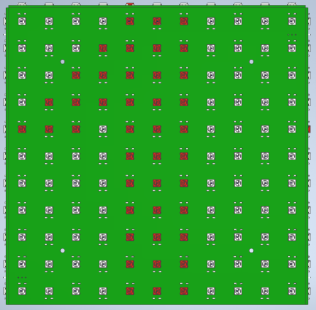
Ease of construction/maintaining The proposed device is a perfectly cube-shaped learning tool, each panel consisting of a RGB led matrix with 11 × 11 pixels providing a number of 121 pixels per side and 726 LED lights in total (figure 1). With dimensions of 20 × 20 x 20cm, the size has been chosen to promote gross motor skills by rotating, throwing or kicking the object as the game require or allow it. The panels are rigid printed circuit boards (PCBs) made of FR4, a composite material which is the most used for this purpose due to its low cost and high durability, the boards contain the LEDs placed in a perfectly uniform matrix pattern with the circuitry and connectors on the back to be driven by an embedded controller. The panels are supported internally by a plastic 3D printed structure that also holds the main controller and rechargeable battery placed at the center of gravity to achieve a balanced body. Each side
202 Moscoso-Montenegro and Serpa-Andrade
Figure 1: Representation of the die showing the number one in red.
could be be covered with a protective and transparent material like acrylic to resist impacts during playing sessions. Its design allows to be easily opened by removing one of the walls attached with screws, in order to do reparations or any kind of configuration. A key factor for our proposal is customization to make it usable to the most possible number of children, adapting the platform to his/ her needs. Adaptability starts with the size of the cube, PCB panels can be dimensioned to work on different skills, games and at different ages. Pixel density can also be modified to favor image resolution or battery life, even pixel pattern could be modified to display only predefined symbols, RGB LEDs could be replaced by simple unicolor ones saving costs even further. In terms of features a variety of sensors can be included in the main controller board internally or on the panels taking advantage of the PCB that can hold sensors and its circuitry directly in between the lights. Developed prototype testing have been done including a inertial measurement unit (IMU) to get information about cube’s orientation and tap detection when child selects a figure, a simple user interface, additionally sound and haptic feedback shows great acceptance and useful applications for many cases.
The concept differs from previous related works mainly because of its adaptability in the way that it can dynamically represents colors, figures or symbols (Figure 1) in comparison to more static, existing approaches where the device has predefined patterns to reinforce cognitive or motor skills of a specific area like math, language, sensorial perception, etc. All of this ada- ptation capability is paired with wireless communication in order to set an interface and receive data from the die so it can work in junction with apps for tablets or pc’s and even coupled with additional dedicated inclusive tools.
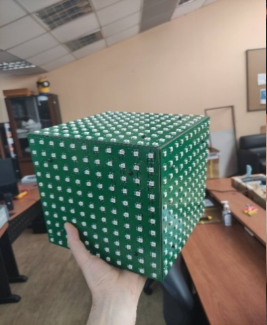
At the moment the device is in a proof-of-concept stage (figure 2) with the main hardware functional and serving as a platform so we can experiment with different processors, sensors, interfaces and enclosure techniques. The experimentation and modifications will be accompanied with therapist to supervise the child behavior and interaction with the toy, the vision is to per- form an iterative design process improving key areas, adding useful features and finally validate a final version of the die as an effective tool for children with SEN.
Interactive Die as an Educational Tool for Children with Special Educational Needs 203
Figure 2: Proposed interactive die prototype.
CONCLUSION
Assistive toys allow playful and enhanced learning experience for children with special educational needs and has a great potential to make a positive impact in the way children acquire knowledge and skills. Tangible user inter- faces bring closer embedded computing systems in the form of toys, games and tools in a constructive interaction. This article presented the concept of a new interactive die as a learning tool for children with SEN that is highly customizable, cheaper than other alternatives, being adaptable for various use cases.
REFERENCES Alper M., Hourcade J., and Gilutz S. (2012). Interactive technologies for children with special needs. In Proceedings of the 11th International Conference on Inte- raction Design and Children (IDC ‘12). Association for Computing Machinery, New York, NY, USA, 363–366. DOI: https://doi.org/10.1145/2307096.2307169 Hana Salihodžic, Konstantin Zilberburg, Niloufar Chakhmaghi, Florian Güldenp-
fennig, Peter Fikar, and Roman Ganhör. 2018. LightSight: A Dice to Meet the Eyes. In Proceedings of the 2018 ACM Conference Companion Publication on Designing Interactive Systems (DIS ‘18 Companion). Association for Compu- ting Machinery, New York, NY, USA, 331–334. DOI: https://doi.org/10.1145/ 3197391.3205399 Peter Fikar, Florian Güldenpfennig, and Roman Ganhör. 2018. The Cuebe: Facilitating Playful Early Intervention for the Visually Impaired. In Proceedings of the Twelfth International Conference on Tangible, Embedded, and Embodied Inte- raction (TEI ‘18). Association for Computing Machinery, New York, NY, USA, 35–41. DOI:https://doi.org/10.1145/3173225.3173263 Sagirani T., Nugroho L. E., Santosa P. I. and Kumara A. “User experience model
in the interaction between children with special educational needs and learning media,” 2015 2nd International Conference on Information Technology, Compu- ter, and Electrical Engineering (ICITACEE), 2015, pp. 72–75, doi: 10.1109/ICI- TACEE.2015.7437773. Stancovici A, Szanto O., Ardelean V., Barbatei R. and Marcu M., “IQube: A cube for learning,” 2011 IEEE International Games Innovation Conference (IGIC), 2011, pp. 89–92, doi: 10.1109/IGIC.2011.6114951. Terrenghi, L., Kranz, M., Holleis, P. et al. A cube to learn: a tangible user interface
for the design of a learning appliance. Pers Ubiquit Comput 10, 153–158 (2006). https://doi.org/10.1007/s00779-005-0025-8
LISTED IN THE AHFE DIGITAL BOOKSTORE CATALOGUE
Explore the complete digital volume
Design for Inclusion
Read this individual research paper free through the original publisher, or explore the full digital proceedings book.
ISBN 978-1-958651-21-6
Explore this ISBN in the AHFE Bookstore ↗Listed in the July 2026 bookstore catalogue; search by ISBN to confirm current availability · Digital book purchase optional