Luis Serpa-Andrade, Roberto García-Vélez, Graciela Serpa-Andrade (2022). Inclusion of people with ADHD in school, college, university and work. In: Design for Inclusion. AHFE Open Access, vol. 45, pp. 224–235. https://doi.org/10.54941/ahfe1001890
1 Research Group on Applied Embedded Hardware – GIHEA, Universidad Politécnica Salesiana Cuenca, Ecuador; Research Group on Artificial Intelligence and Assistive Technologies – GIIATa Universidad Politécnica Salesiana, Cuenca, Ecuador ↗
2 Research Group on Applied Embedded Hardware – GIHEA, Universidad Politécnica, Salesiana Cuenca, Ecuador ↗
The inclusion of people with Attention Deficit Impulsivity and Hyperactivity Disorder (ADHD), in school, college, university, and work has been developing since the nineteenth century because this disorder has similar symptoms to those of a hungry infant, an anxious or antisocial child, a young impetuous or otherwise without social contact, immature adults, lacking an order or commitment; but in the past it was derived from the responsibility of the elders, from the values instilled and from the culture, from the society itself, where they grew up. The inclusion of people with this disorder is due to a multidisciplinary intervention, family interaction, academic-labor-social, therapies, variety of neurobiological specialists, implementation of Educational Integration Projects (PIE) where the entity and its different human and physical resources must adapt to the students to achieve inclusion; the methodologies and processes of inclusion vary according to the field, that is, in the labor part with respect to the entities of initial, middle, and higher education.
Attention deficit, impulsivity, and hyperactivity disorder (ADHD) is a neuro- biological anomaly that interferes with physical and mental synchronization causing difficulties to the individual in all activity performed, this disor- der causes alterations in the mechanisms of executive control affecting their memory, emotions, language with thoughts, and vision of their reality in a negative way (Gasteiz, 2020). ADHD is hereditary in 80%, 10% by genetic factors premature, low birth weight, and also by socio-environmental factors such as in the stage of pregnancy: the mother was subject to abuse, malnu- trition, lived or frequented contaminated places, or at the time of birth there was no proper care or was in precarious conditions (Ureña Morales, 2007). This disorder can develop at any stage of the individual by blows to the head, accidents, neurobrain trauma.
Inattention or fleeting attention, hyperactivity, and impulsivity and their combination constitute the axes of ADHD; in addition, this disorder can merge with others (Mateu Gollart & Sanahuja Ribés, 2020). Reason why
Inclusion of People with ADHD in School, College, University, and Work 225
its diagnosis is complicated because its symptoms are similar to a bad beh- avior of the person, in the different stages of life, for example, in school performance, infants make mistakes due to carelessness, their work is disor- dered, incomplete, and carried out without reflection, in the work or social performance is presented: negativism, aggressiveness, low self-esteem, emo- tional instability, among others: that is; have difficulty learning (de la Parra Yelincic, 2015; Medranoa & Leóna, 2016). The difficulty in learning, also known as special educational needs (SEN) includes the coexistence of various anomalies that can be grouped into several groups of disorders that may or may not coexist with ADHD or belong to one of its axes or types(Romero Pérez et al., 2005).
This disorder was identified in the 1960s because before the sym- ptoms were attributed to school problems (PE), low school performance (BRE), learning difficulties (DA), borderline intellectual disability (DIL), lack of care of their parents, among others; and since the 1990s it has begun to progress thanks to the advancement of technology, combined and multicomponent programs that facilitate intervention from an early age collectively with medical-pharmacological and psychoeducational tre- atments; therapeutic strategies and medications (Liesa Orús et al., 2017; Ramos-Quiroga, 2009; Rubiales et al., 2011), one of these interventions is cognitive behavioral therapy that provides enormous information capa- ble of simulating daily activities and providing various responses (Mesa Mas, 2018), where the individual with ADHD copies and creates solu- tions to the different situations they face daily, either; at home, school, college, university or work allowing their attitudes to increase positi- vely and progressively increasing their adaptation to society, changes their style of seeing reality, cognitive behavioral therapy (CBT) interferes in vision and negative thinking resulting in environment-positive thinking- response, solution or adaptive behavior (Fontecha & Sánchez, 2017; Pérez Galán et al., 2014).
We also have inclusive institutions where they value cultural-economic- social diversity, they have Inclusion Projects and Educational Integration Programs – PIE that constitute specialized multidisciplinary teaching-learning strategies that continuously evaluate both the academic-social learning of the participants with or without special educational needs progressively and the collaborative work of the educational community: teachers, technicians, assi- stants, environment, that is, human and physical resources of the inclusive entity (MINEDUC, 2016).
EVOLUTION Several studies indicate that the evolution of ADHD depends on age, the type of ADHD, and gender; It has been classified into the following general groups of ADHD: attention deficit, hyperactivity, impulsivity, combined, and ADHD with functional diversity, that is, ADHD simultaneously with other disorders; that can last a person’s entire life or appear from astroke. It can be identified by the duration of symptoms, usually if they stay more than six months both at home and at school because their character is changeable,
they can be passive at school and impulsive, restless at home, or the opposite (Ureña Morales, 2007).
Treatment of ADHD is multimodal with drugs and various therapies such as psychosocial stimulants, in children it is recommended that their treatment be with therapies and that they are prescribed, only if it is strictly necessary; 3% of children identified with ADHD in schools take medications that are addictive, decreasing their movement in classrooms and exacerbating their learning difficulty (Mateu Gollart & Sanahuja Ribés, 2020; Medranoa & Leóna, 2016).
The attention deficit is the most difficult to determine because in the school stage studying second grade onwards, they begin to emphasize their school performance, teachers to notice what difficulties the child has to learn due to lack or little concentration, has a fleeting, selective, or short-term atten- tion according to the assigned task, if it is to your liking and you are easily distracted from a routine activity. On the other hand, indicators of hypera- ctivity are noticed from 0 to 2 years the moment of sleep the infant suffers from myoclonics, problems in the rhythm of sleep, startles when waking up, irritability to sounds, from 2 to 3 years anomalies in both oral and body lan- guage, excessive movement of their limbs, suffer numerous accidents, from 4 to 5 years: disobedience, does not respect shifts; hyperactivity in adolescence, 11–13 years decreases their motor activity and increases impulsive cognitive; and from the age of 5 for parents and 6 years for teachers: impulsivity stands out, interrupts any activity, wants to be the center of attention, act without thinking, uneasy, do not have patience, change of attitude from unruly to absent, in itself; and the combined ADHD and ADHD various dysfunctions from 1 or 2 years due to: their difficulty expressing themselves orally and bodily, startles when sleeping, hearing problems, motor-linguistic difficulties (de la Parra Yelincic, 2015; Liesa Orús et al., 2017; Ramos-Quiroga, 2009; Rubiales et al., 2011).
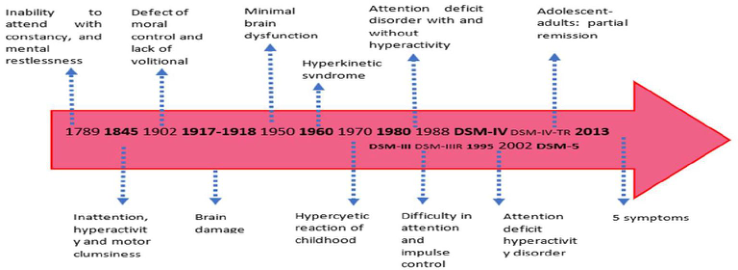
We can also mention that the hyperactive-impulsive ADHD subtype is four times more frequent in men than in women, and ADHD with attention deficit is two to one(Gasteiz, 2020). The course of TDHA, before the 1960s, its beh- avior was attributed to poorly instilled values as a result of the irresponsibility of their elders, hostile environment, and wandering; the first cases are reco- gnized in 1960 and they were treated only by administering stimulant drugs individual, in the 1970s they were prescribed drugs and behavioral therapy, especially to children and adolescents because the drugs had side effects, they are addictive; for the 80s, epidemiological and categorization aspects are con- sidered, predominating Psychoeducational, behavior, with which cognitive behavioral treatments appear for all stages: infant, childhood, adolescence, youth, and adult; from there, studies continue to be carried out on possible treatments that allow the integration and inclusion of everything (Fontecha & Sánchez, 2017; Ibáñez-Tarín & Manzanera-Escartí, 2012; Unicef, 2021).
The following is a summary of the evolution of ADHD according to age, gender, and type of ADHD (see table 1) and historical (see figure 1):
Inclusion of People with ADHD in School, College, University, and Work 227
Table 1. Summary of the evolution of ADHD by age, gender, and type.
Table available in the original PDF paper.
Guy Age Symptoms Gender: male- female 2-1 Attention deficit 0-2 Absent or Fleeting Attention, maximum task of 7 minutes
4-1
2-3 Fleeting attention: Maximum task of 9 minutes 3-4 Fleeting attention: Maximum task of 13 minutes 4-5 Maximum task of 15 minutes from 5 years Selective attention, do not complete tasks for a maximum of 30 minutes, lose interest, get distracted, Short-term care: they do not meet schedules; forgetful, they live that moment without thinking about the consequences hyperactivity 0-2 Sleep problems 4-1 2-3 years Expression deficit 4-5 years Impatience, disobedience From 5 years Extremely restless, unruly Impulsiveness From 5 years They interrupt any activity, thoughtless, multifaceted: calm-restless 4-1 combined Not expressed, startles, change of attitude from aggressive to passive, lack or little behavioral inhibition
ADHD with functional diversity
0-2 years ADHD with sleep disorders such as eating disorders, ASD, Dow syndrome From the age of 2
ADHD with disorders such as language, hearing, motor, visual, sleep, anxiety, fears and phobias, eating, self-esteem, intellectual disability, etc.
EDUCATIONAL INTERVENTION “ADHD is a specific term that refers to a group of school and nonschool disorders, which manifests as significant difficulties for family, school and social learning and adaptation” (Romero Pérez et al., 2005). Currently we have different technological resources that reinforce learning and teaching; facilitate the inclusion of people with educational needs with learning dif- ficulties, in particular; students with attention deficit hyperactivity disorder -ADHD that allow us to perform collective activities such as therapeutic lear- ning games together with technological tools such as a therapeutic robot that constantly analyzes and evaluates each and every one of the individu- als involved: families, learners, collectivity; since inclusion is about general
education, focuses on the capacities of each one, has principles of equity, coo- peration, and solidarity; is the interaction of home, education-labor, social, multi-specialists and the individual to be treated, which is why it provides what each of those involved needs enjoying the same rights, in this case peo- ple with ADHD are helped with schedules, schedules, schemes, concept maps and / or digital agendas that reminds them of their daily activities allowing them to be more organized, respect shifts, greater control of their emotions, that is, inclusion is given by a collective learning that allows personal and social growth in equal conditions (Balbuena Aparicio et al., 2014; Cortés et al., 2017; Estévez & Guerrero, 2017).
In all stages of the individual, it is complex to differentiate people with ADHD from those who do not, since the symptoms are similar to the beha- vior of evolutionary development, the older their age is confused with poorly educated people, without social friction, or are considered conflictive subje- cts (Millán, 2012). The Educational Integration Program– PIE, an inclusive tool that adapts both human and physical resources to the needs of peo- ple with learning difficulties, strengthening a diverse cultural-economic-social educational system, promoting the collaboration of different establishments, disseminating pedagogical practices (MINEDUC, 2016). In these programs, both teachers and the community of their environment have to be aware that a 10-year-old child with ADHD is similar to a student of 7 years, aboy of 18 with TDHA is equal to a student of 12 to 13 years, human resources have to appropriate their socioemotional development that is deficient and stimulate them to improve it; providing them with a guide, a control of beha- vior through the internalization of language that is acquired unconsciously in the game, in music, dance, theatrical works of situations lived by people with ADHD, sports, yoga, meditation, recreational activities or methodologies and mediations implemented by the teacher and motivating them to create pos- sible ways of acting in any situation that is presented to them in an adaptive way (Vieites-Novio, 2018; Zambrano et al.) (see Figure 2); all this involves coupling the physical environment in such a way that it is not distracted, pla- cing it between model people, workplace large enough to perform activities standing or on the ground, activities according to your taste or that do not
Inclusion of People with ADHD in School, College, University, and Work 229
take long to execute them, assign a gradual time according to the difficulty of the action, a schematic schedule or digital timeline, an audio-visual support to remind you of daily goals, motivate them with clear, concrete dialogues and simple rewards (Rocha Tayupanta, 2020; United Nations Educational & Organization, 2020). In most institutions, it has been coupled and com- mitted to promoting the integration and inclusion of people with learning difficulties by compensating their socioeducational needs with all the physi- cal and human resources they possess with the conception that we all learn (Ramos, 2015).
SCHOOL STAGE In the school stage, it is difficult to differentiate the symptoms of ADHD since its attitude is similar to an infant without special educational needs; they are aggressive, restless, do not concentrate, do not respect shifts, do not pay attention, are not orderly, lose things, do not complete tasks, act without thinking, do not measure danger, labile emotionally, are considered unruly, among others (Estévez & Guerrero, 2017; Ureña Morales, 2007); these attitudes not only harm the child with ADHD by being rejected, avoi- ded by other children; but to the whole group in the environment there is discord, fear, less attention to the teacher, neglect of learning (Rocha Tayupanta, 2020; Romero Pérez et al., 2005); so the teacher must adopt teaching methods that involve everyone in a creative, fun way, must fit the need of their students; which is the objective of the Educational Integration Program – PIE.
The best way to reach children is play, art, and/or sports, activities that include cognitive behavioral therapy. This therapy is multimodal, tre- ats the whole, group; to particle, individual; treats all students, including family educators-community, and constantly diagnoses in such a way that the whole group progressively advances without distinction (Ibáñez-Tarín & Manzanera-Escartí, 2012; Paltín Pacheco & Romero Bustillos, 2019; Pineda, 2016) (See Table 2).
COLLEGIATE AND UNIVERSITY STAGE Children and adolescents with ADHD are described as poorly educated and insensitive, challenging behavior persists, increases, or appears due to neuropsychological injuries and socio-environmental factors: contaminated places, socioeconomic precarious sites, these students put resistance to the authority of the learners creating deep gaps in the teaching-learning rela- tionship; that it impairs their development, their performance because it increases their cognitive impulsivity and decreases their motor impulse (Ureña Morales, 2007); in university students with ADHD the consequences of their symptoms are complicated, they do not plan, they lose time, they postpone routine or academic activities, they are not clear about their goals, they are disorganized, a deficit in inhibitory control that affect their lifestyle (Medra- noa & Leóna, 2016); the teacher must be sensitive and adapt to students of special educational needs providing security with a calm body expression,
Table 2. Playful methodology: emotional training for a 6-year-old (Mateu Gollart & Sanahuja Ribés, 2020).
Table available in the original PDF paper.
Number Objectives Methodology Time 30’- 45’ Mastery of emotions Facial recognition of emotions: joy, sadness, anger, surprise, fear, shame, doubt. Encourage attention.
6 tokens are distributed for each participant. It is the classic game of dominoes in which two tiles must be placed with the same face, one next to the other. You can talk about the characteristics of each of the faces so that the child internalizes the characteristic features.
30’- 45’
Memori- emotions
Facial recognition of emotions: joy, sadness, anger Foster memory.
The cards are dealt on the table randomly and pairs must be made of the cards that are the same. Whoever has more partners wins.
30’- 45’
Mysterious box
Facial recognition and interpretation of emotion.
In a box are the tiles of the emotions and by turns, a card is drawn and the same thing that comes out in the card must be done so that the other player recognizes the emotion.
20’
In a mirror, each participant performs an emotion and the other person has to get it right.
Mirror Facial recognition and interpretation of emotion.
30’- 45’
Who’s Who
Expression of emotions.
Each player takes a card from the deck and puts it on his forehead without looking at it, and through questions to the other participant, must guess what emotion he has on his forehead.
10’- 15’
Recognize the emotion you feel at that moment.
Calendar of meetings
At the beginning of the session, the child must put in the file of how I feel today, the emotion he is feeling at that moment using the drawings (cutting and pasting) and explain why, if the child is not able to write, the teacher puts the explanation that the child gives.
10’- 15’
Calendar of meetings
Recognize the emotion you feel at that moment.
At the beginning of the session, the child must put in the file of how I feel today, the emotion he is feeling at that moment using the drawings (cutting and pasting) and explain why, if the child is not able to write, the teacher puts the explanation that the child gives.
eye contact and simple, positive and serene language; that motivates you to observe, listen and adopt that attitude to respond to your speaker (de la Parra Yelincic, 2015).
Inclusion of People with ADHD in School, College, University, and Work 231
Table 3. Strategies for Preschool and School Students with ADHD.
Structured Physical Environment Simple tasks Gradual time according to the task (Millán, 2012)
Spacious workplace that allows you to perform tasks standing and, on the floor, quiet companions, visible routine, clear and concrete orders, one-hour activity divided into three parts, and reward you by completing each part (Gasteiz, 2020; Unicef, 2021).
Control restlessness auto-controlled activity (Mesa Mas, 2018).
Going up and down steps before a task, assigning daily activities that allow you to move during class such as erasing the blackboard, training your classmates when entering or leaving the classroom for recess, giving controlled times according to the difficulty of the task, planning group activities that demand movement, for example, every half hour for 5 minutes (Mateu Gollart & Sanahuja Ribés, 2020; Pérez Galán et al., 2014).
Robotic technologies in the care of ADHD have been an important advance.
A robotic assistant and a smart environment assist a child with ADHD to complete his/her homework avoiding any kind of distractions (Berrezueta-Guzman, Pau, et al., 2021; Berrezueta-Guzman, Robles-Bykbaev, et al., 2021; Dolón-Poza et al., 2020; López-Pérez et al., 2020).
Assist children with ADHD during the development of homework (Berrezueta- Guzman et al., 2020).
Motivate and teach with fun (Zambrano et al.).
Decrease the impulsivity Behavior control Safety
Read stories, perform plays of daily situations that children face and their possible responses to them. helping them to use self-directed speech, to train solutions, positive instructions for their behavior, encourage self-criticism, self-evaluation, and self-reinforcement (Bravo Decimavilla, 2019; Sigua Guarango, 2020).
Students with TDHA receive help in addition to the teacher of information and communication technology (ICT) tools such as digital agendas where they are reminded of their tasks, computers and projectors that highlight important concepts, obtaining complete notes, visualize the tasks as many times as they need and can complete them in less time, increasing their per- formance, allowing them to learn at their own pace, increases confidence decreases frustrations and motivates them to continue learning by rewards created in therapeutic software; they receive the same opportunities as the rest of the students with the help of ICTs that comply with the principle
of equity and inclusion in learning by creating auditory and tactile visual channels (Cortés et al., 2017; Guerrero, 2021; Morales et al., 2020).
WORK STAGE Adults with ADHD present emotional instability, disorganization, impulsi- vity, poor money management, low self-esteem, irritability, impatient, easily distracted by any thought or object wasting time to fulfill their activities, among others; the evolution of hyperactivity is not uniform or specific; so young and adult have antisocial behaviors and are even delinquents, they are the ones who suffer the most from being altered have negative conse- quences that make them more vulnerable (Balbuena Aparicio et al., 2014; Cortés et al., 2017), hence the importance of detecting this disorder at an early age; since 25% of those who have been treated throughout their lives evolve positively decreasing the possible problems they face and 75%, most have a deficiency in planning actions for a goal due to hyperkinetic behavior, a short-term memory or lack of concentration, and others are criminals.
As for impulsivity, they are impatient, misplaced comments, lack of empa- thy, social disinhibition (Ramos-Quiroga, 2009; Vieites-Novio, 2018). In the work stage, generally individuals with ADHD have problems with their boss, with the schedule, long tasks, friction with their peers due to aggres- siveness or lack of attention, economic oversights, their partners do not understand them, they suffer abandonment, their self-esteem is low, some suf- fer depression and resort to drugs and alcohol. UNICEF and WHO demand the implementation of integration and inclusion in all entities, and it is an obligation to have a percentage of employees with special needs and their facilities coupled to them (Ramos, 2015; Unicef, 2021).
CONCLUSION
In conclusion, the evolution and inclusion of people with attention deficit, hyperactivity, and impulsivity disorder -ADHD is in gradual development trying to reduce treatments with drugs that mostly have side effects espe- cially in the period of childhood and adolescence and compensate them with inclusive therapies, playful methodologies such as cognitive behavioral therapy that can treat most disorders and be implemented both in tech- nological tools how to be adopted by the human resources of all kinds of educational or socioeconomic entity and applied from childhood with- out distinction helping from the core of society, family, towards every life cycle.
REFERENCES
Balbuena Aparicio, F., Barrio García, E., González Álvarez, C., Pedrosa Menéndez, B., Rodríguez Pérez, C., & Yágüez Soberón, L. A. (2014). Orientaciones y estrate- gias dirigidas al profesorado para trabajar con alumnado con trastorno por déficit de atención e hiperactividad.
Inclusion of People with ADHD in School, College, University, and Work 233
Berrezueta-Guzman, J., Pau, I., Martín-Ruiz, M.-L., & Máximo-Bocanegra, N.
(2020). Smart-home environment to support homework activities for children. IEEE Access, 8, 160251–160267. Berrezueta-Guzman, J., Pau, I., Martín-Ruiz, M.-L., & Máximo-Bocanegra, N.
(2021). Assessment of a robotic assistant for supporting homework activities of children with ADHD. IEEE Access, 9, 93450–93465. Berrezueta-Guzman, J., Robles-Bykbaev, V., Pau, I., Pesántez-Avilés, F., & Martín- Ruiz, M.-L. (2021). Robotic Technologies in ADHD Care: Literature Review. IEEE Access. Bravo Decimavilla, C. M. (2019). Atención educativa integral en estudiantes de 10
años de edad con trastornos de déficit de atención e hiperactividad en la uni- dad educativa fiscal Tnte. Hugo Ortiz Guayaquil, período lectivo 2017-2018 Guayaquil: ULVR, 2019.]. Cortés, C. C., Martínez-Figueira, M. E., & Raposo-Rivas, M. (2017). LAS TIC PARA LA INTERVENCIÓN EDUCATIVA EN TDAH: UN ESTUDIO BIBLIO- MÉTRICO. Perspectiva educacional, 56(3). de la Parra Yelincic, M. M. (2015). Evaluación de aprendizajes de alumnos con tra-
storno de déficit atencional con y sin hiperactividad y que asisten a colegios con proyectos de integración a partir de la opinión de docentes y coordinadoras del proyecto de integración Pontificia Universidad Catolica de Chile (Chile)]. Dolón-Poza, M., Berrezueta-Guzman, J., & Martín-Ruiz, M.-L. (2020). Creation of an intelligent system to support the therapy process in children with ADHD. Conference on Information and Communication Technologies of Ecuador, Estévez, B. E., & Guerrero, M. J. L. (2017). Inclusión educativa del alumnado
con TDA/H: estrategias didácticas generales y organizativas de aula. Revista de Educación Inclusiva, 8(3). Fontecha, P. D. D. C., & Sánchez, J. I. M. (2017). de Práctica Clínica sobre las Intervenciones Terapéuticas en el Trastorno por Déficit de Atención con Hipera- ctividad (TDAH). Guía de Práctica Clínica sobre las Intervenciones Terapéuticas en el Trastorno por Déficit de Atención con Hiperactividad (TDAH). Ministerio de Sanidad, Servicios Sociales e Igualdad. Instituto Aragonés de Ciencias de la Salud (IACS), 175–186. Gasteiz, V. (2020). Propuestas inclusivas para la intervención con el alumnado con
necesidades específicas de apoyo educativo. Guerrero, J. P. S. (2021). Information and Communication Technologies: 9th Conference of Ecuador, TICEC 2021, Guayaquil, Ecuador, November 24–26, 2021, Proceedings. Springer Nature. Ibáñez-Tarín, C., & Manzanera-Escartí, R. (2012). Técnicas cognitivo-conductuales
de fácil aplicación en atención primaria (I). SEMERGEN-Medicina de familia, 38(6), 377–387. Liesa Orús, M., Latorre Cosculluela, C., & Vázquez Toledo, S. (2017). Habilidades sociales de niños con déficits atencionales y contextos escolares inclusivos. Revista española de orientación y psicopedagogía. López-Pérez, L., Berrezueta-Guzman, J., & Martín-Ruiz, M.-L. (2020). Development
of a home accompaniment system providing homework assistance for children with ADHD. Conference on Information and Communication Technologies of Ecuador, Mateu Gollart, L., & Sanahuja Ribés, A. (2020). Evaluación e intervención en TDAH y TND: Un caso abordado en el contexto escolar.
Medranoa, A. L. J., & Leóna, S. O. (2016). Trastorno por dé cit de atención en la edad adulta y en universitarios. Revista de la Facultad de Medicina UNAM, 59(5), 6–14. Mesa Mas, E. (2018). Terapia cognitivo-condutual en niños y adolescentes con
ansiedad. de XIX Congreso Virtual Internacional de Psiquiatría-INTERPSIQUIS. Psiquiatria. com. Millán, M. J. (2012). Propuesta de metodología docente para alumnos con TDAH MINEDUC. (2016). Programa de Integración Escolar PIE. Ley de Inclusión 20.845.
Manual de apoyo a la inclusión escolar en el marco de la reforma educacional. In: Gobierno de Chile Santiago, Chile. Morales, G. R., Salgado, J. P., Pérez-Gosende, P., Cordero, M. O., & Berrezueta, S.
(2020). Information and Communication Technologies: 8th Conference, TICEC 2020, Guayaquil, Ecuador, November 25–27, 2020, Proceedings (Vol. 1307). Springer Nature. Paltín Pacheco, A. B., & Romero Bustillos, J. (2019). ANÁLISIS DE LA FASE DE EVALUACIÓN EN NIÑOS DE 6 A 11 AÑOS QUE PRESENTAN DEFICIT DE ATENCIÓN, PROYECTO “NIÑEZ POSITIVA Universidad de Guayaquil Facultad de Ciencias Psicológicas]. Pérez Galán, R., Leiva Olivencia, J. J., & Guerrero López, J. F. (2014). Acciones
educativas de éxito con alumnado con (TDA-H) en una escuela inclusiva. Revista RUEDES, 3(5). Pineda, M. (2016). Trastorno por déficit de atención e hiperactividad en las escuelas de San Pedro Sula, 2016”. Honduras. Obtenido de https://www. google. com/url. Ramos, C. (2015). Prevalencia del trastorno por déficit de atención con hiperacti-
vidad en estudiantes ecuatorianos. Revista científica y tecnológica UPSE, 3(1), 13–19. Ramos-Quiroga, J. A. (2009). TDAH en adultos: factores genéticos, evaluación y tratamiento farmacológico. Universitat Autònoma de Barcelona. Rocha Tayupanta, G. E. (2020). Estudio de los trastornos de comportamiento (TDA-
TDAH) en educación básica superior 8.°, 9.° y 10.° de la Unidad Educativa Particular Santo Domingo de Guzmán como discurso de poder durante el año 2018 Quito, EC: Universidad Andina Simón Bolívar, Sede Ecuador]. Romero Pérez, J. F., Lavigne Cerván, R., Díaz Podadera, M. T., Gallardo Fortes, E., Niño Sánchez-Guisande, C., Niño Sánchez-Guisande, P., Paneque Pacheco, J., & Rodríguez Domínguez, R. (2005). Dificultades en el Aprendizaje: Unificación de Criterios Diagnósticos. I. Definición, Características y tipos. Rubiales, J., Bakker, L., & Mejía, I. D. D. (2011). Organización y planificación
en niños con TDAH: evaluación y propuesta de un programa de estimulación. Cuadernos de Neuropsicología/Panamerican Journal of Neuropsychology, 5(2), 145–161. Sigua Guarango, M. D. (2020). Estrategias para mejorar el déficit de atención en los niños del tercer grado de la escuela de Educación General Básica Cornelio Crespo Toral, del cantón Cuenca, 2018–2019 Unicef. (2021). Evaluación formativa del aprendizaje en contextos de provisión
remota de servicios educativos en América Latina y el Caribe. Revisión documen- tal, guías y herramientas. In: Panamá: Oficina Regional de Unicef para América Latina y el Caribe …. United Nations Educational, S., & Organization, C. (2020). Global education monitoring report 2020: Inclusion and education⣳All means all. 92310038.
Inclusion of People with ADHD in School, College, University, and Work 235
Ureña Morales, E. (2007). Guía Práctica con Recomendaciones de Actuación para los Centros Educativos en los Casos de Alumnos con TDAH. Islas Baleares: STILL. Asociación Balear de Padres de Niños con TDAH. Vieites-Novio, L. (2018). Intervención inclusiva en el Trastorno por Déficit de
Atención e Hiperactividad Villagómez Puebla, A. M. (2018). Diagnóstico y manejo de los niños con TDAH en el Ecuador. Zambrano, B. V., Salazar, L. O., Figueroa, A. T., & Grant, M. J. S. Orientaciones
para la inclusión de estudiantes en situación de discapacidad en la Universidad de Concepción.
LISTED IN THE AHFE DIGITAL BOOKSTORE CATALOGUE
Explore the complete digital volume
Design for Inclusion
Read this individual research paper free through the original publisher, or explore the full digital proceedings book.
ISBN 978-1-958651-21-6
Explore this ISBN in the AHFE Bookstore ↗Listed in the July 2026 bookstore catalogue; search by ISBN to confirm current availability · Digital book purchase optional