Daniele Busciantella-Ricci, Carlos Aceves-Gonzalez, Alessandra Rinaldi (2022). Design for Inclusive Attitude: towards a theoretical framework. In: Design for Inclusion. AHFE Open Access, vol. 45, pp. 1–9. https://doi.org/10.54941/ahfe1001863
1 Innovation in Design & Engineering (IDEE) Laboratory, Department of Architecture (DIDA), University of Florence, Florence, 50122, Italy ↗
2 Ergonomics Research Center (ERC), University Center for Art, Architecture and Design (CUAAD), University of Guadalajara, Guadalajara, Jalisco, 44250, México ↗
Seventy one percent of the world’s population live in countries where inequality has grown and the pandemic increased socioeconomic disparities and discriminations. As emphasised in education, healthcare, and migration, fostering an Inclusive Attitude is needed. The Inclusive Attitude is a concept mainly debated in psychology, sociology, anthropology and it has received less attention from a design research perspective. This paper proposes a theoretical framework for using Design for Inclusion to support Inclusive Attitude among the society. Starting from literature review, the paper compares the Inclusive Attitude concept with orders of design, design contents, design domains, continuum of design approaches, and domains of disciplines of Human Factors and Ergonomics (HFE). As a result, a conceptual framework is identified for studying the Design for Inclusive Attitude. Discussions and conclusions underline the essence of this new design approach.
This paper conceptualises visions and theoretical foundations for identifying an innovative systemic design approach for facing exclusions through Inclu- sive Attitudes among the society. The literature review about the Inclusive Attitude emphasises the needs for addressing this concept from a design per- spective. Therefore, this work creates a comparative analysis by placing the Inclusive Attitude within design research references. The main result under- lines possibilities for outlining a theoretical framework about the so-called “Design for Inclusive Attitude”. The main difference from traditional Design for Inclusion approaches is related to a paradigm shift from the design that produces inclusive artefacts to the design that takes care of societal attitu- des. It also exploits the designer’s ability “to contribute along a spectrum that ranges from design within existing paradigms [...] to design of and for radically new paradigms that challenge the status quo and are based upon equity and quality of life” (Irwin et al. 2020). What kind of design appro- ach would be conceptualised for addressing the Inclusive Attitude concept
from a design perspective? This is the main question we followed to build the conceptual framework of the Design for Inclusive Attitude and discuss possible theoretical development on this issue.
Inequality and Exclusion: The Need for an Inclusive Attitude Culture Social exclusion is a complex concept with multiple meanings (Taket et al. 2009), where ‘exclusion’ is a “dynamic, multi-dimensional processes driven by unequal power relationships interacting across four main dimensions - economic, political, social and cultural - and at different levels including individual, household, group, community, country and global levels” (Popay et al. 2008). In considering exclusion, ‘inequality’ is a crucial concept deter- mined by gender, age, origin, ethnicity, disability, sexual orientation, class, religion, and the income. The latter highlights that seventy one percent of the world’s population live in countries where inequality has grown (United Nations, 2019). In addition, the COVID-19 pandemic increased socioeco- nomic disparities and discrimination (Liu et al. 2020). Social exclusions also have economic impact; in Europe racial and ethnic discrimination causes loss to societies of between €2.4 and €10.7 billion annually (de Groot, 2021). Often, discriminatory attitudes drive exclusion (United Nations, 2016) and attitude towards diversity plays a crucial role among these issues (e.g., see Lakhani et al. 2014). Indeed, as emphasised in cases about education (León- Jiménez et al. 2020), healthcare (Donisi et al. 2020) and migration (Naveed and Wang, 2021), fostering an Inclusive Attitude culture is needed and can favour the growth of inclusive contexts. However, the Inclusive Attitude concept is mainly debated in interdisciplinary studies that mainly involve fields of research such as psychology, sociology, anthropology (Calloway and Copeland, 2021, Gasser et al. 2018, Rollè et al. 2021). Literature does not offer a specific definition of the Inclusive Attitude concept. However, by accepting a general definition of “attitude” as a “one’s routine predispo- sition toward an object or event” (Musgrove, 1998), we can understand a definition of the Inclusive Attitude concept as the predisposition with regard to the inclusion concept. From a design research perspective, the Inclusive Attitude has received less attention. The main contribution comes from the studies on Design for Inclusion (Reed and Monk, 2006) in terms of Design for All (DfA), Inclusive Design (ID) and Universal Design (UD), including spe- cific approaches such as Universal Design for Learning (UDL) (Rose, 2000), that do not provide a direct connection with the Inclusive Attitude concept. Traditionally, these design approaches focus on access to technology, envi- ronments, services and daily products by creating tangible solutions, and mostly focusing on elderly and disabled people. Also, the promotion of the Inclusive Attitude through the Design for Inclusion approaches is limited to indirect initiatives such as awards, labels, and living labs (see Design for All Foundation, n.d., Design for All Italia, n.d., Gray et al. 2014). No speci- fic services and initiatives aim to take care of the Inclusive Attitude in the society. ID, DfA, and UD research fields do not provide explicit strategies to spread Inclusive Attitude. They have been given less attention to the design of ‘intangible contents’ (Young, 2008) even if approaches such as the Inclusive
Design for Inclusive Attitude: Towards a Theoretical Framework 3
Service Design (ISD) (Aceves-González et al. 2016) are opening discussions on the connection between ID and Service Design (SD) (Busciantella-Ricci et al. 2020) in line with concepts such as Design for Service Inclusion (Fisk et al. 2018), and the ID 3.0 and 4.0 (Loughborough University, 2020). Therefore, the literature review presents gaps in the direct connection betw- een design and Inclusive Attitude, especially in those design disciplines related with intangibility. Advancements for fostering the Inclusive Attitude through design are needed.
METHODOLOGICAL APPROACH Starting from the gaps of the literature, this paper provides a comparative analysis to frame the Inclusive Attitude concept from a design perspective. With the aim to build a theoretical framework, we selected specific refe- rences that are (i) orders of design (Buchanan, 2001), (ii) design contents (Young, 2008), (iii) design domains (Jones, 2014), (iv) continuum of design approaches (Irwin, 2015, Irwin et al. 2020), (v) domains of disciplines of HFE (Karwowski, 2021). They were used to mapping the relationship between the Design for Inclusion and the Inclusive Attitude and building a conceptual and theoretical framework (Kivunja, 2018). Essentially, these references are models that address different perspectives of the contempo- rary design culture. We used them as maps where theoretically and visually exploring the relationships between the Inclusive Attitude concept and design thinking.
RESULTS
This paper presents a conceptual framework for studying the Inclusive Atti- tude from a design research perspective. The traditional approaches engaged in Design for Inclusion such as ID, DfA, UD (including UDL), and wider related approaches in the direction of Design for Social Inclusion do not expli- citly embed the Inclusive Attitude as one of the focusses of their processes. Even if not explicitly mentioned in design literature, the Inclusive Attitude is intrinsically considered as a value to be supported in these design approa- ches; but no specific studies interrogate these relationships. For this reason, we propose to consider a new design approach namely Design for Inclusive Attitude that studies the synergy between the design culture and the Inclu- sive Attitude concept. Therefore, this paper presents the Design for Inclusive Attitude framework that suggests transitions (i) from Design for Inclusion to Design for Inclusive Attitude; (ii) from inclusive approaches for designing, to designing for approaching Inclusive Attitude; (iii) from achieving inclu- sive contents (e.g., products, services, policies) through design, to conceiving contents that are able to foster Inclusive Attitude. At the same time, these are challenges that the Design for Inclusive Attitude is called to address with innovative researches, training programmes, and practices for a new genera- tion of citizens, activists, and individuals in general that, rather than define themselves “designers”, apply their skills and efforts in the direction of the Inclusive Attitude.
Design for Inclusive Attitude and Design Research Inclusive Attitude in design resides in design knowledge, therefore it resides in people, processes and products (Cross, 2006). In terms of people, we should consider the Inclusive Attitude both in those who design and in those who use designs. About processes, we should consider how the Inclusive Attitude affe- cts the tactics, the strategies and the methodologies to design. About products, there are designs that respect Inclusive Attitude principles and those that foster, and take care of the Inclusive Attitudes. Moreover, in terms of the rela- tionship between design research and the Design for Inclusive Attitude, we can consider the following aspects as early reflections to build the conceptual framework. Indeed, the comparison of the four orders of design (Buchanan, 2001) with the Design for Inclusive Attitude highlighted that the latter could be supported by all the orders based on the situation needs. However, the Inclusive Attitude of a certain context is mainly based on those intangible things that on material and tangible objects, symbols, and actions may only find metaphors or representations of a complexity. The Inclusive Attitude is a concern of the cultural environment and societal systems and the fourth order is the most appropriate to include it. A similar conjecture emerges from the analysis of the “World-view model of levels of design content” (Young, 2008). The “creation of meaning and purpose” (D3) is the most appropriate space for creating intangibilities, in terms of cultural contents and values for inclusion, and for using the Design for Inclusive Attitude. At the same time, even if ID, DfA, UD have been mainly applied for the purposes of the D1 and partially D2 spaces, they have the potential to be applied along the whole ten- sion line between the tangibility and intangibility. In this scenario, Design for the Inclusive Attitude can drive systemic challenges for addressing inclusive cultural and societal issues by integrating ID, DfA and UD and covering all the levels (from micro to micro). Ideally, from a design domains perspective (Jones, 2014) the Design for Inclusive Attitude mainly works at the level of “Design 4.0”. However, it may also be interpreted as an approach and a scope for each different level where (i) D.1 is engaged to ‘make’ products and com- munications that support the Inclusive Attitude in a given context, (ii) D.2 is engaged on products and services to have experience of the Inclusive Attitude, (iii) D.3 is engaged with strategies for organisational change in favour of the Inclusive Attitude, (iv) D.4 is engaged on transforming systems, making poli- cies, and addressing complex societal issues by taking care of the Inclusive Attitude culture. With a similar perspective, the Design for Inclusive Atti- tude seems to have a correspondence with the Transition Design logic within the “continuum of design approaches” (Irwin, 2015, Irwin et al. 2020). As in the Transition Design theory, Design for Inclusive Attitude focuses on radical-changes through design, by guiding and envisioning future paradigms and systems of inclusion. Finally, in terms of domains of disciplines of HFE (Karwowski, 2021), the Design for Inclusive Attitude takes care of the intera- ctions between the humans and the systems related to the culture, the beliefs and the values of contemporary society, in order to create a more inclusive set of interactions. Therefore, disciplines such as Macroergonomics, Ecolo- gical Ergonomics, Service Ergonomics, Community Ergonomics, Knowledge
Design for Inclusive Attitude: Towards a Theoretical Framework 5
Ergonomics can help to integrate a body of knowledge for designing within the purpose of the Inclusive Attitudes.
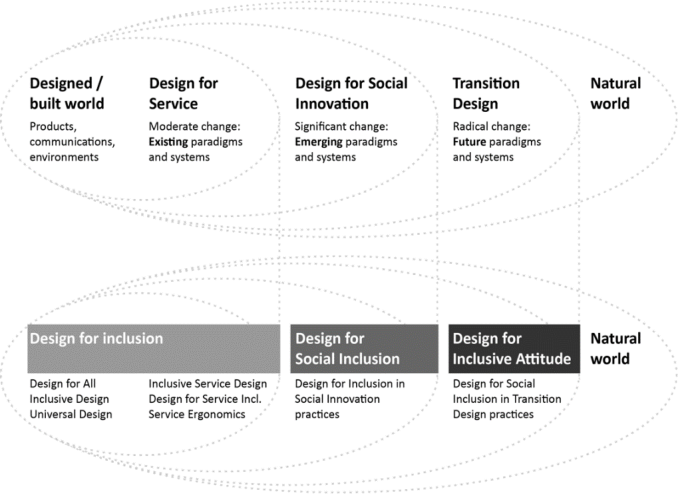
The Conceptual Framework: A General View Fig. 1 describes the conceptual framework of the Design for Inclusive Atti- tude. This visualisation receives all the information we discussed so far and that emerges from the comparison between the concept of Inclusive Attitude and the design perspective. The conceptual framework describes the logic and the theoretical framework of the Design for Inclusive Attitude. It is visu- ally and logically based on the continuum of design approaches within the Transition Design framework (Irwin et al. 2020). Therefore, according to this perspective, DfA, ID, and UD (including UDL) can be considered the corresponding design areas for the “Designed / built world” in the Transi- tion Design framework. We refer to these approaches under the common umbrella term of Design for Inclusion. According to the same logic, ISD, Service Ergonomics, and Design for Service Inclusion are the corresponding design areas of the Design for Service in Transition Design. Consequently, Design for Social Inclusion is compliant with the “Design for Social Innova- tion” area in the Transition Design framework. Finally, Design for Inclusive Attitude is the corresponding of the Transition Design concept. All the previ- ous design areas contribute to the Design for Inclusive Attitude. It drives the visions of change by contributing to the exploration of future paradigms and systems for inclusion through the design culture. Conceptually, the Design for Inclusive Attitude pull Design for Inclusion and Design for Social Inclusion design areas towards new visions and paradigms, while Design for Inclu- sion and Design for Social Inclusion contribute for finding radical inclusive changes, visions and paradigms towards the cultural drivers of the Design for Inclusive Attitude. The theoretical framework of the Design for Inclusive Attitude therefore involves the knowledge of the mentioned design areas that will be applied for future radical inclusive changes, visions and paradigms in order to take care of the Inclusive Attitude culture.
DISCUSSION AND CONCLUSION The conceptual framework helps to understand how doing research and pra- ctising the new design inclusivity approach by considering that Design for Inclusive Attitude addresses, supports, and promotes: (i) people attitudes that design inclusive outputs in order to spread and support Inclusive Attitudes; (ii) the processes for taking care of Inclusive Attitudes; (iii) the outputs that are able to spread and take care of Inclusive Attitudes among the society. Design for Inclusive Attitude mainly focuses on cultural aspects of inclusion from a systemic perspective. It aims to act on values, beliefs and social con- struct, and it starts from the belief that the Inclusive Attitude is a social issue and challenge for all. In terms of actors, the Design for Inclusive Attitude concerns both those that apply Inclusive Attitude for and through designing, and those that may exploit design outputs that favour the Inclusive Attitude. In general terms, the Design for Inclusive Attitude challenges exclusions from a cultural and attitudinal perspective, and it also works on those issues that
Figure 1: The Design for Inclusive Attitude framework based on Transition Design (revised from Irwin, 2015, Irwin et al. 2020).
distort the inclusion culture such as the Inclusionwashing and Inclusionsplan- ning1 phenomena. In terms of design disciplines, fig. 1 describes the main ones directly involved in the concept of the Design for Inclusive Attitude. However, future steps of this research need to discuss emerging approaches such as the Design for Behaviour Change (DfBC) (Niedderer et al. 2016) that may contribute and collaborate with the Design for Inclusive Attitude. Finally, in terms of a tentative and non-exhaustive definition, we can describe what Design for Inclusive Attitude is and is not. Design for Inclusive Attitude is the design culture that takes care of the Inclusive Attitudes in the society and it is not the design for attitude changings. It is the design process for co-discovering new ways for cultivating, promoting and taking care of the Inclusive Attitudes, and it is not the process for designing Inclusive Attitudes. Moreover, Design for Inclusive Attitude is the co-creation of innovative occa- sions for taking care of an innovative perspective of the Inclusive Attitude and it is not the design activity for nudging individual’s beliefs and values in such a new direction. These reflections on the definition also open possibilities to make research on the concept of the Design for Inclusive Attitude. Finally, future works on Design for Inclusive Attitude should include cases collection that manifest the essence of the Inclusive Attitude.
1They are respectively inspired by the concept of ‘greenwashing’ (de Freitas Netto et al. 2020) and ‘mansplaining’ (Solnit, 2014).
Design for Inclusive Attitude: Towards a Theoretical Framework 7
ACKNOWLEDGMENT
This paper is the result of a joint research discussion among the authors. Daniele Busciantella-Ricci designed the study and wrote all the paragraphs. Carlos Aceves-Gonzalez contributed to discuss the overall conceptualization and to the manuscript by revising and editing the text. Alessandra Rinaldi contributed by revising the methodological approach and the conclusions.
REFERENCES
Aceves-González, C., Cook, S., May, A. (2016). Improving bus travel through inclusive service design. In: Soares, M.M., and Rebelo, F., eds. Ergonomics in Design: Methods and Techniques, CRC Press, pp. 431–444. Buchanan, R. (2001). Design research and the new learning. Design Issues, 17(4),
pp. 3–23. Busciantella-Ricci, D., Rizo-Corona, L., Aceves-Gonzalez, C. (2020). Exploring Boundaries and Synergies Between Inclusive Design and Service Design. In: Di Bucchianico, G., Shin, C., Shim, S., Fukuda, S., Montagna, G., Carvalho, C., eds Advances in Industrial Design. AHFE 2020. Advances in Intelligent Systems and Computing, vol 1202, Springer, pp. 55–61. Calloway, K., and Copeland, D. (2021). Acute care nurses’ attitudes toward nursing
students with disabilities: A focused ethnography. Nurse Education in Practice [online], 51, 102960. Available from: https://www.sciencedirect.com/science/arti cle/pii/S1471595320310465 [accessed 14 February 2022]. Cross, N. (2006). Designerly Ways of Knowing. London: Springer. de Freitas Netto, S. V., Sobral, M. F. F., Ribeiro, A. R. B., and da Luz Soares, G. R.
(2020). Concepts and forms of greenwashing: A systematic review. Environmental Sciences Europe, 32(1), pp. 1–12. de Groot, D. (2021). EU legislation and policies to fight racial and ethnic discrimination. In: European Parliamentary Research Service. European Union, pp. 1–12. [Online institutional repository]. Available from: https://www.europarl.europa.eu /RegData/etudes/BRIE/2021/690525/EPRS_BRI(2021)690525_EN.pdf [accessed 02 February 2022]. Design for All Foundation (n.d.). International Design For All Foundation Good
Practices Awards [online]. Available from: http://designforall.org/awards.php [accessed 02 February 2022]. Design for All Italia (n.d.). Quality Design for All Label [online]. Available from: http://quality.dfaitalia.it/design-for-all-italia/en/ [accessed 02 February 2022]. Donisi, V., Amaddeo, F., Zakrzewska, K., Farinella, F., Davis, R., Gios, L., Sherriff,
N., Zeeman, L., Mcglynn, N., Browne, K., Pawlega, M., Rodzinka, M., Pinto, N., Hugendubel, K., Russell, C., Costongs, C., Sanchez-Lambert, J., Mirandola, M., and Rosinska, M. (2020). Training healthcare professionals in LGBTI cultural competencies: exploratory findings from the Health4LGBTI pilot project. Patient Education and Counseling, 103(5), pp. 978–987. Fisk, R. P., Dean, A. M., Alkire, L., Joubert, A., Previte, J., Robertson, N., and Rosenbaum, M. S. (2018). Design for service inclusion: creating inclusive service systems by 2050. Journal of Service Management, 29(5), pp. 834–858. Gasser, L., Grütter, J., and Torchetti, L. (2018). Inclusive classroom norms, children’s
sympathy, and intended inclusion toward students with hyperactive behavior. Journal of School Psychology, 71, pp. 72-84.
Gray, M., Mangyoku, M., Serra, A., Sánchez, L., and Aragall, F. (2014). Integrating design for all in living labs. Technology Innovation Management Review [online], 4(5). Available from: https://timreview.ca/article/793 [accessed 28 February 2022]. Irwin, T. (2015). Transition design: A proposal for a new area of design practice,
study, and research. Design and Culture, 7(2), pp. 229-246. Irwin, T., Tonkinwise, C., and Kossoff, G. (2020). Transition Design: An Educational Framework for Advancing the Study and Design of Sustainable. Cua- dernos del Centro de Estudios en Diseño y Comunicación. Ensayos, (105), pp. 31–65. Jones, P. H. (2014). Systemic design principles for complex social systems. In:
Metcalf, G. S., ed., Social systems and design, Tokyo: Springer, pp. 91–128. Karwowski, W. (2021). The Discipline of Human Factors and Ergonomics. In: Gavriel, S., Handbook of human factors and ergonomics: Fourth Edition, John Wiley & Sons, pp. 3–37. Kivunja, C. (2018). Distinguishing between theory, theoretical framework, and
conceptual framework: A systematic review of lessons from the field. International Journal of Higher Education, 7(6), pp. 44-53. Lakhani, S., Sacks, A., and Heltberg, R. (2014). They Are Not Like Us: Understanding Social Exclusion. Policy Research Working Paper 6784. In: The World Bank, Sustainable Development Network, Social Development Unit. [Online instituti- onal repository]. Available from: https://documents1.worldbank.org/curated/en /365041468181445059/pdf/WPS6784.pdf [accessed 8 February 2022]. Liu, Y., Finch, B. K., Brenneke, S. G., Thomas, K., and Le, P. D. (2020). Perceived
discrimination and mental distress amid the COVID-19 pandemic: evidence from the understanding America study. American Journal of Preventive Medicine, 59(4), pp. 481–492. Musgrove, L. E. (1998). Attitude. English Journal, 87(4), pp. 85-86. Naveed, A., and Wang, C. (2021). Can Attitudes Toward Immigrant Explain Social Integration in Europe? EU versus Non-EU Migrant. Social Indicators Research, 153(1), pp. 345–383. Niedderer, K., Ludden, G., Clune, S. J., Lockton, D., Mackrill, J., Morris, A., Cain,
R., Gardiner, E., Evans, M., Gutteridge, R., and Hekkert, P. P. (2016). Design for behaviour change as a driver for sustainable innovation: Challenges and opportu- nities for implementation in the private and public sectors. International Journal of Design, 10(2), pp. 67–85. Popay, J., Escorel, S., Hernández, M., Johnston, H., Mathieson, J., and Rispel, L. (2008). Understanding and tackling social exclusion: Final Report to the WHO Commission on Social Determinants of Health From the Social Exclusion Knowledge Network. SEKN Final Report. WHO Social Exclusion Knowledge Network, pp. 1–207. [Online institutional repository]. Availa- ble from: https://www.who.int/social_determinants/knowledge_networks/final_r eports/sekn_final%20report_042008.pdf [accessed 10 January 2022]. Reed, D. J., Monk, A. (2006). Design for Inclusion. In: Clarkson, P. J., Langdon, P., Robinson, P., eds., Designing Accessible Technology, Springer-Verlag, pp. 53–63. Rollè, L., Cazzini, E., Santoniccolo, F., and Trombetta, T. (2021). Homonegativity
and sport: A systematic review of the literature. Journal of Gay & Lesbian Social Services, pp. 1–26. Solnit, R. (2014). Men explain things to me. Haymarket Books.
Design for Inclusive Attitude: Towards a Theoretical Framework 9
Taket, A., Crisp, B. R., Nevill, A., Lamaro, G., Graham, M., and Barter-Godfrey, S.
eds., (2009). Theorising social exclusion. Routledge. United Nations (2016). Leaving no one behind: the imperative of inclusive development. Report on the World Social Situation 2016. UN Department of Economic and Social Affairs, pp. 1–186. [Online institutional repository]. Available from: https://www.un.org/esa/socdev/rwss/2016/full-report.pdf [acces- sed 10 January 2022]. United Nations (2019). Inequality – Bridging the divide. [online]. Available from: https://www.un.org/en/un75/inequality-bridging-divide [accessed 02 Febru- ary 2022]. Young, R.A. (2008). An integrated model of designing to aid understanding of the
complexity paradigm in design practice. Futures, 40(6), pp. 562–576.
LISTED IN THE AHFE DIGITAL BOOKSTORE CATALOGUE
Explore the complete digital volume
Design for Inclusion
Read this individual research paper free through the original publisher, or explore the full digital proceedings book.
ISBN 978-1-958651-21-6
Explore this ISBN in the AHFE Bookstore ↗Listed in the July 2026 bookstore catalogue; search by ISBN to confirm current availability · Digital book purchase optional