Giuseppe Di Bucchianico (2022). Teaching Eco Inclusive Design. An innovative educational path. In: Design for Inclusion. AHFE Open Access, vol. 45, pp. 10–14. https://doi.org/10.54941/ahfe1001864
In the contemporary scenario, a substantial change is taking place: everyone now has the perception of the finiteness of natural resources (which are not unlimited and which must be preserved), combined with some demographic phenomena in progress (such as demographic pressure in some areas of the world and the aging of the population in other areas). All issues that refer to the broader issue of sustainability.So, wanting to prefigure a possible and desirable scenario, what scenario do we imagine for the coming decades? What will be the challenges, the demands of the near future, to which designers will be called to respond through their projects? What kind of training is required for them?The paper describes a recently launched teaching experience on the theme of eco-inclusive design. It is a new Master's Degree course, entirely structured in educational laboratories and workshops, to train experts in the processes of innovation of products, services, communication artifacts and strategic systems for environmental sustainability and for the emerging sector of social inclusion.
In the contemporary scenario, an epochal turning point has been underway in recent years: we all have the perception that natural resources are not unli- mited and therefore must be preserved. Up to the Second World War, in fact, the human demand for resources was insignificant in relation to global heri- tage, but subsequently, in just six decades, more resources were consumed than in the entire span of history before then. However, for some time now there has been a growing awareness also at a political level regarding the state of the environment and that it is necessary to resize our consumption accor- ding to the planet’s ability to regenerate the resources used. The eighth EAP (Environmental Action Program) of the European Union, for example, aims to accelerate the green transition in a fair and inclusive way, with the long- term goal for 2050 of “living well within the boundaries of planet “(Council of the European Union, 2020).
However, the environmental crisis is also combined with some ongoing demographic phenomena, such as demographic pressure in some areas of the world and an aging population in others. In the most developed coun- tries, the population in recent decades has dropped birth rates, even reaching negative values, while in the intermediate development countries and in the
Teaching Eco Inclusive Design. An Innovative Educational Path 11
less advanced ones there is a real demographic explosion, which definitively modifies the social, economic and political equilibrium.
All issues that refer to the broader theme of environmental and social sustainability. Sensitivity on sustainability issues, in fact, is now on the politi- cal and economic agendas all over the world. The reference is for example to the 17 objectives (challenges) that the UN has launched for the next decade (United Nations Development Program, 2022): among them environmental issues (6, 7, 12, 13, 14, 15) and equality and social inclusion (1, 3, 5, 10, 11, 16) are central and strategic. These are, therefore, the major international issues also for economic revitalization and for the evolution of society and individuals.
MORE SUSTAINABLE AND INCLUSIVE LIFE CONTEXTS Wanting to prefigure a possible and desirable scenario, what life contexts do we imagine for the next decades? What will be the challenges, the instances of the near future, which designers will be called upon to respond to through their projects? In other words: which company do we imagine for the near future?
Surely cities and territories must be increasingly sustainable and inclusive: this involves, for example, the issues of mobility, services, the green economy, through the increase in the use of renewable energy (solar, wind, etc.), and the reference to the circular economy (which leads to an economic system designed to be able to regenerate itself), which refers, for example, to the use of new “circular” (environmentally friendly) materials, to new products with reduced impacts on natural resources, but also used in a new way through the system design for eco-efficiency.
In this sense there is great space, but also great expectation, for example for “solar” products (or in any case that use renewable energy), for “system” products whose life cycle is optimized through practices and guidelines ecode- sign (adaptable, repairable, maintainable, disassemblable products, etc.), or for “product-systems” (in the mix of services, products and communication) that also have a socio-ethical implication, promoting individual well-being, social cohesion and enhancement of local resources.
In the coming years, however, society itself must also be more inclusive: it must necessarily be recognized that human diversity is an advantage to be valued and not a limit to be feared.
This too will require products, services, systems that take human diversity into account, that enhance local contexts and resources, reduce inequalities and allow everyone to improve their quality of life through an autonomous and comfortable use of products and services as much as possible.
For this reason, products, services, communicative artifacts and syste- mic solutions must increasingly be accessible and usable by all people in an autonomous and comfortable way, starting with those with greater limita- tions (sensory, cognitive, neurological, physical and language), and valuing human diversity, in terms of skills, age, education, culture, language, but also habits, customs, traditions, as well as personal tastes, desires and aspirations.
12 Di Bucchianico
A TRAINING PROPOSAL Based on these assumptions and to respond to new demands for environ- mental and social sustainability, a teaching experience on the coordinated theme of eco-design and design for inclusion was recently launched at the University of Chieti-Pescara (Italy). It is a new Master Degree Course, enti- tled Eco Inclusive Design, which takes up the challenge of a design oriented both by ecological criteria and by social inclusion criteria. On the one hand, ecology, sustainability and the green economy; on the other hand, the inclu- sive issue, applied to the industrial product, services and communication to enhance human diversity. And then there is Design, now recognized as an innovation factor, capable of improving the quality and value of products, services, communication in all sectors of the small and medium-sized enter- prise that characterize Made in Italy, with an approach that in this case it is confronted in a particular and unprecedented way both with the envi- ronmental dimension and with the social and individual dimension of the project.
Great attention has been paid right from the start in defining the cultural and professional profile of the graduates in Eco Inclusive Design: they will be experts in the innovation processes of products, services, communication artefacts and strategic systems for environmental sustainability and for the emerging sector of social inclusion. On a cultural level, they will be sensi- tive to the aesthetic, socio-ethical and economic values of a sustainable, more inclusive and equitable society. On the professional level, on the other hand, graduates in Eco Inclusive Design must be able to manage the design methods and tools to deal with and to coordinate applied researches and experimenta- tions in the fields of Ecodesign and Inclusive design, from the product to the services, from communicative artefacts to the product-system, understood as an integrated mix of product, service and communication strategies. In particular, in fact, the Master Degree Course aims at enhancing the professi- onal figure of Eco Inclusive Designer in four different variations of expertise in: Ecodesign and Inclusive design for product innovation; Design for the innovation of sustainable and inclusive services; Design for the innovation of eco-social visual artefacts; System Design for sustainability and inclusion.
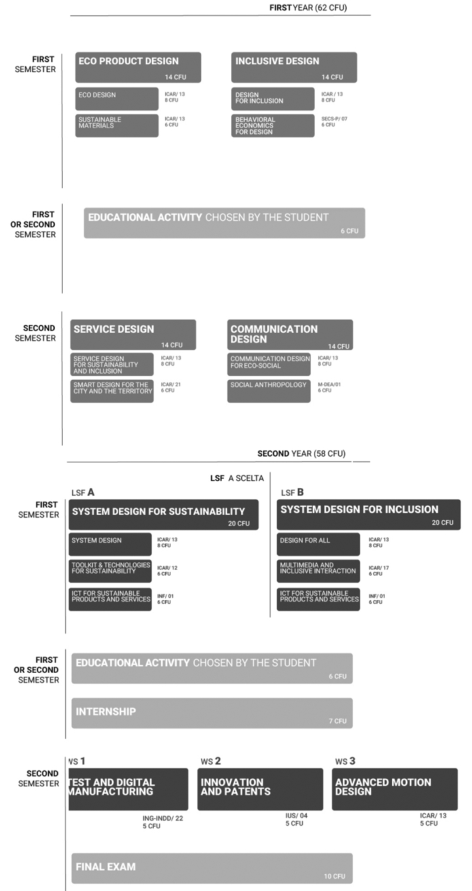
THE COURSE ARTICULATION The Master’s Degree Course in Eco Inclusive Design is developed in two years and is structured on 4 project laboratories, 1 final synthesis laboratory of your choice, 3 professionalizing workshops and 2 elective courses, for a total number of 10 exams and 120 university training credits (see Figure 1).
The main peculiarity of the Course consists precisely in the interdiscipli- nary training model, structured in design laboratories and workshops, with the aim of synergistically integrating tools, methods and conceptual appa- ratuses of the Life Cycle Design, Design for All approach, Design Thinking and, at a more complex level, of System Design for sustainability and System Design for inclusion.
Furthermore, 2 teaching courses chosen by the students and 3 professio- nalizing workshops are included in the laboratory structure of the Master’s
Teaching Eco Inclusive Design. An Innovative Educational Path 13
Figure 1: Overall outline of the didactic plan.
Degree Course. With the elective courses, students can explore specific topics of personal interest and completion of their training course in eco inclusive design, taking advantage of the vast educational offer of the entire University of Chieti-Pescara. With the three intensive workshops, held in the last seme- ster, the student instead explores some of the most current and up-to-date methods and tools of the designer profession.
The final semester is completed with some seminars held with companies and professionals, to facilitate professional choices and knowledge of the working sectors, and with a final internship in institutions, companies and professional firms.
14 Di Bucchianico
Going into more detail of the didactic plan it is possible to see that:
- In the first year there are 4 interdisciplinary project workshops in Eco Product design, Inclusive Product design, Service design, Communication design. In particular, these first 4 laboratories, each organized with two integrated didactic modules, allow the student to reflect (acquiring theo- ries and methods related to “knowledge”) and, at the same time, invent innovative solutions applied to the dimension of the product, services and communication artefacts, according to the criteria of sustainability and social inclusion (ie experimenting with the practice of “know-how” design). In fact, while the first of the two modules is a teaching of adva- nced design experimentation referred to Industrial Design, the second is always referred to other disciplines (economic, technical, urban planning, cultural heritage), which have the task of enriching multidisciplinary kno- wledge and providing the critical and operational tools to support the design activity. - In the second year, 2 interdisciplinary final synthesis workshops are plan- ned, in System design for sustainability or, alternatively, in System design for inclusion, dealt with according to the system-product approach (i.e. the integrated project between product, service, communication). In particular, the two laboratories integrate the modules of the disciplines of design with economics, digital design and anthropological sciences, and are respecti- vely oriented to the deepening of environmental issues or inclusive issues. They also constitute the basis of cultural and specialist orientation for the final elaboration of the graduate project researches.
CONCLUSION
To conclude, the new Master’s Degree Course in Eco Inclusive Design is directly confronted first of all with the reference area of the University of Chieti-Pescara, opening up to the needs expressed by local contexts and pro- ductive fabrics, also through didactic experiments carried out on specific topics in close relationship with companies and local authorities, with which an articulated system of direct relations and comparisons is being activated. This is done starting from a systematic knowledge of the historical, archa- eological, architectural, and artistic values of the settlement, environmental and landscape heritage, as well as of the food and wine, artisan and cultural heritage of which the Italian national territory and the regional and local one of the University are particularly rich. This is done in a sustainable and inclu- sive vision of the society in which we live, and in which future generations will necessarily live.
REFERENCES Council of the European Union (2020), Decision of the European Parliament and of the Council on a General Union Environment Action Programme to 2030, COM(2020) 652 final, https://data.consilium.europa.eu/doc/document/ST -11987-2020-INIT/en/pdf United Nations Development Programme (2022), https://www.undp.org/sustainable-
development-goals
LISTED IN THE AHFE DIGITAL BOOKSTORE CATALOGUE
Explore the complete digital volume
Design for Inclusion
Read this individual research paper free through the original publisher, or explore the full digital proceedings book.
ISBN 978-1-958651-21-6
Explore this ISBN in the AHFE Bookstore ↗Listed in the July 2026 bookstore catalogue; search by ISBN to confirm current availability · Digital book purchase optional