Stefania Camplone, Ivo Spitilli, Giuseppe Di Bucchianico (2025). Exploring Inner Landscapes Through Material. In: Intelligent Human Systems Integration (IHSI 2025): Integrating People and Intelligent Systems. AHFE Open Access, vol. 160, pp. 528–536. https://doi.org/10.54941/ahfe1005858
Today’s youth are confronted with a complex and ever-changing reality, filled with stimuli and contradictions that challenge their inner world and render them more vulnerable to the demands of daily life. Their “interior landscapes,” shaped by the digital age, are increasingly heterogeneous and contradictory, highlighting fragilities and insecurities that can hinder their educational journey. However, verbal expression and the sharing of emotions, whether positive or negative, is a complex and sometimes painful process, often leading to the internalisation of their discomfort.This paper presents the outcomes of a workshop conducted within the framework of the three-year orientation project POT Design NEED, funded by the MUR (Italian Ministry of University and Research). The workshop took place at the Department of Architecture of the University of Chieti-Pescara, with the participation of students from the Design bachelor degree program and students from the MiBe (Art High School) in Pescara.The workshop aimed to guide students on a journey of self-discovery without their awareness of being subjects in a personal exploratory study, to avoid influencing the final results. This “journey” was valuable for exploring the students’ emotional states, in order to understand their latent needs (emotional, psychological, etc.). The goal was to contribute to overcoming the difficulties and discomforts they encounter in the university environment, thus aiding them in their educational journey.The workshop employed a non-invasive approach to explore the emotional universe of the students. Through a creative process that led them to express their emotions by creating tactile, material-based tablets, it was possible to conduct a needs and difficulties analysis in an environment of mutual listening and dialogue. To achieve this, they were invited to manipulate a synthetic, moldable paste in a synesthetic process, adding or removing material, “imprinting textures,” or treating the surface with various tools, all while listening to music that best represented their current emotional state.By selecting a keyword, the students were able to imbue the material with emotional and symbolic significance, tangibly expressing the nuances of their inner world. The resulting tiles were then presented in a video and discussed in groups, offering students a unique opportunity to reflect on their experiences and connect with the emotions of others.This experience lays the foundation for the construction, over the next three years, of an “emotional atlas” of students, identifying areas of greatest vulnerability. This atlas will serve as a valuable compass for guiding support interventions in education, with the aim of promoting a “personal” educational journey that allows students to face and overcome obstacles with the utmost serenity.
The contemporary digital world, with its pervasiveness and complexity, has profoundly transformed the ways young people interact, communicate and learn.
This digital revolution seems to have brought with it a paradox: while technologies offer infinite opportunities, young people seem increasingly vulnerable, fragile and insecure. Digital technology, understood as a dynamic and interactive environment, has a significant and often uncontrollable impact on the construction of individual identity. It offers new possibilities of expression and relationship, but at the same time poses unprecedented challenges to the cohesion of the self, influencing the processes of self- perception and social representation. The cohesion between the different aspects of contemporary life seems to progressively weaken, to the point that social reality presents itself as a set of disconnected elements, while individual experiences lose their ability to integrate into a unitary framework (Bauman, 2003). In fact, today’s young people, born and raised in the digital age, move in a complex and continually changing world, characterized by a multiplicity of stimuli, connections, strong emotions and, very often, also false illusions, to the detriment interpersonal relationships and individual growth. Their interiority, full of nuances, feelings and contradictions, reflects this changing panorama, giving life to “inner landscapes” that are sometimes increasingly complex and problematic, highlighting: fragility, discomfort, loneliness, fears, insecurities and, above all, inadequacy in dealing with everyday life. In this context, therefore, sharing emotional experiences represents a complex challenge for many students, who often tend to internalize their negative experiences, rather than express them openly. In this context, the workshop experience tries to intercept the “needs” of the students in a moment of internal reflection.
The five key skills of the POT Need project: self-awareness, self- management, social awareness, relational skills and responsible decision- making, are the basis of the proposal of the creative workshop carried out in the Department of Architecture of the University of Chieti-Pescara. The objective is to guide the students of the Degree Course in Design and the students of the MiBe Art School of Pescara on a path of exploration and self-knowledge of moods, intercepting their latent needs (emotional and psychological, etc.) to contribute to overcoming the difficulties and inconveniences they encounter even in the university environment and help them in their educational path.
METHODOLOGY
The Workshop The results of recent investigations conducted in Italy (University of Milan-Bicocca, University of Surrey, 2023) confirm what has already emerged from international scientific literature: university students are particularly vulnerable to the development of anxiety and depressive
disorders. The results of these investigations have highlighted how psychological distress is a transversal phenomenon, involving both university and high school students. The COVID-19 pandemic, with its related restrictions and uncertainties, has acted as an additional risk factor, amplifying worries related to the future, academic stress and social relationships. The widespread request for psychological support from students underlines the urgency of intervening with prevention and promotion programs for psychological well-being.
However, a progressive erosion of the practice of introspection is observed. Young people, even in moments of solitude, seem to prefer interaction mediated by digital technologies to personal reflection, actively seeking external confirmation of their existence and social relationships (Bauman, 2003). The workshop, “Exploring internal landscapes through matter”conducted a qualitative and quantitative analysis of the students’ states of mind, with the aim of identifying their psychological and social needs, often not explicitly expressed. To this end, in the educational field, creative methodologies are configured as highly relevant tools, capable of easily transmitting the expression of young people’s emotions, thoughts and difficulties. Through an art-mediated approach, it is possible, in fact, to intervene on the affective- relational sphere, supporting students in the process of awareness and regulation of their emotions. Furthermore, these methodologies encourage metacognitive reflection, promoting the identification of one’s potential and the identification of areas of personal growth (Naumburg, 1966).
The workshop foreseen by Action “C” of the three-year project financed by the MUR (Italian Ministry of University and Research), carried out at the Chieti-Pescara headquarters with the participation of second-year students of the Degree Course in Design and the involvement of fourth and fifth year students of the MiBe Art High School in Pescara. Support teachers and tutors for the project’s creative laboratory collaborated in the activity. It was initially carried out without the students’ awareness of being the subject of a “personal” exploratory investigation/research, so as not to influence the final results. During the days dedicated to the workshop, the students took part in a series of preparatory activities aimed at encouraging their emotional exploration and free creative expression.
At the beginning, a moment of internal reflection was proposed, in which the students were able to focus on the difficulties and discomforts they encounter in daily life and in study, through the identification of a piece of music that effectively represented them.
The importance of music, especially songs, for young people is a widely studied and debated topic. Music allows them, in fact, to express complex emotions that are sometimes difficult to verbalize, offering an alternative and valid communication channel. Through music, adolescents build their own identity, identifying with social groups, strengthening their sense of belonging.
After listening to their own “heart song” that stimulated specific sensations, emotions and moods, they were asked to develop four “tiles”, manipulating a mouldable synthetic clay, with the aim of assigning their own
Exploring Inner Landscapes Through Material 531
“impression” to surfaces. The choice of a key word contributed to giving a decisive “character” to the material, and thus giving it a personality. At the end of the workshop, the new and personal material “inner landscapes” were exhibited and discussed in groups, encouraging a climate of listening and mutual understanding.
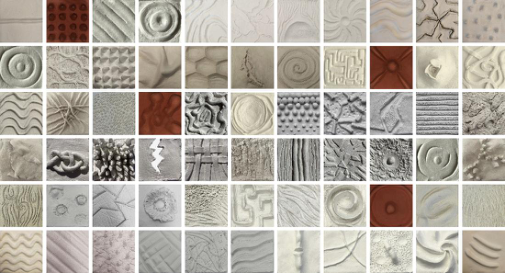
Tactile Boards The proposed creative process allowed them to use a colorless modelling clay (white DAS) as an expressive medium for the creation of square material “tactile tablets” with a side of 7cm, one for each identified keyword. The students were invited to shape the composite, adding or removing material, giving textures and treating the surface with different tools, guided by listening to musical pieces chosen based on their mood. The possibility of working and modifying the material in complete freedom, in the absence of explicit rules, with tools and utensils of one’s choice, allowed this activity to be carried out in an atmosphere of relaxation which favored a greater awareness of one’s own moods. This “synesthetic” activity favored the emergence of symbolic representations of emotions, allowing us to identify recurring patterns in the “inner landscapes” of students and to deepen our understanding of the emotional dynamics underlying the university experience.
Finally, the students were asked to make a video to allow the creation of a visual archive of the experience that would facilitate the subsequent analysis of the qualitative and quantitative data that emerged during the journey. The use of a multimedia product, thanks to its multimodal nature, proved to be an effective tool for comprehensively representing the complexity of the research carried out by the students. The integration of visual, audio and textual elements has made it possible to offer a dynamic and engaging narrative, capable of conveying complex information in a clear and accessible way. Sharing the tiles and videos created favored the creation of a climate of trust and openness, allowing participants to freely express their emotions and receive constructive feedback from peers.
Figure 1: A selection of tactile boards created by students during the ‘interior landscapes’ workshop. These tactile artworks serve as tangible representations of the participants’ inner worlds (2023).
Keywords
Natural language analysis represents a powerful tool for exploring the cognitive and affective processes of individuals. In particular, the analysis of the emotional lexicon made it possible to probe the emotional universe of the group of students, providing valuable information on subjective experiences and internal experiences. The objective was to identify the main emotions expressed by the participants and to understand the affective dynamics that characterized the experience. To organize and interpret the data collected (226 keywords), the primary emotions model was adopted, one of the most consolidated theories in the field of emotional psychology. This model identifies a set of basic emotions (such as joy, sadness, anger, fear, surprise and disgust) considered universal and biologically determined (Ekman, 2008).
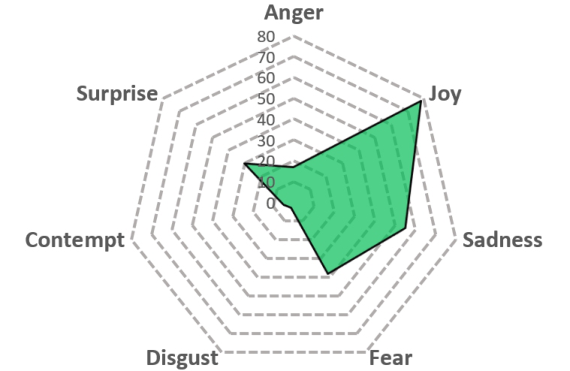
The starting hypothesis is that the analysis of the keywords, crossed with the model of primary emotions, can reveal a detailed picture of the emotional experience experienced by the students during the workshop. In particular, it was possible to identify the predominant emotions through the categorization into primary emotions: the key words relating to the emotion of joy are the most numerous with 78 examples; subsequently those relating to sadness emerge (55), followed by those relating to fear (38), surprise (30) and anger (17). The emotional manifestations relating to contempt (5) and disgust (3) are more rarefied. Specifically, as regards the basic emotion of joy, the most identified key word is “love”, followed by “freedom” and “lightness” to indicate an intrinsic need for affection, autonomy, positive experiences and a perception of life free of excessive worries, thus reflecting the search for psychological balance and an autonomous identity.
Figure 2: Distribution of keywords associated with primary emotions, selected by students participating in the ‘interior landscapes’ workshop.
Regarding the basic emotion of sadness, the recurring terms indicated by the students are “melancholy”, “nostalgia”, “separation”, “fragility”, “loneliness”. These words confirm how the contemporary socio-cultural
Exploring Inner Landscapes Through Material 533
context, characterized by growing individualization and an acceleration of the pace of life, can expose young people to feelings of isolation, nostalgia for an idealized past and concern for the future, amplifying feelings of fragility and precariousness. As regards the primary emotion of fear, the key words mainly used were “change”, “vulnerability”, “diversity”, “difficulty”. These efforts are the result of an idealized image of scholastic and professional success, conveyed and pushed by the media and popular culture, which often contributes to generating feelings of inadequacy, anxiety and fear of not being up to par in young students.
The emotion of surprise was expressed through the identification of evocative key words that refer to natural elements of which it is possible to expect positive or negative and, above all, uncontrollable consequences, such as “fate”, “history”, “unknown”. Regarding the emotion of anger, the key words mainly used were “frustration”, “obsession”, “torment”, “nervousness”, demonstrating that the internal landscapes of young people are often characterized by an intensity and complexity such as to lead to in feelings of intense anger that can have a significant impact on their development and the relationships they experience on a daily basis. Finally, as regards the emotions of contempt and disgust, the key words mainly used are related to unexpected situations in which a “betrayal” is suffered and a sense of “falsity” is felt.
The outcome of this first part of the workshop highlights the emotional complexity in the young participants, characterized by a coexistence of positive and negative feelings. Despite the presence of key words indicating anger, fear and sadness, reflecting the challenges and anxiety of the present and future that young students face on a daily basis, the recurring choice of words linked to joy emerged significantly. This data is particularly relevant as it underlines the ability of young people to find spaces of positivity and hope when they find places of freedom and sharing, even in difficult contexts. This emotional resilience, present regardless of sociocultural background, suggests the need to enhance individual resources and promote interventions that support the psychological well-being of young people.
RESULTS
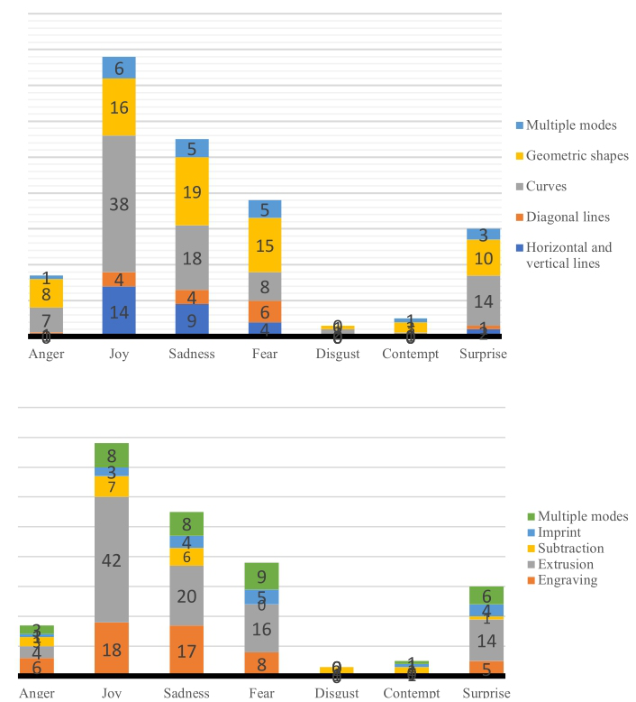
To qualitatively analyse the works created in the second part of the workshop and initiate the creation of an emotional atlas, the tactile tables were categorized according to two main criteria: the processing mode of the DAS and the graphic content. Regarding the processing mode, five main categories emerged: incision, extrusion, subtraction, texture imprinting, and a mixed category combining multiple techniques. As for the graphic content, the works were classified based on the use of lines (horizontal, vertical, diagonal, free curves), geometric shapes, and a mixed category. By cross- referencing these data with the keywords previously identified and linked to the primary emotions associated, an interesting pattern emerged. Anger was predominantly expressed through incision (6 forms) and the use of geometric shapes (8 forms), suggesting a need to vent tension through decisive and clear gestures. Joy, on the contrary, was often associated with extrusion (42)
and free curves (38), indicating a freer and more fluid expression. Sadness showed a combination of techniques, with extrusion (20) and incision (17) and figures associated with free curves (18) and geometric shapes (19) used to probably represent both the depth of the feeling and the will to overcome it. Fear was predominantly expressed through extrusion (16) and geometric shapes (15), suggesting a sense of alarm and threat. Disgust was associated with subtraction (2) and free curves (2), indicating a desire to move away from something unpleasant. Contempt was expressed mainly through subtraction (2) and geometric shapes (3), suggesting an attitude of rejection and superiority. Finally, surprise was associated with extrusion (14) and free curves (14), indicating a sudden and unexpected emotion, difficult to represent or fit into preconceived patterns.
Figure 3: Qualitative analysis of tactile boards: (at the top) distribution of modeling clay manipulation techniques in relation to primary emotions; (bottom) frequency of geometric shapes used to represent primary emotions in modeling clay creations.
The results obtained suggest that creative expression and the manipulation of plastic materials can prove to be a valid tool for understanding the
Exploring Inner Landscapes Through Material 535
emotional and internal character of students. The act of visualizing and making one’s emotions tangible and then integrating them into a video, in a further effort of multimodal representation, favored a process of greater self-awareness, helping students to better understand their moods and the dynamics that characterize them.
The analysis of students’ internal landscapes can help personalize learning paths, taking into account their emotional and cognitive specificities. Furthermore, it made it possible to begin the construction of an “emotional atlas” that takes into account the needs expressed by students and recognize some typical patterns of their sensations and disturbances, of their areas of greatest fragility, thus increasing the awareness of those who have to deal with them. to enhance their peculiarities and help them in their studies and personal growth.
CONCLUSION
The workshop launched an in-depth investigation on the topic of exploring students’ states of mind in contemporary society. The non-intrusive and synaesthetic activities carried out offered privileged access to the emotional world of the participants, revealing a complexity and richness of nuances often not expressed in more formal contexts. This case study accentuates the importance of the cognition of young people’s emotional states and their main points of instability, anxiety and resilience and highlights the most promising strategies for self-awareness of manifest and latent needs on the one hand, and for the support and support for their life path, on the other.
Through an in-depth analysis of the tools used in the workshop activities and the results obtained, this article attempts to provide a significant contribution to the ongoing debate on the definition of young people’s internal landscapes and on the most effective methodologies for training and support paths.
The inner landscapes of young students are complex and constantly evolving. Understanding them means grasping their hopes, their fears and their aspirations. It means helping them invest in their future for a more inclusive, sustainable and just society, in which everyone can express themselves at their best and contribute positively to a better world.
ACKNOWLEDGMENT
The different sections of this paper are the result of collaborative discussions and joint reviews among the authors. Specifically, the composition of the various sections is credited to: S. Camplone (Abstract, Introduction, The Workshop), I. Spitilli (Tactile Boards, Keywords), G. Di Bucchianico (Results, Conclusion).
REFERENCES
Bauman, Z. (2003). Intervista sull’identità. Roma: Edizioni Laterza. Ekman, P. (2008). Te lo leggo in faccia. Riconoscere le emozioni anche quando sono nascoste. Torino: Edizioni Amrita. Naumburg, M. (1966). Dynamically Oriented Art Therapy: Its Principles and
Practice. New York: Grune & Stratton.
LISTED IN THE AHFE DIGITAL BOOKSTORE CATALOGUE
Explore the complete digital volume
Intelligent Human Systems Integration (IHSI 2025): Integrating People and Intelligent Systems
Read this individual research paper free through the original publisher, or explore the full digital proceedings book.
ISBN 978-1-964867-36-6
Explore this ISBN in the AHFE Bookstore ↗Listed in the July 2026 bookstore catalogue; search by ISBN to confirm current availability · Digital book purchase optional