Stefania Camplone, Giuseppe Di Bucchianico (2025). Transitioning to Circularity in the Wood-Furniture Sector: A Case Study on Sustainable Material Selection for Disassemblable Components. In: Human Interaction and Emerging Technologies (IHIET-AI 2025): Artificial Intelligence and Future Applications. AHFE Open Access, vol. 161, pp. 552–561. https://doi.org/10.54941/ahfe1005947
In the Wood-Furniture sector, a profound transition towards the circularity of production processes has been underway for some time. All actors within the production supply chains are committed to optimizing their contribution toward environmentally sustainable manufacturing.This shift has been facilitated by the increasing awareness of environmental issues, as well as by the practical application of Life Cycle Design (LCD) strategies. These strategies focus on minimizing resource consumption (by reducing material and energy use), selecting low-impact resources and processes (ensuring eco-compatibility, often through certified solutions), optimizing product lifespan (through intensive and prolonged use), extending material longevity (via recycling, composting, and energy recovery), and enabling disassembly by ensuring the separability of parts and materials.However, the complexity and multimaterial nature of joint systems in furniture components often hinder recycling, unless disassembly operations are adopted—although such operations are not always feasible. A viable approach could involve selecting materials with bio-based and recyclable properties, alongside modifying the morpho-functional relationships between components to facilitate disassembly and, consequently, recycling. This approach would enhance the lifespan of products, components, and materials, aligning with principles of repairability and material circularity at the end of their life cycle.This paper presents a research study conducted at the Ingeo Department of the G. d’Annunzio University of Chieti-Pescara, within the framework of the “Green Joining and Assembly System for Furniture” project, led by the company Kico Srl. The study aimed to identify the most environmentally and economically sustainable material solutions for designing a furniture component: a fully disassemblable self-adjusting foot.The research employed both qualitative and quantitative assessment tools to compare different material combinations for the component. The first evaluation applied the eight Life Cycle Design (LCD) strategies, using the ASDO software tool for data comparison. Subsequently, the Circular TOOL was used to measure, verify, and compare material circularity across different design iterations. The experimental data validated the initial material selection hypotheses, allowing the refinement of the most promising solution in terms of environmental performance, functional efficiency, and ease of assembly and disassembly.
Transitioning to Circularity in the Wood-Furniture Sector 553
INTRODUCTION
The wood-furniture sector, a cornerstone of Italy’s manufacturing industry, is currently facing significant challenges related to environmental sustainability. Despite the sector’s resilience—evidenced by the growth in exports to strategic markets such as the United Arab Emirates and Saudi Arabia (Federlegno Arredo, 2020)—the urgent need to adopt low-impact production practices, innovative materials, and sustainable design solutions is increasingly apparent, particularly in light of climate change and the depletion of natural resources. The integration of eco-efficient and circular solutions not only addresses the growing demand for sustainability but also offers competitive advantages for businesses (Pellizzari and Genovesi, 2017). These advantages include cost reduction related to raw material and energy consumption, enhancement of corporate image, and access to environmentally conscious markets. Simultaneously, such practices align with increasingly stringent European regulations on ecodesign, including Regulation (EU) 2024/1781 concerning sustainable products.
This research, coordinated by KIKO srl, focuses on the design of a multi- material furniture component—specifically, a self-leveling foot for storage furniture—whose intrinsic complexity arises from the variety of materials involved (plastics, metals, alloys, etc.). This material heterogeneity often complicates disassembly and end-of-life recycling processes.
In this context, the research contribution by the InGeo Department at the University of Chieti-Pescara (Italy) centers on identifying alternative solutions to reduce environmental impact. This is achieved by promoting the use of innovative materials and sustainable production methods through the application of ecodesign methodologies, such as Life Cycle Design (LCD) and Life Cycle Assessment (LCA), which allow for a comprehensive evaluation of a product’s environmental impact throughout its lifecycle— from raw material extraction to final disposal—along with the identification of eco-efficient alternatives.
Specifically, the study proposes an innovative approach aimed at structural simplification and reduction in material diversity, favoring the use of recycled materials. The introduction of low-impact, circular materials, coupled with the design of solutions that facilitate disassembly and material separation, represents a crucial step toward improving the efficiency of material recovery and recycling. The methodology integrates Design Driven Innovation principles and Life Cycle Design guidelines to reduce the complexity of minor components and promote material homogeneity, with a particular focus on the use of innovative circular materials.
The objective of the research is to demonstrate the feasibility of significantly improving the recyclability of multi-material furniture components through the simplification of disassembly processes and enhancement of recycling efficiency. This contribution presents the findings of the investigation conducted by the InGeo Department, which—through the application of design process tools and environmental impact analysis of proposed design solutions—provides a scientific basis for selecting the most suitable solution that addresses both production constraints and
554 Camplone and Bucchianico
environmental demands. This represents a case study on the transition of the wood-furniture sector toward a circular economy model, supporting businesses in their path toward sustainability and reduced environmental impact, thereby fostering the development of a more responsible and long-term sustainable production system.
METHODOLOGY
The research methodology adopted in this study follows a mixed-methods approach, combining both qualitative and quantitative analyses to assess the environmental impact of a furniture component from the earliest stages of design.
In the initial phase, an in-depth qualitative evaluation was carried out, focusing on the collection and systematization of data related to the characteristics of candidate materials for the different design hypotheses. This analysis allowed for a comprehensive understanding of the physical, mechanical, and aesthetic properties of the materials, as well as their potential environmental implications in terms of origin, processing, and end-of-life scenarios.
Subsequently, a quantitative evaluation was conducted through the application of Life Cycle Assessment (LCA) methodology. Using the CircularTool software developed by Matrec, the circularity and environmental impact of various product configurations were measured across their entire life cycle—from raw material extraction to end-of- life management. This tool provided objective and comparable data on the environmental performance of each design alternative, enabling the identification of the most sustainable options.
Finally, an additional qualitative analysis focused on applied and applicable Life Cycle Design (LCD) strategies was conducted to explore advanced and more eco-efficient product configurations. In this phase, the ASDO software (Sustainable for All Orienting Design Toolkit), which supports the design of more inclusive and sustainable solutions based on life cycle thinking (Spitilli, 2021), was employed. The analysis enabled the evaluation of the effectiveness of each design solution in terms of environmental impact reduction, identifying opportunities for further development and performance optimization. Key considerations included material selection, product durability, ease of disassembly and recycling, and production process optimization.
The integration of these three methodological phases enabled a comprehensive and detailed assessment of the environmental impact of the furniture component, providing valuable guidance for the selection of the most sustainable materials and design strategies.
1. Qualitative Analysis of Materials
In the initial phase of the research, a detailed qualitative analysis was conducted to evaluate the suitability of various materials for the construction of the self-leveling foot components under investigation. Given the product’s inherent complexity—comprising eight interrelated sub-components subject
Transitioning to Circularity in the Wood-Furniture Sector 555
to different mechanical stresses—the selection of appropriate materials was essential to ensure functional efficiency and durability.
The preliminary investigation identified the following candidate materials for the fabrication of the various components: CB4 steel (for pins and standard set screws), S235JR steel (for the shaft), 11SMnPb30 steel (for the special set screw), Zamak 15 (for the bushing and leveling body), brass (for the locking ring), POM plastic (for the base-ground interface component), and 50% glass fiber-reinforced nylon (as an alternative material for the leveling body).
For each material, a comprehensive dataset was compiled and systematized, covering the following domains:
Environmental impact (recyclability, biodegradability, pollutant emissions during production and end-of-life phases) At the conclusion of this qualitative analysis, two promising design solutions emerged for the leveling body. The mechanical loads and functional requirements of the various sub-components significantly influenced material selection, restricting the range of viable alternatives. However, for the leveling body—a component less constrained by stringent mechanical demands—two options were identified: Zamak 15 and 50% glass fiber-reinforced nylon. Both materials offer a favorable balance between mechanical performance, cost, and manufacturability, although they differ markedly in terms of environmental impact and aesthetic characteristics.
The structured comparison of material data culminated in the development of a comparative matrix that highlighted the strengths and weaknesses of each candidate in relation to the specific requirements of the self-leveling foot. This qualitative analysis formed the foundation for the subsequent quantitative assessment phase, in which the environmental impact of the selected materials was measured through LCA methodology.
2. Quantitative Assessment – Life Cycle Assessment (LCA) In the quantitative assessment phase, the Life Cycle Assessment (LCA) methodology was applied to evaluate the environmental impact of the product. This approach is grounded in a systemic design framework, which involves a comprehensive analysis of the product’s life cycle—spanning raw material extraction, manufacturing, distribution, usage, and end-of- life management. The primary objective of this methodology is to minimize
556 Camplone and Bucchianico
the product’s ecological footprint by optimizing material and energy flows throughout its life span.
The analysis focused on two main flow categories:
Input flows, representing the set of natural resources (raw materials and energy) extracted from the environment for production
Output flows, comprising emissions (e.g., greenhouse gases, toxic substances, waste) released into the environment across all life cycle stages To quantify the impact of these flows, the CircularTool software developed by Matrec was employed. This tool enabled the measurement of the circularity of different design scenarios for the self-leveling foot component, assessing their environmental impact from resource extraction through end- of-life disposal. CircularTool proved effective in quantifying and comparing the environmental performance of each design alternative, providing an objective overview of their strengths and limitations.
Specifically, the tool allowed for:
The calculation of a “Material Circularity Index” for each product scenario, offering a quantitative measure of environmental performance
Identification of the most environmentally impactful life cycle stages
Simulation of alternative design options and evaluation of how changes in materials, manufacturing processes, or end-of-life strategies affect overall environmental outcomes This LCA-based assessment provided essential insights to support the optimization of product circularity and informed comparative evaluations of proposed design solutions.
3. Qualitative Analysis of Ecodesign Strategies – Life Cycle Design (LCD) To validate and qualitatively assess the Life Cycle Design (LCD) strategies implemented in the development of the new self-leveling foot—both in its nylon and Zamak 15 versions—the ASDO software (Sustainable for All Orienting Design Toolkit) was employed. This tool, developed in previous research at the University of Chieti-Pescara, is based on a strategic ecodesign model that guides and evaluates product innovations from both environmental and social sustainability perspectives.
In this study, the qualitative analysis was conducted through a checklist- based evaluation system integrated into the ASDO tool. Each LCD strategy was assigned a performance score, enabling an assessment of the degree of innovation embedded in the analyzed product variants. The evaluated strategies covered the full product life cycle and focused on environmental sustainability, including:
Reduction of material impact
Production innovation
Minimization of transport-related impact
Reduction of impact during use
Optimization of product lifespan
Transitioning to Circularity in the Wood-Furniture Sector 557
Enhancement of product upgradability
End-of-life optimization
Facilitation of disassembly The application of ASDO facilitated a systematic evaluation of the effectiveness of the design choices in terms of sustainability, offering actionable recommendations for product optimization.
In this case, the tool was not used to guide a new design, but rather to assess and compare the two existing versions of the foot—Zamak 15 and 50% glass fiber-reinforced nylon—with the goal of identifying their strengths and weaknesses, highlighting differences in environmental impact, and benchmarking them against a potential third design iteration based on recycled materials.
RESULTS
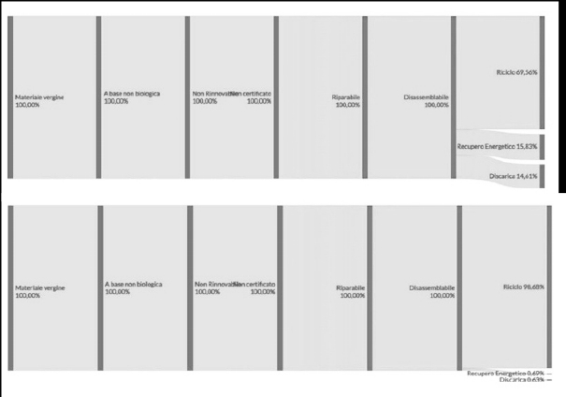
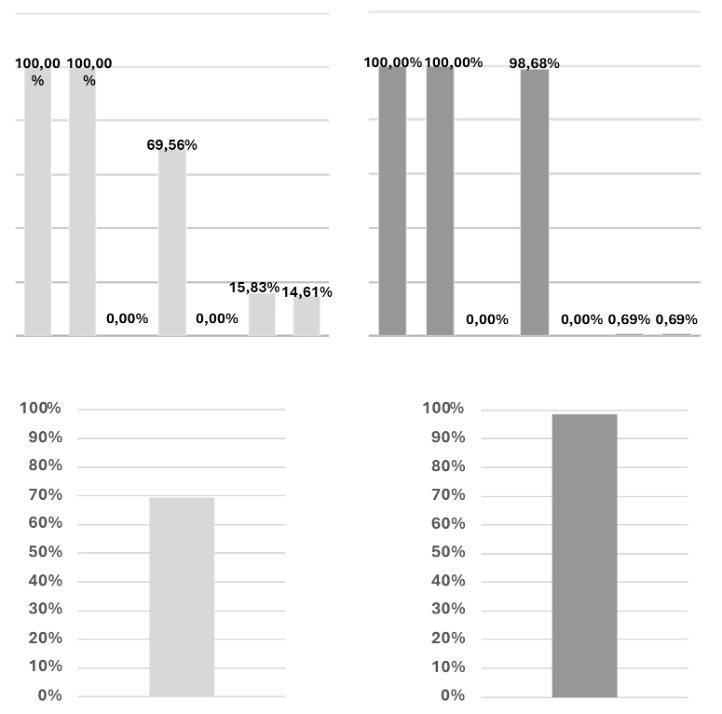
The analysis conducted using the CircularTool software yielded significant comparative data for the two design alternatives of the leveling body, highlighting substantial differences in terms of material circularity and environmental impact (see Fig. 1 and Fig. 2).
The plastic-based solution, specifically the leveling body made of 50% glass fiber-reinforced nylon, offered advantages in terms of reduced weight and ease of manufacturing. However, it demonstrated a Material Circularity Index of 69.56%. While this value is not negligible, it indicates that a notable portion of the material—14.61%—is destined for landfill at end- of-life, and 15.83% is directed to energy recovery. These figures reveal opportunities for improvement in the circular performance of this solution. Although the absence of critical raw materials is a favorable attribute, the use of 100% virgin material highlights the need to explore more sustainable alternatives, such as recycled or bio-based materials. The ease of disassembly is undoubtedly a strength of this design, but other circularity performance indicators (44.93%) suggest potential improvements in terms of repairability and end-of-life management.
In contrast, the solution using Zamak 15 for the leveling body demonstrated exceptional circular performance. Despite the increased component weight, the Material Circularity Index reached 98.68%, indicating a near-closed-loop lifecycle. With 98.96% recyclability and only 0.63% of material destined for landfill, Zamak 15 exhibits excellent environmental efficiency. The design achieved full scores for both disassembly and repairability (100%), confirming its orientation toward durability and maintainability. Overall circularity performance indicators (49.79%) further validated this solution’s superior sustainability profile.
Therefore, the Zamak 15 solution provides a significantly more circular and environmentally preferable alternative compared to the nylon-based option, despite its higher weight. However, material selection should also account for additional factors such as cost, supply chain availability, and specific functional requirements.
558 Camplone and Bucchianico
Figure 1: Graphic representation of the material circularity performances of the two solutions, in reinforced Nylon (top) and Zamak 15 (bottom), on the input and output flows of materials obtained with the Circulartool software by Matrec.Figure 2: Comparison of the performances related to the output flows of the materials (top) and global (bottom) of material circularity, obtained with the Circulartool software by Matrec, of the two different solutions in reinforced Nylon (left) and Zamak 15 (right).
Transitioning to Circularity in the Wood-Furniture Sector 559
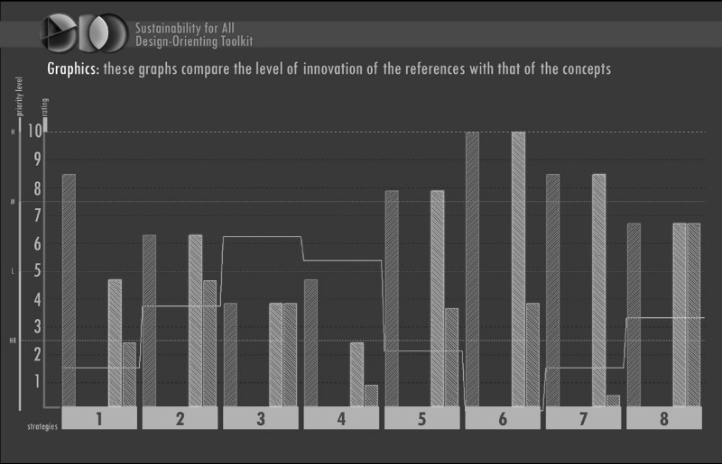
The ASDO software was employed to further analyze the innovative content of the two designs, generating visual outputs in the form of colored bar charts to facilitate direct comparison across ecodesign strategies (see Fig. 3).
The qualitative analysis revealed a clear advantage for the Zamak 15 version, primarily due to the material’s inherently recyclable nature. This translated into tangible benefits throughout various life cycle stages. Specifically:
Strategy 5 (Optimization of Product Lifespan) highlighted Zamak’s superior mechanical properties—such as strength, reparability, and reliability—which contribute to a substantial extension of the product’s useful life. This is crucial for reducing overall environmental impact by decreasing replacement frequency.
Strategy 6 (Optimization of Upgradability) reinforced the advantages of Zamak 15. Its suitability for repair, remanufacturing, and reuse makes it an ideal material for circular economy applications.
Strategy 7 (End-of-Life Optimization) emphasized that Zamak 15’s full recyclability, combined with a disassembly-oriented design, facilitates material recovery and reintegration into the production cycle—an essential factor in minimizing end-of-life environmental burdens.
Figure 3: Evaluation and comparison of the three solutions (for each evaluation: on the left, the solution in virgin Zamak 15, on the right in dark grey the one in reinforced nylon, on the right in light grey the one in recycled Zamak 15) with regards to the Life Cycle Design strategies obtained with the ASDO software.
In summary, the ASDO-based evaluation confirmed the environmental superiority of the Zamak 15 foot. Its complete recyclability, durability, and
560 Camplone and Bucchianico
reparability make it a preferable option over the nylon-based alternative, which, while lighter, has clear limitations in circularity.
Additionally, a third design variant was introduced into the comparative analysis using ASDO, represented visually with purple bar charts. This version incorporated Zamak 15 sourced from recycled materials or production scrap reintroduced into the lifecycle. The inclusion of this solution provided a more comprehensive understanding of available design options and their relative environmental efficiencies.
Comparison among the three variants revealed that Zamak 15 from recycled or reprocessed sources offers the greatest potential for reducing environmental impact. This was especially evident in:
Strategy 1 (Material Impact Reduction), which emphasizes the use of renewable resources, recycled materials (either pure or blended with virgin materials), regenerated components from end-of-life products, and waste from manufacturing processes. Recycled Zamak aligns closely with these principles, minimizing the need for virgin raw material extraction and waste generation.
Strategy 4 (Impact Reduction During Use), which promotes efficient use of materials and resources, cascade reuse, and avoidance of toxic substances. Zamak 15, being inherently non-toxic and chemically stable, poses no harm during use or disposal and meets these requirements effectively.
These findings demonstrate that recycled Zamak 15 represents the most environmentally sustainable option for the leveling body. This approach maximizes impact reduction, supports circularity, and decreases reliance on virgin materials.
CONCLUSION
In conclusion, this research has demonstrated the critical importance of material selection in the design of multi-material furniture components, with the aim of minimizing environmental impact across the product’s entire life cycle.
The integrated use of advanced software tools enabled the optimization of material choices and the comprehensive assessment of environmental impacts throughout the life cycle. Specifically:
Qualitative material analysis tools facilitated the identification of the most suitable and eco-efficient materials by evaluating their mechanical, physical, aesthetic, and environmental properties.
The Life Cycle Assessment (LCA), conducted using Matrec’s CircularTool, quantified the environmental burdens associated with each life cycle phase, providing an objective basis for comparing material options.
The ASDO toolkit enabled qualitative validation of the Life Cycle Design (LCD) strategies adopted, helping to pinpoint potential areas for improvement and optimization of the analyzed product.
This integrated methodological approach not only supported the selection of the most appropriate and eco-efficient materials but also enabled the
Transitioning to Circularity in the Wood-Furniture Sector 561
identification of opportunities for further design optimization, leading to solutions with even lower environmental impacts.
The findings confirm that the use of recycled and recyclable materials, combined with ecodesign methodologies and specialized software tools, represents the most effective strategy for sustainable product development. The study also provides a relevant case study demonstrating how furniture component design can contribute to the transition toward a circular economy.
In this context, the research offers a significant contribution to the development of sustainable innovation within the wood-furniture industry. It illustrates how the combination of qualitative and quantitative analyses, supported by advanced digital tools, can lead to more sustainable design decisions and a measurable reduction in environmental impact. Ultimately, this approach promotes a more responsible and long-term sustainable production model, supporting companies in their journey toward environmental and regulatory compliance, competitive differentiation, and corporate sustainability.
REFERENCES
FederlegnoArredo Report (2020): https://www.federlegnoarredo.it/ContentsFiles/ CAP%203.pdf Matrec: https://www.matrec.com/ Pellizzari, A. Genovesi, E. Eds. (2017). Neomateriali nell’economia circolare. Milano:
Edizioni Ambiente. Spitilli, I. (2021). Kitchen furniture: Dfa+Ecodesign. Soluzioni integrate di Design for All ed Ecodesign per l’innovazione di prodotto nel settore kitchen forniture. [Ph.D Thesis]. Chieti: Unich.
LISTED IN THE AHFE DIGITAL BOOKSTORE CATALOGUE
Explore the complete digital volume
Human Interaction and Emerging Technologies (IHIET-AI 2025): Artificial Intelligence and Future Applications
Read this individual research paper free through the original publisher, or explore the full digital proceedings book.
ISBN 978-1-964867-37-3
Explore this ISBN in the AHFE Bookstore ↗Listed in the July 2026 bookstore catalogue; search by ISBN to confirm current availability · Digital book purchase optional