Giuseppe Di Bucchianico (2022). Human Diversity: A Limit or an Opportunity in the Maritime Design Domain?. In: Advances in Human Aspects of Transportation: Part III. AHFE Open Access, vol. 17. https://doi.org/10.54941/ahfe100718
The complexity of contemporary society can be described also through the diversity between individuals, expressed not only in terms of mental and physical capabilities, but also with respect to social and cultural differences. Diversity, however, can be considered as a limit or a resource for the economic development of society. Design for inclusion has already shown that confront the human diversity, in a different way than traditional ergonomics has done so far, represents a major opportunity in the first place for business, becoming an extraordinary lever of communication, expanding the market dimensions, differentiating the production and retaining customers, but more importantly, it determines a positive effect for the entire social system and for the collective well-being. This inclusive and participatory approach to design, is growing also in the specialized productive sector of maritime transportation design. The paper offers a critical reflection on the need to confront the issues of inclusion and participation in the design of products, systems and services related to specialist areas such as maritime transportation. Through synthetic remarks about good practices, we highlight the benefits and opportunities that the spread of a design approach considering human diversity can determine also for the maritime transportation domain.
MARITIME DOMAIN AND MARITIME DESIGN DOMAIN The maritime domain is defined as all areas and things of, on, under, relating to, adjacent to, or bordering on a sea, ocean, or other navigable waterway, including all maritime-related activities, infrastructure, people, cargo, and vessels and other conveyances.
This definition is strictly connected with the concept of Maritime Domain Awareness (MDA), defined by the International Maritime Organization (IMO)1 as the effective understanding of 1 The International Maritime Organization (IMO), formerly known as the Inter-Governmental Maritime Consultative Organization (IMCO) is a specialized agency of the United Nations with 170 Member States and three Associate Members and has its Headquarter in London (UK). The IMO's primary purpose is to develop and maintain a comprehensive Human Aspects of Transportation III (2022) https://openaccess.cms-conferences.org/#/publications/book/978-1-4951-2099-2 anything associated with the maritime domain that could impact the security, safety, economy, or environment.
So it is a very vast sector, which involves environments, products, and activities of man, that is all the proper elements of ergonomics: seas, rivers, lakes, protected areas, tourist stops, commercial ports, harbors, docks, piers , jetties, lighthouses, platforms, ships, boats, tugs, tankers, cargo, ferries, sailing yachts, motor boating, fishery, trade, transport, control of the coasts, diporto, sport, decks, cabins, cockpits, onboard equipment, etc.
Design, as a "foreshadowing of possible desirable” (Heidegger), obviously plays a central role in all of the changes and alterations made by the project in the maritime domain in view of human needs (Morris). And you can say that the multidimensional complexity of most of the design areas of maritime domain, particularly the one referred to the means of transport, goes through extremely complex systems of constraints that involve multiple disciplines and skills, sometimes highly specialized: from structural engineering to materials engineering, from fluid-dynamics to marketing. To these they must be added also the prefigurative complexity of products to be used in inhospitable environments and sometimes in extremely adverse conditions, or just in spatial conditions of constant motion.
In relation to the human dimension of the project for the maritime domain, ergonomics has always played a central role during the last decades.
THE CONTRIBUTIONS OF TRADITIONAL ERGONOMICS TO MARITIME DESIGN DOMAIN In the hambit of ergonomic design, the User-centred design places at the centre of its identification process, by means of the users’ demands, some ergonomic requirements required of the products. Ergonomic literature, on the other hand, already placed four different requirement levels referable to the users’ demands in a close hierarchical relationship (Jordan 2000).
On this basis, it has already been identified a similar articulation referred to the marine products (Di Bucchianico and Vallicelli, 2011). it is possible now to think about extending this articulation also to the entire universe of artifacts (environments, products, systems and services) of the more complex maritime domain. Thus, the requirements concerning the safety of equipment, systems,infrastructures and environment are identified, those regarding their functionality, ease and practicalness of their use, including the requirements that concern their pleasantness, the physical and mental “pleasure” that is experienced in interacting with them. For each one of them, ergonomics is able to offer, and indeed it already offers, a precious contribution in relation to the project of environments, stations, equipment and finishings, as well as, in a figurative sense, to establishing all those tasks and activities, even apparently secondary, which are carried out on the crafts, on terra firma on piers and docks, and even under the sea regulatory framework for shipping and its remit today includes safety, environmental concerns, legal matters, technical co- operation, maritime security and the efficiency of shipping. In particular, IMO’s Maritime Safety Committee oversees the work of nine sub-committees, among which are: safety of navigation; radio communications and, search and rescue; standards of training and watch keeping; ship design and equipment; fire protection. Human Aspects of Transportation III (2022) https://openaccess.cms-conferences.org/#/publications/book/978-1-4951-2099-2 level.
In particular, it is known that about safety, ergonomics already provides all the most suitable instruments to analyse the characteristics of individuals and the limits of their psychophysical abilities, even in extreme environmental and postural conditions; on the functionality plane, ergonomic research is able to influence, through the project, with a significant impact on morphological and typological evolution of the equipment, systems and infrastructures, in their entirety or with respect to their various parts, in order to allow a critical, objective, well- pondered reading of it; on the plane of usability of the equipment and postural comfort, ergonomic practice allows the identification of more innovative solutions also by means of direct observation and a critical analysis of organizations and structures of tasks on board or on terra firma; on the pleasantness plane, ergonomics has defined the most useful instruments and methods to assess the psychosensory interactions of individuals with components, equipment and environment.
Furthermore, in all the cases the multidisciplinary approach of ergonomics to the design and the availability of methods, intervention procedures and operative instruments which it offers, allows the study of the requirements of the user’s wellbeing to be faced whether in relation to the single product/equipment, or to the task/position or to the environment/context in which he finds himself.
LIMITS OF TRADITIONAL ERGONOMICS AND NEW CONCEPTS OF DIVERSITY The traditional ergonomics too often relies on a mechanistic and deterministic view of man. Born from the industrial culture, in order to ensure the safety and wellbeing in work and use contexts closely related to both a production and consumption approach too tied to Taylorism and the derived Fordist mass production, however, ergonomics has, over decades of development and maturation of the discipline, place the center of its attention on the "standard" man2, though with all possible percentile variations of the case. For decades, in fact, the ergonomic design has dealt with the average individual (man or woman, young or adult), perfectly healthy and intact, fully alert, attentive and informed, with a mastery and a logical and rational behavior in most situations in life and work. The other "specific" cases were and still are largely studied and analyzed as "specific" categories, thus giving rise to design for "specific" users: the elderly, children, disabled, etc.. Furthermore, the aggravation of the so called "segmentation" of the users, from a design point of view leads to the design of artifacts whose physical and cognitive "measures" and whose use are designed for groups of individuals increasingly restricted, to the realization of many “niche" products, even with evident inconsistency.
The complexity of contemporary society, however, can also be described through the diversity between individuals, expressed not only in terms of mental and physical ability, but also with respect to social and cultural differences3. Let us, therefore, to better define what it could be defined as “diversity."
2 Derived from the Old French word "Estendard" (from the Latin extendere), originally had the meaning of banner, ensign. 3 Economic phenomena as the globalization of markets, socio-cultural phenomena such as migration flows between different geographic areas or demographic phenomena such as aging of the population contribute to strengthening the aspects of diversity in contemporary society. Human Aspects of Transportation III (2022) https://openaccess.cms-conferences.org/#/publications/book/978-1-4951-2099-2
The concept of "diversity" has an ancient origin in the history of thought: the concept of "multiplicity" of Plato, that of "otherness" of Aristotle, both with a meaning not necessarily bad, until reaching the philosophers of the last century as Lévinas4, for which instead otherness not only is not a negative value, but is considered the higher ethical value. In common sense, the concept of diversity is ambivalent: on the one hand it arouses curiosity and interest, on the other hand it tends to strike fear in the sense of mystery that brings. Sometimes what is different is rejected, but other times in the difference between people and in the specificity of each one can be seen the wealth that can be derived from the comparison and mutual understanding. The "other" may be different for mental and physical abilities, but also for language, culture, customs, religion, sensitivity.
Diversity, which relates directly to the social "conventions" and “common" sensitivity, it is therefore often seen in a negative way as a threat of his own identity, both from individuals and from social groups, whereas on the other hand not considering that regarding “diversity as an opportunity” could contribute to reaffirm, in a conscious and critical way, exactly their own identity.
Diversity can therefore be regarded as a limit or a resource both for the economic development of society and to its well-being in the broadest sense.
On the economic level, there is an added value deriving from awareness that there is a market made up of “non-standard" users (which in reality are always the vast majority), partially different from those who the design of environments, products and services has so far addressed, and therefore the ability to propose new ones that are actively comparing with the complexity of social articulation. This added value offers even the smallest company new competitive advantages (increase of potential users, customer retention, etc..).
On the social and collective well-being level, to base the development of society on the concept of diversity, promotes inclusion and independent and active participation of all. Thus, by reducing the social tensions and costs (and the resulting fiscal pressure) and increasing productivity, substantially also the wealth and the overall level of wellness increases.
DESIGN FOR DIVERSITY Over the past thirty years were developed different approaches and design methodologies for the inclusion of design enhancing human diversity, considering it as a resource rather than a constraint, thus obtaining solutions more content-rich, innovative, and therefore attractive.
It should, however, make a clarification on the issue of disability. Design for disability, which, especially in the last seventy years has had a very rich and varied history and which was also the launching pad for the most recent and innovative approaches of design for inclusion, however, should be regarded as a separate area, because it refers to specific users. In fact, focusing its interest on specific disabilities with the aim of enabling people, through dedicated aids, to play peacefully their daily life cycles, design for disability can be compared to other areas of “design for specific users”, such such as the design for aging or design for children.
Another thing, then, are those approaches and methodologies that cater to extensive multiplicity 4 Emmanuel Lévinas (1906-1995), French philosopher, argued that the face to face encounter with another human being is a privileged phenomenon in which the other person's proximity and distance are both strongly felt. Human Aspects of Transportation III (2022) https://openaccess.cms-conferences.org/#/publications/book/978-1-4951-2099-2 of different groups of individuals: the most significant of them are Universal Design, Inclusive Design and Design for All.
Universal Design: The Pragmatism of Checklists The Universal Design5, created in the United States at North Carolina State University, and from there spread throughout the world, is an expression of Anglo-Saxon pragmatism. It expresses a fundamental objective of good practice and theoretical project: to meet the needs of as many users as possible. This design methodology is a set of dimensional requirements, complying with codes, standards or special features of specific users with disabilities, but it expresses the tension towards an higher objective: general design principles simple to be implemented and verified. The Universal Design in fact does not only focus on people with disabilities, but for the first time defines the user in a wider way, suggesting to make all the products and spaces accessible and usable by people to the greatest extent possible. Not everything must be fully usable by all: the term "universal" refers more to a methodological attitude than to a rigid and absolute assumption.
The didascalic reduction of the approach to seven design principles6, easy to be applied and then rapidly spread throughout the world, however, tends to an extreme schematization of the project and especially not to take into account the complexity of the individual and the diversity and variability of mankind. In addition, the definition of verification tools projects made from simple checklists, if on the one hand are useful to guide the design process and educate designers and consumers about the characteristics that products and environments should have, on the other hand requires an assessment and verification action "a posteriori" on existing or already developed projects, rather than constituting an inspiring concept.
Inclusive Design: Attention to Diversity Inclusive Design7 has its main center of development in the UK and in the main countries of British influence. Unlike Universal Design, it does not put dogmatic design principles, but it defines a real careful approach to human diversity, based on the idea that no policy, principle or guideline may be absolute but must always deal with the multiplicity of users, contexts and objectives. Inclusive design, in fact, considering the wider range of skills, languages, cultures, genders, ages, and all other possible forms of difference among users, bases its approach on three "dimensions": recognizing the diversity and the 'uniqueness among individuals, the inclusiveness of the tools and design methodologies, the magnitude of the impact in terms of benefits.
Design for All: The Partcipatory Process The Design for All (DfA) was briefly defined as the “design for human diversity, social inclusion and equality”8. It represents the concrete application of both a philosophical, social and political assumption (“Everyone should have equal opportunity to participate in all aspects of society”), and a scientific assumption (“good design enables, bad design disables”, P. Hogan).
5 This wording was used for the first time in 1985 by architect Roland Mace, who is also the creator, promoter and founder of the Center for Universal Design at North Carolina State University (USA). 6 Equitable use; Flexibility in use; Simple and Intuitive Use; Perceptible Information; Tolerance for error; Low Physical Effort; Size and Space for Approach and Use. 7 One of the first definitions of Inclusive Design, referring to the environments ("environments that promote human functioning", Preiser and Ostroff 2001), was that reported is a handbook for Universal Design, where the authors advocated a substantial analogy between UD and ID: this reiterates the superficiality of theorizing and terminological study with which these topics are often treated. 8 EIDD, Stockholm Declaration, 2004 Human Aspects of Transportation III (2022) https://openaccess.cms-conferences.org/#/publications/book/978-1-4951-2099-2
DfA, in fact, aims to improve the quality of life of individuals through the enhancement of their specificity and diversity: a holistic approach to design processes and methods referred to environments, equipment and services, that must be experienced “in a condition of autonomy” by people with special needs and diversified skills.
A first innovative aspect of the DFA is therefore the passage from an interest to the “use” to an attention to the “experience” of environments, products and services. The transition from the user-individual to the experiencer-individual seeks to achieve primarily the fulfillment of the aspirations and desires as well as needs. Not only, therefore, the search for simple “accessibility/usability” of environments and products (which is the starting “basic” condition), but also the search for the “wellbeing” for everyone through the active, comfortable and pleasant enjoyment by the widest variety of subjects, different among them for social and cultural characters and for perceptual, motor and cognitive skills.
The innovative aspect that most of all differentiates the DfA from the two previous approaches, however, is the attention to “process”, that is the path of the project definition. It shall involve, in different forms and at different times, all actors in the “supply chain project”: decision makers, planners, producers/workers, users. This in the idea that to carry out really “inclusive” projects are not sufficient the skill and experience of the designer, and that the project can not be exhausted in a simple comparison between client, designer and experienced employees. On the other side, the solution must come from a consciousness of widespread social participation, involving in different way well all other social, economic and above all political decision makers.
SOME SIGNIFICANT DESIGN EXPERIENCE In different areas of the vast Maritime Domain and in the narrower one of Maritime Transportation design approaches and of design solutions for inclusion are spreading on a global scale, both due to the development of ever more demanding standards on accessibility and usability of environments and products, both for the diffusion of a growing sensitivity to the topics and especially for the growing awareness of the social and economic benefits deriving from it. By now there are numerous examples of marinas, commercial ports, docks, piers, jetties, lighthouses and infrastructure referred to maritime transportation addressing the issues of design for inclusion. Unfortunately, this often happens in a not intelligent and proactive way, but only blindly applying rules and laws on accessibility.
Not as extensive numerically is the series referred to the means of transport, probably due to the design complexity which was mentioned earlier. Surely, however, this is the area in which are recorded the most interesting examples of design for inclusion. Below are some thoughts on three different areas related to maritime transportation: passenger transportation, yachting and coasting. Through the description of some good practices, it is clear as human diversity may represent an opportunity to innovate through the inclusive approach to the project.
Passenger Transportation (Ferries And Cruises) On ferries were performed extremely interesting experiments for the design for inclusion.
For example, for the design of the new high-speed passenger ferries in Ryfylke (Norway) it was Human Aspects of Transportation III (2022) https://openaccess.cms-conferences.org/#/publications/book/978-1-4951-2099-2 banned a specific call for tender in which one of the design criteria was that the ferry had to be designed considering the multiusers. In this case, on the initiative of the same shipping company, it was established a system of requirements, developed also through auditions of representatives of sensitive groups of users (disabled, blind, etc.). The project has identified a number of solutions oriented to the self and pleasurable use of the high-speed ferries, some of which are also extremely simple to be implemented. In particular, for example, the gangways were designed with two levels of handrails, non-slip surfaces and without any stumbling element, hydraulically adjustable in height, length and angle of inclination, so as to facilitate access for both wheelchair users, parents with prams and trolleys used by service personnel on board. Moreover, inside the ferry the colors and surface finishes have been designed to facilitate blind and visually impaired; Lighting returns an overall feeling of naturalness and furnishings are coated with hypoallergenic materials and fabrics; amplification systems with magnetic induction promotes understanding of messages even to people with hearing impairments and a system of monitors allows to instantly know the location of the ferry and facilitates the knowledge of the sequence of stops even to those unfamiliar with the Norwegian language.
For cruise ships, nowadays most of the shipping companies are sensitive to design for inclusion, as they are aware of the potential revenues arising from the possibility of accommodating users with disabilities. They also know the importance that the multiusers who attends cruises (consisting of a large share of families with children and the elderly) retain a pleasant memory of life on board, which may also derive from friendly usability and accessibility of workplaces, equipment, services and activities. So the ships of today have wide doors, often even sliding doors; escalators without stairs and large elevators; accessible swimming pools and whirlpools; theaters, casinos, dining halls and other entertainment areas capable of accommodating all with different needs; tactile routes and signage systems; wireless or magnetic induction amplification systems. These design solutions are often flanked by additional services such as services for boarding and disembarkation for people with special difficulties, priority check-in and check-out or menus for people with specific food intolerances. In the case of cruises, however, the biggest problems come from the integration with ground services enjoyed by guests especially during their excursions. It is necessary in this case to extend the principles of design for inclusion to the entire vacation system, involving therefore also the infrastructures and services of terra firma.
Yachting (Sailing Yachts, Motoryachts) The field in which probably in recent years have been developed particularly innovative design solutions of maritime transportation respect to the issue of design for inclusion is yachting, which deals with the planning of pleasure boats, which have an internal living area and are for open-sea, sports or cruiser navigation.
In this, the dimensions of the object have an important role in the definition of the relationships between interiors (referred to the idea of “house”) and exteriors (referred to the idea of “vehicle”): in general, it can be retained that so much bigger it is, so much narrower does the relationship become with the anthropometric, proxemic and figurative dimensions of the housing area inside (also as a consequence of the greater effective “stability” of the object) and, consequently, its relation to the sea becomes weaker (Di Bucchianico and Vallicelli, 2011). Furthermore, in contrast with other means of “habitable” locomotion, the crafts are forced to resolve the antinomy between movement and stop with a greater planning effort: “(…) A boat is represented as an object which moves even when it is still. When a camper van is still, it is static like a house; a craft is always in movement even when it is still” (Spadolini, 1987).
Human Aspects of Transportation III (2022) https://openaccess.cms-conferences.org/#/publications/book/978-1-4951-2099-2
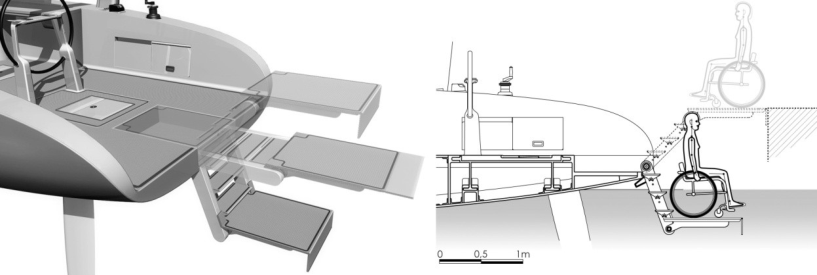
Figure 1. "10 meters Daysailer for All Sustainable Technological Solutions for Easy Navigation" Among the projects of sailing yacht of greater interest in recent years, it should be noted the master's degree thesis "10 meters Daysailer for All Sustainable Technological Solutions for Easy Navigation" (Rossi, Di Bucchianico and Di Nicolantonio, 2012), whose design was derived from the development and application of a specific tool for identifying limit users with regard to specific activities (Di Bucchianico, Gregori and Rossi, 2012). It is a project that offers highly innovative solutions for the living area, the steering position and for going up/down on/from the sailing yacht.
It is also worth mentioning the initiative of the British sailing ships Lord Nelson and Tenacious, three-masted launched respectively in 1986 and 2000 thanks to the action of a group of volunteers, disabled or not. The purpose was to allow people with any physical, mental and nautical ability to navigate side by side on equal terms. So far over 36,000 people have already sailed on the two ships since they were launched.
Human Aspects of Transportation III (2022) https://openaccess.cms-conferences.org/#/publications/book/978-1-4951-2099-2
Figure 2. the accessible pulpit of “Tenacious” vessel
Figure available in the original PDF paper.
Coasting (Small Boats and Vessels)
Within the framework of smaller boats, the dimensions represent often a particularly strong constraints to develop solutions that are truly inclusive. This is also due to the fact that, especially in a sailboat, the technical, physical presence and the importance of the riggings is so prevalent that it is difficult to think of simplifying them to the point of making them accessible to everyone. Therefore, the framework of small boats, although it has produced the first sailing models used by people with disabilities, so far could not produce products that do not appear specifically designed for the disabled. Among the boats Specifically designed for people with disabilities, the most popular classes are: Access, Artemis 20, Challenger, Freedom Independence, GOS 16, Martin 16. Added to these are the following paralympic classes: 2.4 mR (one-person keelboat), SKUD18 (two-person keelboat) and Sonar (three-person keelboat).
Were also developed specific manuals for the adaptability of small boats (eg U.S. Sailing Sailing Adaptive Resource Manual): in fact, through the insertion of on-board seats, transfer benches, steering assits and electronics, it is possible to share the experience of sailing with disabled people on small crafts.
CONCLUSIONS
The good practices that have been described confirm the usefulness and economic, social and cultural opportunities and benefits resulting from the development of projects that are really "inclusive", that is aimed to the enhancement of human diversity. This is especially true in those areas and sectors that more than others tend to deal with multiple dimensions of user, such as the maritime domain.
Human Aspects of Transportation III (2022) https://openaccess.cms-conferences.org/#/publications/book/978-1-4951-2099-2
REFERENCES
Di Bucchianico, G., Gregori, M., Rossi, E. (2012), “Designing from activities. The “ability/difficulty table”, a useful tool to detect the “limit users” in the Design for All Approach”, in: Work: A Journal of Prevention, Assessment and Rehabilitation, Volume 41, Supplement 1/ 2012 Special Issue: IEA 2012: 18th World congress on Ergonomics - Designing a sustainable future. Delft: IOS Press. Di Bucchianico, G., Vallicelli, A. (2011), “User-Centered Approach for sailing Yacht Design”, in: “Human Factors and
Ergonomics in Consumer Product Design. Uses and Applications”, Karwowski Waldemar, Soares Marcelo, Stanton Neville (Ed.). Boca Raton (FL): CRC Press-Taylor & Francis Group. Jordan, P. W. (2000), “Designing Pleasurable Products. An Introduction to the New Human Factors”. London: Taylor & Francis Rossi, E., Di Bucchianico, G., Di Nicolantonio, M. (2012), “10 Meters Daysailer “for All”. Sustainable Technological Solutions for Easy Navigation”, in: “Advances in Social and Organizational Factors”, Vink, Peter (Ed.). Boca Raton (FL, USA): CRC Press (Taylor & Francis Group). Spadolini, P.L. (1987), “Le analisi delle funzioni d’uso e loro relazioni, gli spazi minimi ed i problemi dimensionali nelle
imbarcazioni da diporto a vela e a motore”, in: “Architettura imbarcazioni da diporto, Vol 1°”, Vallicelli, Andrea (Ed.). Firenze: Cesati.
Human Aspects of Transportation III (2022) https://openaccess.cms-conferences.org/#/publications/book/978-1-4951-2099-2
LISTED IN THE AHFE DIGITAL BOOKSTORE CATALOGUE
Explore the complete digital volume
Advances in Human Aspects of Transportation: Part III
Read this individual research paper free through the original publisher, or explore the full digital proceedings book.
ISBN 978-1-4951-2099-2
Explore this ISBN in the AHFE Bookstore ↗Listed in the July 2026 bookstore catalogue; search by ISBN to confirm current availability · Digital book purchase optional