Antonio Marano, Giuseppe Di Bucchianico, Ivo Spitilli (2022). Dynamic worktop for highly inclusive kitchens: Design for All (DfA) solution for product innovation in the kitchen furniture’s area. In: Design for Inclusion. AHFE Open Access, vol. 45, pp. 89–95. https://doi.org/10.54941/ahfe1001873
In the field of Product design, basic and applied research addresses the issue of inclusion through a theoretical-methodological and experimental development approach, aimed at specific user groups with personal needs (anthropometric, postural and use) or with reduced possibility of action and movement.Thus, the solutions and product innovations on the market are mostly partial, specialized and hyper-functional, and they don’t consider, as far as possible, everyone's needs through an inclusive approach to the project.Today, the culture of design evolves towards Design for All (DfA). It is the design for human diversity, social inclusion and equality (EIDD Declaration of Stockholm, 2004), which aims, instead, to extend the active and autonomous, comfortable and pleasant use of products to the widest variety of subjects, different from each other for culture or perceptive, motor and cognitive abilities.In this problematic context and in the perspective of the transition towards social inclusion, this paper proposes a discussion and a theoretical-critical reflection on the application of DfA tools and methods and presents the results of the elaboration and experimental development referred to a dynamic Top concept for a highly inclusive kitchen. The aim of this research is to prefigure a kitchen system able to offer users a more inclusive and personalized access, to respond to the cognitive and physical needs of the different possible targets, in an equitable way and without creating ghettoizations or specializations, to modify and adapt its own characteristics over time in order to guarantee a socially inclusive use.In particular, the studio is critically confronted with the experiences that take place in many parts of the world that develop and manufacture more accessible products in the kitchen supplies sector, to arrive at the development of a concept of a highly inclusive kitchen worktop by applying the methodology of DfA.The design process activities concern a pre-concept phase for the identification of problematic nodes, and, by means of an anthropometric verification, of the size and minimum dimensions of the product.This is followed by a phase of generation and selection of the most promising ideas to come finally, in the final phase, to the development of the product concept and a subsequent empirical validation of the degree of innovation achieved through virtual models and scale prototypes.The concept of a typically innovative kitchen worktop for all, represents the starting point and the methodological basis for the search for new solutions in the various areas of Product design, able of responding effectively to the pressing and urgent questions posed by inclusive society. The result demonstrates the concrete possibility of overcoming the concept of design for disability by proposing as an alternative a design for all approach that promotes equality and equity of use.
In the field of Product design, basic and applied research mainly addresses the issue of inclusion through a theoretical-methodological and experimen- tal development approach aimed at specific user groups with personal needs (anthropometric, postural and use) or with reduced possibilities of action and movement. In the kitchen design sector, in particular, the products offe- red on the market with a presumed high degree of accessibility, are mostly focused on improving the usability of the product with specialized solutions for users with mobility difficulties, facilitating their use through decrease in physical and cognitive efforts necessary to carry out the main activities. In this way, however, they are intended for limited and standard users, without guaranteeing comfort of use for all possible users. The DfA approach, on the other hand, can favor the creation of products that are accessible to every category of people, with diversified perceptive or cognitive physical abilities and skills, or with generational or cultural differences, effectively overco- ming the concept of design for standard condition (Bandini Buti, 2008). In this thematic framework, the research presented in this paper intends to pre- figure a kitchen system, and in particular a dynamic worktop, able to offer users a more inclusive and personalized access, to respond to the cognitive
and physical needs of the various possible targets, in an equitable manner and without creating marginalization or specialization, to modify and adapt their characteristics over time in order to guarantee a socially inclusive use.
THE RESEARCH This contribution presents part of the results of a recent PhD research which, in its complete form, addressed the more general focus of social inclusion and sustainability in Product design, issues considered by the European Union as multidimensional and inseparable, through the study of “Integrated Design for All and Ecodesign solutions for innovation in the kitchen supplies sector” (Spitilli, 2021). The research activities were carried out in the start-up phase in the Pescara Department of Architecture to fine-tune the conceptual fra- mework of reference, subsequently at Brunel University in London for the development of methods and tools for eco-design and DfA in the Kitchen design, and in the final stages in the company ARAN World Srl for the expe- rimental tests. The research, in its complexity, has produced an integrated DfA and Ecodesign strategic model based on the product life cycle, the inte- grated guidelines of DfA and Ecodesign in the kitchen design sector, a toolkit for the orientation and validation of new inclusive and eco-sustainable conce- pts. With respect to the more general framework of the research results, the paper presents the results of an applied research, referring to the elaboration and experimental development of a dynamic worktop for a highly inclusive kitchen.
THE METHODOLOGY On the basis of the concepts, tools and methods of theoretical-critical elaboration of the DfA, the design process activities applied to product design were divided into the phases of: start of exploratory research for the identification and development of cases of study; definition of the DfA Kitchen design guidelines; description of strategies and related checklists on DfA Kitchen design; elaboration of the product brief with the identifica- tion of the target and the system of needs and requirements; pre-concept for the identification of problematic nodes and for the anthropometric verification of the overall dimensions and minimum dimensions of the product; generation and selection of the most promising ideas; synthetic illustration and development of the product concept; empirical validation of the degree of innovation achieved through virtual models and scale prototypes.
Case Studies, Guidelines and Checklists The start of the research concerns the identification, selection and develo- pment of the most innovative case studies in the context of inclusive design from the point of view of typological innovation, methods of inclusion and ease of use. The selected case studies were critically illustrated through a com- parative table that made it possible to highlight the most innovative features and to assess the degree of accessibility.
Dynamic Worktop for Highly Inclusive Kitchens: Design for All (DfA) 91
In most cases, the problem of use due to the anthropometric differences of the users is solved through technological systems and kinematics ensuring the necessary configurative variability of the kitchen system, in order to reduce the physical efforts of people and to facilitate accessibility to equipment and containment. The solutions are designed especially for people on wheelchairs, are low in innovation and limited to the washing and cooking areas. Basi- cally, these are “highly accessible” kitchens rather than “inclusive” kitchens according to the broader meaning of the DfA.
The analysis of the case studies resulted in the DfA guidelines for Kitchen design, divided into the macro-areas size, type of kitchen, spatial structure, easy of use and interface, materials and morphology, accessories, which con- sider respectively the aspects related to the target, the kitchen functions, the general and specific use activities, the functional products and resources necessary for the functioning of the kitchen (electricity, gas, water, internet, etc.) (Di Bucchianico, 2012).
In the next phase, a further tool was developed that provides for the description of strategies and related DfA checklists for Kitchen design: pro- duct optimization to user capabilities, reduced physical and cognitive efforts, equity optimization, increase variability, product accessibility and safety features optimization.
Product Brief The case studies have highlighted the main problem of current worktop solu- tions that do not fully satisfy the user needs with respect to anthropometric diversity, the possibilities of use standing or in a wheelchair, physical and cognitive abilities which are variable over time.
The reference target was identified through the use of a specific tool, the “Abilities/Difficulties Table (A/D Table)” (Di Bucchianico, Gregori, Rossi, 2012), which relates the skills required by the use of a product with the dif- ficulties expressed by users in relation to possible disabilities, with the aim of identifying the limit user as a possible reference of the project. The target audience takes into account the extreme percentiles of men and women, as well as the lowest percentile of women in wheelchairs. This choice represents the possibility that a family unit includes individuals of very different heights, with different motor, cognitive and cultural skills, who should be able to use the worktop even simultaneously performing different functions.
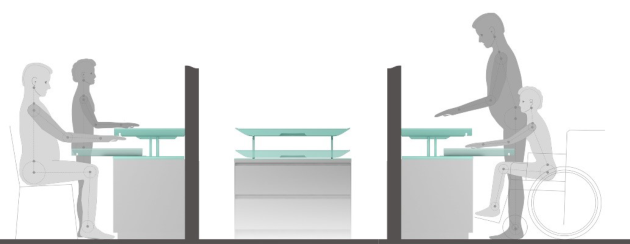
In particular, in order to accurately identify the heights and spaces neces- sary for the use of the worktop, an anthropometric verification was necessary, by comparing all the dimensions in which the use of the tops is comfortable for the main categories of target identified (1st percentile of standing and wheelchair users; 99th percentile of standing and seated women). The dia- grams represent the minimum size of free space required and the height from the ground for the comfortable use of a 600mm deep worktop for the vari- ous target categories. By aligning the green areas and overlapping them and placing a base cabinet with a standard depth of 600mm side by side, an area is identified that identifies the space in which the worktop must be located in order to be accessible and inclusive.
Figure 1: The dynamic worktop used by the target male 99th percentile seated, female 1st percentile standing, male 99th percentile standing and female 1st percentile in a wheelchair.
With the use of the A/D Table it was possible to highlight the most critical needs related to use in relation to the user’s abilities and the equal use of all user categories. On the basis of the highlighted needs, the general and specific product requirements have been described (use, ergonomic, anthropometric, safety, technological, aesthetic). In particular, the requirements relating to cooking, washing and preparation activities were considered. From the analy- sis of the tasks it appears, in fact, that the greatest criticality in Kitchen design concerns the activities carried out on the work surface, on which the attention of the concept design has focused.
Concept Design The conceptual solution to the problem of current non-inclusive kitchen systems is expressed briefly with the idea of a new highly innovative wor- ktop, capable of adapting and optimizing the spatial configuration with ease, efficiency and reliability.
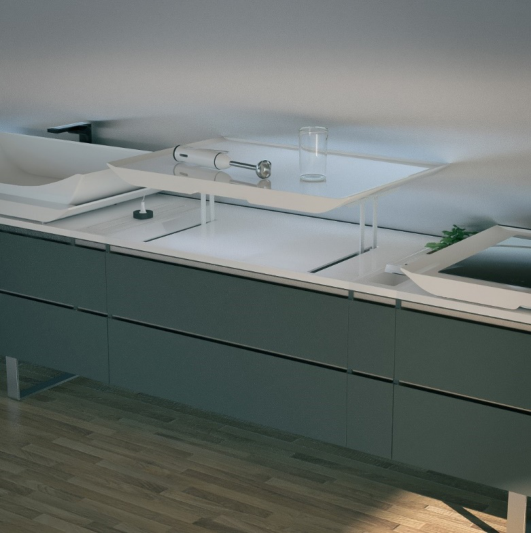
To respond to the anthropometric differences and the different conditions of motor skills of as many people as possible, thus overcoming the concept of a specialized kitchen dedicated to a single user category, the new product concept, in line with the principles of the DfA, proposes a dynamic worktop capable of moving in space in two directions: a horizontal one, to facilitate the comfortable and safe use of the seated top, both for people in wheelchairs, for elderly people or for people with temporary necessity; a vertical one, to meet the needs related to anthropometric differences and, at the same time, to the possibilities of use while sitting or standing (see Figure 1).
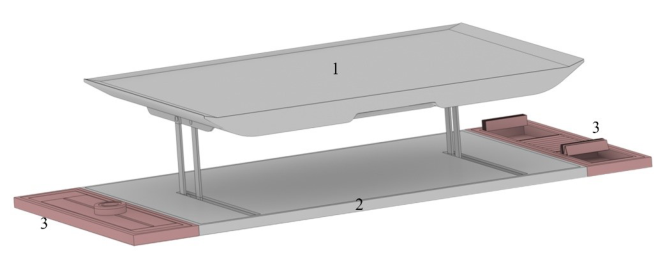
DESIGN RESULTS The dynamic Worktop is made up of a mobile worktop and a structural undertop, connected to each other by a system of rods and sliding guides (see Figure 2), which allow you to obtain multiple configurations in height and depth to easily adapt to the different anthropometric needs of users.
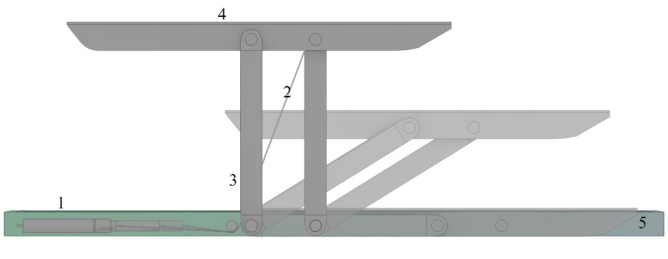
The dynamic movement of the worktop is guaranteed by a shock absorber and a cable hooked to the rod of an articulated parallelogram, inserted in the
Dynamic Worktop for Highly Inclusive Kitchens: Design for All (DfA) 93
Figure 2: The elements of the modular component (1. Mobile worktop, 2. Structural undertop, 3. Service channel).Figure 3: The technological system for the movement of the worktop (1. Hydraulic cylin- der, 2. Support cable, 3. Articulated parallelogram, 4. Mobile countertop, 5. Structural undertop).
undertop element with a thickness of 20 mm (see Figure 3). Two specialized service elements for electrification and small containment are integrated on the sides of the undertop. Alternatively, an induction cooker, a sink equipped with a removable basin to increase its capacity, or a cutting and preparation surface can be integrated on the 50 mm thick mobile worktop. The lower surface integrates both the horizontal and vertical movement control system and the functional and scenographic lighting.
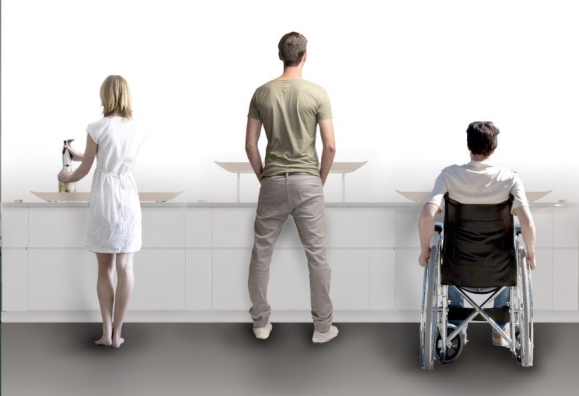
The modularity of the dynamic worktop is based on the 900, 1200 and 1500 mm modules, which include respectively the 600, 900 and 1200 mm modules of the mobile worktop and the underlying service modules of 150 mm inserted on the sides of the undertop. The configuration of the mobile worktop recalls the shape of an ele- gant and functional tray. The slightly tapered side profiles increase the ease of gripping during handling operations and reduce the danger during the lifting and dragging of the table (see Figure 4). The geometric and com- pact line of the undertop, on the other hand, favors integration with the standard kitchen bases. Furthermore, the morphological and technologi- cal solutions of the dynamic worktop meet the environmental requirements to facilitate maintenance and disassembly of the different parts of the system.
Figure 4: Variability of use of the Dynamic worktop.Figure 5: 3d render of the dynamic worktop with the three functional components.
The realization of the physical model allowed the typological, morpho- logical and functional verification of the basic component of the dynamic worktop consisting of the mobile worktop and the structural undertop (see Figure 5).
Dynamic Worktop for Highly Inclusive Kitchens: Design for All (DfA) 95
CONCLUSION
The research presented in this paper has produced a typological innovation of the kitchen worktop through the DfA approach. Specifically, the creative “problem solving” activity and the design process based on known DfA pha- ses, tools and methods has allowed to design and develop a highly inclusive dynamic worktop. The visible result of the research applied to Kitchen design demonstrates the possibility of being able to overcome the current conceptual limits set by design for disability, as it is dedicated to specific groups of users, through a “for All” design approach oriented, instead, to the search for uni- tary solutions capable of satisfying the most complex needs relating to human diversity. In conclusion, the results of the research constitute the starting point for extending the DfA approach and the design process methodology, both to the entire kitchen design sector and to other production sectors, imagining new truly inclusive product solutions.
REFERENCES
Bandini Buti, L. (2008). Ergonomia Olistica. Il progetto per la variabilità umana.
Milano: FrancoAngeli. Di Bucchianico, G. (2012) – Struttura logica per definire i requisiti DfA. Cucine per uso domestico. Design for All Italia Website: http://quality.dfaitalia.it/design-for- all-italia/cucine-per-uso-domestico/ Di Bucchianico, G., Gregori, M., Rossi, E. (2012). Designing from activities. The
“ability/difficulty table”, a useful tool to detect the “limit users” in the Design for All Approach. Work: A Journal of Prevention, Assessment and Rehabilitation, Volume 41, Supplement 1/ 2012 Special Issue: IEA 2012: 18th World congress on Ergonomics - Designing a sustainable future. Delft: IOS Press, pp. 1362–1367. Spitilli, I. (2021). Soluzioni integrate di Design for All ed Ecodesign per l’innovazione nel settore del kitchen forniture. Tesi di dottorato in Sistemi Terrestri ed Ambienti Costruiti, XXXIII ciclo (AA 2018-19), Università di Chieti-Pescara (tutors: prof. A. Marano, Università di Chieti-Pescara, Italy; prof. F. Ceschin, Brunel University, London, UK; arch. U. Narcisi, ARAN World Srl).
LISTED IN THE AHFE DIGITAL BOOKSTORE CATALOGUE
Explore the complete digital volume
Design for Inclusion
Read this individual research paper free through the original publisher, or explore the full digital proceedings book.
ISBN 978-1-958651-21-6
Explore this ISBN in the AHFE Bookstore ↗Listed in the July 2026 bookstore catalogue; search by ISBN to confirm current availability · Digital book purchase optional