Stefania Camplone, Giuseppe Di Bucchianico, Gabriella Petrucci (2024). Circular materials for Eco-Craftsmanship - Development of a Wool-based Biocomposite for 3D printing of Abruzzo region craft products. In: Human Factors in Design, Engineering, and Computing. AHFE Open Access, vol. 159, pp. 462–468. https://doi.org/10.54941/ahfe1005612
The Abruzzo region, in Italy, has a strong artisan tradition. Among the many artisan sectors is also the textile artisan, present in many towns in the area, which uses sheep's wool as a raw material. However, artisan workshops (goldsmiths, ceramists, leather workers, embroiderers, etc.) tend to disappear due to insufficient generational turnover, as young people are interested in more innovative activities. This also results in the loss of cultural identity and the abandonment of internal territories, with serious damage to local socio-economic systems. Furthermore, some artisan productions are unsustainable from an environmental point of view, especially assuming an extension of production to optimize economies of scale. Wool mills, for example, in their textile production, produce large quantities of waste in terms of wool dust and threads, "waste" that cannot be easily recycled.Innovating in the artisan sectors, even the most traditional ones, through the use of digital technologies and 3D printing, could represent an excellent incentive to bring young people closer to ancient professions, thus encouraging a generational change and the creation of new job opportunities. The digitalization of some productions, moreover, associated with the recovery of some waste materials, would also positively interpret some of the UN 2030 objectives.This paper reports the results of a research aimed at reusing production waste from wool fabrics and filaments to generate a new, ecological and circular composite material. The new material involves the use of a bioplastic matrix, PLA (polylactic acid), loaded with wool filaments, to obtain a fiber-reinforced biocomposite printable with 3D digital printing technologies. This new material, based on the use of a typically local material, can be used to create artisanal products that recall some traditional Abruzzo productions, effectively complementing more conventional craftsmanship.
Craftsmanship in the Abruzzo region of Italy represents a valuable heritage, which bridges tradition and innovation, preserving ancient techniques while adapting to contemporary demands, thereby maintaining its identity and authenticity. For the region, craftsmanship, through its workshops, traditional markets, and local fairs, has always been an economic driver,
Circular Materials for Eco-Craftsmanship. Development of a Wool-Based Biocomposite 463
contributing to job creation and playing a fundamental role in promoting tourism and culture.
Among the key sectors of Abruzzo’s craftsmanship is weaving, known for the production of carpets, shawls, tablecloths, blankets, lace, and garments. These items are created using various techniques (bobbin lace, embroidery, looms) and materials (cotton, linen, hemp, wool), resulting in unique products with a strong sense of identity.
In particular, wool and its processing have, over time, acquired a symbolic value for Abruzzo’s craftsmanship, primarily due to the region’s long- standing traditions of sheep farming and weaving. These traditions have been an important catalyst for economic development through a vibrant textile market that has contributed to the growth and prosperity of local communities.
However, despite its long tradition and the quality of the materials produced, the wool industry in Abruzzo is currently facing new challenges related to environmental issues. Wool production has a significant environmental impact due to the intensive use of water resources, chemicals in the dyeing and finishing processes, and the production of waste and by- products at various stages of the textile production process, which are often difficult to dispose of.
On the other hand, in recent decades, the introduction of digital technologies alongside traditional methods represents an opportunity for the craft sector, especially for younger generations of artisans who are more attuned to contemporary changes and challenges (Micelli, 2016). These artisans face new obstacles, such as competition from industrial production and a lack of financial support and infrastructure, which have led to a drastic reduction in employment in this delicate sector.
Moreover, the promotion of craftsmanship can support the overarching goal of the UN 2030 Agenda to promote inclusive and sustainable economic growth. Valuing traditional artisanal skills and promoting fair trade can create income opportunities for people in both rural and urban areas, while also supporting the long-term preservation of artisanal traditions.
Based on these considerations, a thesis research project was conducted with the aim of reusing production waste from wool fabrics and filaments to generate a new, environmentally friendly composite material. Specifically, the hypothesis is that by using a bioplastic matrix reinforced with wool filaments, it is possible to create a fiber-reinforced biocomposite that can be 3D printed using digital technologies. This novel material, rooted in a typically local resource, could subsequently be used to create artisanal products that echo some traditional productions from Abruzzo region, complementing more conventional craftsmanship.
METHODS
The experimental research on the new fiber-reinforced biocomposite with wool fibers was structured into the following phases: identification of the matrix and potential reinforcements; preparation of the tests, including the creation of molds and specimens; laboratory testing and material
characterization; and the systematization and analysis of experimental results.
Matrix and Reinforcement for the Fiber-Reinforced Biocomposite Initially, a specific analysis of possible alternatives among bio-based plastic resins to be used in combination with wool fibers was conducted (Camplone, 2021). Their physical and chemical characteristics, as well as other practical factors (availability, cost, prior use in additive manufacturing, etc.), were analyzed. This investigation led to the identification of PLA (Polylactic Acid) as the most suitable matrix for creating a wool fiber-reinforced biocomposite. PLA is the only polymer produced on a large scale that is bio-based, biodegradable, and biocompatible (European Bioplastics, 2024). It has already widely replaced conventional fossil-based polymers in numerous sectors because it can be easily processed using traditional plastic manufacturing techniques (such as molding, film production, extrusion, and spinning).
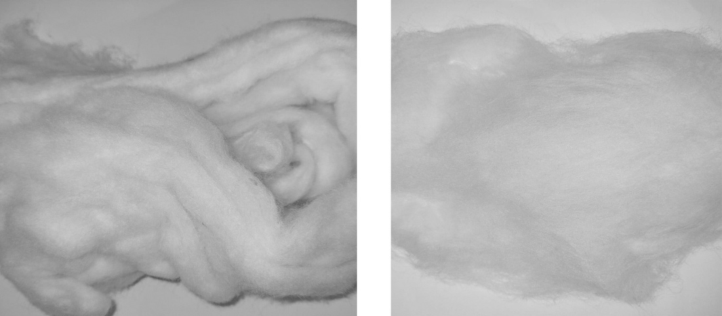
Regarding the wool fiber reinforcement, it was determined that these fibers already possess a very interesting balance between mechanical properties, thermal and acoustic insulation, environmental compatibility, and renewable resources, making them an excellent natural reinforcement choice for a new biocomposite material. Specifically, it was crucial to analyze the conditions and formats in which wool production waste generally appears. It was found that the most common formats are “blousses” (derived from “combing”), “laps”(compact masses of wool fibers that have undergone the initial carding phase but have not yet been combed), and “dusts” (formed during various stages of the production process, such as carding, combing, and spinning).
Figure 1: Blousses and laps of wool fibers.
Preparation of the Tests To proceed with the experimentation and study of the composite material made of PLA (matrix) and wool processing waste and by-products (reinforcement), the creation of various so-called “dog-bone” specimens was planned, adhering to standards in terms of dimensions and thicknesses.
Circular Materials for Eco-Craftsmanship. Development of a Wool-Based Biocomposite 465
Three different types of “mixtures” for the new fiber-reinforced composite material were established:
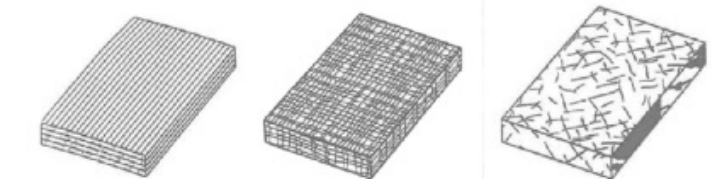
- PLA with “Laps”: with long wool fibers positioned unidirectionally along the matrix (anisotropic). - PLA with “Laps”: with long wool fibers positioned bidirectionally along two orthogonal directions in the matrix (orthotropic). - PLA with “Blousses”: with short wool fibers positioned in a disordered and discontinuous manner (isotropic).
In addition to these three combinations, a pure PLA mixture was also tested as a control element to compare the different fiber-reinforcement combinations with the pure matrix material.
Figure 2: Schematic representation of wool fiber arrangement in the specimens: Anisotropic laps, orthotropic laps, and isotropic blousses.
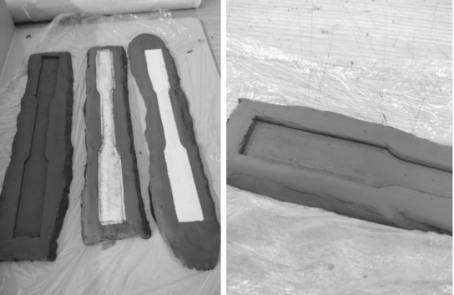
In particular, to test the different combinations, it was necessary to produce specific specimens with standardized geometry and dimensions according to specific regulations. These were made using a mold to contain the fluid mixture, which was then brought to polymerization temperature, allowing the initial mixture to achieve the solid consistency needed for handling the specimens. In this case, clay was chosen for the mold due to its easy workability, even with digital printers (for creating products with a high degree of finish), as well as its high melting point (over 1200
C), which is significantly higher than that of PLA (230
C).
Figure 3: “Dog-bone” specimens made with clay molds.
Testing Process Mechanical tests verify the degree of material resistance to external forces, identify technical characteristics, and determine whether the materials meet technical production standards that ensure quality and safety (UNI EN, UNI ISO, ETAG, ASTM).
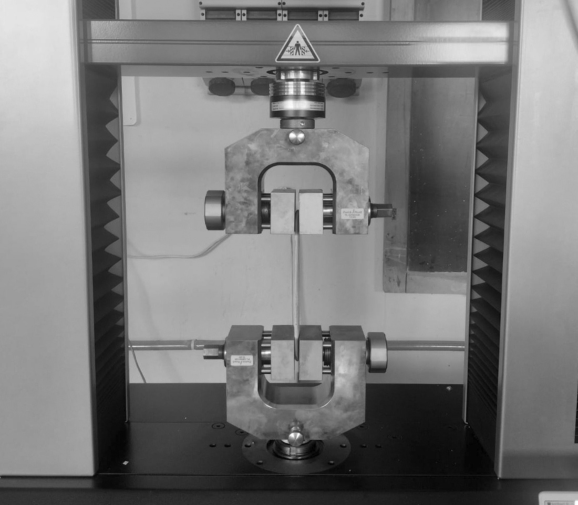
Among the various possible mechanical tests (tensile, compression, flexural, hardness, impact, etc.), the experimentation began with a tensile test to analyze the stress-strain behavior. Specifically, the test involved subjecting the specimen to a slowly increasing unidirectional tensile force from 0 to a value sufficient to cause breakage, measuring the applied force and deformation.
Long fibers, which significantly contribute to the composite’s tensile load- bearing capacity, improve overall mechanical strength by transmitting the load across the entire composite length, reducing stress concentration, and enhancing the material’s overall strength. The improved load transmission would result in greater tensile strength.
The test, conducted with a specific stress-strain measurement machine, involved 12 specimens, 3 for each type: 3 with PLA and long wool fibers (laps) oriented unidirectionally, 3 with PLA and long wool fibers (laps) oriented in two different directions, 3 with PLA and short wool fibers (blousses) arranged discontinuously, and 3 with pure PLA for comparative analysis of the mechanical behavior between the new fiber-reinforced material hypotheses and the pure PLA matrix.
Figure 4: A test specimen subjected to experimental verification in the tensile measuring machine.
Circular Materials for Eco-Craftsmanship. Development of a Wool-Based Biocomposite 467
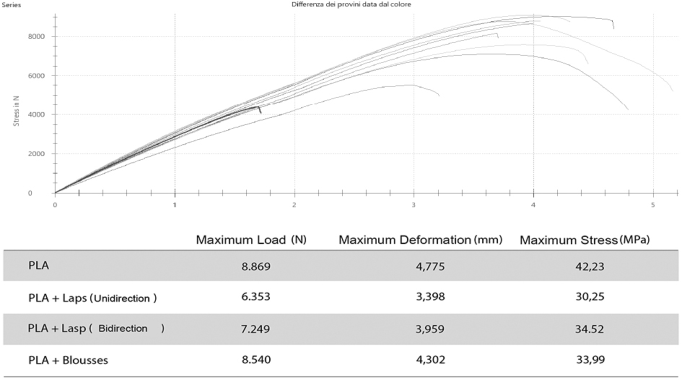
Analysis of Experimental Results The data obtained from the experimental tests were plotted on a stress- strain diagram to compare the different tensile behaviors. The graph shows consistency among the three test specimens, indicating reliable test results. It can also be observed that PLA is a relatively brittle material with low elongation at break.
Figure 5: Comparison graph between the behaviors of the three different arrangements of the wool fiber reinforcements.
RESULTS
The experimental tests demonstrated that the incorporation of wool fibers as reinforcement within a PLA matrix increases the material’s ductility. In particular, the material with bidirectionally oriented long fibers proved to be the “weakest,” possibly because only the fibers aligned with the tensile direction contributed, while those oriented orthogonally may have reduced the efficiency of the others.
Conversely, the material containing short, discontinuous fibers outperformed even the one with long fibers. This result likely depends on the fiber distribution within the specimen. Given the random distribution (with fiber clusters not easily controllable), more tests on a larger number of specimens would be necessary to confirm the reliability of this finding.
Nonetheless, it is indisputable that incorporating wool fibers as reinforcement in a PLA-based biocomposite makes the original material more ductile and thus more resistant to breakage.
CONCLUSIONS
The new composite material made of PLA and wool offers a wide range of craftsmanship applications due to its combination of ecological, aesthetic, and functional properties. It can be used in various production sectors,
from interior design to jewelry, from fashion accessories to decorative elements, while preserving the stylistic elements of local artisanal traditions and offering sustainable and innovative solutions for artisans and designers.
Thanks to the ductility of the new material, which could be produced in formats compatible with common 3D printers, it is conceivable to create artifacts with even highly complex shapes. Additionally, its use as a substitute for non-eco-friendly polymeric materials would make artisanal products more sustainable, thereby imbuing new productions with ethical considerations (Karana et al., 2014).
Finally, due to the distinctive aesthetics provided by the visible fibers within the PLA matrix, each product will be unique and unreplicable. This characteristic can contribute to strengthening the identity
CREDITS The research was developed as part of a Master Degree thesis in Eco Inclusive Design at the Department of Architecture of Pescara (University of Chieti- Pescara, Italy). Thesis title: “Circular materials for Eco-Craftsmanship. Development of a wool-based biocomposite for 3D printing of Abruzzo region craft products”, supervisor prof. S. Camplone, co-supervisors prof. G. Brando and V. Sangiorgio, academic research consulting prof. G. Di Bucchianico, graduating G. Petrucci.
This paper, which is the result of a common discussion during the whole research process, summarizes the objectives, the phases of implementation and the main results obtained, was written by S. Camplone (Methods - Analysis of experimental results; Results; Conclusions), G. Di Bucchianico (Introduction), G. Petrucci (Methods - Matrix and reinforcement for the fiber-reinforced biocomposite, preparation of the tests and testing process).
REFERENCES
Camplone, S. (2021). BioPlastics: The Challenge of a Perpetual Material. In: Russo, D., Ahram, T., Karwowsky, W., Di Bucchianico, G. and Talar, R. (eds.) Intelligent Human Systems Integration 2021. Advances in Intelligent Systems and Computing series, Vol. 1322. Cham (Switzerland): Springer. European Bioplastics (2024). What are bioplastics? Available at: https://docs.eur
opeanbioplastics.org/2016/publications/fs/EUBP_fs_what_are_bioplastics.pdf (Accessed: 12 August 2024). Karana, E., Pedgley, O. and Rognoli, V. (2014). Materials Experience. Fundamentals of Materials and Design. Oxford: Butterworth-Heinemann. Micelli, S. (2016). Fare è innovare. Il nuovo lavoro artigiano. Bologna: Il Mulino. Shady, F. et al. (2016). Physical and Mechanical Properties of PLA, and Their
Functions in Widespread Applications - A Comprehensive Review. Advanced Drug Delivery Reviews, No. 107.
LISTED IN THE AHFE DIGITAL BOOKSTORE CATALOGUE
Explore the complete digital volume
Human Factors in Design, Engineering, and Computing
Read this individual research paper free through the original publisher, or explore the full digital proceedings book.
ISBN 978-1-964867-35-9
Explore this ISBN in the AHFE Bookstore ↗Listed in the July 2026 bookstore catalogue; search by ISBN to confirm current availability · Digital book purchase optional