Jiayi Zhu, Xi Zheng, Xin He, Yu Yun (2021). ARunning: A Discussion on the Role of Augmented Reality-assisted Application in Amateur Runner Athletes. In: Human Systems Engineering and Design (IHSED2021): Future Trends and Applications. AHFE Open Access, vol. 21. https://doi.org/10.54941/ahfe1001175
This research aims to explore and demonstrate the advantages of ARunning compared with traditional sports methods by studying the research status and development trend of augmented reality assisted sports applications, so as to realize the design and development of ARunning and enrich the form and development of ARunning. It also conducts usability testing and evaluation for the user experience, so as to realize the preliminary exploration on how AR can complement the practical application of sports psychology. In order to test the impact of ARunning on amateur runners' decision-making, experience during running, and feeling after running, we conducted live and online research on amateur runners. The results show that the popularization and application of this program will improve amateur athletes' exercise level to a certain extent and reduce their emotional burden, and it is likely to become the main motivation for users to participate in sports.
Human Systems Engineering and Design (IHSED 2021) https://openaccess.cms-conferences.org/#/publications/book/978-1-7923-8987-0
INTRODUCTION
Most amateur runners find it difficult to maintain long-term continuous intensity running because they usually focus on the perceived physical fatigue and the psychological fear that comes with it. Research showed that professional athletes have the highest self-esteem, feeling-seeking, and mental health (Samadzadeh, Abbasi, & Shahbazzadegan, 2011). In these respects, the condition of amateur athletes is slightly inferior, with negative and significant correlations observed between self-esteem, sensory-seeking and physical symptoms, anxiety levels, social behavior disorders and depression levels. We describe here an academic project that uses AR technology to supplement the practice of applied sports psychology, designing an augmented reality assisted sports application, based on the theoretical support of augmented reality gamification experience design, and integrating gamification into the application. ARunning is a long-distance running companion app based on augmented reality assistance and AR technology, combined with AR head-mounted display glasses, cleverly combined with the goggles worn by long- distance runners during running. Our goal is to relieve the fear of long-distance runners for a long-distance running journey to a certain extent, and achieve the gain effect of restoring body functions and improving physical fitness through AR-assisted exercises.
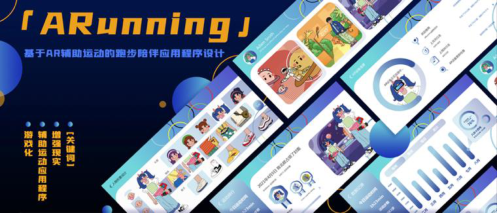
ARUNNING Do you have a specific preferred running environment? From playgrounds, walking streets to forest greenways. During the ARunning process, players seem to be immersed in the universe for a dip. Achievements can be achieved by collecting pieces of satellite rocket ships and discovering the mysteries of the galaxy. As the number of player laps increases, the full number of layers of the eight galaxies will also increase, and the probability of rare planets appearing will also increase. The forest has a wide variety of vegetation on the trails. Players can greet the virtual animals that rush to say hello on the road and find food in the space. As the player's running distance increases, the probability of rare animals appearing increases, and the probability of rare animals dropping food also increases. Achievements can be achieved by feeding and collecting rare animals. There is more traffic on the driveway and more danger factors. Players can use the virtual light display to avoid some sudden dangers and hidden safety hazards on the road.
Human Systems Engineering and Design (IHSED 2021) https://openaccess.cms-conferences.org/#/publications/book/978-1-7923-8987-0
Figure 1. One of the wonderful AR scenes based on urban pedestrian street
The concept of ARunning was developed to inspire people to exercise outdoors, thereby turning activities that some people may consider boring into games. In order to change the current predicament and create a more suitable jogging exercise program for the younger generation, we use wearable AR The equipment makes more young people fall in love with running. In ARunning, users can set their own character images: cute, sunny, and damp avatars as the main body to accompany the movement, so that they become the main character of the game, and the real world becomes the user interacting with them through their own body movements Game world. Users can select corresponding game scenes in ARunning (for example: space travel, animal viewing, alien spacecraft) according to their immediate running sports environment (for example: playground track, pedestrian street, forest greenway), and interact with each other in various ways. ARunning game objects interact. For example, in the process of running, the player seems to be immersed in the universe to swim. Achievements can be achieved by collecting fragments of satellite rocket spacecraft and discover the mystery of the galaxy. As the number of laps of the player increases, the number of full layers of the eight major galaxies will also increase, and the probability of rare planets will increase; during the running, the player passes through the virtual The red, yellow and green lights show that to avoid some sudden dangers and hidden safety hazards on the path (such as manhole covers, chewing gum), there will be several staggered paths on the relatively unobstructed path, and the player will get the corresponding jump according to the path. gift. Users can also choose to play the game in ARunning alone or with others (cooperation or competition). These mini- games bring more fun to daily running and help users improve their physical health and overall health. ARunning focuses on companionship and stimulates users' perseverance and physical stamina through a fun and gamified exercise experience.
Human Systems Engineering and Design (IHSED 2021) https://openaccess.cms-conferences.org/#/publications/book/978-1-7923-8987-0
Figure 2. The design of ARunning’s main operation interface
We currently use AR head-mounted display glasses, combined with GPS technology and depth sensors to achieve the development of ARunning. The existing available technologies still have many shortcomings. The AR 3D spatial environment recognition of pedestrian street obstacles needs to be faster and more accurate, because This is related to the safety of users. Specifically, many people expressed the need for AR head-mounted displays to be more mature. It is compact, durable, and has improved optics to provide higher visual comfort, field of view and spatial resolution; and AR head-mounted displays have safety and health issues. All interviewees believe that wearing AR helmets is possible It will increase distraction and decrease situational awareness, which may be more obvious than using smartphones. At the same time, research mentioned that AR is still suffering from usability and hardware problems, which leads to higher uncertainty for users in navigations (Rehrl, Häusler, Leitinger, & Bell, 2014). But by combining digital maps and accurate voice commands, the best navigation performance and user experience can be achieved. We hope that in the future, sports goggles and even digital contact lenses that can use digital content to enhance the real environment can be used as display technology, as well as more accurate and reliable GPS technology and depth sensor technology, so as to bring a better experience to ARunning in the near future.
METHOD
Participants A total of 76 participants were recruited for this study (64 for online research and 12 for field research). Participants are between 18 and 49 years old, and their education is mainly undergraduate and postgraduate. 64 online researchers accepted oral interviews and paper questionnaire interviews. The 12 field study participants were divided into two groups to participate in the study. The researchers used the experimental group (n = 7) as users of the ARunning application, and compared the control group (n = 5).
Human Systems Engineering and Design (IHSED 2021) https://openaccess.cms-conferences.org/#/publications/book/978-1-7923-8987-0
Tasks This study established a real sports scene in the track and field of the East Campus of Huazhong University of Science and Technology in Wuhan, China. All simulation schemes include the whole process of amateur runners' main long-distance running (greater than 5 km) (such as pre-run decision-making, goal setting, warm up and prepare, experience the feeling after running during the run). Both the experimental group and the control group used exercise assistance applications to assist in the whole process of long-distance running. The experimental group uses ARunning, and the control group uses the traditional exercise assistance application Keep 2.0. The number of participants who completed the entire process of long-distance running (greater than 5 km) was 10, and the user completion rate was 83%.
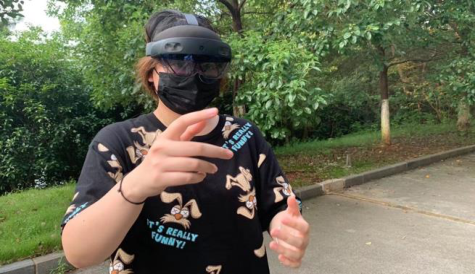
Figure 3. Participants are experiencing ARunning with AR glasses
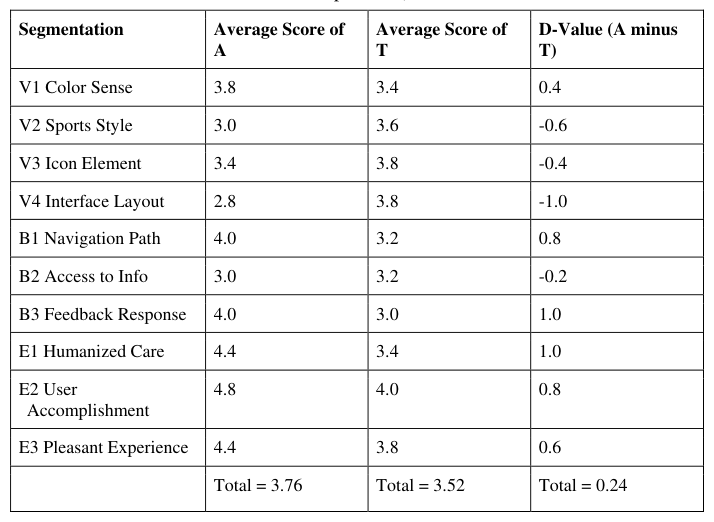
Measures Participants completed the paper questionnaire survey report after completing the task. The control group filled in the plan usability and user satisfaction questionnaires and SUS questionnaires for the entire process of long-distance running (greater than 5 km) in real sports scenes in the East Campus of Huazhong University of Science and Technology. The experimental team filled out the availability and user satisfaction survey form of the revised ARunning program. The two groups tested the usability of two long-distance running auxiliary applications from three subdivisions of "V" (visual language), "B" (behavioral interaction) and "E" (emotional experience). User satisfaction scores from low to high are 1-5 points. The researchers analyzed the average score for each indicator and category.
Human Systems Engineering and Design (IHSED 2021) https://openaccess.cms-conferences.org/#/publications/book/978-1-7923-8987-0
Table 1. Availability and User Satisfaction Data. (A = ARunning, T = Traditional Application, V = Visual Language, B = Behavior Interaction, E = Emotional
Experience.)
Human Systems Engineering and Design (IHSED 2021) https://openaccess.cms-conferences.org/#/publications/book/978-1-7923-8987-0 necessary to continuously test, evaluate and improve in order to achieve the ultimate usability goal.
CONCLUSIONS
The discussion on the above topics shows that augmented reality has the ability to affect the experience of amateur runners. However, further research is still needed to investigate the running experience of amateur athletes through quantitative research methods and implement long-term tracking. The evidence so far and the concerns expressed by experts from different industries all indicate that for ARunning to become mainstream and effective in industry use, many technical, practical and human factors must be overcome. Although we only focused on a limited number of issues in this short paper, we suggest that this series of issues can be at least partially solved by following the following approaches in future research. More research is needed in the following areas.
Optimize information display based on sports needs and risk awareness. The current ARunning usually supports voice or gesture/touch-based interaction. However, the current interaction mode is limited by different sports conditions (for example, running intensity, complexity of running environment, etc.) and athlete characteristics (for example, age, body type). In addition, given that there may be many safety risks in sports venues (for example, pedestrians, traffic, natural disasters), it is necessary to ensure that the information provided in ARunning will not negatively affect amateur athletes' perception of such risks. Therefore, we will focus on optimizing the style of information presentation (such as color, rendering style, font, font size).
Provide physical health and safety warnings. There is little evidence in existing studies to guide AR glasses on how to design effective safety warnings during long- term exercise. Under normal circumstances, AR glasses can be useful to present safety hazards (for example, incoming vehicles, existing trip hazards). However, what ARunning still needs to explore is how to design such warnings or reminders to effectively help amateur runners develop and/or maintain safe sports conditions and skills.
Improve user acceptability and incentive sustainability. This social acceptability element (in terms of the acceptability of using wearable devices in public) has previously been discovered by many studies. For example, it was found that some people opposed the use of wearable devices because it attracted a lot of (usually negative) attention (Han, Tom Dieck, & Jung, 2019) (Bird, 2019). It also called for further research on public resistance to the use of wearable technology. Although users are divided between embracing innovative designs and preferring familiar design solutions, it is clear that all users are aware of the impact of technology use on the experience of their peers (Han et al., 2019). At the same time, gamification as a
Human Systems Engineering and Design (IHSED 2021) https://openaccess.cms-conferences.org/#/publications/book/978-1-7923-8987-0 topic of academic research is still relatively young, and there are few recognized theoretical frameworks or unified discourses. Since gamification has great differences in users’ motivational abilities, behavioral/psychological outcomes, and methodology, it is impossible to conduct a formal meta-analysis (Juho, Jonna, & Harri, 2014). Our future research will be conducted on user acceptability and incentive sustainability experiments or psychological measurements and long-term tracking are required.
The use of augmented reality still has many practical uncertainties in the safety and health of amateur athletes, which requires future research work. In addition, the interviewees represent only a few industries, so our research recommendations may not cover all important issues. In the near future, AR devices will be as popular as our mobile phones. Runners with the help of AR technology will no longer worry about the boringness of running, and replace it with Experience improvement brought by the introduction of real scenes. Similarly, running plus technology can transform a person's exercise into a richer multi-person collaboration. The collaboration between people and technology, whether it is sports experience or industry development model, will bring infinite possibilities.
REFERENCES
Bird, J. M. (2019). The use of virtual reality head-mounted displays within applied sport psychology. Journal of Sport Psychology in Action, 11(2), 115-128. doi:10.1080/21520704.2018.1563573 Han, D.-I. D., Tom Dieck, M. C., & Jung, T. (2019). Augmented Reality Smart
Glasses (ARSG) visitor adoption in cultural tourism. Leisure Studies, 38(5), 618-633. doi:10.1080/02614367.2019.1604790 Juho, H., Jonna, K., & Harri, S. (2014). Does Gamification Work? — A Literature Review of Empirical Studies on Gamification. 2014 47th Hawaii international conference on system sciences, Ieee, 2014, 3025-3034. Rehrl, K., Häusler, E., Leitinger, S., & Bell, D. (2014). Pedestrian navigation with
augmented reality, voice and digital map: final results from anin situfield study assessing performance and user experience. Journal of Location Based Services, 8(2), 75-96. doi:10.1080/17489725.2014.946975 Samadzadeh, M., Abbasi, M., & Shahbazzadegan, B. (2011). Comparison of sensation seeking and self-esteem with mental health in professional and amateur athletes, and non- athletes. Procedia - Social and Behavioral Sciences, 15, 1942-1950. doi:10.1016/j.sbspro.2011.04.032
Human Systems Engineering and Design (IHSED 2021) https://openaccess.cms-conferences.org/#/publications/book/978-1-7923-8987-0
LISTED IN THE AHFE DIGITAL BOOKSTORE CATALOGUE
Explore the complete digital volume
Human Systems Engineering and Design (IHSED2021): Future Trends and Applications
Read this individual research paper free through the original publisher, or explore the full digital proceedings book.
ISBN 978-1-7923-8987-0
Explore this ISBN in the AHFE Bookstore ↗Listed in the July 2026 bookstore catalogue; search by ISBN to confirm current availability · Digital book purchase optional