Zikun Gao, Peiqi Yi, Luyu Wang, Xin He (2022). Design of Access Control System Based on Ergonomics in Post-epidemic Era. In: Ergonomics In Design. AHFE Open Access, vol. 47, pp. 566–573. https://doi.org/10.54941/ahfe1001984
The main function of the access control system is to restrict and manage the people entering and leaving the access control area to ensure safety. In the post-epidemic era, according to the needs of epidemic prevention and control, there are three characteristics in China. First of all, everyone needs to wear a mask when going out. Secondly, body temperature needs to be measured when entering or leaving any place. Thirdly, QR codes often need to be scanned when entering or leaving public places. Based on this, the author found that the current access control systems on the market cannot fully meet the needs of epidemic prevention and user behavior. Therefore, this article takes Hubei Art Museum in China as an example to improve the design of the access control system through the principle of ergonomics, aiming to make it meet the needs of epidemic prevention, bring better user experience and provide reference for related product design.
RESEARCH BACKGROUND Environmental Characteristics in Post-Epidemic Era
The “post-epidemic era”refers to the era after the novel coronavirus epidemic has passed. The epidemic rises and falls from time to time, and a small out- break may occur at any time. This environment has had a profound impact on all parts of China, and people’s lifestyles have also undergone certain changes.
1. Everyone wears a mask outside. Wearing a mask is the most direct and effective way to prevent the spread of the virus. The Chinese have long regarded wearing a mask as a necessary measure for epidemic prevention. 2. Body temperature needs to be taken when entering or leaving any place. Almost all public places have strict real-name registration and tempera- ture records for people entering and leaving to prevent potential virus carriers from moving around. 3. QR codes often need to be scanned when entering or leaving public places. Some public places have corresponding place codes, which can be scanned at the entrance by people entering and leaving to enter entry and exit information. Other public places require an online real- name booking to obtain a QR code before entry, which can be scanned
Design of Access Control System Based on Ergonomics in Post - Epidemic Era 567
Table 1. A description of the main functions of the two types.
Table available in the original PDF paper.
Access card scanning QR code scanning
Face recognition Temperature measurement Floor-standing ✓ ✓ ✓(some have) ✓(some have) Wall-mounted ✓ ✓(some have)
for verification upon entry, again for the purpose of recording access information.
Access Control System The main function of the access control system is the control of entrances and exits. To stop the spread of viruses, access control systems need to perform their function of managing the entry and exit of people. Combined with the environmental characteristics of China in the post-epidemic era, it can be seen that there are problems in the design of the access control system. On the one hand, functions such as face recognition and recording are not well implemented and often need to be done manually. On the other hand, the size setting of the access control system makes the user experience poor during use. The access control system needs to be improved to optimize the user experience and improve its efficiency.
Literature Research The current research on access control systems is more about technology. For example, Sovetov, B.Ya et al. have built physical access control system for the premises using the Internet of Things technology (Sovetov, B.Ya. et al. 2020); Na Yang has explored the design of embedded intelligent face recognition access control system (Na Yang, 2021). There are fewer stu- dies on ergonomics and user experience. Chunxue Wang researched the palmprint recognition access control system for student flats, analysed its shortcomings and put forward improvement suggestions based on ergono- mics (Chunxue Wang, 2014). Huang Changyong analyses the relationship between passengers and gates from an ergonomic point of view, and inve- stigates the human-machine relationship and interface design of the metro ticketing system (Changyong Huang, 2011).
In the context of the post-epidemic era, the research on access control systems is relatively blank, so this research is more meaningful.
RESEARCH PROCESS Field Research
Through research on the access control systems of different functional types of public places in Wuhan, Hubei Province, China, the existing access control systems are summarized into two categories: floor-standing and wall-mounted. Table 1 is a description of the main functions of the two types.
The table shows that the function of scanning card, the primary method of intercepting people in circulation, can be well realized on both types of access
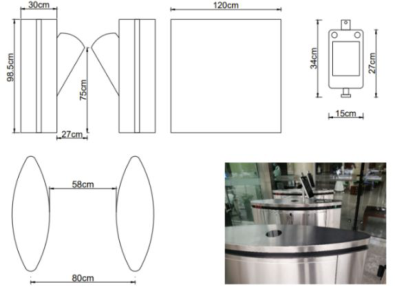
Figure 1: Three views of the access control system of Hubei Art museum.Table 2. The height data of males aged 18-60.
control systems. Code scanning, face recognition and temperature measure- ment, which are more relevant to the prevention and control of epidemics, are more likely to be implemented in floor-standing access control systems. The wall-mounted type can achieve fewer functions due to its small size. There- fore, this paper presents a targeted and improved design for a floor-standing access control system.
Analysis of Access Control System of Hubei Art Museum Hubei Art Museum, as one of the landmark buildings in the cultural constru- ction of Hubei Province, China, shows the charm of provincial art museums in all aspects of artistic communication. It also provides good tour experience for visitors from all over the world.
This paper takes the access control system of Hubei Art Museum as the subject of research and improved design, dedicated to meeting the needs of epidemic prevention in the post-epidemic era, while improving the experience of visitors from around the world. Figure 1 is its specific dimension drawing.
1. The temperature measurement system cannot adapt to people of different heights. Table 2 and 3 show the height data of males aged 18-60 and the height data of females aged 18-55 according to the National Standard of the People’s Republic of China (GB 10000-88).
The height of the temperature measuring device in the access control system of Hubei Art Museum is 1 325mm, which makes it difficult to adapt to a difference in height of about 365mm. Through observation, the author also found that some tall men need to bow their heads or squat slightly when taking temperature measurements. This suggests that the access control system does not perform the temperature measurement function well and can be inconvenient for those passing through.
Design of Access Control System Based on Ergonomics in Post - Epidemic Era 569
Figure 2: The process of measuring the temperature.
To solve this problem, a temperature measuring device that can be raised or lowered or adjusted in direction can be used to expand the range of heights that can be measured.
2. The temperature measuring device will mislead the users to take off the masks. Figure 2 shows the temperature measurement device of the access control system. It does not have the function of facial recognition as the museum is a public place for all to visit. The temperature measurement function of this device is actually realized by the sensor above and the screen below has no actual function. As shown in Figure 2, the screen often misleads tourists that it is necessary to detect the face and remove the mask, which does not meet the needs of epidemic prevention and control.
To solve this problem, the temperature measurement device can be simpli- fied and the screen of real-time monitoring can be removed.
3. The setting of the scanning area is unreasonable. Visitors entering the art gallery need to make an online real-name reservation in advance to obtain a QR code, which will then be scanned for verification when passing through the access control. Figure 3 shows the action of a visitor scanning the code.
The figure shows that the scanning area of the access control system is completely parallel to the ground, which is not in line with the comfortable range of human arm movement and may cause discomfort when scanning the code. To solve this problem, it is necessary to reset the height and inclination angle of the scanning area.
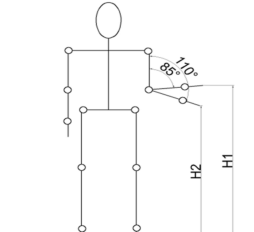
When visitors scan the code, the main body parts that move are: the per- son’s upper arm to torso, lower arm to upper arm and hand to lower arm. The analysis was performed on the basis of the female body size at the P5 percentile and the male body size at the P95 percentile, respectively. Calcu- lated from the ratio of the length of the forearm and the length of the elbow to the ground relative to the height H shown in Table 4 and the comfortable range of limb movement shown in Table 5.
Figure 3: The process of scanning the code.Table 4. The ratio of the length of the forearm and the length of the elbow to the ground relative to the height H.
Table available in the original PDF paper.
Body parts Ratio height 1 the length of the forearm 0.253 the length of the elbow to the ground 0.630
Table 5. Comfortable range of motion of the relevant limb.
Table available in the original PDF paper.
Body parts Joint Action Comfort range/(°) Upper arm to torso Shoulder joint (clavicle) Outer hem, inner hem Front hem, back hem
Elbow joint Bend, stretch +85~+110
0 +40~+90 Lower arm to upper arm Hand to lower arm Wrist joint Outer hem, inner hem Bend, stretch
0 0
Based on the female body size at the P5 percentile, it is concluded that under the premise of feeling comfortable, the maximum height of the hand from the ground H1=sin5°×the length of the forearm + the length from the elbow joint to the ground=sin 5°×0.253×1 484+0.630× 1 484≈967.6 mm. The minimum height of the hand from the ground H2 = the length from the elbow joint to the ground - the length of the forearm×sin 20°=0.630×1 484-0.253×sin 20°×1 484≈806.5 mm. Based on the male human body size at the P95 percentile,the same method can be used to measure the maximum height of the hand from the ground H1’≈964.6 mm.
Take the overlapping part of both men and women, then add 25 mm of shoe height correction. The final height of the scan area is taken to be 989.6 mm - 992.6 mm.
According to the behavior analysis, scanning in the side direction is more comfortable and convenient than scanning in other directions, and the hand to the lower arm can be bent upwards up to a maximum of 75°, so a tilt angle of less than 75° in the scan area is sufficient.
Design of Access Control System Based on Ergonomics in Post - Epidemic Era 571
Figure 4: Illustration of the height of H1 and H2.Figure 5: The improved temperature measurement device.
OPTIMIZED DESIGN Display of Design Achievements
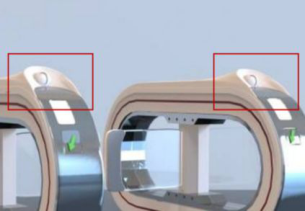
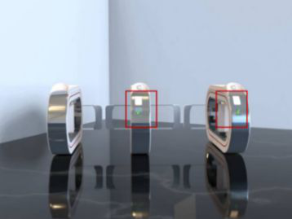
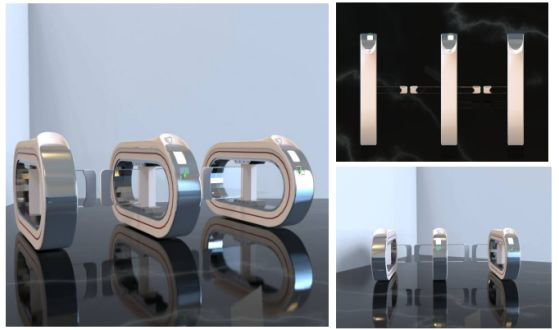
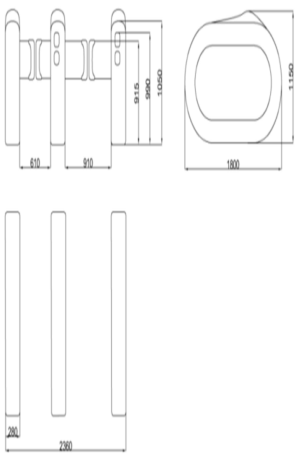
1. Temperature measuring device. The redundant screen has been removed to avoid misleading visitors. The temperature measurement sensor is pla- ced on the surface of the access control system with a certain tilt angle. And the sensor can be rotated to automatically target visitors’ faces to adapt to people of different heights. At the same time, compared with the original temperature measuring device, it is also more integral and beautiful. 2. QR code scanning area. With a height of 990 mm and a tilt angle of less than 75°, visitors can move their arms within a comfortable range when using it. It is positioned to the left and an arrow has been added at the bottom to prevent accidental scanning by left-handed people. 3. Overall display. In addition to the temperature measurement device and the setting of the code scanning area, the height of the gate body and the width of the gate of the access control system are also considered based on ergonomic principles. The gate width of the original access control system is narrow, making it difficult for envoy tourists in wheelchairs to pass smoothly. The optimized access control system has two lanes, one wide and one narrow, with the wider lane allowing visitors in wheelchairs to pass through.
Figure 6: The improved code scanning area.Figure 7: The overall design of the improved access control system.Figure 8: Three views of the improved access control system (unit: mm).
Design of Access Control System Based on Ergonomics in Post - Epidemic Era 573
CONCLUSION
To obtain a good user experience in product design, the relationship between man, machine and environment must be taken into account. In the post-epidemic context, improvements to the size and appearance of the access control system based on ergonomic theories can further meet the needs of epi- demic prevention and control, as well as contribute to the quality of social infrastructure. This design considers the relationship between the access con- trol system and human behavioural actions, but there are some limitations, such as whether it matches the environment of the art gallery, which remains to be considered. It is hoped that this study will provide a reference for the design of relevant products that conform to ergonomics.
REFERENCES
Changyong Huang. (2011). Ergonomics Study of Automatic Ticketing Machines in the Metro. Nanjing University of Science and Technology. Chunxue Wang. (2014). Ergonomics in the Palmprint Recognition Access Control
System of Student Apartments. Henan Science & Technology, 2014, (20). Na Yang. (2021). Design of embedded intelligent face recognition access control system. 2021 International Wireless Communications and Mobile Computing (IWCMC), Harbin, China. 1189–92. Sovetov, B.Ya., Tatarnikova, T.M., Cehanovsky, V.V. (2020). Physical Access Control
System for the Premises using the Internet of Things Technology. 2020 9th Medi- terranean Conference on Embedded Computing (MECO), Budva, Montenegro.
LISTED IN THE AHFE DIGITAL BOOKSTORE CATALOGUE
Explore the complete digital volume
Ergonomics In Design
Read this individual research paper free through the original publisher, or explore the full digital proceedings book.
ISBN 978-1-958651-23-0
Explore this ISBN in the AHFE Bookstore ↗Listed in the July 2026 bookstore catalogue; search by ISBN to confirm current availability · Digital book purchase optional