Marvin Curiñaupa-Alvarez, Grimaldo Quispe, Heyul Chavez, Luis Rivera, Francisco Dominguez (2021). Design and modeling of a maca leaf cutter and classifier machine for the Junin region. In: Human Systems Engineering and Design (IHSED2021): Future Trends and Applications. AHFE Open Access, vol. 21. https://doi.org/10.54941/ahfe1001195
In the high Andean areas of Junín in Peru, maca (a tuber typical of Peru) and maca flour are produced. At the end of the harvest, farmers have the hard work of removing the root and stalks of the remaining maca. Faced with this problem, the "stalk cutting and maca sorting machine" was designed, a machine proposed when analyzing the difficulty of cleaning the maca after harvest, then it must be dried and processed. This proposed machine will save time and increase produc-tion. In the traditional way (manual), farmers clean 4 kg of maca in 2 to 3 minutes, however, with the proposed machine 6.67 kg of maca will be cleaned in 3 minutes. In addition, a heat treatment will be developed on the copper surface that will have contact with the tuber, for the elimination of bacteria and viruses such as COVID-19.
Peru is the first producer of maca, its scientific name is Lepidium Meyenii, origi-nally from the Junín region in high Andean areas, a product that is planted in the puna since it tolerates strong frosts and hailstorms without losing its properties, differentiating itself from other products that do not resist these phenomena; but being harmful pests, like white worms. This domesticated tuber character of our country for its nutritional and medic-inal properties, in both cases with a high rate of nutrition unlike other foods providing protein and calories; noted for its quality of helping the reproductive system in both men and women and helping in cases of infertility. (Cruz-Meza, P and Romantchick-Kriuchkova, E and Hahn, 2010).
In the study of the Thesis of "Design and implementation of electronic ma-chine for cutting the stem and root of the big-headed onion" in Colombian agri-culture there is a lack of development and implementation of technology, so that in all phases of cultivation They are carried out with methods that add very little value to the product, resulting in low competitiveness and low quality of the product in the national and international market. Specifically in the cultivation of big-headed onion, the processes of arranging the product for its commercializa-tion are carried out with the risk of cutting sharp blades. As an alternative to this problem and to improve the quality of the product, providing competitiveness to the farmer, a semi-autonomous machine is made, which by means of opening arms hold the onion, adapted to a caterpillar-type transport belt that moves the bulb to a cutting system able to adapt to the size and shape of the bulb to cut the stem and root accurately. The movement of the band is originated by a reducer motor controlled by a PWM signal that allows to control the rotation speed of the DC motor, on the other hand, the counting of the finished products is carried out with a barrier sensor, the process is displayed in an LCD. The system is powered by a source connected to the AC power network. Due to the reduction in the han-dling of the bulbs, it is possible to reduce the risk of injury to workers, in addi-tion to reducing damage or loss of product. (Sánchez, 2015).
Where to obtain this wonderful product it takes 2 years between the prepara-tion of the land, the sowing and the harvest. The most important part being the sowing where the care is given to obtain a good product; the germination test, fertilization and disinfection of the seed. But the project is heading into the 3rd phase, which is the harvest. The harvest takes place 7 to 9 months after sowing where the culture of the region customarily makes the "huatla" which consists of burning lots of champa (Cruz-Meza, P and Romantchick-Kriuchkova, E and Hahn, 2010). Then make a hole where to deposit the embers produced and the maca.The
Human Systems Engineering and Design (IHSED 2021) https://openaccess.cms-conferences.org/#/publications/book/978-1-7923-8987-0 project of building the machine aimed at helping the production of maca that occurs after the harvest so that it goes to the market or is exported consists of helping the farmer, facilitating the removal of what remains of the stem and root after being harvested in addition to selecting according to the sizes for it to be processed, this prototype of a large-scale machine can be industrialized, thus saving production time. Time, because the remaining stems and roots would no longer be removed individually but massively; because in a production time sav- ing accelerates the process generating more income. The vision of a student of Mechanical Engineering is to design and manufac-ture an efficient machine that complies with saving time, to produce more and can select. One of the main functions is to help better production. Depositing a large amount of maca in the machine through the hopper and entering by means of shafts that extract the remains of stems and roots, transported in the second part of the machine that selects the maca according to size according to its size. To opt for this design, the researchers have relied on the "onion tail cutting ma-chine" from FERMAQ .(Peeling et al., 2017)
STATE OF THE ART A study carried out by P. Cruz, determined physical-mechanical properties of the corn cob and the conceptual and detailed design of the machine was carried out; where the cut is made by means of a smooth disc, while the leaf is removed by the friction between the surface of the cob and the rollers that rotate in opposite directions and at different speeds. (Cruz-Meza, P and Romantchick-Kriuchkova, E and Hahn, 2010). In this investigation by Sánchez, for the agro-industrial process of corn, alter-natives are proposed for a model that is low-cost in manufacturing, operation and maintenance; In addition, the Corn Removal Machine is chosen by means of rotating rollers, being the one that best meets the aforementioned requirements. (Sánchez, 2015). In Tapia's study, it is made up of two rubber rollers that rotate in opposite di-rections and bring the cob to the joint area of the two rollers, directing it and at the same time generating the friction necessary to detach the leaf. (Peeling et al., 2017).
In the research of Zapata Castañeda et al. (2017), the control for the operation of the machine, allows to set the speed at which the system must cut the onions, in addition it grants the motor an emergency stop with a push button, in case of malfunction or accident. (Zapata Castañeda and Ruiz Martínez, 2017). The maximum force and specific energy required to cut vegetables depend on the texture of the crust and the meat, and their homogeneity; while the cutting speed and the angle of the blade edge significantly influence the maximum force and specific energy. (Singh, Das and Das, 2016).
When the main knife roller rotates clockwise with the counter-clockwise rota-tion of the knife roller, there are more turbulent movements. (Dai and Wang, 2020). The tobacco leaf cutting technique consists of rollers that, due to their speed of rotation, will tear off the tobacco leaves; In addition, the study included calcu-lations for the best decision making
Human Systems Engineering and Design (IHSED 2021) https://openaccess.cms-conferences.org/#/publications/book/978-1-7923-8987-0 regarding the materials to be used. (Papusha, Papusha and Pestryakova, 2019).
METHODOLOGY
The maca stalk cutting and sorting machine will have parts and accessories that will be taken into account from the items already mentioned. Our great contribution is to introduce this machine model for the maca production area, since there is not yet a team to develop the maca cutting and selection process; Furthermore, in recent times, with the appearance of this new COVID-19 virus, measures have been taken that seek to protect people's health; in this case, the copper heat treatment is carried out, which will help disinfection and extermination of viruses and bacteria that may be in the tuber and in the process in general.
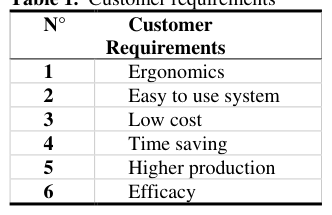
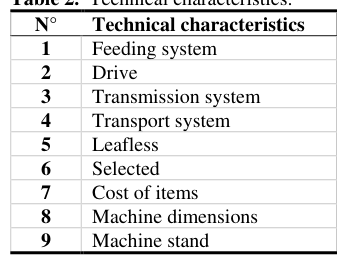
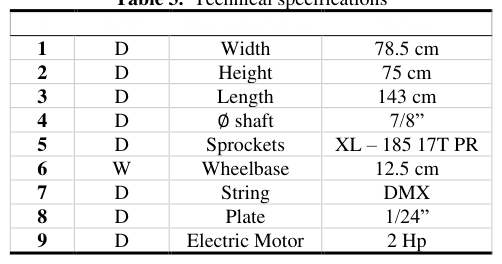
Stage 1. Clarify and define the task. Requirements of the client. Factors to consider in the design of the equipment and the needs of the end user, alignment of needs with design specifications.
Table 1. Customer requirementsTable 2. Technical characteristics.Table 3. Technical specifications # D/W Characteristics Values 1 D Width 78.5 cm 2 D Height 75 cm 3 D Length 143 cm 4 D ∅ shaft 7/8” 5 D Sprockets XL – 185 17T PR 6 W Wheelbase 12.5 cm 7 D String DMX 8 D Plate 1/24” 9 D Electric Motor 2 Hp Legend: D: Demand, W: Wish.
Human Systems Engineering and Design (IHSED 2021) https://openaccess.cms-conferences.org/#/publications/book/978-1-7923-8987-0
Stage 2. Divide into feasible modules. Module 1. Mechanical structure
Base frame (¼ ”square tube)
Catarina
Rotating shafts 7/8 ”
Hopper
Chains
17 teeth sprocket
1/24 ”plate Module 2: Control structure
Electric motor All the elements and materials obtained through the following equations:
𝜎′: 𝑉𝑜𝑛 𝑀𝑖𝑠𝑒𝑠 𝑒𝑓𝑓𝑜𝑟𝑡 𝜎𝑚: 𝑀𝑒𝑑𝑖𝑢𝑚 𝑒𝑓𝑓𝑜𝑟𝑡 𝜎𝑎: 𝐴𝑙𝑡𝑒𝑟𝑛𝑎𝑡𝑖𝑛𝑔 𝑒𝑓𝑓𝑜𝑟𝑡 𝜎𝑚: 𝑀𝑒𝑑𝑖𝑢𝑚 𝑠ℎ𝑒𝑎𝑟 𝜎𝑎: 𝐴𝑙𝑡𝑒𝑟𝑛𝑎𝑡𝑖𝑛𝑔 𝑠ℎ𝑒𝑎𝑟 Equation 3: Static analysis of creep based on the Von Misses equation
Human Systems Engineering and Design (IHSED 2021) https://openaccess.cms-conferences.org/#/publications/book/978-1-7923-8987-0
(4)
𝑑: 𝐷𝑖𝑎𝑚𝑒𝑡𝑒𝑟 𝑛: 𝑆𝑒𝑐𝑢𝑟𝑖𝑡𝑦 𝑓𝑎𝑐𝑡𝑜𝑟 𝐾𝑓: 𝐵𝑒𝑛𝑑𝑖𝑛𝑔 𝑐𝑜𝑛𝑐𝑒𝑛𝑡𝑟𝑎𝑡𝑖𝑜𝑛 𝑓𝑎𝑐𝑡𝑜𝑟 𝐾𝑓𝑠: 𝑇𝑜𝑟𝑠𝑖𝑜𝑛 𝑐𝑜𝑛𝑐𝑒𝑛𝑡𝑟𝑎𝑡𝑖𝑜𝑛 𝑓𝑎𝑐𝑡𝑜𝑟 𝑀: 𝑀𝑜𝑚𝑒𝑛𝑡 𝑇: 𝑇𝑜𝑟𝑞𝑢𝑒 Stage 3. Develop diagrams of the main modules.
Module 1. Mechanical structure
Fig. 2. Rotating axis.
Fig. 1. Catarina Module 2. Control structure The plan of the electric motor can be seen in Fig. 3. Stage 4. Complete the final outline. The final assembly is seen in Fig. 4.
Fig. 4. Final assembly
Fig. 3. Electric motor plan
Human Systems Engineering and Design (IHSED 2021) https://openaccess.cms-conferences.org/#/publications/book/978-1-7923-8987-0
RESULTS AND DISCUSSION
First result obtained for the safety factor based on the SolidWorks program (flow simulation)
Fig. 5. Security factor The result of the simulation of the rotary axis was made with AISI 1035 steel, which gives us greater resistance, greater elastic limit and therefore an optimal work safety factor; the minimum shaft FS is 1.9, while the maximum is 6.54. Therefore, the roller or rotating axis of the machine, together with the blade, will have greater resistance at work (Fig. 6). The structure of the proposed machine will support 13 rotating axes, it will also receive the maca waste (leaves, root, etc.), therefore its safety factor is high to develop an optimal work (Fig. 7). According to the client's requirements and the calculations, the machine could be designed; that without measurements or parameters, a well-functioning machine would be obtained. It was taken as support to the book "Design in mechanical engineering by Shigley", to select the different elements and materials that were used for its manufacture. (Richard Budynas y Keith Nisbett, 2019)
Fig. 6. Rotary axis of the machine
Fig. 7. Structure simulation
Human Systems Engineering and Design (IHSED 2021) https://openaccess.cms-conferences.org/#/publications/book/978-1-7923-8987-0
VALIDATION According to the articles, I am validating the prototype of the maca stripping and classifying machine, working with its two processes that will lead to optimizing cost, time, generating greater production taking into account the problems that are currently experienced. Going from the calculations to the design in the SolidWorks, the model closest to the required measurements was sought, as is well known in the mechanical elements market, it is regulated, but not all coincide. In addition, 3 fundamental scientific articles were taken into account for the design of the machine, where a series of simulations were also carried out, verifying that it can cut stems and root remains of the maca, thus proving that the main function of the "Machine Stem cutter and sorter ”is optimal; that the force exerted by the selected electric motor is the correct one, when passing to the sorting stage we obtain the classifi-cation by size of this. And taking the articles into account, the machine design that I propose is better than that of the articles, since we work with an AISI 1035 steel shaft, which gives us greater resistance, greater elastic limit and therefore an optimal safety factor. of work; the minimum FS of the roll is 1.9, while the maxi-mum is 6.54, which in this case was simulated by SolidWorks. Therefore, the roller of the maca remover machine, together with the blade, are better and will have greater resistance at work.
CONCLUSIONS AND RECOMMENDATIONS Based on the objectives set when starting the design of the "Stem cutting and maca sorting machine", it can be concluded that the functions are fulfilled in said machine, that is, stem and root remains are cut and maca is selected by size. The design of the prototype of the "Maca stalk cutting and sorting machine" was made from seeking greater production, optimizing time and increasing profits. For farmers in the high Andean areas. The effectiveness of mathematical calculations to be able to choose the type of material and the appropriate measures for development, as well as being able to know if what we calculate is optimal through simulation in programs such as SolidWorks allow us to give an acknowledgment before the subsequent creation of the machine. to know if it will be effective and resistant or not. Both in the construction and in the design of the machine there was an approximate budget of 15,000.00 PEN.
Table 4. artisan production and technological production.
Human Systems Engineering and Design (IHSED 2021) https://openaccess.cms-conferences.org/#/publications/book/978-1-7923-8987-0
This prototype can be improved and industrialized, maca as well mentioned has many benefits, it is a product that will not disappear from the market. Companies can opt for this machine reducing labor and speeding up its production, thus also improving its drive system that could be automatic and no longer manual. Although it is true, the product is cleaned in large portions, but it can be modified for massive portions 5 times its capacity.Human Systems Integration (HSI) is becoming a critical piece of complex systems to help resolve system designs. This proposal has presented a growing body of knowledge for HSI and new technologies that are being developed to capture critical aspects of HSI. The development of a framework for Human Systems Integration with Systems Modeling Language (SysML) will enable teams to collaborate better by providing a common language and process to distribute models and share information. The Human Systems Integration component in systems engineering will be able to recognize the human as an integral element of every system by representing behaviors, constraints, states, and goals through-out the entire lifecycle.
REFERENCES
Cruz-Meza, P and Romantchick-Kriuchkova, E and Hahn, F. and others (2010) ‘Design, construction, and evaluation of a husking machine to permit the use of the husks as wrapping for tamales’, Ingenieria Agricola y Biosistemas, 2(1), pp. 69–74. Dai, H. and Wang, Y. (2020) ‘Analysis and experiment of flow field in sugarcane leaf cutting
and returning machine’, International Agricultural Engineering Journal, 29(4), pp. 97– 107. doi: 10.1088/1757-899X/735/1/012079. Papusha, S. K., Papusha, V. K. and Pestryakova, Y. A. (2019) ‘Theoretical research of process of separating tobacco leaf from stem’, E3S Web of Conferences, 126, pp. 1–6. doi: 10.1051/e3sconf/201912600027. Peeling, C. et al. (2017) ‘Design and construction of a low price corn peeling machine for
soft dry variety of height’, 6(Edición 22), pp. 52–64. Richard Budynas y Keith Nisbett (2019) Shigley’s Mechanical Engineering Design.
McGraw-Hill Education. Available at: https://predictiva21.com/diseno-ingenieria- mecanica-shigley/. Sánchez, C. J. M. (2015) ‘DISEÑO Y CONSTRUCCIÓN DE UNA MÁQUINA DESHOJADORA DE MAIZ SECO, QUE PARTIENDO DE LA MAZORCA CON SU ENVOLTURA, ENTREGARÁ COMO PRODUCTO, LA MAZORCA Y COMO SUBPRODUCTO, LA ENVOLTURA DE MAÍZ’, ESPE, 1. Singh, V., Das, M. and Das, S. K. (2016) ‘Effects of knife edge angle and speed on peak
force and specific energy when cutting vegetables of diverse texture’, International Journal of Food Studies, 5(1), pp. 22–38. doi: 10.7455/ijfs/5.1.2016.a3. Zapata Castañeda, C. A. and Ruiz Martínez, S. A. (2017) ‘Diseño e implementación de máquina electrónica para el corte de tallo y raíz de la cebolla cabezona’, pp. 1–9. Available at: http://repository.ucatolica.edu.co/handle/10983/14143.
Human Systems Engineering and Design (IHSED 2021) https://openaccess.cms-conferences.org/#/publications/book/978-1-7923-8987-0
LISTED IN THE AHFE DIGITAL BOOKSTORE CATALOGUE
Explore the complete digital volume
Human Systems Engineering and Design (IHSED2021): Future Trends and Applications
Read this individual research paper free through the original publisher, or explore the full digital proceedings book.
ISBN 978-1-7923-8987-0
Explore this ISBN in the AHFE Bookstore ↗Listed in the July 2026 bookstore catalogue; search by ISBN to confirm current availability · Digital book purchase optional