Thays Arotoma, Grimaldo Quispe, Heyul Chavez, Elva Castaneda (2021). Implementation of Lean Manufacturing in the company dedicated to the production of grains. In: Human Systems Engineering and Design (IHSED2021): Future Trends and Applications. AHFE Open Access, vol. 21. https://doi.org/10.54941/ahfe1001200
The following investigation shows the problems in “Industria Granero del Centro EIRL”, it is a company that is dedicated to the production of grains such as split bean, split wheat, american morón and corn flour. The goal is to improve the production planning and scheduling system, and eliminate overproduction and economic losses. VSM (Value Stream Mapping) was used to identify the improvement in the production process. The root causes of the problem were then determined using the Ishikawa diagram. The activities to be carried out are: identification of times of each process of the evaluated product, carry out the implementation of the master production plan, application of Kanban and application of Heijunka for load balancing [1]. The results of this implementation will be visualized through a simulation making use of efficiency, effectiveness and productivity indicators to meet the objective.
Human Systems Engineering and Design (IHSED 2021) https://openaccess.cms-conferences.org/#/publications/book/978-1-7923-8987-0
INTRODUCTION
Manufacturing companies operating in the changing and competitive marketplace of the past two decades have opted for Lean principles. It builds on flows to im-prove flexibility, cycle time of your production processes, and improves quality. The Lean methodology originated in the production of the automobile industry, the Toyota production system (TPS), where it focuses on minimizing waste, thus eliminating the action that does not add value to the process and as a result, obtains less effort, capital, space, reduces delivery time to the customer, achieves an increase in quality and a decrease in production cost (Pillai et al., 2015), (Reyes et al., 2018). Competitiveness and efficiency are two major challenges in today's global marketplace that have encouraged many manufacturing companies to plan new management strategies for their manufacturing processes. The most frequent problem that industries have today is the delivery of their products on time, product at low cost and of good quality, so Lean tools help improve efficiency and productivity (Rohani and Zahraee, 2015).
In a food industry, residues were identified that impede efficient work that is not based on management models to increase competitiveness, profitability due to the lack of planning, organization and control of the production system. So they chose to make use of Lean Manufacturing tools such as VSM, Just time and 5s (Enfoque, 2016). The problem of the company “Industria Granero del Centro EIRL” is the over- production it has in its production, which generates economic losses in the com-pany, taking into account that the plant schedules its production not based on sales estimates or on orders, but on According to the criteria of the person in charge in the philosophy of producing more than the customer's order quantity, so they produce more than necessary and this generates economic losses on a monthly basis. The main objective of this research is the reduction of overproduction by making use of Lean Manufacturing tools such as the Master Production Plan (MPS) for the planning system, Kanban tool for scheduling and Heijunka for load leveling.
STATE OF THE ART Not all companies should apply the same practice. The success of any manage-ment practice depends on the organization (Lopes, Freitas and Sousa, 2015). Lean Manufacturing implementation is not easy if it is not planned properly. The stages of Lean implementation start with a mapping of the company's value chain (VSM). Then the future VSM is used making use of the improvement tools that will be implemented, so it is necessary to understand how a value chain mapping is carried out since everything starts from this analysis.
Improving the efficiency of the grain processing industry through VSM This document is about efficient implementation in the grain processing industry. Value Stream Mapping (VSM) is one of the main lean tools that can be used to
Human Systems Engineering and Design (IHSED 2021) https://openaccess.cms-conferences.org/#/publications/book/978-1-7923-8987-0 identify opportunities for improvement in a production flow process. All process information related to grain processing is collected and a VSM is developed for the current status that shows the current operating status of the rice mill. Then the '5 whys' methodology is issued and root causes are determined using the fishbone diagram (Ishikawa diagram). A total of five root causes are determined that make up the main problems in the rice mill. These five causes are resolved and a value stream map is developed for the future state that shows the increase in overall process efficiency. This study will guide the future implementation of lean activi-ties and help to improve the rice mill process when it is done on a large scale. Understanding the process This is the initial stage of the improvement process. The basic concepts and the process in each processing line must be carefully observed and observations made to improve productivity: working methods, tools used, process flow, number of workstations and their purpose. The basic process of milling rice (Pillai et al., 2015).
Lean Manufacturing Implementation Techniques In manufacturing it was developed to maximize resource utilization through minimization of waste, later lean was formulated in response to the fluctuating and competitive business environment. Due to the rapidly evolving business environment organizations are forced to face challenges and complexities. Any organization be it industrial or service oriented to survive may ultimately depend on its ability to respond systematically and continuously to these changes to improve the value of the product. Lean Manufacturing is considered a waste reduction technique as suggested by many authors, but in practice lean manufacturing maximizes product value through waste minimization. Lean Principles defines the value of the product / service perceived by the client and then making the flow in line with the attraction of the client and the pursuit of perfection through continuous improvement to eliminate waste from the classification of the activity on the Value Added (VA) and non-added activity value (NVA). The sources of NVA activity wastes are transportation, inventory, backlog movement, overproduction, over processing, and defects. Production leveling production volume, as well as production mix and production efficiency by reducing waste, unevenness, and overloading people or equipment. Leveling the pieces leads to successful implementation. This literature review explains the incorporation and sequencing of thin elements during the application period, along with application issues, It suggests the importance of measuring Takt time due to costs and inefficiency factors in the production ahead of demand, which includes storage and retrieval of finished products (Sundar, Balaji and Satheesh Kumar, 2014). Application of manufacturing techniques adjusted to the planning of distribution requirements in the Ecuadorian flour industry. The flour industry presents these types of problems, for which it is necessary to apply statistical tools, methods or techniques that allow reaching viable solutions, such as lean manufacturing techniques and planning of distribution requirements. Manufacturing techniques to obtain Distribution Requirements Planning (DRP). The
Human Systems Engineering and Design (IHSED 2021) https://openaccess.cms-conferences.org/#/publications/book/978-1-7923-8987-0 document describes a case study in an important company of an Ecuadorian industry that is dedicated to the production of flour, with Lean Manufacturing techniques, its objective is to improve and optimize the production system, reduce delivery times, waste and Inventories generated by work in process. Value stream mapping is used to identify wasteful actions as opportunities for improvement and, through the DRP matrix, the inventory turnover and the distribution operation were improvements that allowed a greater flow of money for the company. When the demand for the product determines how much to produce, the size of the production orders is small, the inventories generate low costs and a low risk due to the obsolescence of the product (Thakur, 2016)
CONTRIBUTION The proposed methodology is based on the analysis of the company's production using the Value Stream Mapping (VSM) tool, which is one of the main lean tools that can be used to identify opportunities for improvement in a flow process. of production. From the problem of overproduction, the tools that will be used to eliminate waste from production are fixed.
After carrying out the current value chain mapping, the root causes of the problem were determined using the Ishikawa diagram, once the problem was identified, the solution procedure was carried out.
The activities that were carried out were, first is the identification of times of each process of the valued product, since the company is not only dedicated to the production of a product but of several grains such as: split bean, split wheat, American morón and flour corn. So the bean was chosen, since it is produced in greater quantity and has greater demand from customers. After the identification of times, the implementation of the Master Production Plan (MPS) is carried out, this in a planning system and thus the person in charge has the quantity that has to be produced and the time that must be delivered. After the Kanban programming is carried out using the production cards and containers, there will be a system where what has to be produced and the quantity according to the MPS planning will be taken into account. Finally, the Heijunka tool is used to level capacity and create production systems that adapt to customer demand and is also related to planning. For this, the methodology shown in figure 1 was carried out, Figure 2 shows the procedure for implementing Lean Manufacturing.
Fig. 1. Methodology for implementation
Human Systems Engineering and Design (IHSED 2021) https://openaccess.cms-conferences.org/#/publications/book/978-1-7923-8987-0
Fig. 2. Procedure for implementation For these tools the control will be given by means of indicators such as: the amount of weekly production, efficiency, effectiveness, and productivity to see if they are giving successful results.
RESULTS
The company “Industria Granero del Centro EIRL” is a company that is dedicated to the production of grains such as split bean, split wheat, American morón and corn flour, apart from that they have an amount of 17500kg per month, The company performs the production of its grains in the city of Huancayo, where it also has a small store that does retail sales, the company has a delivery time of its product of one week to its customers, so the company does not carry out its production according to the demand of its client but produces according to the criteria of the person in charge, because they do not have a planning system of how much to produce and the delivery time, so an MPS planning system was carried out according to demand the client's.
First, the root cause of the problem was identified, which is overproduction, for which the Ishikawa diagram was used as shown in Fig. 3.
Fig. 3. Ishikawa diagram
Human Systems Engineering and Design (IHSED 2021) https://openaccess.cms-conferences.org/#/publications/book/978-1-7923-8987-0
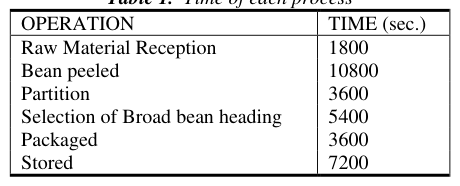
Second, the time was taken for each production process of the evaluated product, which was chosen Haba split because it has greater demand as shown in table 1.
Table 1. Time of each process OPERATION TIME (sec.) Raw Material Reception 1800 Bean peeled 10800 Partition 3600 Selection of Broad bean heading 5400 Packaged 3600 Stored 7200 Third, the current value chain mapping (VSM) of the company was carried out, taking into account the lead time and the added value provided by each production process of the evaluated product. Having a Lead time of 6 days and a value-added time of 180 seconds.
A calculation of the current Takt time of the company, which was obtained 76 sec/kg. taking into account a daily demand of 333 kg./day.
Using the Lean Manufacturing tools and the planning system, a future VSM was carried out as shown in Fig. 4, with the improvements to achieve a reduction in overproduction.
Fig. 4. Future Value Stream Mapping Resulting in a Lead Time 4.5 days and a value-added time of 135 sec and as can be seen in figure 3, the peeling and selection processes had changes because they are the two processes that have a long delay in the time they add. value to production.
Human Systems Engineering and Design (IHSED 2021) https://openaccess.cms-conferences.org/#/publications/book/978-1-7923-8987-0
Therefore, a future Takt time calculation was also carried out, simulating the improvements using Lean tools. Having a result of a takt time of 72 kg / sec, it is shown that the time decreased. To carry out the planning system, the analysis of the current state of the company was first taken into account using indicators, where the amount of real daily production and the amount of scheduled production are observed. Fourth, the planning system was carried out and results were obtained as shown in Fig. 5.
Fig. 5. Production planning for the period 2020 Using Lean tools and implementing the production planning system, the results were increased effectiveness, efficiency and productivity and, above all, the objective of reducing overproduction was achieved, so now the company produces according to planning and programming according to the Kanban cards and load leveling is done with the Heijunka tool. The results obtained are shown in Fig. 6 and statistically shown in Fig. 7 which are the current data and Fig. 8 with the data implementing the Lean tools.
Fig. 6. Comparative table of indicators
Human Systems Engineering and Design (IHSED 2021) https://openaccess.cms-conferences.org/#/publications/book/978-1-7923-8987-0
Fig. 8. Future results
Fig. 7. Current results Next, the amount of production was carried out before and after the Lean Manufacturing implementation, so it was achieved with the decrease in overproduction as shown in Fig. 9.
Fig. 9. Production quantity every 8 hours Finally, the Arena software was used for the simulation and validation of the acquired data as shown in Figure 10.
18:34:05 a.1./p.1. Category Overview agosto 1, 2020 proceso 1
Replications: 1 Time Units: Days Key Performance Indicators System Average
Number Out
784
Fig. 10. Simulation data
Human Systems Engineering and Design (IHSED 2021) https://openaccess.cms-conferences.org/#/publications/book/978-1-7923-8987-0
CONCLUSIONS
The results show an overproduction decrease of 48.5 kg per day from a production quantity of 780 kg per day, due to the fact that minimum quantity data was provided and the simulation of the Lean Manufacturing implementation provides results that meet our objective.
By simulating the implementation of Lean Manufacturing, satisfactory results were obtained in incorporating an MPS planning system where it would provide data on the quantities to be produced weekly.
Making use of one of the Lean Manufacturing tools that is current VSM throughout the process, Bean split shows 180 sec in adding value to the process and a takt time of 76 kg/sec, performing the future VSM using the Lean tools and the MPS planning system, a value added time of 135 sec was obtained with a takt time value of 72 sec / kg.
Because the results are based on a simulation and in minimal quantities, making use of Lean tools we obtained an increase of 5% in efficiency per day, as opposed to current data, an increase in productivity was also obtained by 4% per day. day.
By means of the ISHIKAWA diagram we were able to obtain the causes for what occurred overproduction of the company “Industria Granero del Centro EIRL”, so a result was obtained that tools were necessary to use for overproduction such as Kanban, Heijunka and a MPS planning. Human Systems Integration (HSI) is becoming a critical piece of complex systems to help resolve system designs. This proposal has presented a growing body of knowledge for HSI and new technologies that are being developed to capture critical aspects of HSI. The development of a framework for Human Systems Integration with Systems Modeling Language (SysML) will enable teams to collaborate better by providing a common language and process to distribute models and share information. The Human Systems Integration component in systems engineering will be able to recognize the human as an integral element of every system by representing behaviors, constraints, states, and goals through-out the entire lifecycle.
REFERENCES
Enfoque, U. (2016) ‘Implementation of lean manufacturing in a food enterprise’, Enfoque UTE, (1), pp. 1–12. Available at: http://ingenieria.ute.edu.ec/enfoqueute/. Lopes, R. B., Freitas, F. and Sousa, I. (2015) ‘Application of lean manufacturing
tools in the food and beverage industries’, Journal of Technology Management and Innovation, 10(3), pp. 120–130. doi: 10.4067/s0718-27242015000300013. Pillai, P. K. et al. (2015) ‘Content Irc ’ S International Journal of Multidisciplinary Research in Social & Management Sciences Vol . 3 Issue 1 Issn : 2320-8236’. Reyes, J. et al. (2018) ‘Applying Lean Manufacturing Techniques to Distribution
Requirements Planning in Ecuadorian Flour Industry’, 2018 Congreso Internacional de Innovacion y Tendencias en Ingenieria, CONIITI 2018 -
Human Systems Engineering and Design (IHSED 2021) https://openaccess.cms-conferences.org/#/publications/book/978-1-7923-8987-0
Proceedings. doi: 10.1109/CONIITI.2018.8587069. Rohani, J. M. and Zahraee, S. M. (2015) ‘Production Line Analysis via Value Stream Mapping: A Lean Manufacturing Process of Color Industry’, Procedia Manufacturing, 2(February), pp. 6–10. doi: 10.1016/j.promfg.2015.07.002. Sundar, R., Balaji, A. N. and Satheesh Kumar, R. M. (2014) ‘A review on lean
manufacturing implementation techniques’, Procedia Engineering, 97, pp. 1875–1885. doi: 10.1016/j.proeng.2014.12.341. Thakur, A. (2016) ‘A Review on Lean Manufacturing Implementation Techniques: A Conceptual Model of Lean Manufacturing Dimensions A Review on Lean Manufacturing Implementation Techniques: A Conceptual Model of Lean Manufacturing Dimensions View project A Review on Lean Manuf’, REST Journal on Emerging trends in Modelling and Manufacturing, 2(3), pp. 62–72. Available at: www.restpublisher.com/journals/jemm.
Human Systems Engineering and Design (IHSED 2021) https://openaccess.cms-conferences.org/#/publications/book/978-1-7923-8987-0
LISTED IN THE AHFE DIGITAL BOOKSTORE CATALOGUE
Explore the complete digital volume
Human Systems Engineering and Design (IHSED2021): Future Trends and Applications
Read this individual research paper free through the original publisher, or explore the full digital proceedings book.
ISBN 978-1-7923-8987-0
Explore this ISBN in the AHFE Bookstore ↗Listed in the July 2026 bookstore catalogue; search by ISBN to confirm current availability · Digital book purchase optional