Heyul Chavez, Henry Juan Javier Ninahuaman, W. Cochachi Poma, Grimaldo Quispe, Luis Rivera, Francisco Dominguez (2021). Biomaterials and Technologies for Sustainability. In: Human Systems Engineering and Design (IHSED2021): Future Trends and Applications. AHFE Open Access, vol. 21. https://doi.org/10.54941/ahfe1001192
The research designs and developed a biofertilizer from Mycorrhiza and Rhizobium evaluating its antagonistic capacity and biotization in the cultiva- tion of vegetables with a DCA, the sample considers potatoes, peas and barley in the District of Huasahuasi, with 9 treatments in three formulas, considering a control group without inoculation and two repetitions. As a result, the optimal formula is obtained with 300g of mycorrhiza and Rhizobium strains + 500g of black soil + 200g of potato peel bran, which has an effective antagonistic capacity of 100% in pea crops, 90% in the barley and 85% in the potato, besides that it achieves a biotization in the pea crop of 95%, in the barley 100% and in the potato 90%.
Human Systems Engineering and Design (IHSED 2021) https://openaccess.cms-conferences.org/#/publications/book/978-1-7923-8987-0
INTRODUCTION
The soils of Latin America have low yields, chemical fertilizers have a high cost, there are phytosanitary problems, soil deterioration and nitrogen deficiency in agricultural lands. The croplands have low yield problems resulting in a decrease in the yield of their plantations, an emblematic case is the Camu Camu that decreased reaching 1.5 to 2.5 t / ha during the year 2017 due to the reduction of N , K and Mg in the land, for this reason it is urgent to raise production levels with biofertilizers, it was proposed to increase these compounds with cow manure, chicken manure, island manure, chicken manure and river sediment. The use of biofertilizers promotes repellency of insects, increases resistance to attack by pests and pathogens due to their odors (Abanto-Rodríguez et al., 2019). Climate change challenges agriculture, and the variations in production and costs that directly affect farmers.
In response, they have been working on raising awareness, proposing other forms of energy use such as alternative energies and on the use of arbuscular mycorrhi-zal fungi (AMF) together with Twin-N as biofertilizers, an option to potential impact. Mycorrhizae cover 95% of the requirements in the production of walnuts, there are studies where by providing rhizobia, a good amount, offering a biotechnological alternative with acceptable performance (Fornasero and Toniutti, 2015), but the antagonistic activity is another important factor. Work was done on wheat grains, obtaining an increase in N (2 to 15 N / ha) and absorbed dry matter from 20 to 40% of that applied, biofertilizers improve nutrient absorption (Grageda-Cabrera et al., 2018). AMF, HSO and Mucoromycotina fungi that colonize 78.1% of the species of these are studied, only 56.2% are considered mycorrhizal (Lara-pérez, Zulueta-rodríguez and Andrade-torres, 2017). When inoculating native rhizobia in pea (pisum sativum), 40% of the cultures show the formation of nodules in symbiosis, but only 10% show their efficiency by percentage of nodulation and speed (Moreno-chirinos et al., 2016), the benefits of biofertilization is an increase in available N which increases the microbial activity of the soil, increases the content of P and K, the yield of dry matter and protein. It was found that biofertilizers increase the values of P, Ca and Mg, the wells and conventional plantation systems did not have differences with respect to the plagiotropic branches as well as the application of fertilizers and the type plantation, similarly to the addition of biofertilizer BMV the increase in N relapsed, also the contents of Cu and Fe decrease linearly with the increase of biofertilizer. The loss of volatile N favored by the alkalinity and aggre-gation of Ca and Mg in the oil is indicated (Cardoso et al., 2017).
This study proposes a biofertilizer design from the Mycorrhiza strains isolated from the pine fungus and the Rhizobiums isolated from the pea root, thus promoting its use as a biofertilizer and taking advantage of its antagonistic capacity, considering its biotization generated from said microorganisms in the vegetables. It is estimated that this process contributes between 60-80% of biological nitrogen fixation and this sym-biosis contributes a considerable part of nutrients and nitrogen combined in the soil and allows plants to grow without synthetic fertilizers and without depleting the soils (Ventura and Bernilla, 2014).
Human Systems Engineering and Design (IHSED 2021) https://openaccess.cms-conferences.org/#/publications/book/978-1-7923-8987-0
METHODS
The present research work was carried out in the San Juan de Huasahuasi district, located 48 km from the Tarma district, with an altitude of 2751 meters above sea level. The raw material consists of Mycorrhiza and Rhizobium isolated from the root of pea and pine fungus, rhizobiums are diazotrophic bacteria that have the ability to fix N in the nodules of plants and mycorrhizae are the double absorption organs that are formed when symbiotic fungi live within healthy absorption organs (roots, rhizomes or thalli) (Ramírez et al., no date; Moreno- chirinos et al., 2016; Flores-cordova et al., 2018) black earth and potato peel bran were used as inputs, the oil and potato dextrose agar, the equipment used was the microorganism incubator and an analytical balance. Vegetable crops were sampled: potato, pea and barley from the Huasahuasi district of the Tarma Province.
Among the methods used is the sowing in vitro and the counting of colonies. Once the product was obtained, the physical-chemical characterization was carried out, evaluating the fertility, antagonistic capacity and biotization. The experimental process consists of obtaining strains of microorganisms and the biofertilizer of Mycorrhiza and Rhizobium through two stages; the first stage consisted in obtaining strains of Mycorrhiza and Rhizobium microorganisms, obtained from the root of pea and pine fungus; the second stage consisted in obtaining the optimal biofertilizer formula for Mycorrhiza and Rhizobium. 3 formulas are designed for this purpose: F1: 50 g of rhizobium + 50 g mycorrhiza + 500 g of black earth and 200 g of potato peel bran; F2: 100 g of rhizobium + 100 g mycorrhiza + 500 g of black earth and 200 g of potato peel bran; F3: 150 g of rhizobium + 150 g mycorrhiza + 500 g of black earth + 200 g of potato peel bran.
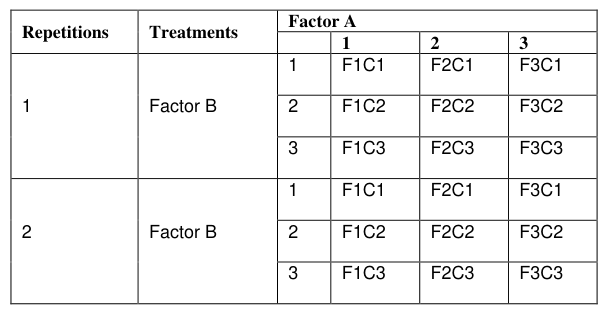
The statistical evaluation evaluated the percentage of the effect of the biofertilizer in relation to its antagonistic capacity and biotization. The antagonistic capacity of the biofertilizer was measured with respect to the Fusarium Solani fungus as it is the representative fungus in the crops of the area, this fungus integrates different syndromes such as vascular wilting and root rot. applying a completely randomized design (DCA) with factorial arrangement and two repetitions, the factors were: Factor A: Inoculation of the Mycorrhiza and Rhizobium biofertilizer formula (F1, F2, F3); Factor B: vegetable crops (potatoes, peas and barley) C = Vegetable cultivation (C1 potato, C2 pea and C3 barley).
Human Systems Engineering and Design (IHSED 2021) https://openaccess.cms-conferences.org/#/publications/book/978-1-7923-8987-0
Table 1. Relationship of the biofertilizer formula and the vegetable crop Repetitions Treatments Factor A 1 2 3
RESULTS
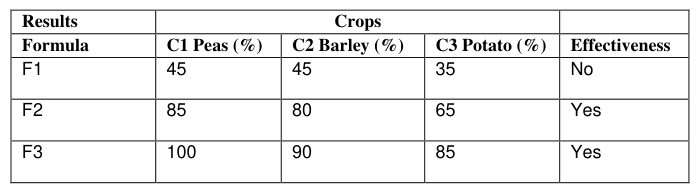
The antagonistic capacity analysis applied to the Mycorrhiza and Rhizobium biofertilizer treatments, inoculating the sample with 50gr for 200gr of seed, an effective antagonistic capacity of 100% was obtained in the pea crop, 90% in the barley and 85% in the potato. , from the biofertilizer of Mycorrhiza and Rhizobium with the formula F3, the biofertilizer with the formula F2 inoculated in the pea crop, the result of 85% effectiveness was obtained, in the barley 80% and 65% in the potato crop In comparison to these two formulas where the result was effective, the biofertilizer with formula F1 the results were not very good, in peas 45%, barley 45% and in potatoes 35%. The optimal formula of the Mycorrhiza and Rhizobium biofertilizer was F3 (15% Pea Root, 15% Pine Mushroom, 50% Black Earth and 20% Potato Peel), to be used in the cultivation of vegetables obtaining a significant result in the antagonistic capacity of the biofertilizer with respect to the fungus Fusarium Solani. Proportion of strains of microorganisms 500gr of Mycorrhiza (pine fungus) + 500gr of Rhizobium (pea root)
Table 2. Comparison of antagonistic capacity effectiveness Results Crops Formula C1 Peas (%) C2 Barley (%) C3 Potato (%) Effectiveness F1 45 45 35 No
Human Systems Engineering and Design (IHSED 2021) https://openaccess.cms-conferences.org/#/publications/book/978-1-7923-8987-0
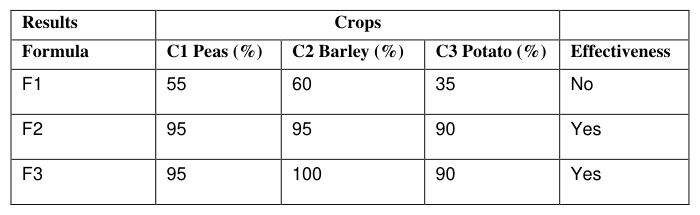
This analysis of biotization in vegetable crops carried out to verify the growth of the root system, the acclimatization phase and the increase in the functionality of the roots and consequently the nutritional and water status of the plant crops. Whose results were obtained in relation to the inoculated formula and the vegetable culture used as a sample, which in this case was potatoes, peas and barley, are shown in the following table.
Table 3. Comparison of biotization effectiveness Results Crops
According to the results can determine that the Mycorrhiza and Rhizobium biofertilizer affects the biotization of the vegetable crop in an effective way according to the increase in the amount of strains of microorganisms in the biofertilizer formula.
Therefore, the most effective formula in biotization and antagonistic capacity was the result of the mixture of 150 g of rhizobium + 150 g mycorrhiza + 500 g of black earth + 200 g of potato peel bran (F3).Balance of matter of obtaining the biofertilizer of Mycorrhiza and Rhizobium according to the optimal formula.In order to determine the performance of the optimal formula of the Mycorrhiza and Rhizobium biofertilizer.
15 kg of pea root are taken, the roots are selected taking into account the optimal characteristics, 2.56 kg (17.3%) are lost. The conditioning operation discards the useless parts of the stems and filaments, decreasing by 1.8 Kg (12%), during the drying operation it removes 7.95 Kg of water by 53%, the dry matter is brought to grinding with a loss of 0.4 Kg (2.7 %), thus obtaining a 15% yield compared to the initial raw material (2.25 Kg).
Σ (x) Inputs = Σ (x) Outputs 100x = 17.3x + 12x + 53x + 2.7x + 15x Yield to obtain rhizobium from pea root: 15%; 19.75 kg of pine fungus are collected, the less optimal 3.55 kg (18%) are eliminated, then the unusable 2.57 kg (13%) is discarded, during the drying operation it removes 10.86 kg of water by 55%, the matter Dry is brought to grinding with a reduction of 0.51 Kg (2.6%), thus obtaining 2.25 Kg (11.4%). Balance of Matter of Obtaining Mycorrhiza of Matter of Pine Fungus:
Equation reproduced from the original PDF.
Human Systems Engineering and Design (IHSED 2021) https://openaccess.cms-conferences.org/#/publications/book/978-1-7923-8987-0
100y = 18y + 13y + 55y + 2.6y + 11.4y -- Yield to obtain mycorrhiza from pine fungus: 11.4% 2.25 Kg of rhizobium (15%) + 2.25 Kg (15%) of pine mycorrhiza are mixed with 7.5 Kg of black earth (50%) + 3 Kg of potato peel flour (20%), making a total of 15 Kg of biofertilizer for every 15 kg of fresh pea root and 19.75 kg of fresh pine fungus. The total matter balance:
Σ (x) Inputs = 45.25: 15 Kg Pea root + 19.75 Kg Pine Mushroom + 7.5 Kg Black earth + 3 Kg potato peel bran.
Σ (y) Outputs = 45.25 Kg: 12.75 Kg Loss to obtain Rizobium + 17.5 Kg Loss to obtain Mycorrhiza + Biofertilizer = 15 Kg
DISCUSSIONS Antagonism is the direct inhibitory activity exerted by one microorganism on another and it is biologically controlled by attenuating damage to growth systems (Ikeda et al., 2000), the antagonism test against soil phytopathogens was measured with respect to the Fusarium Solani fungus, formulas F2 and F3 were effective in the antagonistic capacity against this fungus, which represents 100% of the strains, a result higher than that of Ikeda, who achieved 27% .This could be due to the fact that the amount of Streptomyces strains evaluated by him exceeded 4000, the areas of inhibition obtained are equivalent to the average of the percentages of inhibition resulting in the present work, the mechanism of antibiosis effect is presumed through inhibitory metabolites, in the same way as (Orihuela, 2016), or by repellency (Abanto-Rodríguez et al., 2019).
Regarding the recovery of the soils, the product obtained easily deals with the prevention of soil erosion can be considered as a new form of alternative chemical energy to conventional ones (Gonzáles, 2019) since both the mycorrhizal and rhizobium base products elevate the amount of N in the soil in addition to K and Mg, the results are similar to those obtained by (Cardoso et al., 2017) for their effectiveness in biotization.
Biotization is the use of fungi and bacteria in plants that achieve air conditioning and the creation of a beneficial rhizosphere (Orihuela, 2016). The biotization effect showed the growth of the root system, its acclimatization and the increase in the functionality of the roots. The comparisons show that the F3 in barley is 100% effective in direct benefit to farmers and similar to the findings of Flore-Córdova with the ability to replace traditional fertilizers (Flores-cordova et al., 2018) even at a lower cost since the inoculation of enhancers (Fornasero and Toniutti, 2015) to have results, these results are supported by Grageda-Cabrera et al. (2018) and Lara-pérez et al. (2017), but they surpass those obtained by Moreno-chirinos et al. (2016) since it achieves the formation of nodules greater than 40% of crops, being values of 95% in peas and even the least effective formula F1 shows 55%.
Human Systems Engineering and Design (IHSED 2021) https://openaccess.cms-conferences.org/#/publications/book/978-1-7923-8987-0
CONCLUSIONS
The biofertilizer based on mycorrhiza and rhizobium is antagonistic to the Fusarium Solani fungus, increasing its antagonistic activity by increasing the dose of these strains in the formulation. These data are so important for the food industry and technological development because it was possible to design an ecosystem-friendly fertilizer for the prevention of tuber rot by mycotics.
The biofertilizer based on mycorrhiza and rhizobium is capable of recovering soils for the cultivation of peas, potatoes and barley. The development of biofertilizers of this type translates into a significant advance in the recovery of impoverished soils to make them useful again.
The biotization effect of the biofertilizer under study is greater in barley (100% effective) due to its greater capacity to produce substances that stimulate plant growth. With these results, the biofertilizer could be considered as a key factor in plant growth and development, thus becoming essential in times of ecological and sanitary crisis.
ACKNOWLEDGMENTS
The authors would like to thank the high Andean peoples of the Peruvian highlands.
REFERENCES
Abanto-Rodríguez, C. et al. (2019) “Uso de biofertilizantes en el desarrollo vegetativo y productivo de plantas de camu-camu en Ucayali, Perú,” Revista Ceres, 66(2), pp. 108–116. doi: 10.1590/0034-737X201966020005.
Cardoso, M. O. et al. (2017) “Growth, production and nutrients in coriander cultivated with biofertilizer,” Horticultura Brasileira, 35(4), pp. 583–590. doi: 10.1590/s0102-053620170417.
Flores-cordova, M. A. et al. (2018) “Contribution of nutrients , organic amendments and mycorrhizae on the yield components in pecan walnut ( Carya ilinoinensis ),” Cultivos tropicales, 39(1), pp. 35–42.
Fornasero, L. V and Toniutti, M. A. (2015) “Evaluación de la nodulación y rendimiento del cultivo de soja con la aplicación de distintas formulaciones de inoculantes,” FAVE - Ciencias Agrarias, 14(1), pp. 79–90. doi:
Human Systems Engineering and Design (IHSED 2021) https://openaccess.cms-conferences.org/#/publications/book/978-1-7923-8987-0
10.14409/fa.v14i1/2.5708.
Gonzáles, Y. (2019) “Acciones preventivas del deterioro de los suelos como alternativa para fomentar la cultura conservacionista,” Revista Scientific, 53(9), pp. 1689–1699. doi: 10.1017/CBO9781107415324.004.
Grageda-Cabrera, O. A. et al. (2018) “Efecto de los biofertilizantes sobre la asimilación de nitrógeno por el cultivo de trigo,” Revista Mexicana de Ciencias Agrícolas, 9(2), pp. 281–289. doi: 10.29312/remexca.v9i2.1071.
Ikeda, K. et al. (2000) “Growth-inhibition effect of Streptomyces sp. 39L40C to mulberry twig blight pathogen, Fusarium lateritium f. sp. mori,” Journal of Sericultural Science of Japan, 69(3), pp. 163–168. doi: 10.11416/kontyushigen1930.69.163.
Lara-pérez, L. A., Zulueta-rodríguez, R. and Andrade-torres, A. (2017) “Micorriza arbuscular , Mucoromycotina y hongos septados oscuros en helechos y licófitas con distribución en México : una revisión global,” Biología tropical, 65(101), pp. 1062–1081.
Moreno-chirinos, Z. E. et al. (2016) “Eficiencia en la nodulación por rizobios nativos , procedentes de nódulos de Pisum sativum ‘ arveja ’ colectados de diferentes departamentos del Perú,” Scientia Agropecuaria, 7(3), pp. 165–172. doi: 10.17268/sci.agropecu.2016.03.02.
Orihuela, M. (2016) “Morfotipos de hongos endomicorrizógenos asociado al maíz amiláceo (Zea mays L. amiláceo), y su capacidad antagónica para el control de Fusarium oxysporum,” Universidad Nacional se San Cristobal de Huamanga.
Ramírez, M. et al. (no date) “Biofertilización con hongos formadores de micorrizas arbusculares ( HFMA ) en especies forestales en vivero,” Biotecnología en el sector y agroindustrial, 16(2), pp. 15–25.
Ventura, S. and Bernilla, B. S. (2014) “Efecto de Trichoderma viride y Bradyrhizobium yuanmingense en el crecimiento de Capsicum Annuum en condiciones de laboratorio,” Rebiolest, 2(2).
Human Systems Engineering and Design (IHSED 2021) https://openaccess.cms-conferences.org/#/publications/book/978-1-7923-8987-0
LISTED IN THE AHFE DIGITAL BOOKSTORE CATALOGUE
Explore the complete digital volume
Human Systems Engineering and Design (IHSED2021): Future Trends and Applications
Read this individual research paper free through the original publisher, or explore the full digital proceedings book.
ISBN 978-1-7923-8987-0
Explore this ISBN in the AHFE Bookstore ↗Listed in the July 2026 bookstore catalogue; search by ISBN to confirm current availability · Digital book purchase optional