Maritzol Tenemaza, Carlos Sarzosa (2022). Agile Methodologies in the Fashion Industry. In: Intelligent Human Systems Integration (IHSI 2022): Integrating People and Intelligent Systems. AHFE Open Access, vol. 22. https://doi.org/10.54941/ahfe1001050
SCRUM is an agile management methodology in the development of software systems. A first major problem is that production environments are re-luctant to accept agile methodologies as a guide in their processes, due to lack of knowledge in their application. Some researchers even state that the empirical evidence of the results of applying agile methodologies is still limited.Another big problem for the textile industry is its own dynamics, since fashion changes rapidly and in short periods, therefore, research, development, manu-facturing, and distribution times must also be short. Additionally, the textile in-dustry generally requires more effective solutions to address competitiveness in the globalized market.To measure the level of contribution of agile methodologies. We have consid-ered a large textile company in our country in which the Kanban and SCRUM methodologies have been applied, to control orders and production. The pro-duction was guided by the SCRUM methodology, and the process control was adapted to Kanban boards. People and processes were reorganized to control production processes. A set of production teams from the company formed the SCRUM teams. A terminology adapted to their everyday jargon was applied by readjusting both SCRUM and Kanban. It is necessary to consider that the par-ticipating group does not have knowledge of computer technology. The contribution of this document is to analyze, organize, and show how agile software development contributes to the organization of processes adopted by the textile industry. For this purpose, an analytical framework is built, to guide the production process in a visual, incremental, cooperative, and controlled way, systematizing the textile production processes. Agile methodologies and tools were applied to efficiently manage the production systems of the textile company.This proposal is useful research for small and large companies outside software development to feel attracted by agile tools and methodologies, improving the management of personnel associated with production processes.The best thing about this proposal is the inclusion of performance indicators known as Key performance indicators (KPIs). KPIs measure the behavior of a process or activity. This research will consider these types of indicators to show results on the inclusion of agile methodologies in the control of produc-tion in a selected textile industry.In conclusion, the textile production processes required a broad evaluation to be adapted to a Scrum and Kanban framework. The schemes and rules defined for the automation of the platform in the textile production process will serve as a reference framework for future implementations in textile processes. The adap-tation of the SCRUM framework allows you to reorganize the way of working within textile organizations, defining a structure and an agile work culture in the different teams of an organization. As future work, it is expected to apply other agile methodologies to production processes, to establish comparisons in terms of management and process de-velopment. The quality standards that are required to be implemented must be associated with the ISO standards of each industry.
Intelligent Human Systems Integration (IHSI 2022): Integrating People and Intelligent Systems https://openaccess.cms-conferences.org/#/publications/book/978-1-7923-8988-7
INTRODUCTION
The signatories of the Agile Manifesto of agile software development in 2001 generated four values and twelve principles1, which we highlight in this proposal. With the manifesto in mind, a great effort has been made to adapt its organizational culture to an agile methodological process; we have respected the empirical control of processes (transparency, accuracy, observation, and adaptation) of the company, adjusting them to our research. We highlight the values of Scrum: openness, courage, focus, respect and commitment and the principles that guide this process. The enrichment of the manifesto is the substantive points considered and the agreements.
On the other hand, SCRUM2 as an agile methodology, in accordance with Kanban, are powerful weapons, which can be considered in the productive environment; As a whole, they guide the process in an orderly and systematic way. Applying an agile methodology requires that the company have clear processes, in this way it contributes to achieving production objectives, considering priorities and with periods of time that allow generating the minimum viable product (MVP), to reduce costs and improve production levels. SCRUM manages both personnel and processes. Instead, Kanban detects bottlenecks, to make corrections as soon as possible.
Currently, the textile industry worldwide faces several problems: One of them is brutal competition for markets worldwide (Yusuf et al., 2004, Christian and Zimmers Jr, 1999). Another great problem of the textile industry and fashion in particular, changes in short periods (Christopher, 2000, Silva et al., 2019), when the seasons of the year change, they also change: models, colors, designs and so on. therefore, rapid adaptation to change is a feature required by the textile industry, therefore, research, development, preparation, and distribution times must also be short, that is, companies must be agile(Yusuf et al., 2004, Christian and Zimmers Jr, 1999), but for this, agile methodologies are a support since adaptation to change is the rule (Christian and Zimmers Jr, 1999, Christopher, 2000). On the other hand, it has been observed that the textile industry itself is reluctant to accept new methodologies that help to improve its processes. Additionally, companies are mostly interested in process analysis, but they do not observe agile methodologies as a complementary option to respond to their requirements. We have considered a large textile company in our country Ecuador in which the Kanban and SCRUM methodologies have been applied, to control orders and production. The production was guided by the SCRUM methodology, and the progress control was adapted to Kanban boards. People and processes were reorganized to control production processes. A set of production teams from the company formed the SCRUM teams. Terminology adapted to their everyday jargon was applied. Additionally, the staff required prior training.
The contribution is to analyze, organize, and show how agile software development 1 https://agilemanifesto.org/ 2 https://www.scrum.org/
Intelligent Human Systems Integration (IHSI 2022): Integrating People and Intelligent Systems https://openaccess.cms-conferences.org/#/publications/book/978-1-7923-8988-7 contributes to the organization of processes adopted by the textile industry, identifying bottlenecks to make decisions on time and ensuring product quality when a good definition “Done”. For this purpose, an analytical framework is built, to guide the production process in a visual, incremental, cooperative, and controlled way, systematizing the textile production processes.
The best thing about this proposal is the inclusion of performance indicators known as KPIs (Key performance indicators). KPIs measure the behavior of a process or activity. And the most important thing is to observe the effects of applying an agile methodology in a production environment. From the teams' perspectives, we observe openness, and possible difficulties with those who produce the garments.
Next, in unit 2 a theoretical analysis is presented, in unit 3 the method used during the experiment is presented, in unit 4 one of the results of the indicators applied to measure the process is presented. and finally in unit 5 conclusions are presented.
THEORETICAL BACKGROUND SCRUM3 is a framework in which people can tackle complex adaptive problems, creatively delivering viable products of the highest possible value. Scrum drives innovation, customer satisfaction, performance. Scrum uses radical transparency and a series of formal events to provide opportunities to inspect and adapt the team and its products.
Jeff Sutherland in an update he makes to SCRUM proposes: The Master Scrum cycle (the how) and the Product Owner Cycle (the What), always intersecting these cycles. Together these cycles produce a powerful support structure to coordinate the efforts of multiple teams on a single path.
Delgado (Delgado and Antunez-Maguiña, 2020) propose a system for human resources control using agile methodologies such as SCRUM and Kanban y Loaysa (Loayza et al., 2019) uses Lean. They insist that Peruvian companies are not interested in applying this type of methodologies to include in the textile industry.
Jin-Hai (Jin- Hai et al., 2003) y Potdar (Potdar et al., 2017), present a definition on agile manufacturing (AM), the nature of agile manufacturing is described. It includes the term, real agile manufacturing (RAM), they call it an evolutionary process, developed through management systems and technologies. The key to developing RAM is: 1) it should benefit all partners, 2) multiple winners (manufacturers, suppliers, customers) is the goal. Second, integration (resources, methods, technologies, departments, or organizations) this means RAM reached. Third, IT is a condition and finally core competence is the key. The interesting thing about this research is that they define as successful production the cost of the product 3 https://www.scrum.org/
Intelligent Human Systems Integration (IHSI 2022): Integrating People and Intelligent Systems https://openaccess.cms-conferences.org/#/publications/book/978-1-7923-8988-7 itself that we will consider applying KPI. The exposed conceptualization only confirms the concordance with the agile methodologies that we apply to textile processes.
Manfredsson, y Bruce (Manfredsson, 2016, Bruce et al., 2004), the authors refers to the supply chain and its management using the Lean methodology, considering the elimination of waste as the strong point of Lean in a textile company that produces clothing With this theoretical basis, we want to show the importance of observing the application of agile methodologies in productive environments, looking at what happens with people and what happens with the results when applying a process that visually shows where and how necks are generated of bottle and the production capacity that the company has.
METHOD
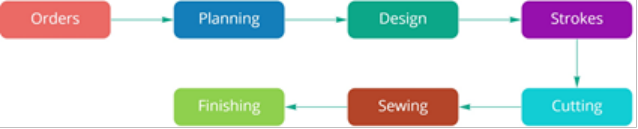
The normal production process of the textile company is observed in the Figure 1, each process is a work area that works independently but related.
Figure 1. Textile production process
The production processes have been analyzed and adapted to SCRUM as an agile methodology that controls management in general. Each production process has its own description, with a beginning and an end. For example, Design involves the following subprocesses: production designs are reviewed, design measurements are adjusted, the production datasheet is filled out, supplies availability is reviewed, and designs are submitted in strokes. While in traces, the process involves: reviewing the size curve, reviewing the availability of inputs, if the inputs are in stock the design scaling is executed, the design scaling is plotted, the design scaling data is recorded, the design is plotted and sent to cut; But, if the necessary inputs do not exist, the process returns to production. In other words, each normal production process involves a subset of subprocesses that the company executes, two of the four processes have been described.
Once all the production processes that the company maintains are known and analyzed, it is planned; the Figure 2 shows the automation diagrams for each of the Kanban boards to be generated, the required lists and the respective backups that will be generated each time.
Intelligent Human Systems Integration (IHSI 2022): Integrating People and Intelligent Systems https://openaccess.cms-conferences.org/#/publications/book/978-1-7923-8988-7
Figure 2 Automatization for dashboards
Additionally, the SCRUM model had to be adapted to the environment and jargon known in the textile company, in the Figure 3, the roles (Product Owner → sales and production manager, Production Operators → Scrum Team) are observed, so that the people who participate in this analysis know where they should intervene. The same happens with the artifacts to be produced (Product Backlog → Proposed Orders, Sprint Backlog → Items to be produced in a Sprint or period, Order Increase → Increase, Complete Orders → Complete product) and the meetings to be held (Planning Meeting of the Sprint, daily meeting sprint review and retrospective). Everything follows the logic established by the SCRUM methodology.
During the development of each Sprint, the team commits to deliver three production orders according to the priority level defined by the sales and production manager. During the Sprint duration, daily synchronization meetings are held, at the end of each Sprint a meeting is held where the fulfillment of order delivery is reviewed and improvements for the next Sprint are analyzed. When the four Sprints are completed, a production closure is carried out in which the fulfillment of the production orders is analyzed through the performance indicators.
Regarding the automation and adaptation of the Kanban framework to the company's production processes, to control where bottlenecks occur and determine the amount of finished production, Kanban integrates it into the SCRUM framework. For this, several boards are generated, to control each work process: Order management production planning, Production centers, Digital documentation. As an example,
Intelligent Human Systems Integration (IHSI 2022): Integrating People and Intelligent Systems https://openaccess.cms-conferences.org/#/publications/book/978-1-7923-8988-7
Figure 3 Adaptation of the SCRUM process4
Figure 4 shows the Kanban corresponding to the production centers. Normally, the production centers collect the orders to be made according to the designated workload, which will be developed by the production operators (development Team) during the development of the sprint. In the main boards "production center" production is planned and the backups are generated in the backup boards ".BAK". In total, ten boards, thirty lists, and WIPs were developed for each list: these are the boards for design, lines, cutting, making, and finishing. The Trello tool was used to handle the boards, while to automate the movement of the cards between boards, the Butler plugin was integrated, allowing the definition of a workflow for the production processes within the tool.
Figure 4 Generic Kanban for production centers
4 https://www.scrum.org/resources/what-is-scrum
Intelligent Human Systems Integration (IHSI 2022): Integrating People and Intelligent Systems https://openaccess.cms-conferences.org/#/publications/book/978-1-7923-8988-7
EVALUATION To evaluate data analytics was applied, integrating productivity indicators in the Trello platform, with Charts addons. The generated indicators were linked to the boards: orders, planning and production centers. The indicators developed were:
Sales indicator: to determine the quantity produced and the value of sales in the period of the experiment.
Productivity indicator: to visualize the status of the different production processes in the period of application of the experiment.
Order management indicator: Orders placed were analyzed with respect to the quantity of production delivered. Production Capacity Indicator The company's objective is to increase production capacity, avoiding wasting resources by team members, avoiding bottlenecks, and ensuring the quality of its products. In Figure 5, each line represents a production center. To analyze the results, the Work in Progress (WIP) metric in Kanban was key in controlling the production capacity for each team. From the results, it is observed that in the month of September, three production centers: cutting, design and clothing achieve a balance, that is, between the three areas the rhythm of work was balanced, that is, the resources work in a balanced way, they do not need to move. ; In this same period it is observed that the bottleneck is in the finishes and the cut; additionally, it was detected that the human resource to establish quality control was not enough, this was corrected in the following sprints. However, in the following period between September 30 and October 28, more was designed than what the plant produced, Likewise, the month of October is better balanced all the production centers and obviously the capacity is being determined real productive company. Table 1confirms what is explained in Figure 5.
Intelligent Human Systems Integration (IHSI 2022): Integrating People and Intelligent Systems https://openaccess.cms-conferences.org/#/publications/book/978-1-7923-8988-7
Figure 5 Production Capacity indicator
Table 1 Production Capacity Indicator
CONCLUSIONS
Analyzing the production processes to be adapted to the SCRUM-Kanban framework requires observing the entire structure of the company, identifying the teams, a clear definition of "Done", defining the MVP, and considering the principles of the methodologies
Intelligent Human Systems Integration (IHSI 2022): Integrating People and Intelligent Systems https://openaccess.cms-conferences.org/#/publications/book/978-1-7923-8988-7 and putting them in practice.
The proposed scheme can be implemented in other textile organizations or in another production line. To improve the organization of information, the integration of digital documentation was positive as the management of technical sheets was systematized.
The integration of indicators facilitated the analysis of the situation in real time for timely decision making. Indicators make it easy to identify bottlenecks, overloading, poor organization, and lack of planning.
To conclude, agile methodologies in congruence with current frameworks allow optimizing the processes defined by the company and quickly systematizing the organization's workflows.
This work as research on the application of agile methodologies in the industry shows that the organization requires a prior definition of processes, which should be considered as guides in the implementation of the chosen agile methodology.
ACKNOWLEDGMENTS
The authors would like to acknowledge to the Ecuadorian company for allowing the application of an agile methodology in its process.
REFERENCES
BRUCE, M., DALY, L. & TOWERS, N. 2004. Lean or agile: a solution for supply chain management in the textiles and clothing industry? International journal of operations & production management. CHRISTIAN, P. H. & ZIMMERS JR, E. W. 1999. Age of agile manufacturing puts quality
to the test. Quality Progress, 32, 45. CHRISTOPHER, M. 2000. The agile supply chain: competing in volatile markets. Industrial marketing management, 29, 37-44. DELGADO, A. & ANTUNEZ-MAGUIÑA, C. P. 2020. Web System Design for Human
Resources Management in an SME in the Textile Sector. International Journal, 8. JIN- HAI, L., ANDERSON, A. R. & HARRISON, R. T. 2003. The evolution of agile manufacturing. Business Process Management Journal. LOAYZA, L., OLAVE, S., PEREZ, M., ROJAS, J. & RAYMUNDO, C. Management model
based on the lean thinking method for medium-sized peruvian companies in the apparel sector. International Conference on Human Interaction and Emerging Technologies, 2019. Springer, 896-902. MANFREDSSON, P. 2016. Textile management enabled by lean thinking: a case study of textile SMEs. Production Planning & Control, 27, 541-549.
Intelligent Human Systems Integration (IHSI 2022): Integrating People and Intelligent Systems https://openaccess.cms-conferences.org/#/publications/book/978-1-7923-8988-7
POTDAR, P. K., ROUTROY, S. & BEHERA, A. 2017. Agile manufacturing: a systematic review of literature and implications for future research. Benchmarking: An International Journal. SILVA, B. F. M., TERESO, A. P. & AMARAL, A. M. P. D. S. 2019. Analysis of Project
Management Practices Within the Textile and Clothing Industry. YUSUF, Y. Y., GUNASEKARAN, A., ADELEYE, E. O. & SIVAYOGANATHAN, K.
2004. Agile supply chain capabilities: Determinants of competitive objectives. European journal of operational research, 159, 379-392.
Intelligent Human Systems Integration (IHSI 2022): Integrating People and Intelligent Systems https://openaccess.cms-conferences.org/#/publications/book/978-1-7923-8988-7
LISTED IN THE AHFE DIGITAL BOOKSTORE CATALOGUE
Explore the complete digital volume
Intelligent Human Systems Integration (IHSI 2022): Integrating People and Intelligent Systems
Read this individual research paper free through the original publisher, or explore the full digital proceedings book.
ISBN 978-1-7923-8988-7
Explore this ISBN in the AHFE Bookstore ↗Listed in the July 2026 bookstore catalogue; search by ISBN to confirm current availability · Digital book purchase optional