Tianxiong Wang, Yuqi Han, Long Liu, Jing Chen, Xian Gao, Tong Yu (2025). Elderly-friendly Design of In-vehicle Navigation Interface in New Energy Vehicles from the Perspective of Implicit Interaction. In: Advances in Human Factors of Transportation. AHFE Open Access, vol. 186, pp. 269–279. https://doi.org/10.54941/ahfe1006516
To enhance the user experience and safety of the interactive interface in new energy vehicles, this study explores the age-friendly design methods for the in-vehicle central control navigation interface from the perspective of implicit interaction. Through literature analysis and questionnaire surveys, factors influencing the age-friendliness of automotive interactive interfaces were obtained, and the influence weights of different factors were calculated using the entropy weight method. Based on the calculation results, key requirements were extracted from three aspects: interface layout, interface elements, and interaction feedback, and a practical age-friendly design plan for the central control navigation interface was further proposed. On this basis, elderly drivers were recruited to conduct simulated interaction experiments, and the completion time of navigation tasks was collected. By comparing the operational performance of the navigation interface under explicit and implicit interaction schemes, the usability of this plan was verified. The experimental results show that the central control navigation interface under implicit interaction can effectively shorten the interaction time and improve the interaction experience of elderly drivers. Based on this, this study proposes age-friendly design strategies for the central control interface from three aspects: multi-sensory design, simplification of the interface hierarchy structure, and adaptive adjustment of the interaction interface, thereby providing new theoretical references for the age-friendly design of new energy vehicle navigation interfaces.
interactive systems integrating visual, auditory, and tactile displays. It plays a crucial role in enhancing the driving and riding experience and assisting driving. The rapid development of in-vehicle sensing technology and machine learning technology has significantly improved the ability of in-vehicle central control systems to perceive and predict user interaction intentions, vehicle driving states, and contextual changes, providing new possibilities for enhancing driving safety, interaction experience, and innovative interaction methods (Murali et al., 2022). Therefore, this study aims to improve the aging-friendly level of the interaction interface of new energy vehicles from the perspective of implicit interaction. By perceiving the facial expressions, voices, behavioral characteristics, physiological features, and driving environment of elderly drivers, it infers their potential states and interaction intentions and outputs corresponding implicit feedback without disturbing normal driving. The goal is to free elderly people from complex and cumbersome interaction modes, enhance driving safety, and explore new paths for the aging-friendly design of new energy vehicle interaction interfaces.
RESEARCH STATUS OF AGE-FRIENDLY INTERACTION INTERFACES FOR NEW ENERGY VEHICLES In recent years, with the wide application of new technologies such as information technology, artificial intelligence, and big data analysis in the transportation field, and the significant changes in people’s definition of car functions in the digital age, cars are gradually transforming from pure driving tools to intelligent mobile living terminals. This transformation has brought revolutionary changes to the interior space, human-machine interaction interfaces, and interaction methods of cars. The increasingly popular in- vehicle electronic information systems have transformed the information model inside cars from a simple driving and vehicle condition information model to a more complex information system. This change is bound to lead to excessive consumption of the driver’s, especially the elderly driver’s, attention resources, thereby triggering safety risks.
At present, domestic research on age-friendly interaction interfaces for cars mainly focuses on the redesign of interface elements and the simplification of interaction levels. The research entry point is still based on the explicit interaction theory of user active input, so the effect in improving the interaction experience of elderly drivers and increasing interaction efficiency is limited. This paper starts from the perspective of implicit interaction theory, enhancing the perception ability of the central control navigation interface for the unconscious behaviors of elderly drivers, and dynamically adjusting the interaction interface and providing multi-dimensional feedback of in- vehicle information based on different driving scenarios, thereby reducing unnecessary interaction steps. The results not only include improvements in the visual aspects of the interaction interface but also, more importantly, in the context of the continuous development of in-vehicle sensor technology and artificial intelligence, conduct deeper research on the interaction mode of car interaction interfaces.
Elderly-Friendly Design of In-Vehicle Navigation Interface in New Energy Vehicles 271
Research Status of Implicit Interaction Theory Implicit interaction is an interaction method that perceives user behavior through sensor technology and acquires real-time environmental information to automatically understand and meet user needs. Schmidt proposed two elements of implicit interaction - perception and inference, and emphasized the importance of contextual information in inferring interaction behavior (Schmidt, 2000). Additionally, from the dimensions of device proactiveness and user attention, human-computer interaction can be divided into explicit interaction and implicit interaction. Compared with the information processing requests brought by the persuasive and recommendation services of explicit interaction, implicit interaction has the characteristics of higher proactiveness and lower attention, thus having more advantages in reducing the allocation of user attention resources and improving interaction efficiency.
Currently, research related to implicit interaction not only perceives users’ natural behaviors but also recognizes the driver’s state through users’ physiological signals, language, pupil diameter, and gaze duration. For example, based on detecting facial muscle movements to infer the driver’s emotional state, (Li et al., 2021) proposed the cognitive feature enhancement model CogEmoNet, which combines the driver’s facial expressions with cognitive process features to construct a model architecture including attention, memory, and decision-making modules, effectively recognizing discrete emotion models and dimensional emotion models. Benedetto et al. (2011) identified the driver’s concentration, fatigue, and cognitive load based on the driver’s gaze direction, eye movement trajectory, and blink frequency. In addition, speech recognition is convenient to collect in the car cabin, has low cost, and does not disturb the user. However, unlike traditional voice systems that analyze users’ explicit voice commands, speech recognition from the perspective of implicit interaction utilizes the correlation between emotional states and voice features to extract emotional information, and acquires information about the driver’s emotional state in real time by analyzing paralinguistic information such as speech rate, rhythm, pauses, and volume (Zepf et al., 2020). Recognition technology based on neurophysiological signals has the characteristics of objectivity and difficulty in disguise, and can measure physiological activation levels and reflect the driver’s driving fatigue, stress levels, etc. Common measurement methods include Electrodermal Activity (EDA), heart rate variability (HRV), respiratory rate (RR), and electroencephalogram (EEG). For example, Solovey et al. (2014) inferred the driver’s fatigue level, attention level, and alertness by analyzing the driver’s heart rate. Du et al. (2020) established a driving fatigue assessment system based on heart rate measurement and the degree of eye and lip opening. Moreover, explicit driving data can also be analyzed to obtain implicit information about driver behavior preferences. Imai et al. (2019) predicted destinations and driving routes based on a large amount of car driving data.
Implicit interaction mainly focuses on technical application and computer algorithm intervention, using hardware facilities as the technical carrier, with
an emphasis on algorithm design. This completely technicalized implicit interaction is a one-way communication and output, neglecting the needs and goals of the user as the subject in the design process, leading to the complexity and dehumanization caused by excessive technicalization in interaction design. Thus, this study adopted a user-centered design strategy, obtained influencing factors through questionnaires and user interviews, and developed a prototype of the in-car navigation interface for new energy vehicles based on the calculation results of the entropy weight method. At the same time, through simulation interaction experiments, the completion time of navigation tasks was collected to evaluate the usability of the design scheme, and the humanistic nature of implicit interaction was re-examined from the user’s perspective.
RESEARCH METHOD A total of 30 elderly drivers over 50 years old with more than 3 years of driving experience were surveyed. The questionnaire covered demographic characteristics, usage problems, frequently used functions, perceived usefulness of the in-vehicle navigation interface, and usage intentions. Based on the literature analysis, the influencing factors and user needs were integrated and classified. Ultimately, two influencing factors, namely visual and interaction, were set and further divided into five categories and 21 sub- items. A five-point scale was used to collect the attitudes of elderly drivers towards the perceived usefulness of each influencing factor and their usage intentions, as shown in Table 1.
Table 1: Summary of weight results calculated by entropy method of automobile interactive interface.
Degree of order 16.31% Brevity 22.55% Intensity 20.88% Degree of dominance 21.09% Interface elements Font size 14.96% Type of font 20.75% Density of font, icon arrangement
The recognition of ICONS 17.18% Color of the interface 17.01% Touch area of the ribbon 14.91% Interaction factors Touch screen interaction 27.32% Physical button interaction 38.42% Interactive feedback Visual feedback Reminders 33.23%
Continued
Elderly-Friendly Design of In-Vehicle Navigation Interface in New Energy Vehicles 273
Table 1: Continued Influencing Factors Categories Content Weight Coefficient
Analysis of Results To further enhance the interaction experience of elderly drivers, this study calculated the influence weights of different factors in interface layout, interface elements, interaction methods, interaction feedback, and interaction experience through the entropy method, as shown in Table 1. The results indicate that the simplicity of interface layout, font types, physical button interaction, voice feedback reminders, and simplified interaction levels have the highest weight coefficients in their respective influencing factor categories. Specifically, a higher degree of layout simplicity can reduce the complexity of interface information, helping elderly drivers quickly grasp the operation logic and functional relationships of the interface; sans-serif fonts and higher font weights can effectively reduce the visual fatigue of elderly drivers and improve the efficiency of reading text; physical button interaction is more suitable for elderly drivers with limited hand movement and has better applicability in scenarios where quick operation is needed or the line of sight cannot be focused. Intelligent voice assistants reduce the visual load of elderly drivers and the number of interactions through auditory compensation.
AGE-FRIENDLY DESIGN PRACTICE OF AUTOMOTIVE INTERFACE BASED ON IMPLICIT INTERACTION THEORY Design of Implicit Interaction System
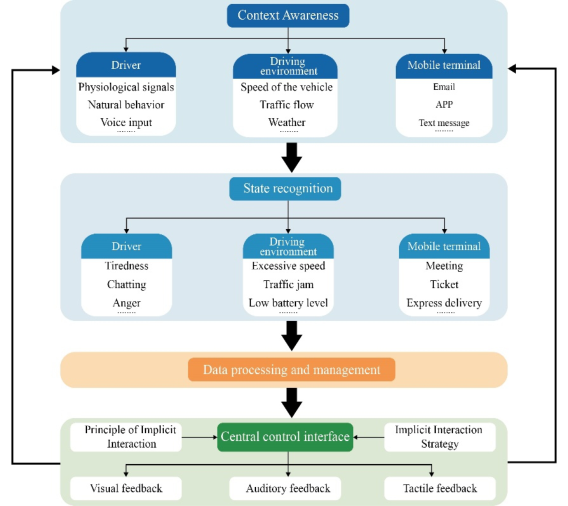
Based on the key requirements and implicit interaction theory mentioned above, this chapter proposes the system architecture of automotive interaction interface and the design practice of the central control navigation interface. The specific process of the implicit interaction system can be divided into four parts, as shown in Figure 1.
The dynamic perception ability of the scene is the primary condition for the central control interface to achieve implicit interaction. This system uses sensors to collect the natural behaviors and physiological information of elderly drivers, such as limb movements, language, expressions, heart rate, etc. It also collects information about the driving environment, such as traffic flow, changes in light inside and outside the vehicle, and changes in distance from surrounding vehicles. In addition, emails, text messages, and other information sent by smart mobile terminals are also important
sources of information for the vehicle’s central control to infer the driver’s intentions. Through the comprehensive perception of the above environment, the driver’s interaction intentions in different situations can be accurately inferred and corresponding interaction feedback can be accurately input. Secondly, to improve the accuracy of system recognition, choosing the appropriate perception mode can effectively enhance recognition accuracy and the stability of the interaction system. For example, in a fatigued state, the driver’s language information may be missing, making it difficult to accurately identify. Therefore, facial expressions and head movements are used as additional detection indicators.
Figure 1: System architecture of automobile interaction interface based on implicit interaction.
At the same time, considering the complexity of the driving environment, the recognized information and interaction tasks need to be classified according to the principle of safety first to prevent secondary information and interaction tasks from interfering with the main driving task, affecting safety and user experience. Finally, multimodal interaction methods aim to provide richer interaction feedback and emotional experiences from visual, auditory, and tactile aspects, and design different levels of feedback and provide personalized interaction paths based on the importance of the task and the danger level of the situation, building an intelligent interaction process.
Practice of Age-Friendly Design for Automotive Interaction Interfaces Based on a questionnaire survey, the five most frequently used functions of in-vehicle interaction interfaces by elderly drivers are map navigation,
Elderly-Friendly Design of In-Vehicle Navigation Interface in New Energy Vehicles 275
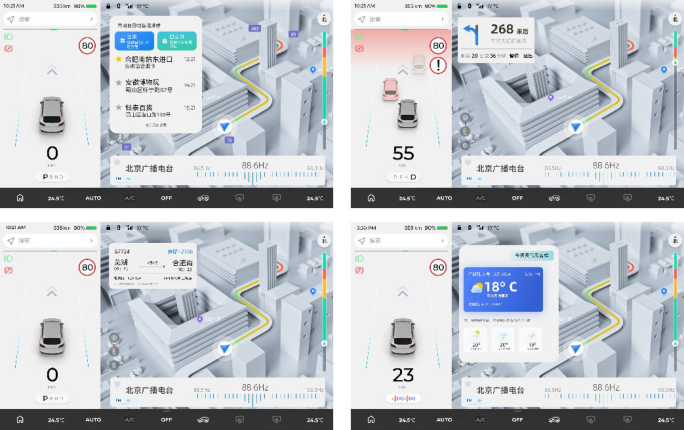
radio, music, air conditioning temperature adjustment, speed observation, and gear shifting. The five most common problems are low levels of interface intelligence, unclear text or icons, excessive interaction steps, unreasonable layout of interface functions, and unattractive interfaces. In response to the above statistical results, this study has carried out corresponding age-friendly design for the automotive central control navigation interface based on the implicit interaction theory, as shown in Figure 2.
Figure 2: Elderly-friendly design of the navigation interface.
First, in terms of interface layout, the interface is clustered and integrated based on function and importance, adopting a modular functional layout to enhance the orderliness and simplicity of interface information. Secondly, the map interface and the vehicle driving status interface are separated according to the primary and secondary relationship, ensuring the display area of key information such as speed, gear, and speed limit while maintaining the relative independence of different functional areas. Second, in terms of interface element design, key information such as speed, gear, and road speed limit is presented in sans-serif fonts and contrasting color schemes to improve the information retrieval efficiency for elderly drivers. Third, in terms of interaction feedback, a driving animation is designed on the left side of the interface to provide elderly drivers with intuitive and clear road condition information. In emergency situations, it can implicitly output multimodal warning feedback such as voice and animation. Fourth, in terms of interaction efficiency, by analyzing a large amount of driving route data, functions such as automatic destination recommendation and optimal route change are designed to reduce repetitive interaction steps and avoid cognitive overload caused by operating the navigation interface during driving. Fifth, the central control interface connects to smart mobile terminals such as
smartphones to automatically recognize multi-scenario interaction tasks and implicitly output information suitable for different scenarios. For example, this navigation interface prototype connects to a smartphone and actively recognizes the information of purchased tickets in the phone’s APP, and recommends the optimal route based on time, traffic volume, etc. At the same time, when arriving at the destination, it automatically displays information such as train number, seat number, and destination, thereby enabling the central control interface’s service scope to cross different scene boundaries and achieve an integrated implicit service system for multi-scenario fusion.
TASK TESTING Task Preparation
To verify the interaction efficiency and usability of map navigation under implicit interaction, this task mainly conducts a horizontal comparison of the performance of elderly drivers operating the navigation interface under explicit and implicit interaction schemes. For the selection of comparison interfaces, a popular model of a certain new energy vehicle brand in China is chosen for quantitative and qualitative evaluation. The selection principles include: Firstly, this model is a popular one in China or domestically, with a user base covering all age groups, especially middle-aged and elderly drivers; Secondly, the system interface has complete basic functions and its architecture, interaction, and interface are representative to a certain extent. In terms of the selection of participants, a total of 10 senior drivers over 60 years old with more than 5 years of driving experience were invited to test the two navigation interfaces. The test items include selecting the destination, the optimal route, observing the speed, turning information, remaining mileage, and ending the navigation, etc. The test indicator is the time taken to complete the task.
Task Implementation This task utilized a 2020 model 12.9-inch iPad Pro as the testing device, which was placed on the right side of the test subjects to simulate the position of the car’s central control panel in real scenarios, ensuring the validity of the data. Each elderly driver conducted two tests for each of the two interfaces as per the above tasks and recorded the time required to complete each task. Finally, a T-test was used to detect significant differences in the operational performance data under the two schemes.
Result Analysis According to Tables 2, the average task completion time for elderly drivers under the explicit interaction scheme was 21.92 seconds, with a standard deviation of 2.4; The average task completion time under the implicit interaction scheme was 13.53, with a standard deviation of 1.59. The paired difference in task completion time between the two design schemes was 8.42, and the significance P-value was less than 0.001, which was significantly less than 0.05. Therefore, based on the calculation results, it can
Elderly-Friendly Design of In-Vehicle Navigation Interface in New Energy Vehicles 277
be concluded that there is a significant difference in the task completion times between the two groups. The operational performance of the navigation interface under the implicit interaction scheme is significantly better than that under the explicit interaction scheme. In terms of the average task completion time, the improvement of the implicit interaction scheme is approximately 38.3%. The actual improvement in real driving scenarios may be even greater, as this simulated interaction test cannot simulate factors such as route changes due to road congestion and the decline in operational efficiency caused by cognitive load in real driving environments.
Based on the above analysis, it can be found that the implicit interaction scheme can predict the destination based on the driving data and usage habits of elderly drivers and proactively match the optimal route, effectively reducing the number of interactions and improving interaction performance compared to the explicit interaction scheme. Secondly, in terms of interface element design, this scheme has made corresponding age-friendly designs for fonts, icons, and other information, such as using sans-serif fonts, appropriate font sizes, and animation elements. For safety information with high observation frequency, such as speed, road speed limits, and turns, the display area is enlarged, and bright color schemes such as red and blue are selected to distinguish from secondary information, reducing the gaze time of elderly drivers on the interface. In terms of interaction feedback, the implicit interaction scheme uses a combination of auditory and visual methods for emergency situations to improve the reaction speed of elderly drivers (Huang et al., 2023).
Table 2: Completion time of navigation tasks under two interaction modes.
The multi-sensory integration strategy can effectively broaden the ways of receiving and providing feedback information in implicit interaction, and guide elderly drivers to simultaneously utilize multiple sensory resources to maintain safe driving, thereby effectively compensating for the deteriorated physical functions of the elderly. Therefore, combining auditory, visual, and tactile methods to expand the feedback methods of interaction information,
for non-essential information, background information prompts should be the main approach to avoid overloading the cognitive resources of elderly drivers, concentrating their attention on the main driving task and improving driving safety.
Simplification of Interface Hierarchy Architecture Based on the above experimental data, it can be found that excessive interaction levels can affect task completion time. Excessive functional levels and dense, complex interaction instructions in the interaction interface not only increase operation steps and extend interaction time but also cause understanding and operation difficulties for the elderly. For automotive HMI based on implicit interaction, the hierarchy architecture of interface functions should be simplified, deleted, and hidden based on the priority of functions, driving scenarios, and the usage habits of elderly drivers, thereby reducing repetitive interaction steps and avoiding the interference of secondary task information to elderly drivers.
Adaptive Adjustment of Interaction Interface The adaptive adjustment of the functional areas of the interaction interface is an important manifestation of the perception ability of implicit interaction. The automotive central control system connects different information in various driving scenarios, actively analyzes scene changes, and adjusts corresponding services, enabling the service scope of the automotive interface to cross the boundaries of different scenarios and achieve an integrated implicit service system for multiple scenarios.
CONCLUSION
With the integration of artificial intelligence technology and big data, a dynamic human-machine interaction user database is constructed by utilizing massive user physiological, psychological information and driving data, providing a guarantee for further enhancing the perception ability of the central control interface in multiple scenarios. This paper proposes a design method for the central control navigation interface of new energy vehicles based on implicit interaction theory, analyzes and summarizes the demands of elderly drivers for the central control navigation interface, extracts key demands based on the calculation results of the entropy method, and on this basis, conducts an aging-friendly design of the central control navigation interface based on the key demands, and verifies the effectiveness of the scheme. The experimental results show that the central control navigation interface of automobiles based on implicit interaction theory can greatly improve the operation performance and interaction experience of elderly drivers, thereby enhancing driving safety.
ACKNOWLEDGMENT
This research was supported by the Project of Philosophy and Social Science Planning of Anhui Province in 2024 (AHSKYY2024D040).
Elderly-Friendly Design of In-Vehicle Navigation Interface in New Energy Vehicles 279
REFERENCES
Benedetto, Simone, et al. “Driver workload and eye blink duration.” Transportation research part F: Traffic psychology and behaviour 14.3 (2011): 199–208. Du, Guanglong, et al. “Vision-based fatigue driving recognition method integrating
heart rate and facial features.” IEEE transactions on intelligent transportation systems 22.5 (2020): 3089–3100. Huang J, Deng M, Lyu N C. A Survey on Multimodal Human-Computer Interaction in Intelligent Cockpits[M]. Hubei: China Communications Press, 2023. Imai, Ryo, et al. “Proactive car navigation: how can destination prediction give us
new navigation experience?”Adjunct Proceedings of the 2019 ACM International Joint Conference on Pervasive and Ubiquitous Computing and Proceedings of the 2019 ACM International Symposium on Wearable Computers. 2019. Li, Wenbo, et al. “Cogemonet: A cognitive-feature-augmented driver emotion recognition model for smart cockpit.”IEEE Transactions on Computational Social Systems 9.3 (2021): 667–678. Murali, Prajval Kumar, Mohsen Kaboli, and Ravinder Dahiya. “Intelligent in-vehicle
interaction technologies.” Advanced Intelligent Systems 4.2 (2022): 2100122. Schmidt, Albrecht. “Implicit human computer interaction through context.”Personal technologies 4 (2000): 191–199. Solovey, Erin T., et al. “Classifying driver workload using physiological and driving
performance data: two field studies.” Proceedings of the SIGCHI conference on human factors in computing systems. 2014. Zepf, Sebastian, et al. “Driver emotion recognition for intelligent vehicles: A survey.” ACM Computing Surveys (CSUR) 53.3 (2020): 1–30.
LISTED IN THE AHFE DIGITAL BOOKSTORE CATALOGUE
Explore the complete digital volume
Advances in Human Factors of Transportation
Read this individual research paper free through the original publisher, or explore the full digital proceedings book.
ISBN 978-1-964867-62-5
Explore this ISBN in the AHFE Bookstore ↗Listed in the July 2026 bookstore catalogue; search by ISBN to confirm current availability · Digital book purchase optional