Yue Jiang, Jing Chen, Yidan Xu, Shimeng Xiao, Long Liu (2023). Eagle Model: A Future Medical Product Innovative Design Model Driven by Human-Technology Symbiosis and Co-design. In: Intelligent Human Systems Integration (IHSI 2023): Integrating People and Intelligent Systems. AHFE Open Access, vol. 69, pp. 888–895. https://doi.org/10.54941/ahfe1002914
Medical products are complex professional artefacts used in the medical situation, such as disease prevention, diagnosis, treatment, and rehabilitation, that hierarchically originate from basic medical research, medical process, and service process. With the coming of the ageing society and the experience economy era, both physical and experiential needs of people for medical products are becoming increasingly complicated, diverse, and comprehensive day by day. However, balancing the conflicts among various needs is still a significant challenge. This article explores a future medical product innovative design model driven following the ideology of human-technology symbiosis and co-design, named the Eagle Model (shaped like an eagle), as a potential proposal for this question. This model is constructed based on 50 design outputs in the last 3-year medical product design curriculum for bachelors in D&I, Tongji University, Shanghai, China. We hope this article can inspire other researchers in the medical innovative design area.
Medical products are complex professional artefacts used in the medical situation, such as disease prevention, diagnosis, treatment, and rehabili- tation, that hierarchically originate from basic medical research, medical process, and service process (IEC and ISO, 2015, 2016; Palmer et al., 2019; Branaghan et al., 2021; Durfee and Iaizzo, 2021; Nadeem and Weiss, 2021). Classified by use, medical products can be divided into scientific research, teaching, and clinical medical products. With the coming of the ageing soci- ety (Santoro, Vera-Munoz and Belli, 2017) and the experience economy era (Pine and Gilmore, 1999), both physical and experiential needs of people for medical products are becoming increasingly complicated, diverse, and com- prehensive day by day (Jones, 2013). According to statistics, in 2020, the market size of the global medical product industry was 484.05 billion dol- lars, with a year-on-year growth of 4.6%. It is expected that the scale of the global medical product industry will reach nearly 579.30 billion dollars by
Eagle Model: A Future Medical Product Innovative Design Model Driven 889
2025. Especially in China, by 2020, the scale of the medical product mar- ket was about 112.28 billion dollars, with a year-on-year growth of 15.5%, which was close to 4 times the global growth rate of medical products. China has also become the world’s second-largest medical product market after the United States. (Xue et al., 2008; China National Center for Biotechnology Development, 2010; Cushman & Wakefield, 2021; Wang et al., 2021; Brand Finance, 2022; Han, 2022; iResearch, 2022; Zeng, 2022).
Because of the extremely high professional threshold, complicated stake- holders, and strict regulation of security and usability (Martin et al., 2008), the design and development of medical products require the deeply integra- ted participation of multiple disciplines, especially Medicine, Design, and Engineering. However, integrating the strengths and balancing the conflicts among various disciplines are still significant challenges. For instance, how to harmonize the innovativeness of Design and the normalization of Medicine?
This article explores a future medical product innovative design model dri- ven by the ideology of human-technology symbiosis and co-design, named the Eagle Model (shaped like an eagle), as a potential proposal for this question. This exploration is based on the teaching experience.
MEDICAL CO-DESIGN NEEDS BOTH HUMAN AND TECHNOLOGY With the development of technology and social progress, the object of design is also evolving - from a product that initially only responds to a single functional need to a complex system that meets multiple values of stakehol- ders, integrates multiple disciplines, and embeds a large number of advanced technologies (Buchanan, 1992; Lou, 2018). This evolution also brings new challenges to designers, divided into two main aspects: (1) if the design object will cause multiple value conflicts among stakeholders, how can designers coordinate and resolve these conflicts in the design process? (2) If the needs of the users served by the design object are far beyond the boundaries of the designer’s understanding, how can the designer respond well to these needs in the design process?
Co-design provides a way for designers to address these challenges. In Sanders and Stappers’ definition, co-design is a design development process in which designers work with people not trained in design to be creative (Sanders and Stappers, 2008) to make the design more fit for purpose. Klein- smann and Valkenburg, on the other hand, identify in more detail the work done by the individual participants in co-design, i.e., sharing their knowledge about the design process and design content, building a common understan- ding, and realizing the design of a new product (Kleinsmann and Valkenburg, 2008). Combining the findings of related scholars and from its perspective as a group activity involving multiple parties, the author defines co-design in this study as a method of using group intelligence to solve complex design problems that individual designers’ intelligence cannot solve. Co-design is commonly used in particular fields with high barriers of expertise, such as medical (Bate and Robert, 2006), aviation (O’Sullivan, 2006), chip (Shakeri and Meindl, 2005), and chemical (Li and Wang, 2019), or social fields with
Table 1. List of common areas and usage aim of co-design.
Table available in the original PDF paper.
Common Areas (Ranked by Literature Quantity)
Usage Aim Value Conflict Knowledge Barrier Computer Science (866) × √ Health Care (613) √ √
Social Innovation (489) √ × Engineering (96) × √
Table 2. List of the recent 3-years curriculum materials.
Table available in the original PDF paper.
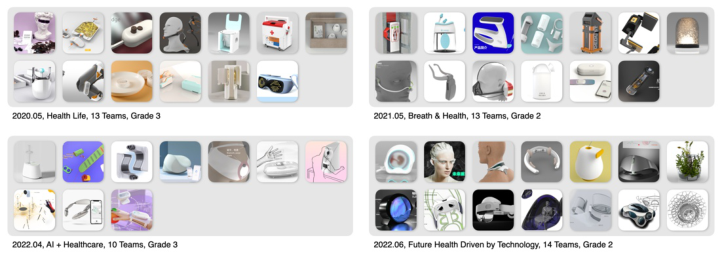
No. Time Grade Subtopic Team Number 1 2020.05 3 Health Life 13 2 2021.05 2 Breath & Health 13 3 2022.04 3 AI + Healthcare 10 4 2022.06 2 Future Health Driven by Technology 14
significant multiple value conflicts, such as community (Deakin, Lombardi and Cooper, 2011), children (Thabrew et al., 2018), and elderly (Xie et al., 2012). The common areas of co-design (top 4 by literature quantity) and their target uses are listed in Table 1, based on 2210 journal articles obtained by the author on October 14, 2022, in Web of Science and Scopus, using “co- design* or co-design*” as the search formula.
As can be seen, the usage aim of co-design in healthcare has a particu- lar specificity, i.e., it is used not only for the reconciliation of multiple value conflicts (human end) but also for the crossing of knowledge barriers (tech- nology end). In other words, we need to consider both human and technology when co-designing a medical product. This requirement leads us to construct a medical product innovative design model driven by human-technology symbiosis and co-design in this article.
MEDICAL PRODUCT DESIGN CURRICULUM IN D&I Several years ago, we initiated a curriculum of medical product design for 2nd-3rd year undergraduates majoring in industrial design at the College of Design and Innovation (D&I), Tongji University, Shanghai, China. This curriculum series has already become a critical stage for students and a representative teaching achievement for D&I.
Considering the data’s variability, timeliness and completeness, we selected the recent 3-years curriculum materials for further analysis in this article. The detailed information on these materials is in table 2, and the product design renderings are collected in figure 1.
During the teaching process year by year, we gradually realize some common problems that most preliminary medical designers will probably encounter:
Eagle Model: A Future Medical Product Innovative Design Model Driven 891
Figure 1: Output collection of the recent 3-years curriculum.
(1) Unconscious easy-way preference. Because designers are often emotio- nal people who lack systematic medical knowledge, they unconsciously take easier ways during the medical design process. The Easier way means more emotional, including experience, service, communication, and lifestyle. According to the statistics, over 80% of teams in these four curriculums have performed this unconscious easy-way preference. (2) Lost in the unnecessary mass learning. Because designers often have no idea about a specific medical topic, they are eager to find as many learning sources as possible at the beginning of a medical design project. However, as a designer, no matter how much medical knowledge he or she learns, there are still bound to be many misunderstandings. As one of the leading figures in medical design, professor Xiangyang Xin has also said, “Although I have paid attention to and participated in the design of the medical and healthcare field for about six years, I am still far from mastering enough expertise in the medical and health care field” (Xin and Wang, 2014). We have seen too many students lost in the unnecessary mass learning in the curriculum during these years. (3) Too innovative or too practical. Medical products are complex artefacts with the perfect balance of innovativeness and normalization. However, design outputs in the curriculum demonstrate that this balance is hard to achieve. Some outputs may be too innovative to have any practical meaning for today’s life, while others may be too practical that they are just a small optimization from the experience or appearance aspect of current products.
CONSTRUCTION OF THE EAGLE MODEL Driven by the three common problems mentioned above, this article explores a potentially more comprehensive model to describe the structure and factors of medical design, and instruct the preliminary medical designers better to start their work.
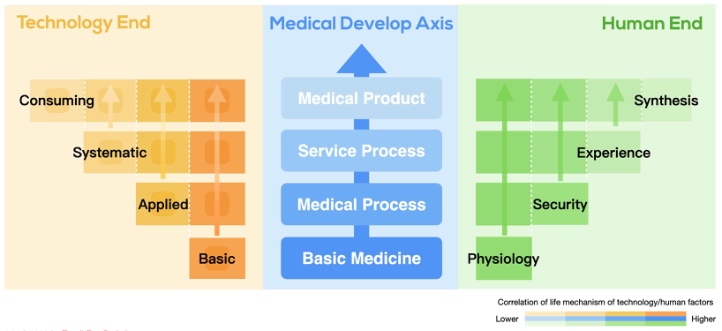
Based on the teaching experience, unstructured observation, and outputs analysis of this curriculum, we propose the hypothesis of the Eagle Model. As shown in Figure 2, this model is constructed following the ideology of human-technology symbiosis and co-design. It is composed of the principal
Figure 2: Schematic graph of the eagle model.
medical axis in the centre line as the “body”, with the technology axis on the left and the human axis on the right as the “wings”. Each line is constructed by four layers from the basic factors (basic technology - basic medicine - human physiology) to applied factors (applied technology - medical process - human security), to service factors (systematic technology - service process - human experience), and finally to product factors (consuming technology - medical product - human synthesis).
The following is a detailed explanation: (1) The principal medical axis in the centre line. By delineating the scope of medical innovation research that is distinct from the traditional scope of medical design work, it was determined that basic medicine, medical process, service process, and medical product would be included in the scope of medical innovation (Boyd et al., 2012; Jones, 2013; Donetto et al., 2015; Robert et al., 2015; Liu et al., 2020). Based on the pro- tection of human life safety and physiological health, we expand to user-level research on medical services and products. (2) The technology axis on the left. Integrating the new economic grow- thism theory SLIM minimal linear model in economics (David, 1992) and the theory of technological excess in sociology (Geels, 2002), while referring to the classification of technology by the Chinese Association of Science and Technology (CAST, 2022), we correspond technology to medicine & human and consider its relevance to life mechanisms. We expand the multi-application scenarios of technology transforma- tion from the scientific and consumer levels to maximize the innovation opportunities of technology based on compliance with safety standards, laws, and regulations. (3) The human axis on the right. From the historical dimension of human factor engineering development (Dreyfuss and Tilley, 1993; Drey- fuss, 2003), human factor consideration is embedded in every level of medical product innovation, focusing on forward-looking technology, innovative product form and concept based on the full-dimensional
Eagle Model: A Future Medical Product Innovative Design Model Driven 893
exploration of future human-computer interaction, considering the moral ethics and sustainable direction of human well-being on top of emotional experience, scientifically answering the value of pro- duct innovation and ease of use, and defining interaction experience standards and norms. Facing the present and future in the field of medi- cal innovation, covering product innovation, promoting the overall profound innovation and upgrade of medical health from a multi- dimensional and comprehensive perspective, providing a comprehen- sive human factors engineering reference for creating Chinese medical innovation products, and taking performance and well-being as one of the critical factors to be considered in concert with medical services and technical safety.
CONCLUSION
This article initially constructs an innovative design model of medical pro- ducts driven by the ideology of human-technology symbiosis and co-design based on the teaching experience of many years. We plan to continue iterating it by evaluating it with experts, putting it into the next-year medical pro- duct design curriculum at Tongji and executing a series of innovative design practices. We hope this article can be an initial inspiration for the relative researcher.
ACKNOWLEDGMENT
The authors would like to acknowledge: Liwen Gu for the curriculum arch- ive; 2022 Tongji University First-class Interdisciplinary Innovation Design and Intelligent Manufacturing Discipline Cluster Construction Fund (project number: F2204).
REFERENCES
Bate, P. and Robert, G. (2006) ‘Experience-based design: from redesigning the system around the patient to co-designing services with the patient’, Quality and Safety in Health Care, 15(5), pp. 307–310. Available at: https://doi.org/10.1136/qshc.2005.016527. Boyd, H. et al. (2012) ‘Improving healthcare through the use of co-design’, The New Zealand Medical Journal, 125(1357), pp. 76–87. Branaghan, R.J. et al. (2021) Humanizing Healthcare – Human Factors for Medi-
cal Device Design. Cham: Springer International Publishing. Available at: https://doi.org/10.1007/978-3-030-64433-8. Brand Finance (2022) Healthcare 2022 - The annual report on the most valuable and strongest pharma, medical devices and healthcare services brands. Brand Finance, p. 42. Available at: brandirectory.com/healthcare. Buchanan, R. (1992) ‘Wicked Problems in Design Thinking’, Design Issues, 8(2),
p. 5. Available at: https://doi.org/10.2307/1511637. CAST (2022) Twenty-fourth Annual Meeting of CAST Successfully Concluded, Chinese Association of Science and Technology. Available at: https://www.cast.org.cn/ art/2022/7/5/art_42_191159.html (Accessed: 2 December 2022).
China National Center for Biotechnology Development (2010) International Comparison of China’s Medical Device Technology Innovation and Industrial Com- petitiveness. Beijing, China: China Science Publishing & Media Ltd. (CSPM). Available at: http://2015.casted.org.cn/store/ShowProduct.php?ProductID=2624 (Accessed: 9 July 2019). Cushman & Wakefield (2021) Shanghai Biopharmaceutical Industry Environment
Report 2021. China: Cushman & Wakefield, p. 16. David, P.A. (1992) ‘Knowledge, Property, and the System Dynamics of Technological Change’, The World Bank Economic Review, 6(suppl_1), pp. 215–248. Available at: https://doi.org/10.1093/wber/6.suppl_1.215. Deakin, M., Lombardi, P. and Cooper, I. (2011) ‘The IntelCities Community of
Practice: The Capacity-Building, Co-Design, Evaluation, and Monitoring of E- Government Services’, Journal of Urban Technology, 18(2), pp. 17–38. Available at: https://doi.org/10.1080/10630732.2011.601107. Donetto, S. et al. (2015) ‘Experience-based Co-design and Healthcare Improvement: Realizing Participatory Design in the Public Sector’, The Design Journal, 18(2), pp. 227–248. Available at: https://doi.org/10.2752/ 175630615X14212498964312. Dreyfuss, H. (2003) Designing for People. Skyhorse Publishing Inc. Dreyfuss, H. and Tilley, A.R. (1993) The Measure of Man and Woman: Human Factors in Design. Updated and expanded. Whi- tney Library of Design. Available at: http://gen.lib.rus.ec/book/index. php?md5=fcdc03174960093a19ec375802192acd (Accessed: 16 November 2021). Durfee, W. and Iaizzo, P. (2021) The Medical Device Innovation Pro- cess. Edition 8. Minneapolis, USA: University of Minnesota. Available at: https://doi.org/10.1016/B978-0-12-813068-1. 00019–1. Geels, F.W. (2002) ‘Technological transitions as evolutionary reconfiguration processes: a multi-level perspective and a case-study’, Research Policy, 31(8), pp. 1257–1274. Available at: https://doi.org/10.1016/S0048-7333(02)00062-8. Han D. (2022) 2021-2022 China Healthcare Industry Investment and Development
Report. Beijing, China: ITJUZI, p. 48. IEC and ISO (2015) Medical devices — Part 1: Application of usabi- lity engineering to medical devices, IEC 62366-1:2015. Available at: https://www.iso.org/obp/ui#iso:std:iec:62366:-1:ed-1:v1:en (Accessed: 28 February 2022). IEC and ISO (2016) Medical devices — Part 2: Guidance on the applica- tion of usability engineering to medical devices, IEC 62366-2:2016. Available at: https://www.iso.org/obp/ui#iso:std:iec:tr:62366:-2:ed-1:v1:en (Accessed: 28 February 2022). iResearch (2022) 2021 China Medical Device Domestic Substitution Trend Research Report. Shanghai, China: iResearch, p. 39. Jones, P.H. (2013) Design for care: innovating healthcare experience. Brooklyn, N.Y:
Rosenfeld Media. Kleinsmann, M. and Valkenburg, R. (2008) ‘Barriers and enablers for creating shared understanding in co-design projects’, Design Studies, 29(4), pp. 369–386. Available at: https://doi.org/10.1016/j.destud.2008.03.003. Li, G.-R. and Wang, L.-S. (2019) ‘Durable TBCs with self-enhanced thermal insula-
tion based on co-design on macro- and microstructure’, Applied Surface Science, 483, pp. 472–480. Available at: https://doi.org/10.1016/j.apsusc.2019.03.309.
Eagle Model: A Future Medical Product Innovative Design Model Driven 895
Liu, L. et al. (2020) ‘The Co-creation Process of a Platform for Healthcare Engineering Design and Innovation (HEDI)’, in P. Langdon et al. (eds) Designing for Inclusion. Cham: Springer International Publishing, pp. 47–55. Available at: https://doi.org/10.1007/978-3-030-43865-4_5. Lou, Y.(2018) ‘Designing Interactions to Counter Threats to Human Survival’, She Ji:
The Journal of Design, Economics, and Innovation, 4(4), pp. 342–354. Available at: https://doi.org/10.1016/j.sheji.2018.10.001. Martin, J.L. et al. (2008) ‘Medical device development: The challenge for ergonomics’, Applied Ergonomics, 39(3), pp. 271–283. Available at: https://doi.org/10.1016/j.apergo.2007.10.002. Nadeem, M. and Weiss, A.-P.C. (2021) ‘Medical Product Development Part 1: Idea, Partnerships, and Commercialization’, The Journal of Hand Surgery, 46(8), pp. 703–708. Available at: https://doi.org/10.1016/j.jhsa.2021.04.020. O’Sullivan, A. (2006) ‘Why tense, unstable, and diverse relations are inherent in
co-designing with suppliers: an aerospace case study’, Industrial and Corporate Change, 15(2), pp. 221–250. Available at: https://doi.org/10.1093/icc/dtj015. Palmer, V.J. et al. (2019) ‘The Participatory Zeitgeist: an explanatory theoretical model of change in an era of coproduction and codesign in health- care improvement’, Medical Humanities, 45(3), pp. 247–257. Available at: https://doi.org/10.1136/medhum-2017-011398. Pine, B.J. and Gilmore, J.H. (1999) The Experience Economy: Work is Theatre &
Every Business a Stage. the USA: Harvard Business Press. Robert, G. et al. (2015) ‘Patients and staff as codesigners of healthcare services’, BMJ, 350, p. g7714. Available at: https://doi.org/10.1136/bmj.g7714. Sanders, E.B.-N. and Stappers, P.J. (2008) ‘Co-creation and the new landsca-
pes of design’, CoDesign, 4(1), pp. 5–18. Available at: https://doi.org/10.1080/ 15710880701875068. Santoro, R., Vera-Munoz, C. and Belli, A. (2017) ‘People Olympics for Social Innovation: Co-creating the Silver Sharing Economy for the Aging Society’, in R. JardimGoncalves et al. (eds). 2017 INTERNATIONAL CONFERENCE ON ENGINEERING, TECHNOLOGY AND INNOVATION (ICE/ITMC), pp. 551–556. Shakeri, K. and Meindl, J.D. (2005) ‘Compact Physical IR-Drop Models for Chip/Pa-
ckage Co-Design of Gigascale Integration (GSI)’, IEEE Transactions on Electron Devices, 52(6), pp. 1087–1096. Available at: https://doi.org/10.1109/TED.2005. 848125. Thabrew, H. et al. (2018) ‘Co-design of eHealth Interventions With Children and Young People’, Frontiers in Psychiatry, 9. Available at: https://doi.org/10.3389/ fpsyt.2018.00481. Wang B. et al. (2021) 2021 China Medical Device Industry Development Report
(Medical Device Blue Book). Beijing, China: Social Sciences Academic Press (China). Xie, B. et al. (2012) ‘Connecting generations: developing co-design methods for older adults and children’, Behaviour & Information Technology, 31(4), pp. 413–423. Available at: https://doi.org/10.1080/01449291003793793. Xin, X. and Wang, X. (2014) ‘Focus on Medical Health Design’, Creation and
Design, (06), pp. 6–7. Xue, L. et al. (2008) ‘The design evolution of medical devices: moving from object to user’, J. of Design Research, 7(4), p. 411. Available at: https://doi.org/10.1504/ JDR.2008.026991. Zeng C. (2022) China Medical Device Industry Policy Analysis in 2022. China:
LeadLeo, p. 20.
LISTED IN THE AHFE DIGITAL BOOKSTORE CATALOGUE
Explore the complete digital volume
Intelligent Human Systems Integration (IHSI 2023): Integrating People and Intelligent Systems
Read this individual research paper free through the original publisher, or explore the full digital proceedings book.
ISBN 978-1-958651-45-2
Explore this ISBN in the AHFE Bookstore ↗Listed in the July 2026 bookstore catalogue; search by ISBN to confirm current availability · Digital book purchase optional