Małgorzata Oleś-filiks, Robert Waszkowski (2024). Implementation of a centralised system for managing processes in cultural institutions. In: Creativity, Innovation and Entrepreneurship. AHFE Open Access, vol. 125, pp. 97–105. https://doi.org/10.54941/ahfe1004725
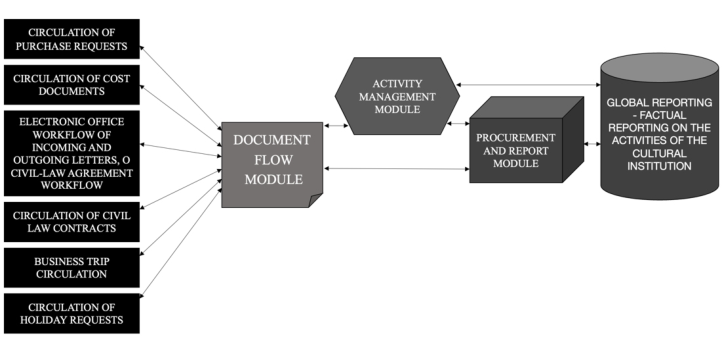
The article presents the implementation of a centralised system for managing processes in cultural institutions.As part of their activities, public institutions promote attitudes of civic and patriotic responsibility for cultural and natural heritage, and carry out many educational activities, exhibitions, shows, concerts aimed at different social groups. All these activities require the coordination of many employees from different departments and a high level of management commitment. Each event organised requires cash control and work planning.Cultural organisations need a reliable IT solution to support staff in the following processes: managing and monitoring project budgets; managing and monitoring procurement plans; and document handling processes.The basic architecture of the centralised system of process management in cultural institutions involves the use of a number of components responsible for: data preparation in the document circulation module (e.g. costs, business trips, holidays, civil contracts, incoming and outgoing); implementation in the activity handling module; supervision and monitoring of the course of action by the management in the procurement module and the reporting module. Global reporting takes place in the factual reporting of the cultural institution's activities. The solution designed and implemented is based on dedicated modules and the Aurea BPM platform. The Aurea BPM platform enables the dynamic design of business processes.The actions taken by individual user groups within modules and processes directly affect the related components and processes. Mutual communication within the tasks performed allows: synchronisation of work between modules; continuous reporting on the progress of ongoing activities; speeding up the flow of information and improving the quality of task handling; monitoring and reporting on completed tasks during the maintenance phase. Thanks to the use of the latest technology, users can access the system on multiple devices (tablets, smartphones and computers) and have access to up-to-date data. The process management system for cultural institutions records every action and decision taken by participants in a process history with an accurate time stamp and a record of who performed the activity.The result of the implementation was presented in the form of business process diagrams in BPMN notation. The system was implemented in an organisation that is a leader among public institutions. The system provides a single location for information and knowledge about the activities performed and accelerates the flow of data, which allows to increase its quality. The automation of document handling, data validation and reporting reduces decision-making time and improves communication between process participants. After implementation, costs associated with paper handling and document archiving have been reduced. Data registers for each process allow all process participants to quickly access and manipulate data according to defined authorisations. For managers, the system provides excellent access to management data and the ability to set specific KPIs. Ultimately, it has also become possible to manage and monitor procurement plans, as well as to use the budget effectively and efficiently, allowing the institution's tasks to be carried out simply and transparently.
Nowadays, cultural institutions have to face not only the problems faced by all developing organisations, but also the conditions imposed by the rules of public funding of activities. In addition, the evolution of audiences and their growing expectations affect the nature of activities, their pace and their diver- sity. Cultural institutions now have to combine traditional statutory activities with new forms of access to collections. The evolution of audiences and their expectations influence the nature of activities and their diversity (Pepin et al., 2023; Krupskyi and Stasiuk, 2023; Fitzpatrick, 2022; Nikiel, 2019; Tekeli, 2023; Biryukov and Romanenko, 2017). With the rapid development of global economic integration, business exchanges between domestic and foreign enterprises are becoming more and more frequent (Huang, 2023).
Due to the diverse nature of the needs, the responsibility for the domain and funding processes in the cultural institution under study was, until recently, distributed among different people and communication flows, which often resulted in a lack of consistency of activities and a high time commitment for the team (Waszkowski et al., 2017; Nowicki et al., 2013). Prior to implementation, the cultural organisation’s staff relied on IT systems
that, over time, had reached their limits in terms of efficiency and usability. The organisation had been looking for a long time for an innovative solu- tion that would combine the features of a modern, efficient IT tool and at the same time be easily adaptable to the specificities of working in a cultural institution (Zem¯ıte, 2022; Smiraglia, 2014; Wavell et al., 2002; Waszkowski, 2019; Waszkowski et al., 2018; Waszkowski et al., 2020). The innovativeness of enterprises is determined by the operations and activities of the numerous innovation centres, including technology parks, innovation centres, technology and transfer centres, academic incubators, as well as loan funds, credit guarantee funds and other organisations whose aim is to support innovation in a broad sense. The innovative capacity of enter- prises is strengthened by good cooperation with local authorities and the scientific community, as well as with the above-mentioned business environ- ment institutions. These are all prerequisites for the acquisition and creation of new knowledge, skills and technologies. Cooperation between enterprises and external entities makes it possible to obtain the synergy effect, which increases the competitive position, effectiveness and efficiency of operations (Kami´nska, 2023).
The cultural institution was looking for a platform to assess and describe project risks and monitor progress. A notification system for critical dead- lines that would reduce routine and redundant formal operations in favour of automation.
The implementation of business processes based on the Aurea BPM plat- form engine was a major step in the development of the selected cultural institution. The overall goal of the system is to support process management while increasing organisational efficiency and optimising budget utilisation. The use of a class BPM system provides the opportunity for extensive user involvement in the process description phase, process modelling and faster implementation (Aurea BPM; Apaydin et al., 2022; Wiggins and Davis, 2006). Cross-cultural integration plays a crucial role in international business management. It not only promotes diverse development and innovation within companies, but also acts as an important driving force for the imple- mentation of global strategies. Therefore, in-depth research and attention to cross-cultural integration is crucial for the future development of inter- national business management. This will help to provide more effective management models and strategies for companies to meet the challenges of global development (Huang, 2023).
OBJECTIVES AND CHALLENGES OF IMPLEMENTATION Before starting the work, the main objectives of the implementation of a centralised system for managing processes in cultural institutions were iden- tified and described. These objectives were identified on the basis of the needs of the studied cultural institution related to the development of statu- tory activities, reduction of expenses and time, as well as adaptation to modern working standards. During the analytical work the following main
Implementation of a Centralised System for Managing Processes in Cultural Institutions 99
implementation objectives were distinguished (Zem¯ıte, 2022; Kutsuri, 2020; Çakmak, 2018):
support process management to increase organisational efficiency,
optimise budget utilisation,
integration with internal finance, HR, workflow and accounting systems,
ability to manage budget, control procurement processes and activity reporting system,
introduction of electronic document workflows and registers (e.g. holiday requests, business trips, invoices).
The conceptual work identified the following challenges related to the nature of cultural institutions’ activities (Zem¯ıte, 2022; Kutsuri, 2020; Çakmak, 2018; Nabli and Nugent, 1989):
the need to combine traditional statutory activities with new ways of working,
the parallel operation of several enterprises with a complex organisational structure,
the creation of special modules in the system for the activities of cultural institutions,
the parallel running of projects at the substantive and formal levels, and the coordination of human teams working simultaneously on several projects.
The process of planning and preparing for the implementation of a cen- tralised system for process management in cultural institutions involved a wide range of activities, from the formulation of functional goals and objec- tives, integration with the existing infrastructure, to preparing staff and process owners for changes resulting from the new system. The process of planning and preparing for system implementation mainly involved activities such as (Zem¯ıte, 2022; Kutsuri, 2020; Çakmak, 2018; Antosz et al., 2022):
working with a design approach,
the need to formulate functional assumptions and goals for the project,
developing the assumptions and goals together with the analysis team,
carrying out a comprehensive business case for building the new system,
defining priorities, such as monitoring work progress, automating rou- tines, and building a reporting system,
conducting meetings and training sessions for end users,
integration with the existing IT infrastructure,
preparation for migration (data, documents, users, procedures, records).
The lack of a proper planning process, the lack of understanding of the nature and role of certain instruments, and the insufficient link between all elements of the plan and the mission of individual cultural institutions leave room for individual improvisation and disputes (Gałecka and Smolny, 2023; Hasitschka et al., 2005).
100 Ole´s-Filiks and Waszkowski
COMPONENTS OF THE PROJECT The following elements of the implementation of a centralised system for process management in cultural institutions were identified:
1. The supply of software licences for the development, test and produc- tion environments. 2. Installation and commissioning of the delivered software. 3. Analysis of the current state of the organisation in terms of the processes used in it, optimisation of the business processes in accordance with the scope of the implementation. 4. Delivery of the system, including design and implementation of modules based mainly on business processes (see Figure 1):
Document flow module This module allows the handling of business processes related to document circulation. It includes the following processes:
circulation of purchase requests,
circulation of cost documents,
electronic office workflow of incoming and outgoing letters, o civil-law agreement workflow,
circulation of civil law contracts,
business trip circulation,
circulation of holiday requests.
Activity Management Module This module is the main element of the system that allows the cre- ation, management and follow-up of initiatives registered by users in the system. Thanks to the possibility of defining approval paths, the actions created can be validated and approved by the required per- sons and then directed for implementation. Special forms allow users to describe and categorise the actions entered into the system, which greatly facilitates their further evaluation and verification. It also defines objectives, scope and deadlines, and assigns team members and their authorities and responsibilities. In addition, this module allows you to identify and assess the risks associated with the activ- ity and to define countermeasures, thus facilitating the management of the risks associated with the idea. This module has built-in com- munication tools that allow easy exchange of information between team members associated with an activity.
Procurement and Reporting Module This module is responsible for creating budget lines, managing the budget for activities and all work related to activities by creat- ing a schedule of activities and actions, and controlling the budget by attaching specific expenses to previously created activities and actions from the schedule. Thanks to the integration with the work- flow module and the activity handling module, the system allows to track the use, implementation and transfer of funds from individual projects, activities and actions.
Implementation of a Centralised System for Managing Processes in Cultural Institutions 101
Global reporting - factual reporting on the activities of the cultural institution This module is integrated with the modules described above and is based on the data collected in them. The module enables the presen- tation of the schedule of individual activities and actions, as well as the schedule of all activities on a Gantt chart. The module makes it possible to efficiently manage activities and monitor the progress of work carried out within them, as well as to design and implement dynamic reports.
5. Provide analytical documentation for the above modules. 6. Delivery and parameterisation of the system. 7. Delivery of the configured system installed in a test environment. 8. Testing and implementation. 9. Installation of the system in a production environment. 10. Implementation for BPMS platform administrators, business analysts and key users of the system. 11. User training. 12. Implementation of maintenance and support services. 13. System development.
Figure 1: Centralised system for managing processes in cultural institutions.
IMPLEMENTATION LESSONS The implementation of a centralised system for process management in cul- tural institutions has undoubtedly had an impact on the implementation of day-to-day tasks, among others:
comprehensive budget management, process control, an integrated report- ing system that can be handled in one place,
reduction of routines and unnecessary formal operations in favour of automation,
possibility of electronic handling of processes (accessibility, remote work, registers, reports),
102 Ole´s-Filiks and Waszkowski
easier management and implementation of projects,
increased efficiency of work organisation,
optimisation of budget utilisation, thanks to process management,
easier monitoring of work progress,
faster and easier reporting on the activities of cultural institutions,
electronic document circulation,
integration with an external system (smooth flow of information and data between different areas such as finance, human resources and document flow),
automation of processes, thanks to the elimination of unnecessary steps, including acceptance steps.
The implementation of a centralised system for process management in cultural organisations has identified a comprehensive set of lessons that can be recommended to other cultural organisations (Nowicki et al., 2017, Waszkowski, 2019):
the active involvement of users in the planning phase brings far-reaching benefits in implementation,
taking into account the specificities of the sector and the needs of cultural institutions is essential for success,
the ability to modify and adapt the platform to individual needs is essential in this type of implementation,
planning the implementation objectives; defining the functional scope is fundamental and a step that cannot be omitted,
the flexibility of implementation and the ability to adapt the system is essential in today’s dynamically changing environment.
CONCLUSION
The implementation of a centralised system for managing processes in cul- tural institutions in the selected organisation enabled more effective man- agement of the financial sphere, and in particular the planning of budget expenditure and the monitoring of the implementation of approved projects, which made it possible to assess risks in the planning and implementation of projects carried out as part of statutory activities, such as exhibitions and conferences. The implementation of the system has improved communication with suppliers and subcontractors in terms of drafting letters, contracts and documentation, as well as enforcing and settling tasks assigned to employees. The structuring and documentation of existing processes and the modelling of future processes is important in terms of creating quality standards for cultural institutions and supporting the training and information system for staff. As the importance of organising remote working has definitely increased in the face of epidemic threats (Reformat, 2023; Roggeveen and Sethuraman, 2020), the implemented system has ensured that data and func- tions can be accessed from anywhere via secure web interfaces that comply with the latest standards. Integration with existing IT systems is also impor- tant. The system provides a reporting platform for management information as well as substantive and financial reporting to regulatory authorities.
Implementation of a Centralised System for Managing Processes in Cultural Institutions 103
The integration of the central system with the internal systems for finance and human resources, document circulation and archiving, and the account- ing system went smoothly and according to the agreed timetable. After a multi-threaded integration, the central process management system is now the only place to manage budgets, control processes, public procurement and monitor the cultural institution’s activities. After two years of working with the system, employees point out that the implementation has enabled them to work in a modern organisation that aims to reduce costs and time and focus on developing statutory activities.
It is worth noting that the process owners and potential users of the system had extensive input into the design of the processes, forms and dashboards, which ultimately minimised the need for lengthy and complex training. The training sessions enjoyed broad involvement from process owners and future users of the system and were divided into sections tailored to specific user groups. The training was based on real data and pre-prepared test scenarios.
Challenges faced during the implementation included: limited financial resources; parallel project work and ongoing tasks; implementation of electronic workflows for processes that were previously analogue.
A key objective of the implementation was also to create a reporting system for internal use and regulatory reporting that would enable group work.
REFERENCES
Antosz, K., Jasiulewicz-Kaczmarek, M., Waszkowski, R., & Machado, J. (2022).
Application of Lean Six Sigma for sustainable maintenance: Case study. IFAC- PapersOnLine, 55(19), 181–186. Apaydin, M., Branch, J., Gillett, A. (2022) Business and Culture: A Virtual Exchange Across Four Countries, in: Pedagogy, Presence, and Motivation in Online Education, doi: 10.4018/978-1-7998-8077-6.ch009. Aurea BPM system documentation. Website: aurea-bpm.com. Biryukov, V. V., Romanenko, E. V. (2017) Economic behavior of business enti-
ties, culture and institutions: Specifics of their interrelations in conditions of neo-industrialization, in: European Research Studies Journal 20(4): 370–385. Çakmak, T. (2018) Digitization in Cultural Memory Institutions: Analysis of the Practices Carried Out in 17 Institutions in Ankara, in: Journal of Ankara Studies 6(2): 167–182, doi: 10.5505/jas.2018.30502. Fitzpatrick, F. (2022) Towards Interculturality in International Creative Business and
Management in Higher Education, in: Powell, P., Shankar Nayak, B. (eds) Creative Business Education. Palgrave Macmillan, Cham. Gałecka, M., Smolny, K. (2023) Cultural institutions in Poland: the nature of their organisation and financing, in: Economics and law, 22(2): 211–225, doi: 10.12775/EiP.2023.012. Hasitschka, W., Goldsleger, P., Zembylas, T. (2005) Cultural institutionsstudies:
investigating the transformation of cultural goods, in: The Journal of Arts Man- agement, Law, and Society, 35(2), 147–158. https://doi.org/10.3200/JAML.35.2. 147-158. Huang, H. (2023) On Cultural Differences in Business Negotiation, in: Frontiers in Business Economics and Management 10(3): 136–139, doi: 10.54097/fbem.v10i3.11465.
104 Ole´s-Filiks and Waszkowski
Huang, H. (2023) Research on the Importance of Cross-cultural Integration in International Business Management, in: Modern Economics & Management Forum 4(6): 171, doi: 10.32629/memf.v4i6.1502. Kami´nska, A. (2023) The activity of business environment institutions in terms
of supporting the innovativeness, in: Scientific Papers of Silesian University of Technology Organization and Management Series, No. 170, doi: 10.29119/1641- 3466.2023.170.12. Krupskyi, O. P., Stasiuk, Y. M. (2023) Storytelling as a tool for forming and supporting organisational culture in medical institution, in: Communications and Communicative Technologies, 23(23): 134–144, doi: 10.15421/292321. Kutsuri, G. N. (2020) Development of the Mechanism for Financing Cultural
Institutions, in: Vestnik Universiteta, doi: 10.26425/1816-4277-2020-7-145-153. Nabli, M. K., Nugent, J. B. (1989) The New Institutional Economics and itsapplicability to development, in: World Development, 17(9), 1333–1347. http://dx.doi.org/10.1016/0305-750X(89)90076-4 Nikiel, S. (2019) New business models for Cultural and Creative Institutions, in: Management 23(2): 124–137, doi: 10.2478/manment-2019-0022. Nowicki, T., Kiedrowicz, M., Waszkowski, R., Chodowska, A., & Lach, A. (2017).
Access control system for RFID-tagged documents in supply chain management. LogForum, 13(1), 91–101. Nowicki, T., Pytlak, R., Waszkowski, R., & Bertrandt, J. (2013). The method for finding optimal sanitary inspectors schedules. Annals of Nutrition and Metabolism, 63, 1027. Pepin, M., Tremblay, M., Audebrand, L. K., Chassé S. (2023) The responsible busi-
ness model canvas: designing and assessing a sustainable business modeling tool for students and start-up entrepreneurs, in: International Journal of Sustainability in Higher Education 25(5), doi: 10.1108/IJSHE-01-2023-0008. Reformat, B. (2023) Cultural Cultural Participation in a Pandemic Reality: Challenges for Cultural Institutions, in: Perspektywy Kultury 42(3):27–38, doi: 10.35765/pk.2023.4203.05. Roggeveen, L., Sethuraman, R. (2020) How the COVID Pandemic MayChange the World of Retailing, in: Journal of Retailing, No. 96(2), 169–171, doi: 10.1016/j.jretai.2020.04.002. Smiraglia, R. P. (2014) Cultural Synergy in Information Institutions, in: Springer
Science+Business Media New York 2014, doi: 10.1007/978-1-4939-1249-0. Tekeli, E. K. (2023) Augmented Reality and Virtual Reality Technologies in Cultural Heritage Tourism: A Systematic Literature Review, in: Conference: 4th Congress on Architecture and Cultural Heritage in Tourism. Waszkowski, R. (2019). Low-code platform for automating business processes in
manufacturing. IFAC-PapersOnLine, 52(10), 376–381. https://doi.org/10.1016/j. ifacol.2019.10.060 Waszkowski, R., Nowicki, T. W., & Worwa, K. A. (2018). Corporate efficiency improvement with business process automation. MATEC Web of Conferences, 210. Waszkowski, R., Nowicki, T., & Ole´s, M. (2020). Human-computer interaction in
business process external tasks. In Advances in Intelligent Systems and Computing (Vol. 972). https://doi.org/10.1007/978-3-030-19135-1_5 Waszkowski, R., Nowicki, T., & Saniuk, A. (2017). Human-computer interaction in sanitary inspection simulation exercises. In Advances in Intelligent Systems and Computing (Vol. 486). https://doi.org/10.1007/978-3-319-41685-4_22
Implementation of a Centralised System for Managing Processes in Cultural Institutions 105
Wavell, C., Baxter, G., Johnson, I., Williams, D. (2002) Impact evalua- tion of museums, archives and libraries: available evidence project. Web- site: https://www3.rgu.ac.uk/file/dorothy-williams-im-pact-evaluation-of-muse ums-archives-and-libraries-available-evi-dence-project Wiggins, S., Davis, J. (2006) Economic institutions. Website: https://assets.publishin g.service.gov.uk/media/57a08c27ed915d622c001177/IPPGBP3.pdf. Zem¯ıte, I. (2022) Challenges for a 21st Century Cultural Organisation: Cultural
Read this individual research paper free through the original publisher, or explore the full digital proceedings book.
ISBN 978-1-964867-01-4
Explore this ISBN in the AHFE Bookstore ↗Listed in the July 2026 bookstore catalogue; search by ISBN to confirm current availability · Digital book purchase optional