Tadeusz Nowicki, Robert Waszkowski, Agata Chodowska Wasilewska (2023). Simulation studies in a low-code development platform for improving the flow of internal electronic documents. In: Application of Emerging Technologies. AHFE Open Access, vol. 115, pp. 310–320. https://doi.org/10.54941/ahfe1004328
The article shows a certain methodology for investigating the properties of real processes described by business processes. Studying the properties of a business process allows you to evaluate various properties of a real process. The study of the business process takes place in a Low-code platform. This gives the opportunity to study the properties of processes even for people who do not know the methods and technologies of programming, in particular the design and implementation of computer simulators.In this case, the process that is related to the flow of internal electronic documents in the organization is considered. The process begins when there is a need to prepare an internal electronic document in an organization. The flow of electronic internal documents can be initiated by various persons. The new document can be information for staff, decisions, or announcements. Electronic internal documents during the flow can be modified, submitted for approval, completed, saved in the knowledge base, canceled, etc. The process ends by saving the document to the knowledge base.The number of internal electronic documents sent during the day is usually very large. Therefore, it is worth considering improving the flow of internal documents in the organization. Supporting the process of electronic internal documents flow will make it easier for employees to prepare, distribute, modify, accept and, as a result, save such documents in the knowledge base. A process of internal electronic document flow is constructed. Its equivalent in the Low-code platform is also presented. This platform has a built-in simulator. Simulation experiments allow us to analyze various dynamic properties of real processes described by business processes. Business processes and their elements can be described by many various characteristics such as random streams of internal document generation, execution times of detailed tasks, probabilities of certain events controlling the flow of documents, costs of tasks, work schedules of individual employees, parameters of shared resources, organizational structure, etc.Simulation of internal electronic documents flow in a Low-code platform allows to obtain results for various values of characteristics defined in the model. This gives the opportunity to examine the characteristics of the internal electronic document flow process itself, find bottlenecks, lack of appropriate resources, etc. Such an analysis is very important from the point of view of the human factor in relation to the employees of the organization.As a result of a series of simulation experiments, several interesting characteristics related to the internal electronic document flow can be obtained. Interesting statistics are shown related to the execution times of various types of actions, their execution costs, and waiting times for various steps of the document flow. For employees participating in the electronic internal documents flow, their time load on individual tasks in this area can be determined. It is possible to show (indicate) those actions that are activated most often or those that are activated rarely. The degree of the use of resources in the process of electronic internal document flow may also be interesting. A few characteristics can be displayed in tabular or graph form easy to analyze and evaluate. It is important that the real process is described in the form of a business process, and it is easy to construct by a person from outside the IT sector. This is important from the point of view of considering the human factor in this activity.Finally, the article shows the methodology of proceeding in the case of construction, simulation and efficiency, time, and cost analysis of detailed processes of the organization's functioning. Such a methodology allows for the improvement of processes in the organization, including the consideration of the human factor in such processes.
The article shows a methodology for investigation the properties of real processes described by business processes (Dirk etal., 2009), (Jasiulewicz- Kaczmarek et al., (2018) and (Wang et al., 2005). Studying the properties of a business process allows you to evaluate various properties of a real process. The study of the business process takes place in a Low-code plat- form (Waszkowski et al., 2019), (Waszkowski et al., 2021), (Waszkowski, 2022). This gives the opportunity to study the properties of processes even for people who do not know the methods and technologies of program- ming, in particular the design and implementation of computer simulators (Jonkers et al., 1996), (Kiedrowicz et al., 2016), (Waszkowski et al., 2012) and (Waszkowski et al., 2018). Low-code platforms also help in modeling and optimizing the effectiveness of various types of administrative and warehouse processes (Kiedrowicz et al., 2017a), (Kiedrowicz et al., 2017b), Waszkowski et al., 2020). AI methods are sometimes used for these problems (Mrugalski et al., 2003) and (Mrugalski et al., 2007).
Using low-code development platform we can offer several significant ben- efits for manufacturing processes. In Low-code system, the Forms module is responsible for user data processing. All the data and their subsequent versions are stored in the database. It helps to organize the knowledge transfer from one part of the organization to another (Waszkowski et al.,
Simulation Studies in a Low-Code Development Platform for Improving 311
2017), (Dudek et al., 2016), (Patalas-Maliszewska et al., 2015), (Patalas- Maliszewska et al., 2020), (Pazera et al., 2020) and (Witczak et al., 2020).
In this case, the process that is related to the flow of internal electronic documents in the organization is considered. The process begins when there is a need to prepare an internal electronic document in organization. The flow of electronic internal documents can be initiated by various persons. The new document can be information for staff, decision, or announcement. Electronic internal documents during the flow can be modified, submitted for approval, completed, saved in the knowledge base, cancelled etc. The process ends by saving the document to the knowledge base. The number of internal electronic documents sent during the day is usually very large. Therefore, it is worth to consider improving the flow of internal documents in the organization. Supporting the process of electronic internal documents flow will make it easier for employees to prepare, distribute, modify, accept and, as a result, save such documents in the knowledge base.
A process of internal electronic documents flow is constructed. Its equiv- alent in the Low-code platform is also presented. This platform has built-in simulator. Simulation experiments allow to analyze various dynamic proper- ties of real processes described by business processes. Business processes and its elements can be described by many various characteristics such as: ran- dom streams of internal document generation, execution times of detailed tasks, probabilities of certain events controlling the flow of documents, costs of tasks, work schedules of individual employees, parameters of shared resources, organizational structure, etc.
Simulation of internal electronic documents flow in Low-code platform allows to obtain results for various values of characteristics defined in the model. This gives the opportunity to examine the characteristics of the internal electronic document flow process itself, find bottlenecks, lack of appropriate resources, etc. Such an analysis is very important from the point of view of the human factor in relation to the employees of the organization.
As a result of a series of simulation experiments, several interesting char- acteristics related to the internal electronic documents flow can be obtained. Interesting statistics are shown related to the execution times of various types of actions, their execution costs, waiting times for various steps of the docu- ment flow. For employees participating in the electronic internal documents flow, their time load on individual tasks in this area can be determined. It is possible to show (indicate) those actions that are activated most often or those that are activated rarely. The degree of resources use in the process of elec- tronic internal documents flow may also be interesting. A few characteristics can be displayed in tabular or graph form easy to analyze and evaluate.
CHARACTERISTICS OF INTERNAL ELECTRONIC DOCUMENT FLOW PROCESS The process begins when there is a need to prepare an internal document in the system. The new document may be a document, which may be an order decision or announcement. The process ends by saving the document to the knowledge base. The employee can start the internal document circulation
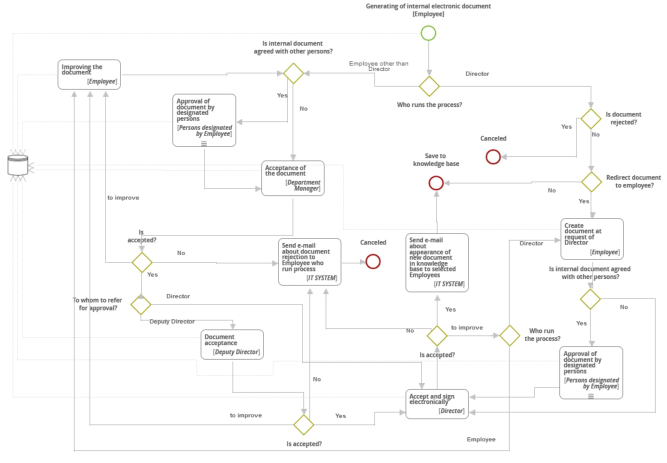
process. He has the option to create a document on his own initiative or upon the request of the Director. In the case of creating a document at the request of the Director, after completing the creation of the document, it is sent for approval by the Museum Director. After creating the document on his own initiative, he sends it for approval by the Head of the Depart- ment. He is responsible for making corrections to the document. The director may start the internal document circulation process. He can create, sign and approve the document himself, and then add it to the knowledge base. It can also start the document circulation process and commission the employee to create the document. After creating the document by the Employee, he is responsible for accepting the document. It has the option of accepting, reject- ing, or directing the document for correction. After accepting the document, he signs it electronically. Only his signature on the document makes the letter valid. The Deputy Director is responsible for verifying the document created by the Employee after prior approval by the Manager. They can accept the document and refer it to the Museum Director for approval, reject it or refer it to an Employee for correction. The Department Manager is responsible for verifying the correctness of the document created by the Employee. If he accepts the document, he passes it on to the Deputy, Deputy Museum Direc- tors or the Museum Director for approval. He has the option of rejecting the document or referring it to be corrected by the Employee. Persons designated by the Employee Persons designated by the employee creating the document have the ability to edit the created document and the obligation to approve the data if they do not introduce changes. In the registers, everyone can see internal documents created by the relevant employees.
In Fig. 1. a business process constructed for the case of internal electronic documents flow in an organization was shown.
Figure 1: Business process of internal electronic documents flow (source: own study).
Simulation Studies in a Low-Code Development Platform for Improving 313
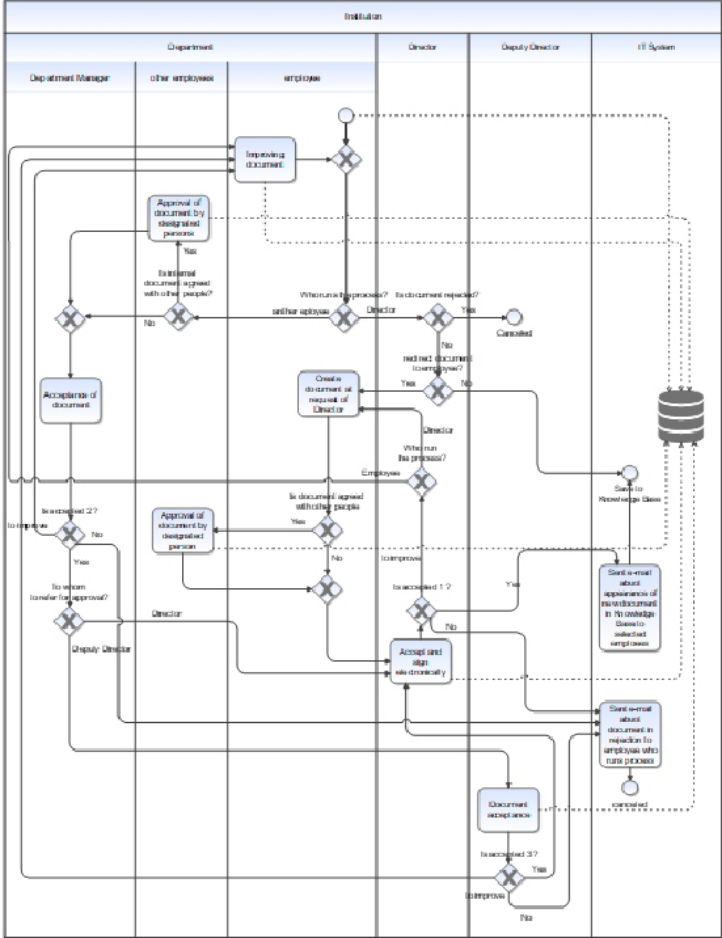
IMPLEMENTATION OF A BUSINESS PROCESS IN THE LOW-CODE ENVIRONMENT To simulate the business process relating to internal electronic documents flow, this process can be implemented in the iGrafx environment, which is a low-code type system. This process made in iGrafx environment is shown in Fig. 2.
Figure 2: Business process of internal electronic documents flow in Low-code platform (source: own study).
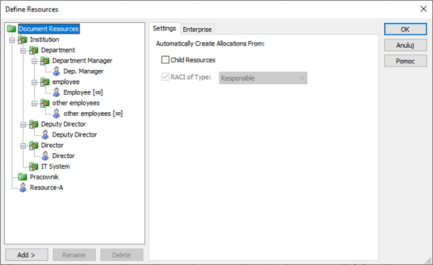
For the process implemented in the iGrafx environment, a few data nec- essary to run a computer simulation of the process functioning must be declared. The structure of a part of the organization corresponding to internal electronic documents flow in the organization was established. This structure is shown in Fig. 3.
Figure 3: The structure and resources of business process related to internal electronic documents flow in iGrafx platform (source: own study).
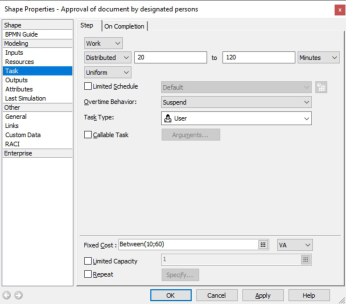
For all tasks (activities) in business process we can define their random performance characteristics: time and cost (Fig. 4).
Figure 4: Random performance characteristics for business process of internal elec- tronic documents flow in iGrafx platform (source: own study).
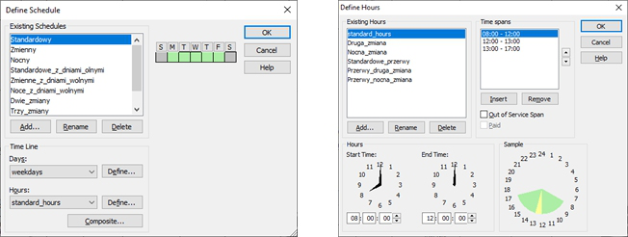
Each of the people shown in the organization structure has a fixed work schedule. We can determine the hourly scope of work of people participating in the process of documentation circulation in the organization by planning their actual working hours, lunch breaks, other breaks, etc. The method of planning the work schedule is shown in in Fig. 5.
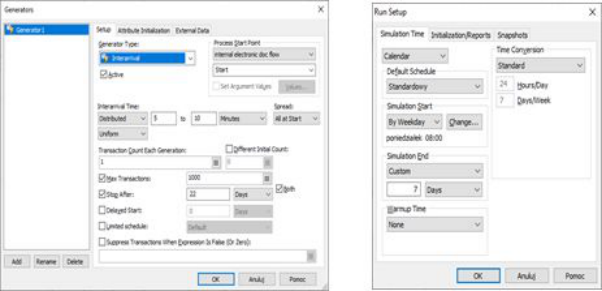
It is necessary to specify the flow of electronic documents The charac- teristics of internal electronic documents flow must be determined. The
Simulation Studies in a Low-Code Development Platform for Improving 315
parameters of internal electronic documents flow generator are shown in Fig. 6.
Figure 5: Time schedule for employees in business process related to internal elec- tronic documents flow in iGrafx platform (source: own study).Figure 6: Characteristics of internal electronic documents flow in iGrafx platform (source: own study).
RESULTS OF SIMULATION EXPERIMENTS As a result of the simulation experiments, several interesting combinations related to the process of internal electronic documents flow were obtained. You can show statistics relating to the execution times of various types of activities (Tab. 1).
Similarly, statistical collective characteristics relating to various activities are recorded (Tab. 2).
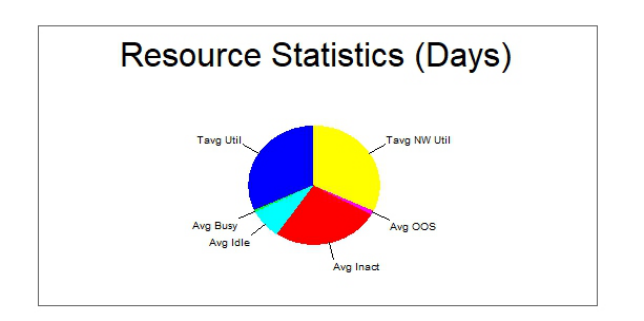
It is also important to show the characteristics related to individual resources in the model. Several properties of the processes of using these resources in the process of electronic circulation of documents can be shown (Tab. 3).
This type of characteristics can also be shown in the form of various types of pie (Fig. 7).
Table 1. Statistics relating to the execution times of various types of activities in the iGrafx environment (source: own study).
Table available in the original PDF paper.
Transaction Statistics (Hours) Count Avg Cycle Avg Work Avg Wait Avg Res Wait Avg Block
Table 2. Aggregate characteristics for various activities in the iGrafx environment (source: own study).
Table available in the original PDF paper.
Activity Statistics (Hours) (15 of 26 rows) Count Avg Cycle Avg Work Avg Wait Avg Serv
1402 0,06 0,06 0 0,06
Institution/Department/employee - 1403 0 0 0 0 Institution/Department/employee - Who runs the process?
981 0,06 0,06 0 0,06
Institution/Department/employee - 1352 0 0 0 0 Institution/Department/other employees - Is internal document agreed with other people?
710 0 0 0 0
Institution/Department/Department Manager -
465 6,17 1,16 5 1,16
Institution/Department/other employees - Approval of document by designated persons
238 28,9 0,16 29 10,3
Institution/Director - Is document rejected? 421 0,06 0,06 0 0,06 Institution/Department/Department Manager - Acceptance of document
238 0,06 0,06 0 0,06
Institution/Department/Department Manager - Is accepted 2 ?
210 0,06 0,06 0 0,06
Institution/Deputy Director – Canceled 211 0 0 0 0 Institution/Director - redirect document to employee?
202 0 0 0 0
Institution/IT System - Save to Knowledge Base
143 0,06 0,06 0 0,06
Institution/Department/Department Manager - To whom to refer for approval?
134 0,02 0,01 <0,01 0,01
Institution/IT System - Sent e-mail abuot document in rejection to employee who runs process Institution/IT System - canceled 134 0 0 0 0
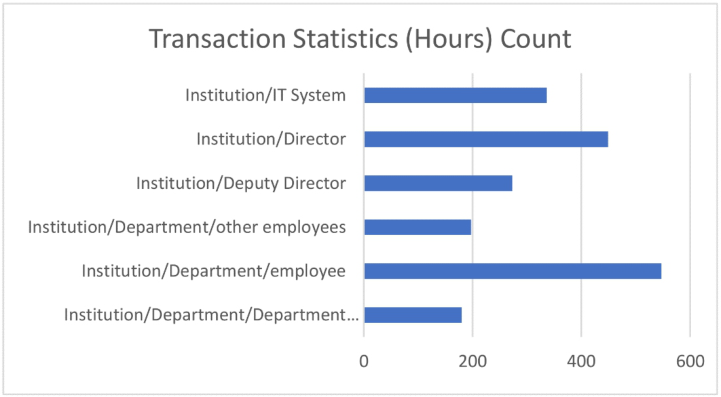
We can also show several other aggregate statistics relating to the activities in the process of internal electronic documents flow. Such a summary in the form of a bar chart is shown in Fig. 8.
Simulation Studies in a Low-Code Development Platform for Improving 317
Table 3. The degree of resources usage in process in the iGrafx environment (source: own study).
Figure 7: Aggregated resources characteristics in iGrafx platform (source: own study).Figure 8: The chart of internal electronic documents flow time characteristics (source: own study).
CONCLUSION
The article shows how to model and simulate the process describing the flow of internal electronic documents in the organization. The process was pre- sented in the form of a business process. The constructed process and its equivalent in the Low-code environment allow for simulating the functioning of the internal electronic documents flow process and obtaining results for various values adopted in the model of characteristics. This gives the oppor- tunity to examine the properties of flow of internal electronic documents, find bottlenecks, lack of appropriate resources, etc.
An interesting aspect of the application of business process modeling and computer simulation in the Low-code environment to determine the charac- teristics of a real process was shown. The natural consequence of this is the constant development of the model in the organization and the implemen- tation of subsequent modifications of the process to obtain the appropriate values of its efficiency indicators.
ACKNOWLEDGMENT
The work was financed by the Military University of Technology in Poland, as part of the project No. UGB 810/2023.
REFERENCES
Dirk F., Favre C., Jobstmann B., Koehler J., Lohmann N., Völzer H., Wolf K. (2009).
Instantaneous soundness checking of industrial business process models, 7th Int. Conference on Business Process Management, Springer LNCS 5701, pp. 278–293. Dudek, A., Patalas-Maliszewska, J. (2016). A Model of a Tacit Knowledge Transformation for the Service Department in a Manufacturing Company: A Case Study. Found. Manag. 8, 175–188. https://doi.org/10.1515/FMAN-2016-0014 Jasiulewicz-Kaczmarek M., Waszkowski R., Piechowski M., Wyczółkowski R. (2018). Implementing BPMN in maintenance process modeling, in Information Systems Architecture and Technology: Proceedings of 38th International Confer- ence on Information Systems Architecture and Technology ISAT’2017: Part II, 2018, pp. 300–309. Jonkers H., Franken H. M. (1996). Quantitative modeling and analysis of business
processes, Simulation in Industry, 8th European Simulation Symposium, vol. I, pp.175–179. Kiedrowicz M., Nowicki T., Waszkowski R (2016). Business process data flow between automated and human tasks, in 3rd International Conference on Social Science (ICSS’2016), pp. 9–11. Kiedrowicz M., Nowicki T., Waszkowski R. Worwa K. (2017a). Customer service processes automation in administrative office with RFID tagged documents, 4th International Conference on Mathematics and Comput- ers in Sciences and Industry, Corfu, Greece IEEE 978-1-5386-2820-1/17, https://doi.org/10.1109/MCSI.2017.47 Kiedrowicz M., Nowicki T., Waszkowski R. Worwa K. (2017b). Access control man-
agement in administrative office with RFID tagged documents, 4’th International Conference on Mathematics and Computers in Sciences and Industry, Corfu, Greece, IEEE 978-1-5386-2820-1/17, https://doi.org/10.1109/MCSI.2017.48
Simulation Studies in a Low-Code Development Platform for Improving 319
Mrugalski, M., Arinton, E., Korbicz, J. (2003). Dynamic GMDH Type Neural Networks. Neural Netw. Soft Comput. 698–703. https://doi.org/10.1007/978-3- 7908-1902-1_108 Mrugalski, M., Korbicz, J. (2007). Least mean square vs. outer bounding ellipsoid
algorithm in confidence estimation of the GMDH neural networks. Lect. Notes Comput. Sci. Subser. Lect. Notes Artif. Intell. Lect. Notes Bioinforma. 4432 LNCS, 19–26. https://doi.org/10.1007/978-3-540-71629-7_3/COVER Nowicki T., Saniuk A., Waszkowski R. (2019). Clothing distribution optimization for the rental company warehouse, in. Advances in Social and Occu- pational Ergonomics, Springer International Publishing AG, part of Springer Nature, R. H. M. Goossens (Ed.): AHFE 2018, AISC 792, pp. 1–12, 2019, https://doi.org/0.1007/978-3-319-94000-7_39 Patalas-Maliszewska, J., Krebs, I. (2015). Decision model for the use of the applica-
tion for knowledge transfer support in manufacturing enterprises. Lect. Notes Bus. Inf. Process. 228, 48–55. https://doi.org/10.1007/978-3-319-26762-3_5/COVER Patalas-Maliszewska, J., Łosyk, H. (2020). An Approach to Assessing Sustainability in the Development of a Manufacturing Company. Sustain. 2020 Vol. 12 Page 8787 12, 8787. https://doi.org/10.3390/SU12218787 Pazera, M., Buciakowski, M., Witczak, M., Mrugalski, M. (2020). A quadratic
boundedness approach to a neural network-based simultaneous estima- tion of actuator and sensor faults. Neural Comput. Appl. 32, 379–389. https://doi.org/10.1007/S00521-018-3706-8/FIGURES/9 Wang J., Zhu J., Liang H. (2005). Aspect-Oriented Business Process Modeling, IBM Research Report, Beijing, China. Waszkowski R., Nowicki T. (2012). Modeling, and characteristics investigation
of warehouse business processes in a clothes Clean&Rental Company, Inno- vation management and information technology impact on global economy in the era of pandemic. Procedings of the 37th International Business Information Management Association Conference (IBIMA). Waszkowski R., Kowalski A. (2017). Comparative analysis of business process management frameworks, in Proceedings of the 30th International Business Informa- tion Management Association Conference IBIMA’2017 - Vision 2020: Sustainable Economic development, Innovation Management, and Global Growth. Waszkowski R., Nowicki T., Worwa K. (2018). Corporate efficiency improvement
with business process automation, in MATEC web of conferences. Waszkowski R. (2019). Low-code platform for automating business processes in manufacturing, in IFAC-PapersOnLine, Elsevier B. V., pp. 376–381. DOI: 10.1016/j.ifacol.2019.10.060. Waszkowski R., Nowicki T. (2020). Efficiency investigation and optimization of con-
tract management business processes in a workwear rental and laundry service company, Procedia Manuf, vol. 44, pp. 551–558. Waszkowski R., Nowicki T. (2021). The low-code methodology in the design of a simulation exercise support system for sanitary services, Innovation Management and Sustainable Economic Development in the Era of Global Pandemic, Pro- ceedings of the 38th International Business Information Management Association Conference (IBIMA), Seville, Spain. Waszkowski R., Bocewicz G. (2022). Visibility Matrix: Efficient User Interface
Modelling for Low-Code Development Platforms, Sustainability 2022, Vol. 14, Page 8103, vol. 14, no. 13, p. 8103, DOI: 10.3390/SU14138103.
Waszkowski, R. (2022). Low-code Development Platform for Business Process Automation: Aurea BPM. Presented at the Production Management and Process Control, AHFE International. https://doi.org/10.54941/ahfe1001633 Witczak, M., Mrugalski, M., Pazera, M., Kukurowski, N., 2020. Fault diagnosis
of an automated guided vehicle with torque and motion forces estimation: A case study. ISA Trans. 104, 370–381. https://doi.org/10.1016/J.~ISATRA.2020.05.012
LISTED IN THE AHFE DIGITAL BOOKSTORE CATALOGUE
Explore the complete digital volume
Application of Emerging Technologies
Read this individual research paper free through the original publisher, or explore the full digital proceedings book.
ISBN 978-1-958651-91-9
Explore this ISBN in the AHFE Bookstore ↗Listed in the July 2026 bookstore catalogue; search by ISBN to confirm current availability · Digital book purchase optional