Diya Suresh Nair, Min Kang (2026). Knowledge Navigated and Organized Together(KNOT): An AI-Integrated System Design for Enhanced Collaborative Learning in Higher Education. In: Interdisciplinary Practice in Industrial Design. AHFE Open Access, vol. 222, pp. 265–275. https://doi.org/10.54941/ahfe1007765
Collaborative learning in higher education is often hindered by the cognitive overhead of administrative tasks and fragmented, passive digital tools. This research introduces KNOT, a proactive AI-driven system designed to serve as an integrated facilitator, administrator, and tutor for student study groups. Utilizing a multi-phase human-centered design approach, we conducted ethnographic observations (5 sessions, 15 hours), surveys (N=54), and semi-structured interviews (N=6) with undergraduate STEM students. The research identified four primary challenges: administrative friction, conceptual deadlocks, lack of group synchronicity, and dependence on scarce physical resources. In response, we developed and prototyped the KNOT ecosystem, featuring automated scheduling, AI-powered Socratic tutoring, interactive content synthesis, and personalized learning paths. User testing (N=5) validated that KNOT successfully offloads logistical burdens, with participants reporting improvement in their ability to focus their cognitive energy on learning. The AI tutor effectively guided groups through conceptual roadblocks without replacing human critical thinking. Furthermore, the integration of interactive study aids and gamified features directly mitigated focus loss, a primary challenge identified by 48% of surveyed students. KNOT demonstrates how an adaptive AI can seamlessly organize, enhance, and support collaborative learning.
The motivation for this research stems from a specific design inquiry into the changing nature of academic workspaces. The initial design project was aimed at re-imagining the university work environment, where preliminary ethnographic observations were conducted in a campus library as well as other co-working spaces on campus. These observations revealed a striking pattern: the library was not merely an area for books, but a vibrant, chaotic hub for group collaboration. Observations revealed that students, despite demonstrated academic competence, were consistently hindered by administrative overhead. Valuable cognitive energy was being expended on syncing calendars, searching for digital assets, and navigating awkward Received April 30, 2026; Revised June 3, 2026; Accepted June 23, 2026; Available online July 20, 2026
266 Nair and Kang silences during conceptual deadlocks. It became evident that while students were physically together, they lacked a supportive infrastructure to facilitate the process of collaboration.
This research addresses two central questions: (1) How can AI reduce coordination costs in collaborative learning without diminishing the benefits of peer interaction? (2) What design features enable AI agents to function as effective facilitators rather than passive tools?
This paper details the research-driven design process behind KNOT. We first situate the project within the academic frameworks of Computer- Supported Collaborative Learning (CSCL) and AI in Education (AIEd). We then present the findings of our user research, which defined the system’s core requirements. Finally, we describe the KNOT system architecture and present the results of a usability evaluation, demonstrating how a proactive, socially aware AI agent can shift the focus of group study from logistics back to learning.
Literature Review
KNOT is situated within the field of Computer-Supported Collaborative Learning (CSCL), which studies how technology can mediate and support the building of shared knowledge. Unlike cooperative learning, which often involves dividing tasks among individuals, CSCL focuses on the “mutual engagement of participants in a coordinated effort to solve the problem together” (Stahl, Koschmann & Suthers, 2014). However, the literature consistently identifies two structural failure modes in unsupported collaborative groups:
Effective collaboration imposes a high cognitive load related to scheduling, role allocation, and workflow management. Stahl (2014) argues that these “coordination costs” often overwhelm the learning task itself, transforming potential academic gains into logistical burdens.
A pervasive issue in group work is unequal participation or low group participation. The challenge of regulating collaborative efforts can often inhibit the effectiveness of CSCL.
KNOT addresses these fundamental CSCL challenges by offloading coordination costs to an automated agent, releasing cognitive resources for content mastery. KNOT’s system also emphasizes the importance of preparatory, real-time, and post learning support, encouraging students to stay engaged and contribute more regularly when collaborating.
Intelligent Tutoring Systems (ITS) have a strong record of efficacy in education. Currently, the primary strength of ITS is providing individualized instruction and personalized feedback, mimicking the role of one-on- one tutoring. Human tutoring already shows improvement in student performances, and ITS provides a scalable way to offer similar levels of personalized support. It is important to note that most ITS are designed for individual use, creating a gap for incorporation within collaborative environments (Zerkouk et al., 2025). However, some specialized applications of ITS have begun to address group dynamics:
Team-Based Problem Solving: In industrial settings, systems like STEAMER utilize collaborative Virtual Reality (VR) to enhance vehicle diagnostics and improve team-based problem-solving skills (Zerkouk et al., 2025).
Human-AI Collaboration: Current literature emphasizes that the most effective systems will likely involve a collaboration that emphasizes the human role in motivation, guidance, and socio-emotional support alongside AI’s operational and feedback functions (Lin et al., 2025).
KNOT bridges this gap by transitioning from individual-focused ITS to group-oriented support systems. It aims to redefine the role of AI from one- on-one support to a group support system.
There are general-purpose tools that are universal across higher education, but they remain “passive” technologies that provide connectivity but not guidance.
Google Docs: While Google Docs makes unequal participation visible, it does not address it, leading to no performance improvement because it is not paired with structured supporting interventions.
Discord: Widely adopted for its community features, Discord poses significant challenges for academic focus. Its environment is not strictly academic and has a casual feel, facing students with cognitive overload (balancing academic and personal lives on one service) and distractions from the sheer volume of content displayed.
Notion: As an “all-in-one” workspace, Notion offers flexibility but imposes the high “coordination costs” described by Stahl (2014). The requirement for students to manually build and maintain their own organizational systems (pages, databases, trackers) adds a layer of work that competes with actual study time, often leading to tool abandonment or fragmented workflows.
While there are digital tools that help with planning, sharing, and searching for/during study sessions, they often digitize the logistical challenges rather than alleviating them, making students rely on a fragmented system of different applications rather than a system that adapts to their wants and needs.
Methodology and Results This research utilized the Product Experience Design (PXD) framework, a methodology that prioritizes the definition of a desired user experience before the development of physical or digital products. Within a PXD framework, a systems-level integration is key, where the physical device, digital interface, and artificial intelligence emerge as a unified solution to specific user needs. The research followed a structured three-phase iterative process: (1) Experience Analysis (Empathize & Define), (2) System Integration (Ideate & Design), and (3) Product Experience Evaluation (Prototype & Test).
268 Nair and Kang Phase (1): To define the ideal group study experience, a mixed-methods study comprised of ethnographic observations, surveys, and semi-structured interviews was conducted. The objective was to identify the structural “frictions” in collaborative learning and fully understand the user’s current state, needs, wants, and goals to design a system driven by the user for the user.
The ethnographic observations consisted of 5 group study sessions totalling 15 hours across 4.5 weeks, to learn how a study group functions and identify naturally occurring breakdowns, inefficiencies, and general pain points related to their collaborative study. Sessions involved 3-6 students, each from engineering and natural sciences. The students’ collaborative studying was shown to be hindered by obstacles such as administrative friction, struggling to stay productive/engaged, and going in circles over a singular concept for much too long. These observations sparked the central question: how could an intelligent systems design intervene to absorb these obstacles?
A total of 54 students, ranging from undergraduates 85% to graduate students 15%, were surveyed to identify general areas of friction and to validate the need for a group study intervention identified during the ethnographic observations. It was found that 49% of students struggle to stay focused and engaged, with many commenting that staying on task in a group is difficult. To better understand collaborative study, students were asked what study methods were typically used in group study: 63% said reviewing notes together, 68% said solving practice problems together, and 30% said quiz-style studying. To further define the scenarios, interviews were conducted with 6 undergraduate STEM students from the University of Houston who consistently participate in group study, recruited during the initial ethnographic observation at the library. A junior mechanical engineering student stated, “Finding a balance between prioritizing time to study and socializing. Keeping track of time is hard because it goes by really fast when studying with a group.” A senior majoring in psychology discussed about individual support within the collaborative study sphere: “Sometimes I’ve been in situations where it’s hard to keep up with people who know much more about a topic, and you get brushed past because there isn’t always time to be spoon-fed the info. So it’s not the most inclusive to different levels of understanding.” Overall, the data collected from observations, surveys, and interviews confirmed a consistent set of challenges associated with the group study experience: administrative friction, conceptual deadlocks, and lack of group synchronicity. A significant portion of students’ cognitive energy is spent on logistics rather than learning. This analysis provides a clear mandate for a design intervention focused on absorbing these logistical burdens to liberate cognitive energy for the primary task of learning.
Phase (2): The initial research, along with ongoing conversations conducted during phase (1), informed the creation of a system that included a physical and digital learning system crafted to support students’ education in higher education. The initial iteration included a digital whiteboard that would sync with everyone’s personal device, as well as screens that were used for quiz games and timers to keep students engaged and on task. The digital product
KNOT (Knowledge Navigated and Organized Together): An AI-Integrated System Design 269 was meant to facilitate information sharing between students in a study group. Allowing them to share notes on one easy-to-access platform, access their collaborative work, and make it easier to find and generate content for them to review. While this was a start of creating an ideal system for collaborative study, there was much more room for this product to expand, which led to the next iterations, extended research, and creating a framework for the next round of ideation and design.
The significant logistical and cognitive strains that come with collaborative study can hinder the ability to fully experience the benefits. Higher education students, already juggling attending classes, demanding coursework, and personal commitments, face a consistent struggle with coordinating schedules, curating relevant study materials, creating an engaging study environment, and making sure everyone is staying up to pace with the material covered. This administrative friction causes a large portion of the study time and energy to be spent organizing the study session rather than learning.
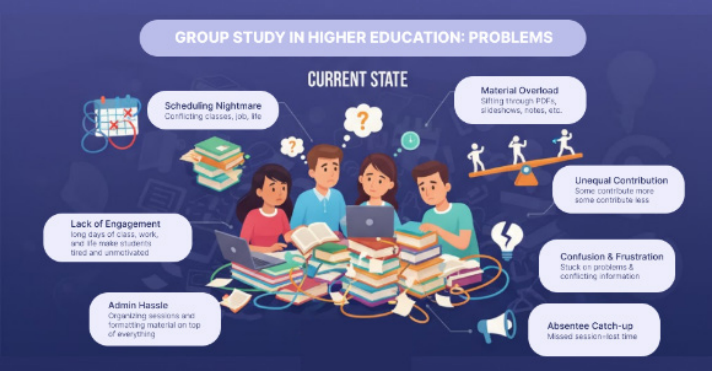
To expand even further, even when a study group can organize the logistics of a study session, they can encounter blocks to success. Complex problems often come with shared confusion amongst group members, which can bring learning to a halt, especially with limited access to professors and teaching assistants. This results in students wasting time circling the same problems for extended periods of time or also engaging in inefficient internet searches that may provide unreliable or unhelpful information. While there are digital tools that exist to help with planning, sharing, and searching for/during study sessions, they often digitize the logistic challenges rather than alleviating them, making students rely on a fragmented system of different applications, rather than providing them with a system that adapts to their wants and needs. Figure 1 illustrates the fragmented digital ecosystem currently used by students. As shown, students navigate between 4–6 different tools, creating cognitive overhead and context-switching costs that directly impede learning.
Figure 1: Current state of group study infographic.
270 Nair and Kang Simultaneous advancements in Large Language Models (LLMs) are signalling a shift toward proactive, multimodal assistants capable of processing diverse sensory inputs (text, audio, and vision) to support learning in real time (Kasneci et al., 2023). In the educational domain, the use of AI is well-established, meta-analyses of Intelligent Tutoring Systems (ITS) have consistently demonstrated that AI-driven, one-on-one instruction can significantly improve student achievement outcomes compared to traditional classroom methods (Kulik & Fletcher, 2016).
Beyond general instruction, a primary benefit of these emerging systems is their capacity for adaptive personalization. Unlike static learning management systems, modern AI can dynamically customize the scope, sequence, and difficulty of learning materials to match individual student profiles (Walkington & Bernacki, 2014). Furthermore, the integration of Educational Data Mining (EDM) allows these systems to analyze vast quantities of interaction data, providing “actionable insights” that support informed educational decision-making (Romero & Ventura, 2010). Finally, Generative AI is fundamentally reshaping day-to-day academic workflows. By automating cognitive scaffolding tasks such as generating lecture summaries, transforming notes into structured diagrams, and serving as in-meeting assistants, AI systems are increasingly designed to adapt to users’ natural workflows, reducing the cognitive load associated with managing complex digital environments (Baidoo-Anu & Owusu Ansah, 2023).
From extensive research of existing AI models and applications, it was crucial to understand how the AI agent in KNOT could drive a solution in a collaborative study that could enhance the learning experience. Using the entire collection of research, data, and observations, hypotheses for the AI agent were formed, driven by empathy for students and the desire to create a tool that brings the focus back to learning, not logistics. The central hypothesis of this research is that an AI agent can significantly reduce the cognitive load associated with the logistics of group study, thereby freeing students to devote their mental resources to content mastery and collaborative problem- solving. To test this, we propose three dimensions of AI intervention:
1) Administrative Scaffolding (Reducing Friction) The agent is hypothesized to function as an automated operational manager. This includes:
Logistical Automation: Handling scheduling, sending reminders, and creating shared digital workspaces to eliminate “coordination costs.”
Asynchronous Continuity: Supporting absent members by generating automated summaries, key decision logs, and interactive catch-up sessions to ensure no student falls behind due to scheduling conflicts.
2) Pedagogical Augmentation (Deepening Understanding) The agent is hypothesized to act as a “Socio-cognitive Teammate” that enhances, rather than replaces, peer discussion. This includes:
Real-Time Tutoring: Identifying conceptual errors, explaining difficult topics, and generating on-demand diagrams to resolve “stuck points” without providing the answers directly.
Feedback & Assessment: Monitoring participation patterns to encourage balanced collaboration and providing real-time feedback on the clarity and depth of contributions.
Personalized Learning Paths: Tracking individual progress within the group context to ensure that students with different strengths remain engaged and supported.
3) Engagement & Resource Transformation (Sustaining Focus) The agent is hypothesized to transform the study environment to maintain high energy levels. This includes:
Material Synthesis: Instantly transforming raw notes or dense academic texts into interactive infographics, quizzes, or audio summaries to promote active review.
Gamified Learning: Introducing timed challenges, flashcard battles, and debate modes to combat fatigue and improve motivation during long sessions.
To evaluate these hypotheses, we conducted semi-structured interviews with undergraduate students in STEM disciplines who engage in weekly group study. The qualitative data yielded consistent enthusiasm for the agent’s role as an organizer and facilitator, while highlighting important nuances in user trust.
Participants strongly validated the need for logistical automation. Leah, a senior Psychology major, noted that the poor organization of existing platforms often hinders visual learning and review. The proposed features for resource curation and absent member support were universally welcomed, with participants confirming that current workflows involve simply “sending notes” to absent peers without providing necessary context, a gap the agent’s “catch-up” feature would effectively close. There was immense support for the agent acting as a tutor, specifically to overcome comprehension roadblocks. However, participants emphasized a critical distinction: the agent must support learning, not replace it. An Industrial Engineering student noted that simply finding an answer online bypasses the “critical thinking process,” whereas an agent that guides the group through the solution. The hypothesis regarding real-time feedback received mixed responses. While some acknowledged its value for accountability, others expressed concerns about privacy and the fairness of judging peer-teaching roles in real time. Jordan, a junior Biomedical Engineering major, strongly endorsed personalized learning paths, stating, “Having that kind of model where you can see your personal progress can help motivate you to catch up to the group. Participants validated the hypothesis that energy management is a major struggle, citing frequent “low energy sessions” where groups stare blankly at daunting material. The proposed gamification and interactive study aids were seen as high-value interventions to break this monotony and re-engage the group.
Phase (3): Based on these findings, KNOT was designed to integrate AI technology with these core principles in mind: reduce cognitive overhead, provide in-time support, and foster deeper engagement. It is a connected ecosystem that takes care of all your group study needs.
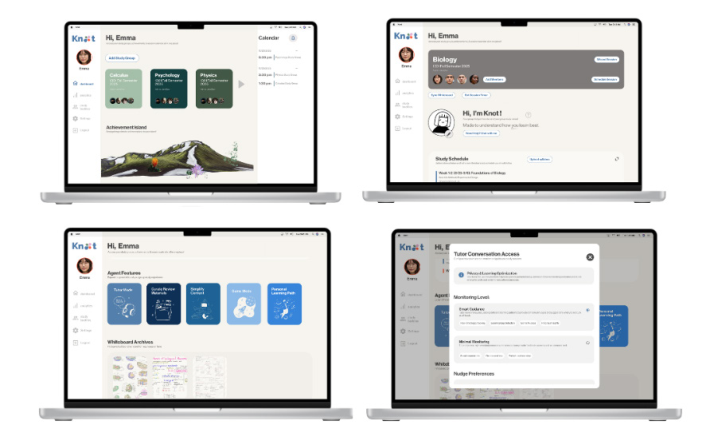
272 Nair and Kang We created personas for Emma and her study group and developed in-depth scenarios that showcased the value each feature brings to the study group experience. The following scenarios, developed using a functional prototype, illustrate these principles in action. The first scenario allows group members a seamless session scheduling experience by allowing students to synchronize their calendars and authorize the AI agent to find a suitable time slot for them to meet.
The system also integrates an AI tutor that gently nudges them in the right direction in moments of struggle. It doesn’t give the answer, but the Socratic nudge helps the group resolve the “stuck point” without undermining the collaborative problem-solving process. The agent is also able to do on-demand content synthesis.
With so many lecture notes, slides, readings, and additional material, it can be overwhelming and difficult to approach. The agent is able to scan all the files and identify key concepts to generate review content, as well as use inputted content in addition to group discussion to create engaging review games to stay engaged.
KNOT recognizes that group learning goes beyond the group sessions and that for group sessions to be successful, individual study must also be supported. That is why the AI agent is able to analyze your progress, your strengths, and weaknesses to create personalized learning paths meant to keep you on track.
This system also considers students who miss a session, the agent making it easy for them to catch up without putting any extra strain on their other group members. The agent will analyze group discussion, collaboration, and overall study topics to create a missed recap for the missing group member, allowing them to catch up with ease.
User Testing and Iterative Refinement: To evaluate KNOT’s real-world impact on collaborative learning, we conducted user testing with higher- education students. 6 undergraduate students (6 STEM) participated in usability testing. Participants completed 4 task scenarios: (1) scheduling a session, (2) using an AI tutor, (3) generating quiz content, (4) reviewing a session recap. Sessions lasted 45 minutes and combined the think-aloud protocol with post-test interviews. The foundational response was highly positive: participants validated the platform’s comprehensive, clutter-free design and specifically praised the AI agent as an effective, unobtrusive “hybrid” of automated support and student-led study.
Crucially, the testing phase yielded actionable insights that provide a clear, user-driven roadmap for refining the solution. Based on this feedback, the next iteration of KNOT will implement the following improvements:
Interface Optimization: To improve visibility and align with established UX mental models, we will adjust the visual hierarchy by enlarging subheadings and creating a stronger visual distinction for primary actions, such as the “Sync Whiteboard” button. Additionally, the chat interface will be relocated to the conventional bottom-right corner.
Workflow Integration: To reduce navigational friction, the study schedule will be upgraded so that calendar text links directly to the relevant course materials for that week’s session.
Feature Expansion: To better bridge the gap between group collaboration and individual preparation, future builds will integrate a personal task calendar and a mind-mapping tool, giving users more ways to visualize and organize their personal study goals within the shared ecosystem.
Overall, the testing confirmed KNOT’s core value while explicitly defining the necessary UI adjustments and personalization features required to elevate the final product.
Figure 2: Initial key screens in UI.
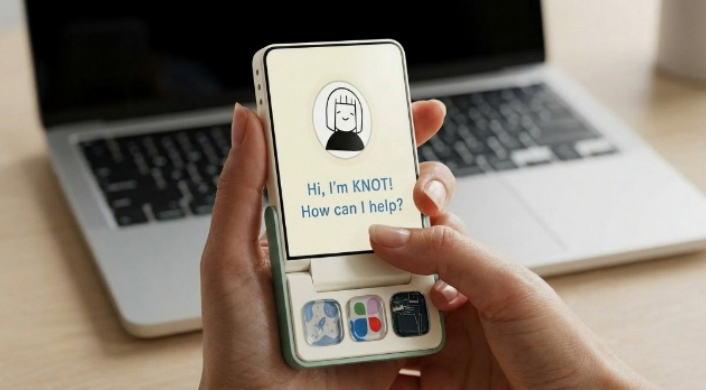
Hardware Design The physical counterpart to the KNOT digital ecosystem is a personal, multi- articulated device that serves as the sensory and interactive bridge for the AI agent. Designed to transition seamlessly between solo and collaborative environments, the hardware architecture is defined by its physical adaptability and context-aware interface.
Configurable Form Factor: To accommodate the fluid ergonomic needs of student study habits, the Node features a multi-hinged, folding architecture. This allows the device to physically morph into distinct functional postures.
Adaptive OLED Interface: The base is equipped with three programmable OLED screen buttons. Forgoing static hardware keys, these dynamic screens alter their iconography, color, and functionality based entirely on the device’s physical orientation and the active digital scenario. During
274 Nair and Kang individual study, the buttons may display a support button, and during a collaborative gamified review, they transform into color-coded quiz buzzers.
Ambient Visual Feedback: The edges incorporate an LED light strip to provide ambient cues, such as a soft, breathing light to indicate active “Focus Mode” or color-syncing to denote team affiliations during group activities.
Distributed Mesh Networking: When multiple devices are brought into proximity on a shared table, they automatically connect via proximity sensors. This synchronizes the individual devices into a unified, distributed 360-degree microphone. This hardware integration is critical for the AI agent, as it enables the agent to identify exactly who is speaking and to capture audio equitably, regardless of where a student is sitting.
By combining a shape-shifting physical form with a dynamic digital interface, the Node transforms from a passive learning accessory into an active, context-aware companion that physically embodies the AI agent within the student’s workspace.
CONCLUSION
Collaborative learning is often hindered by the logistical friction of passive digital tools. This research introduces KNOT, a proactive AI ecosystem designed to resolve these inefficiencies. By combining a configurable physical device with a multimodal AI agent, KNOT acts as an active socio-cognitive facilitator. User evaluations confirmed that KNOT successfully automates administrative tasks, provides Socratic scaffolding, and sustains group focus without replacing peer-to-peer critical thinking. While initial results show high usability, future work involves a longitudinal study to measure sustained
KNOT (Knowledge Navigated and Organized Together): An AI-Integrated System Design 275 impacts on academic performance, proving the value of intelligent, unified educational ecosystems.
Limitations: This study focused on STEM students at a single university, and user testing evaluated short-term usability for design concept development rather than longitudinal learning outcomes. Future work will address these limitations through longer deployment studies measuring academic performance metrics and cross-institutional testing across diverse disciplines.
Theoretical Contribution: KNOT advances CSCL theory by demonstrating that AI agents can mitigate coordination costs without diminishing collaborative learning benefits, and by proposing a “socio-cognitive teammate” model where AI actively facilitates rather than merely provides infrastructure.
ACKNOWLEDGMENT
The authors would like to acknowledge the PXD LAB at the University of Houston for supporting this research study and design.
REFERENCES
Baidoo-Anu, D. & Owusu Ansah, L. (2023). Education in the Era of Generative Artificial Intelligence (AI): Understanding the Potential Benefits of ChatGPT in Promoting Teaching and Learning. Journal of AI, 7(1), pp. 52–62. Kasneci, E., Sessler, K., Küchemann, S., Bannert, M., Dementieva, D., Fischer, F.,
Gasser, U., Groh, G., Günnemann, S., Hüllermeier, E. & Krusche, S. (2023). ChatGPT for good? On opportunities and challenges of large language models for education. Learning and Individual Differences, 103, p. 102274. Kulik, J.A. & Fletcher, J.D. (2016). Effectiveness of Intelligent Tutoring Systems: A Meta-Analytic Review. Review of Educational Research, 86(1), pp. 42–78. Lin, C.-P. and Chen, P.-C. (2025) ‘Mentoring for effective human-AI collaboration:
an integrated theoretical framework’, Total Quality Management & Business Excellence, 36(9-10), pp. 1062–1076. Romero, C. & Ventura, S. (2010). Educational Data Mining: A Review of the State of the Art. IEEE Transactions on Systems, Man, and Cybernetics, Part C (Applications and Reviews), 40(6), pp. 601–618 Stahl, G., Koschmann, T. & Suthers, D. (2014). Computer-supported collaborative
learning: An historical perspective. Cambridge handbook of the learning sciences, 2006, 409–426Walkington, C.A. & Bernacki, M.L. (2014). Motivating Students by “Personalizing” Learning around Individual Interests: A Consideration of Theory, Design, and Implementation Challenges. Advances in Motivation and Achievement, 18, pp. 139–176. Zerkouk, M., Mihoubi, M. and Chikhaoui, B. (2025) ‘A Comprehensive Review
of AI-based Intelligent Tutoring Systems: Applications and Challenges’, arXiv preprint arXiv:2507.18882.
LISTED IN THE AHFE DIGITAL BOOKSTORE CATALOGUE
Explore the complete digital volume
Interdisciplinary Practice in Industrial Design
Read this individual research paper free through the original publisher, or explore the full digital proceedings book.
ISBN 978-1-964867-98-4
Explore this ISBN in the AHFE Bookstore ↗Listed in the July 2026 bookstore catalogue; search by ISBN to confirm current availability · Digital book purchase optional