Ozlem Ozden Tunca, Ayse Altunkaya Erdogmus, Betul Sahin (2026). Psychological Resilience and Academic Burnout: Serial Mediation of Cognitive Flexibility and Emotion Regulation in University Students. In: Neuroergonomics and Cognitive Engineering. AHFE Open Access, vol. 207, pp. 87–97. https://doi.org/10.54941/ahfe1007398
University life represents a significant transitional period for an individual's academic, social, and psychological development. During this period, students face multifaceted stressors such as increasing academic demands, future uncertainty, performance pressure, and psychosocial adjustment requirements. Prolonged and intense exposure to these stressors increases the risk of academic burnout in university students, potentially leading to negative consequences not only on academic performance but also on mental health and psychological well-being. In this context, identifying the psychological processes that play a protective role against burnout emerges as an important need.This research aims not only to consider academic burnout as an outcome variable, but also to explain how psychological resilience influences academic burnout through various cognitive and emotional mechanisms. Specifically, examining cognitive flexibility and emotion regulation skills within a sequential process model in relation to the relationship between psychological resilience and academic burnout contributes to a more holistic understanding of the psychological mechanisms underlying burnout in university students.This research was conducted within the framework of a relational survey model. The sample consisted of a total of 488 university students studying at different universities in Turkey. The sample consisted of a total of 488 university students aged between 18 and 37 years (M = 22.17, SD = 4.15), studying at different universities in Turkey. The Short Psychological Resilience Scale (Doğan, 2015), Maslach Burnout Inventory–Student Form (Çapri, Gündüz & Gökçakan, 2011), Cognitive Flexibility Inventory (Gülüm & Dağ, 2012), and Emotion Regulation Difficulty Scale–Short Form (Yiğit & Güzey-Yiğit, 2017) were used in the data collection process. Descriptive statistics and Pearson correlation analysis were performed using IBM SPSS 25 Statistics program. To test the mediating roles of cognitive flexibility and emotion regulation in the effect of psychological resilience on academic burnout, the PROCESS Macro 4.2 (Model 6) was applied; the significance of indirect effects was evaluated with a 5000 bootstrap sample.Correlation analyses revealed that academic burnout was significantly and negatively associated with psychological resilience, cognitive flexibility, and emotion regulation skills. Similar negative associations were observed between academic competence, a sub-dimension of academic burnout, and psychological resilience, cognitive flexibility, and emotion regulation. In addition, academic insensitivity was found to be negatively related to psychological resilience, cognitive flexibility, and emotion regulation abilities. Conversely, psychological resilience showed significant positive associations with both cognitive flexibility and emotion regulation skills.Sequential mediation analyses revealed that cognitive flexibility and emotion regulation together played a significant series mediating role in the relationships between psychological resilience and academic burnout and academic incompetence. In contrast, cognitive flexibility alone did not play a significant mediating role in the dimension of academic insensitivity; however, emotion regulation played a significant mediating role in this relationship.The findings indicate that the impact of psychological resilience on academic burnout in university students occurs largely indirectly through cognitive flexibility and emotion regulation processes. These results suggest that focusing on developing cognitive flexibility and emotion regulation skills in psychological counseling and preventive mental health programs for university students could be an effective approach to reducing burnout.
University education offers significant opportunities for academic and professional development but also introduces intensive and chronic stressors. Increasing academic expectations, performance pressure, evaluation processes, economic uncertainties, and social adjustment demands are among the primary factors threatening students’ psychological well-being.
Prolonged exposure to these stressors contributes to the emergence of academic burnout. Academic burnout is defined as a response to chronic academic stressors and is conceptualized across three dimensions: emotional exhaustion, depersonalization/cynicism, and reduced academic efficacy or ineffectiveness (Maslach & Jackson, 1981; Schaufeli et al., 2002). Recent studies demonstrate that academic burnout is a prevalent and multidimensional issue among university students. Large-scale international research indicates that a substantial proportion of students exhibit symptoms of burnout, which adversely affect both academic performance and psychological well- being (Liu et al., 2023; Chong et al., 2025). Similarly, current studies show that academic burnout is widespread and significantly associated with variables such as perceived stress, academic motivation, and life satisfaction (Güngör & Sari, 2022). The development of academic burnout is influenced not only by environmental stressors but also by individuals’ emotional and psychological resources. Previous studies indicate that emotional and social competencies enhance psychological resilience against stress and function as critical protective factors in reducing burnout risk (Kinman & Grant, 2010). Accordingly, psychological resilience emerges as a key protective resource. Psychological resilience is defined as the capacity to recover and maintain equilibrium in the face of stress and adversity (Smith et al., 2008). Studies conducted with university students show that individuals with higher levels of resilience perceive stressors as more manageable and demonstrate greater adaptive functioning (Terzi, 2008). Furthermore, research across different contexts indicates that resilience is a significant protective factor in reducing burnout symptoms (Yıldırım & Solmaz, 2022). However, the mechanisms through which psychological resilience influences academic burnout remain insufficiently understood. In this regard, cognitive flexibility is conceptualized as a functional cognitive component of resilience. Cognitive flexibility refers to an individual’s ability to adapt to changing conditions, generate alternative perspectives, and restructure rigid thought patterns (Dennis & Vander Wal, 2010). Research among university students indicates that cognitive flexibility is negatively associated with academic stress and psychological symptoms, enabling more adaptive evaluations of stressful academic situations (Alsaif et al., 2024). Other studies have shown that cognitive flexibility is positively related to coping skills and psychological resilience (Sapmaz & Doğan, 2013). The influence of cognitive flexibility on academic burnout is largely associated with emotion regulation processes. Emotion regulation is defined as a multidimensional construct involving the monitoring, evaluation, and modification of emotional responses (Gross, 1998). In academic settings, effective emotion regulation supports sustained effort under conditions of stress or failure, whereas difficulties in regulation contribute to chronic stress and the development of burnout components. A recent meta-analysis indicates that adaptive emotion regulation strategies are negatively associated with academic burnout, whereas difficulties in emotion regulation are positively related to burnout and its sub-dimensions (Iuga & David, 2024). Studies conducted in Türkiye similarly demonstrate that difficulties in emotion regulation significantly predict psychological resilience and are closely linked to protective processes against burnout
Psychological Resilience and Academic Burnout: Serial Mediation of Cognitive 89 (Gözel Topkaya & Şahin, 2024). Taken together, these findings suggest that psychological resilience, cognitive flexibility, and emotion regulation operate within a sequential mechanism in relation to academic burnout. It is hypothesized that resilience facilitates the restructuring of stressful academic experiences by enhancing cognitive flexibility, and that increased flexibility reduces academic burnout by strengthening emotion regulation processes. However, studies that simultaneously test these relationships, particularly within a serial mediation framework, remain limited. The present study aims to examine the sequential mediating roles of cognitive flexibility and emotion regulation in the relationship between psychological resilience and academic burnout among university students. In this context, by testing both the direct and indirect effects of psychological resilience on academic burnout, the study seeks to provide a more comprehensive explanation of the cognitive and emotional mechanisms underlying academic burnout.
METHOD
Research Design In this study, a predictive correlational design was employed to examine the effect of psychological resilience on the dimensions of academic burnout (academic burnout, academic inefficacy, and academic cynicism) and the sequential mediating roles of cognitive flexibility and emotion regulation in this relationship among university students. The predictive correlational design is one of the quantitative research designs that allows for the statistical identification of the predictive effect of independent variables on the dependent variable, as well as the direction and strength of the relationships between variables (Creswell, 2017). In the study, psychological resilience was treated as the independent variable (X), cognitive flexibility as the first mediator (M1), and emotion regulation as the second mediator (M2). The dimensions of academic burnout were determined as the dependent variables (Y), and the relationships were tested within the framework of a serial mediation model.
Sample The study group of the research consists of a total of 488 university students with ages ranging from 18 to 55 (Mean = 22.14, SD = 4.15). Of the participants, 80.9% are female (n = 395) and 19.1% are male (n = 93). Detailed demographic information regarding the study group is presented in Table 1.
Table 1: Demographic characteristics of the sample (N = 488).
Table available in the original PDF paper.
Variables Groups N % Female 395 80.9 Gender
Male 93 19.1 Single 455 93.2 Marital Status
Married 23 4.7 Divorced 4 0.8
Other 6 1.2 (Continued)
Table 1: Continued.
Table available in the original PDF paper.
Variables Groups N % Preparatory 14 2.9
1st Year (Freshman) 65 13.3 Class Level 2nd Year (Sophomore) 126 25.8
3rd Year (Junior) 172 35.2 4th Year (Senior) 83 17.0
Graduate 28 5.7
Data Collection Instruments
1. Personal Information Form: Basic demographic information related to the participants’ gender, marital status, and class level was collected using a form developed by the researchers. 2. Maslach Burnout Inventory – Student Survey (MBI-SS): The Turkish adaptation of the scale, which was originally developed by Schaufeli et al. (2002) to assess academic burnout in students, was conducted by Çapri et al. (2011). The scale consists of three sub-dimensions—exhaustion, cynicism, and efficacy—and is rated using a 5-point Likert-type scale. In the Turkish version, internal consistency coefficients were reported as .76, .82, and .61 for the sub-dimensions, respectively. 3. Brief Resilience Scale (BRS): The Turkish validity and reliability study of the scale, originally developed by Smith et al. (2008) to measure psychological resilience, was conducted by Doğan (2015). The scale consists of six items, is rated using a 5-point Likert-type scale, and has a single-factor structure; the internal consistency coefficient for the Turkish version was reported as .83. 4. Cognitive Flexibility Inventory (CFI): The Turkish adaptation of the scale, originally developed by Dennis and Vander Wal (2010) to assess cognitive flexibility, was conducted by Gülüm and Dağ (2012). The inventory consists of twenty items and two sub-dimensions (alternatives and control) and is rated using a 5-point Likert-type scale; higher scores indicate higher cognitive flexibility. The internal consistency coefficients of the scale were reported to range between .70 and .85. 5. Difficulties in Emotion Regulation Scale – Short Form (DERS-16): The psychometric properties of the Turkish version of the scale, originally developed by Bjureberg et al. (2016) to assess difficulties in emotion regulation, were examined by Yiğit and Güzey Yiğit (2017). The scale consists of 16 items and is rated using a 5-point Likert-type scale. The internal consistency coefficient for the total score of the Turkish version is .92. In this study, the scores were reverse-coded so that higher scores represent better emotion regulation skills.
Data Analysis Statistical analyses of the research data were conducted using IBM SPSS Statistics 25.0 software. Initially, descriptive statistics of the participants were calculated; the assumption of normality was evaluated based on
Psychological Resilience and Academic Burnout: Serial Mediation of Cognitive 91 skewness and kurtosis values within the ±1.5 range (Tabachnick & Fidell, 2013). The relationships between the variables were examined using Pearson correlation analysis. The mediating roles of cognitive flexibility and emotion regulation in the effect of psychological resilience on the dimensions of academic burnout were tested within the scope of serial mediation analysis (Model 6) using Hayes’ PROCESS Macro program (Hayes, 2018). In the serial mediation analyses, psychological resilience was included in the model as the independent variable (X), cognitive flexibility as the first mediator (M1), emotion regulation as the second mediator (M2), and the dimensions of academic burnout (academic burnout, academic cynicism, academic inefficacy) as the dependent variables (Y). The significance of the indirect effects was evaluated based on 95% confidence intervals calculated with 5,000 bootstrap samples; indirect effects were considered significant if the confidence interval did not include the value of zero.
FINDINGS Findings on the Relationships Between Variables
The relationships between burnout types (academic burnout, academic inefficacy, and academic cynicism) and psychological resilience, cognitive flexibility, and emotion regulation were examined using Pearson correlation analysis (see Table 2). The results revealed that academic burnout shows significant negative correlations with psychological resilience, cognitive flexibility, and emotion regulation. Similarly, academic inefficacy and academic cynicism were found to be negatively correlated with these variables. Furthermore, positive and significant relationships were identified between psychological resilience and both cognitive flexibility and emotion regulation, as well as between cognitive flexibility and emotion regulation. The strongest relationships were observed between psychological resilience and emotion regulation (r = 0.58, p < .01) and between psychological resilience and cognitive flexibility (r = 0.50, p < .01). The findings presented in Table 2 indicate that as levels of psychological resilience, cognitive flexibility, and emotion regulation increase, academic burnout and its sub-dimensions decrease.
Table 2: Correlation results regarding the relationships between burnout types, psychological resilience, cognitive flexibility, and emotion regulation.
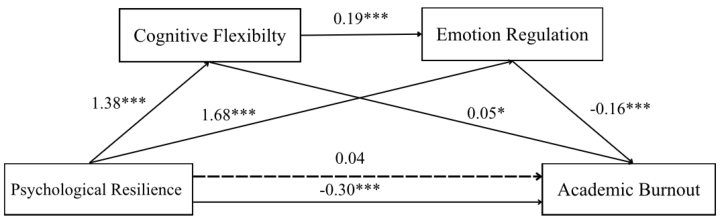
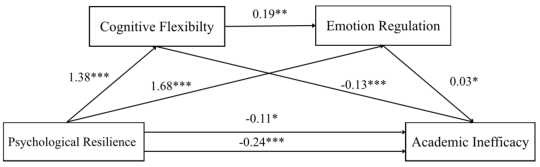
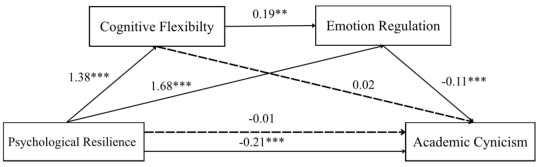
Findings Regarding Serial Mediation Analysis The roles of cognitive flexibility (M1) and emotion regulation (M2) in the effect of psychological resilience (X) on the dimensions of academic burnout were tested within the scope of a serial mediation model (Model 6) using the PROCESS Macro developed by Hayes (2018). In all models, it was observed that psychological resilience predicted cognitive flexibility positively and significantly (B = 1.38, SE = 0.11, p < .001, 95%CI[1.17,1.59]). Furthermore, it was determined that psychological resilience had a positive and significant effect on emotion regulation (B = 1.68, SE = 0.14, p < .001, 95%CI[1.41,1.96]) and that cognitive flexibility predicted emotion regulation positively (B = 0.19, SE = 0.05, p < .001, 95%CI[0.09,0.29]). These findings indicate that psychological resilience is a fundamental personal resource that supports cognitive and emotional regulation processes.
Model 1: Academic Burnout In the model established for academic burnout, it was observed that cognitive flexibility significantly predicted academic burnout (B = 0.05, SE = 0.02, p = .036), while emotion regulation had a negative and significant effect on academic burnout (B = −0.16,SE = 0.02,p < .001). While the direct effect of psychological resilience on academic burnout was not found to be significant (B = −0.04,p = .57), the total effect was determined to be negative and significant (B = −0.30,SE = 0.05,p < .001).
It was observed that the total indirect effect was significant (B = −0.26, BootSE = 0.05,95%CI[−0.35,−0.17]) and that the effect of psychological resilience on academic burnout was sequentially transmitted through cognitive flexibility and emotion regulation (B = −0.04, BootSE = 0.02,95%CI[−0.07,−0.02]). The fact that the direction of the coefficient for cognitive flexibility diverged from the correlation findings points to a potential suppression effect emerging with the inclusion of emotion regulation in the model. This situation suggests that the effect of cognitive flexibility on academic burnout operates largely through emotion regulation processes. The findings regarding the model are presented in Figure 1.
Figure 1: The serial mediation model of psychological resilience, cognitive flexibility, and emotion regulation on academic burnout.
Psychological Resilience and Academic Burnout: Serial Mediation of Cognitive 93 Model 2: Academic Inefficacy
In the model established for academic inefficacy, the direct effect of psychological resilience was found to be negative and significant (B =−0.11, SE = 0.04, p = .011). It was observed that cognitive flexibility had a negative and significant effect on academic inefficacy (B = −0.13,SE = 0.01,p < .001). The effect of emotion regulation on academic inefficacy was positive and significant (B = 0.03, SE = 0.01, p = .042). It was determined that the total effect of psychological resilience was negative and significant (B = −0.24, SE = 0.04, p < .001), the total indirect effect was significant (B = −0.12, BootSE = 0.03, 95%CI[−0.19,−0.06]), and the serial indirect path was statistically significant (B = 0.01, BootSE = 0.00,95%CI[0.00,0.02]). The direction of the coefficient for emotion regulation reflects a relative effect emerging from the simultaneous inclusion of variables in the model and should be considered within the framework of the academic inefficacy dimension’s highly sensitive nature toward cognitive evaluation processes. The findings regarding the model are shown in Figure 2.
Figure 2: The serial mediation model of psychological resilience, cognitive flexibility, and emotion regulation on academic inefficacy.
Model 3: Academic Cynicism In the model established for academic cynicism, it was found that emotion regulation predicted academic cynicism negatively and significantly (B = −0.11, SE = 0.02,p < .001). The direct effects of psychological resilience (B=−0.01,p=.80) and cognitive flexibility (B = 0.02, p = .38) on academic cynicism were not significant. In contrast, the total effect of psychological resilience on academic cynicism was negative and significant (B = −0.21, SE = 0.04,p < .001). It was determined that the total indirect effect (B = −0.19, BootSE = 0.04,95%CI[−0.27,−0.12]) and the serial indirect path were significant (B = −0.03, BootSE = 0.01,95%CI[−0.05,−0.01]). The findings regarding the model are presented in Figure 3.
Figure 3: The serial mediation model of psychological resilience, cognitive flexibility, and emotion regulation on academic cynicism.
DISCUSSION
In this study, the sequential mediating roles of cognitive flexibility and emotion regulation in the relationship between psychological resilience and academic burnout among university students were examined. The findings indicate that academic burnout is not merely a consequence of academic demands; rather, it represents a multidimensional process closely linked to individuals’ cognitive and emotional regulatory capacities. The findings are largely consistent with both international and national literature, while also revealing several distinct patterns across the sub-dimensions of burnout. First, correlation analyses demonstrated that all sub-dimensions of academic burnout (academic burnout, academic inefficacy, and academic cynicism) are negatively associated with psychological resilience. This finding is consistent with studies highlighting psychological resilience as a protective resource against the adverse effects of academic stress and burnout among university students (Terzi, 2008; Yıldırım & Solmaz, 2022; Liu et al., 2023). Large-scale international studies further suggest that resilience facilitates academic adjustment and reduces the likelihood of burnout (Chong et al., 2025). Similarly, evidence across diverse samples indicates that psychological resilience serves as a protective factor not only against burnout but also against broader psychological distress (Kinman & Grant, 2010).The relatively weak yet significant associations between cognitive flexibility and academic burnout suggest that cognitive flexibility influences burnout primarily through indirect mechanisms rather than direct effects. This interpretation aligns with theoretical perspectives proposing that cognitive flexibility operates through the cognitive evaluation and reframing of stressful experiences (Dennis & Vander Wal, 2010). Empirical studies indicate that cognitive flexibility is negatively associated with academic stress and psychological symptoms; however, its effects often emerge through emotion regulation or coping processes (Alsaif et al., 2024). Research conducted in Türkiye further supports that cognitive flexibility is positively related to psychological resilience and adaptive functioning (Sapmaz & Doğan, 2013). The strong associations between emotion regulation and academic burnout constitute one of the most notable findings of the study. The negative relationships between emotion regulation skills and both academic burnout and academic cynicism indicate that emotional exhaustion and motivational decline are closely tied to emotional processes. This result is consistent with recent meta-analytic evidence demonstrating that adaptive emotion regulation strategies reduce burnout, whereas difficulties in emotion regulation increase both burnout and its sub-dimensions (Iuga & David, 2024). Findings from studies conducted in Türkiye similarly show that difficulties in emotion regulation significantly predict psychological resilience and are closely linked to protective processes against burnout (Gözel Topkaya & Şahin, 2024). Serial mediation analyses further revealed that the effect of psychological resilience on academic burnout is largely explained through indirect pathways involving cognitive flexibility and emotion regulation. The non- significant direct effects of resilience in the academic burnout and academic cynicism dimensions, combined with significant indirect effects, suggest that resilience primarily operates through cognitive and emotional regulatory
Psychological Resilience and Academic Burnout: Serial Mediation of Cognitive 95 processes. This finding supports contemporary literature conceptualizing burnout as a multifactorial and process-oriented construct (Chong et al., 2025; Liu et al., 2023). Consistent with this perspective, intervention studies indicate that programs targeting emotion regulation and learning strategies yield positive outcomes in student mental health and burnout reduction (Charbonnier et al., 2023). The persistence of the direct effect of psychological resilience in the academic inefficacy dimension suggests that this component may be more closely related to self-efficacy and cognitive self- evaluations than other dimensions of burnout. Existing research indicates that perceptions of academic efficacy are strongly associated with cognitive appraisals and personal resources (Yıldırım & Solmaz, 2022). Accordingly, psychological resilience may influence academic efficacy through both direct and indirect pathways. Overall, the findings underscore the importance of adopting holistic intervention approaches that prioritize the development of cognitive flexibility and emotion regulation skills, rather than focusing solely on stress reduction, in efforts to prevent and reduce academic burnout. This perspective aligns with the growing emphasis on skill-based and process-oriented interventions in both international and Turkish literature (Terzi, 2008; Charbonnier et al., 2023; Iuga & David, 2024).
CONCLUSION AND RECOMMENDATIONS
Conclusion
In this study, academic burnout among university students is conceptualized as a multidimensional construct associated with psychological resilience, cognitive flexibility, and emotion regulation processes. The findings indicate that the effect of psychological resilience on academic burnout operates largely through indirect pathways, particularly via cognitive flexibility and, more prominently, emotion regulation skills. While the significant associations between emotion regulation and all dimensions of burnout highlight the central role of emotional processes in academic burnout, the findings also suggest that cognitive flexibility functions primarily as a cognitive resource that supports emotion regulation rather than directly reducing burnout. These findings are consistent with current literature emphasizing that academic burnout should be addressed within a process-based framework.
Recommendations In line with the findings, it is recommended that prevention and intervention programs for university students adopt holistic approaches that prioritize the development of cognitive flexibility and emotion regulation skills rather than focusing solely on reducing academic stress. Specifically, the implementation of skill-based programs incorporating emotion regulation strategies and cognitive restructuring techniques within psychological counseling and guidance services may contribute to reducing academic burnout. Furthermore, future longitudinal and experimental studies would enable a more robust examination of the causal mechanisms underlying the sequential model proposed in this study and enhance the generalizability of the findings across diverse university and cultural contexts.
REFERENCES
Alsaif, B., Hassan, S.-u. N., Alzain, M. A., Almishaal, A. A., & Zahra, A. (2024).
Cognitive flexibility’s role in reducing academic stress during the COVID-19 pandemic. Psychology Research and Behavior Management, 17, 457–466. https:// doi.org/10.2147/PRBM.S451211 B. (2002). Burnout and engagement in university students: A cross-national study.
Journal of Cross-Cultural Psychology, 33(5), 464–481. Bjureberg, J., Ljótsson, B., Tull, M. T., Hedman, E., Sahlin, H., Lundh, L.- G., Bjärehed, J., DiLillo, D., Messman-Moore, T., Gumpert, C. H., & Gratz, K. L. (2016). Development and validation of a brief version of the Difficulties in Emotion Regulation Scale: The DERS-16. Journal of Psychopathology and Behavioral Assessment, 38(2), 284–296. Charbonnier, E., Le Vigouroux, S., Puechlong, C., Montalescot, L., Goncalves, A.,
Baussard, L., Gisclard, B., Philippe, A. G., & Lespiau, F. (2023). The effect of intervention approaches of emotion regulation and learning strategies on students’ learning and mental health. INQUIRY: The Journal of Health Care Organization, Provision, and Financing. https://doi.org/10.1177/00469580231159962 Chong, L. Z., Foo, L. K., & Chua, S.-L. (2025). Student burnout: A review on factors contributing to burnout across different student populations. BehavioralSciences,15(2),Article170.https://doi.org/10.3390/bs15020170 Creswell, J. W. (2017). Research design: Qualitative, quantitative, and mixed methods
approaches (S. B. Demir, Çev.). Eğiten Kitap. Çapri, B., Gündüz, B., & Gökçakan, Z. (2011). Adaptation of the Maslach Burnout Inventory Student Form (MBI-SF) into Turkish: Validity and reliability study. Çukurova Üniversitesi Eğitim Fakültesi Dergisi, 40(1), 134–147. Dennis, J. P., & Vander Wal, J. S. (2010). The cognitive flexibility inventory: Instrument
development and estimates of reliability and validity. Cognitive Therapy and Research, 34(3), 241–253.https://doi.org/10.1007/s10608-009-9276-4 Doğan, T. (2015). Turkish adaptation of the Brief Psychological Resilience Scale: Validity and reliability study. The Journal of Happiness & Well-Being, 3(1), 93–102. Gross, J. J. (1998). The emerging field of emotion regulation: An integrative review.
Review of General Psychology, 2(3), 271–299. Gözel, D., Topkaya, N., & Şahin, E. (2024). Emotion Regulation Difficulties and Intolerance of Uncertainty as Predictors of Psychological Resilience in University Students. Korkut Ata Türkiyat Araştırmaları Dergisi, (16), 450–463. Gülüm, İ. V., & Dağ, İ. (2012). Adaptation, validity, and reliability of the Repetitive
Thinking Scale and the Cognitive Flexibility Inventory into Turkish. Anadolu Psikiyatri Dergisi, 13(3), 216–223. Güngör, A., & Sari, H. I. (2022). Effects of academic motivation on school burnout in turkish college students. International Journal for the Advancement of Counselling, 44(3), 414–431. Hayes, A. F. (2018). Introduction to mediation, moderation, and conditional process
analysis: A regression-based approach (2nd ed.). Guilford Press. Iuga, I. A., & David, O. A. (2024). Emotion regulation and academic burnout among youth: A quantitative meta-analysis. Educational Psychology Review, 36, Article 106. https://doi.org/10.1007/s10648-024- 09930-w Kinman, G., & Grant, L. (2010). Exploring stress resilience in trainee social workers:
The role of emotional and social competencies. The British Journal of Social Work, 41(2), 261–275.
Psychological Resilience and Academic Burnout: Serial Mediation of Cognitive 97 Liu, Z., Xie, Y., Sun, Z., Liu, D., Yin, H., & Shi, L. (2023). Factors associated with
academic burnout and its prevalence among universit students: A cross-sectional study. BMC Medical Education, 23, Article 317. https://doi.org/10.1186/s12909- 023-04316-y Maslach, C., & Jackson, S. E. (1981). The measurement of experienced burnout.
Journal of Occupational Behavior, 2(2), 99–113. Sapmaz, F., & Doğan, T. (2013). Assessment of cognitive flexibility: Reliability and validity studies of Turkish version of the Cognitive Flexibility Inventory. Ankara University Journal of Faculty of Educational Sciences (JFES), 46(1), 143–162. Schaufeli, W. B., Martínez, I. M., Pinto, A. M., Salanova, M., & Bakker, A. Smith, B. W., Dalen, J., Wiggins, K., Tooley, E., Christopher, P., & Bernard, J. (2008).
The brief resilience scale: Assessing the ability to bounce back. International Journal of Behavioral Medicine, 15(3), 194– 200. Tabachnick, B. G., & Fidell, L. S. (2013). Using multivariate statistics (6th ed.).
Pearson. Terzi, Ş. (2008). The relationship between university students’ psychological resilience and their perceived social support. Turkish Psychological Counseling and Guidance Journal, 3(29), 1–11. Yiğit, İ., & Güzey-Yiğit, M. (2017). Psychometric properties of Turkish version
of Difficulties in Emotion Regulation Scale–Brief Form (DERS- 16). Current Psychology, Advance online publication. Yıldırım, M., & Solmaz, F. (2022). COVID-19 burnout, COVID-19 stress and resilience: Initial psychometric properties of COVID-19 Burnout Scale. Death Studies, 46(3), 524–532.
LISTED IN THE AHFE DIGITAL BOOKSTORE CATALOGUE
Explore the complete digital volume
Neuroergonomics and Cognitive Engineering
Read this individual research paper free through the original publisher, or explore the full digital proceedings book.
ISBN 978-1-964867-83-0
Explore this ISBN in the AHFE Bookstore ↗Listed in the July 2026 bookstore catalogue; search by ISBN to confirm current availability · Digital book purchase optional