Han Zhang, Diyu Zhou (2024). Effects of Daylight Intensity on Emotion Regulation in a Virtual Healing Space. In: Human Factors in Design, Engineering, and Computing. AHFE Open Access, vol. 159, pp. 1178–1186. https://doi.org/10.54941/ahfe1005685
With increasing social pressure, the youth population in colleges and universities generally faces increasingly severe negative emotional problems, which not only affect academic performance but also significantly reduce the quality of daily life. In response to this challenge, numerous educational institutions have established psychological healing rooms to provide emotional support and stress management services. However, existing psychological healing spaces often fail to achieve the expected healing effects and affect student engagement due to a lack of sufficient privacy and interactivity. To address this issue, this study proposes a virtual psychological healing space design based on the audiovisual fusion effect, aiming to improve students' emotional regulation and mental health management by enhancing privacy and interactivity. The design prototype incorporates four natural environments: water and sky, woodland and sky, grassland and sky, and elemental uniform distribution environments. Each environment is paired with customized Lofi music to enhance the healing effect through a multi-sensory experience. Additionally, by utilizing Unreal Engine's dynamic sky and weather simulation system for natural light, real-time transitions between four lighting environments (early morning, midday, dusk, and night) were achieved in virtual reality to explore the specific effects of light intensity on emotion regulation. This study surveyed 30 college student participants to collect the subjective effects of environmental lighting on emotions in a virtual healing space through semi-structured interviews. This study demonstrates that varying lighting conditions have a significant impact on participants' emotional states. It underscores the critical necessity of customizing lighting to accommodate the specific needs of users in the design of virtual healing spaces, thereby minimizing the influence of inter-individual differences on therapeutic outcomes. The results of this study provide an empirical basis for designing virtual healing spaces and are expected to offer a theoretical reference and practical basis for implementing personalized healing strategies in virtual environments.
Effects of Daylight Intensity on Emotion Regulation in a Virtual Healing Space 1179
Hsieh et al., 2023; Theodorou et al., 2023; Riches et al., 2024), aiming to alleviate negative emotions among young people in colleges and universities as well as the broader population. Studies have confirmed that virtual healing environments promote positive emotions, reduce negative emotions, facilitate attention recovery, relieve stress, and improve cognitive abilities (Serrano et al., 2016; Hamzeheinejad et al., 2019; Yin et al., 2018; Jin et al., 2023; Peng et al., 2024; Hatta et al., 2022). However, few studies have directly examined the emotional impact of light on users in virtual environments. Therefore, this study developed an Unreal Engine-based light control system in four virtual healing spaces with audio-visual fusion effects to evaluate the effectiveness of environmental light changes on users’ emotions through direct scene light control.
To validate and enhance the healing properties of virtual environments, previous studies have utilized attention restoration theory (ART) (Karaca et al., 2024; Moran, 2019; Kumpulainen et al., 2024) and stress reduction theory (SRT) (Karaca et al., 2024; Wang et al., 2024) as crucial theoretical foundations. These theories mechanistically explain the impact of virtual environments on cognitive functioning, work efficiency, and emotional well-being. Additionally, previous research has confirmed the healing potential of virtual scenes with pro-nature attributes (Wang et al., 2024; White et al., 2018; Yin et al., 2018). Previous research on lighting in virtual environments by Heydarian found that most participants prefer simulated sunlight over electro-optic lighting and perform better in such environments (Heyderan et al., 2017). Li et al., pointed out in their virtual experiment involving six levels of sunlight brightness that, compared to very bright (i.e., the lightest level) or very dark (i.e., the darkest level), exposure to natural light with medium brightness (i.e., moderate light and shade) in a virtual forest can significantly reduce participants’ stress (Li et al., 2020). However, it is worth noting that the aforementioned study only involves static simulated sunlight, whereas this study examines controllable dynamic simulated sunlight in virtual environments.
Unlike previous studies, this study employs a dynamic sky and natural light weather simulation system in a virtual engine to enable real-time transitions between four light environments (morning, noon, dusk, and night) in virtual reality and explores the specific impact of light in virtual environments on emotion regulation. This study selected 30 college students as subjects. The subjective influence of environmental light on emotion in a virtual rehabilitation space was investigated through the experience of four scene prototypes and a control group without natural light. After the experience, a semi-structured interview method was used to ask five questions, and 30 participants were interviewed to collect their subjective feelings regarding the impact of environmental light changes on their emotions.
The purpose of this study is to provide new insights into the impact of light on the emotion of the experimenter in the virtual environment, and to explore the subjective feelings of the impact of environmental light changes on the emotion of the experimenter. The purpose of this study is to (1) investigate whether different virtual lighting has an impact on the emotions
1180 Zhang and Zhou
of the participants, (2) compare the psychological tendencies of participants in different brightness and time periods in the virtual environment.
DEVELOPMENT OF INTERACTION SYSTEM To simulate the virtual healing environment for this laboratory experiment, we used the virtual reality simulation software UE4 to construct the virtual environment. During the construction of the virtual environment, relevant virtual scene design experts were consulted, and their guidance and improvement suggestions were incorporated. The virtual healing environment consists of indoor and outdoor environments. The indoor environments are designed based on principles of environmental psychology and existing healing spaces. The outdoor design prototype includes four natural settings: water and sky, woodland and sky, grassland and sky, and an environment with evenly distributed elements, as shown in Figure 1.
Figure 1: Virtual environment design.
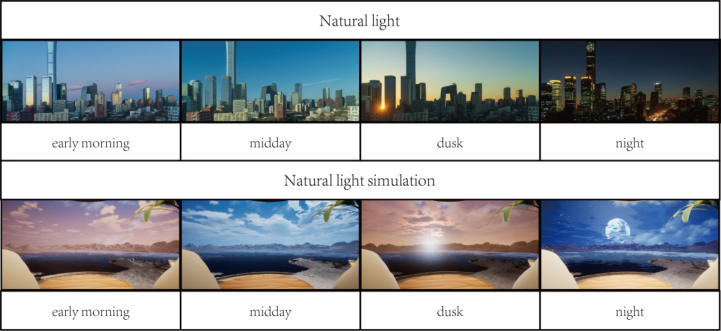
Each environment is equipped with customized LOFI music to enhance the healing effect through an audiovisual integration experience. Any factors that may affect the experiment’s effectiveness, such as animals, artificial structures, varying weather conditions (e.g., rain and fog), and pedestrians, have been removed. Due to technological and hardware limitations, fully reproducing real natural lighting is challenging, as shown in Figure 2.
Figure 2: Natural light and natural light simulation.
Effects of Daylight Intensity on Emotion Regulation in a Virtual Healing Space 1181
Therefore, we designed a lighting interaction system using the virtual engine. The virtual dynamic illumination system’s time periods are divided into four main segments. These periods are early morning, noon, dusk, and night, as shown in Figure 2. Using the natural light weather simulation system, we control the lighting in the virtual environment to simulate natural lighting at various times of the day. The natural light in each period is adjusted using a touch panel on the handle to achieve precise time and light angle control.
Studies have shown that dynamic stimuli can elicit more natural viewing behavior than static stimuli (Li et al., 2020). Therefore, participants can walk, move, and interact in the virtual healing space instead of merely sitting. Four virtual healing interaction spaces were created in UE4, and participants were immersed using HMD (HTC Vive Pro). In the virtual healing space, users can adjust the light in the scene to their preferred angle and brightness at any time and interact freely within the defined range.
METHODS
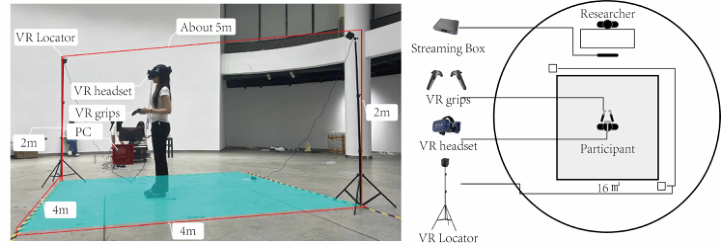
This empirical experiment involved 30 young college students (MAGE = 21 ± 2, male = 11, female = 19) from central China Normal University as participants in the virtual healing space. To mitigate the influence of participants’ age, major, and education level on the experimental results, subjects were selected accordingly. Participants were given a half- hour sitting period before the experiment to facilitate emotional recovery. Before the experiment, we conducted interactive function training for the participants to ensure they could comfortably experience the virtual healing space. Participants were invited to the university laboratory building for testing. The experimental space is approximately 16 m2, as depicted in Figure 3. During the experiment, each participant experienced four sets of virtual healing environments and one set of control scenes without simulated sunlight in random order to prevent order-related errors.
Figure 3: Schematic diagram of experimental environment.
1182 Zhang and Zhou
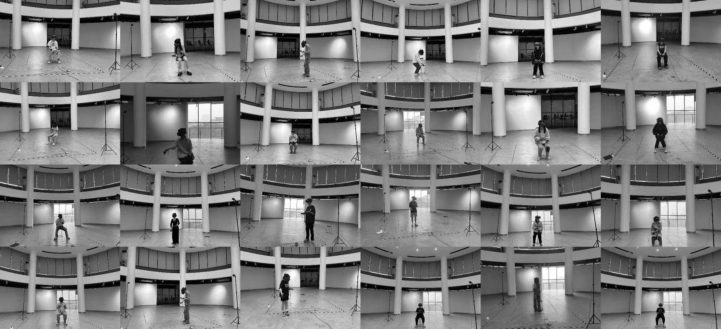
Figure 4: Photos of some participants.
Before each group of experiments, complete the DSB array test. The array increases from 3 digits to 7 digits. Recite the array just seen in reverse order according to the voice prompt. After the array test, the oral English test task was conducted, with a total of 4 English questions, which were used as the stress source in the stress stage. After the completion of each oral task, the virtual environment experience test will be conducted as the relief phase of the healing period. The subjects can adjust the scene light one minute before, and can move freely change the light and interact with the scene after that. Each virtual environment experience task is about 5 minutes long, a total of 5 space experiences. After the five groups’ space experience, the subjects will be interviewed with questions, and then rest or leave by themselves.
In order to obtain the participant’s experience of the light in the scene, the following five user interview questions were set for the experience: Q1: Which time period of lighting do you prefer? Is it morning, noon, dusk, or night?
Q2: Do you prefer darker or brighter lighting? Q3: Have you noticed that the light in the morning, noon, evening, and dusk can affect your emotions and mood?
Q4: Do you think any light is particularly uncomfortable for you? Q5: What kind of the light makes you feel particularly comfortable? The above questions Q1-Q2 asked the experimenter about the lightness tendency and time tendency of light in the virtual healing space, and Q3 asked the experimenter’s subjective feelings. Q4-Q5, in an open-ended question and answer mode, allows the experimenter to fully put forward the uncomfortable light and comfortable light based on their own feelings, which is used to determine whether the virtual healing space prototype system can be applied to the real situation with large individual differences.
RESULTS
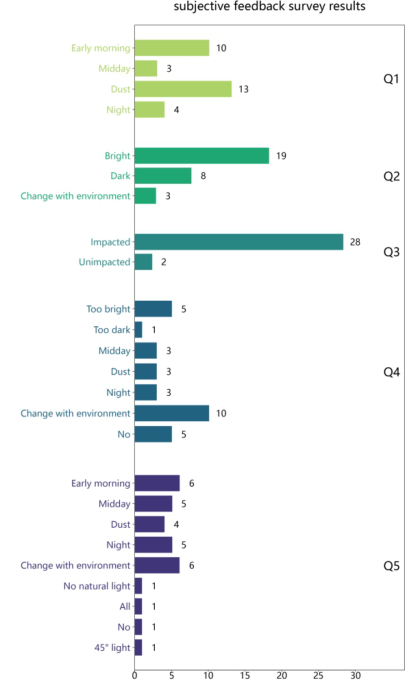
Figure 5 presents the subjective feedback survey results (number of respondents) regarding the emotional impact of light on the experience in the virtual healing space prototype.
Effects of Daylight Intensity on Emotion Regulation in a Virtual Healing Space 1183
In the simulation of natural light patterns in virtual space, the interview results of Q1 showed that 76% (23 participants) prefer the natural and soft light of morning or dusk. Regarding the subjective interview results on the preference for light and darkness in space in Q2, 63% (19 participants) preferred medium brightness light to avoid extremes of brightness and darkness. For Q3, have you observed that the light during morning, noon, evening, and dusk can affect your emotions and mood? Nearly all feedback received was positive; about 93% (28 participants) believe that different lighting conditions significantly affect their emotional state. On the contrary, there were significant individual differences in the evaluation of uncomfortable and comfortable lighting under different lighting conditions in open-ended interviews based on Q4 (“Do you think any lighting made you particularly uncomfortable?”) and Q5 (“Can you identify which lighting angle made you particularly comfortable?”).
When participants were asked about the light that makes them uncomfortable, significant individual differences emerged. Thirty-three percent (10 participants) reported that the light causing discomfort changes with the environmental conditions. Seventeen percent (5 participants) reported no discomfort with any type of lighting. Twenty percent (6 participants) were more attentive to discomfort resulting from changes in brightness in the environment. Thirty percent (9 participants) focused on discomfort due to the light in different periods of time. Similar significant individual differences were also observed in Q5, ‘What kind of lighting makes you feel particularly comfortable?’, from the subjective interview results regarding comfortable light in VR environments. Twenty percent (6 participants) reported that comfortable lighting changed with the scene, while seventy percent (21 participants) felt that comfortable lighting varied across different time periods. Notably, one participant noted finding greater comfort in the control group without natural light, while another participant preferred lighting at a 45-degree angle.
Participant responses include subjective feedback that reflects general trends in lighting preferences within virtual environments. Interview results have helped develop predictive factors for lighting design in virtual therapeutic spaces. Chi-square tests were conducted to analyze feedback from questions Q1 to Q3 with significant findings: Q1 (p = 0.027), Q2 (p = 0.001), and Q3 (p<0.001). Questions Q4 and Q5, being open- ended, were not subjected to this analysis. All differences were statistically significant. Binary tests were performed on Q3, showing statistically significant differences (p<0.001). Based on Q1 (p = 0.027), we conclude that preferences for different time periods vary significantly, with over 50% of participants preferring natural and soft morning or dusk light. Based on Q2 (p = 0.001), we conclude that preferences for different brightness levels vary significantly, with over 60% of participants preferring medium brightness light. Based on Q3 (p<0.001), we conclude that lighting in virtual space significantly affects the emotions of over 90% of participants. Based on the participant responses from Q4 and Q5, we conclude that the evaluation of uncomfortable and comfortable lighting under different lighting conditions does not show a significant sample distribution range, indicating no uniform user preference.
1184 Zhang and Zhou
Figure 5: subjective feedback survey results.
DISCUSSION & CONCLUSION Q3 indicates subjective feedback regarding the emotional impact of light changes in virtual space. 93% of participants agreed with this, indicating a clear perception of the impact of dynamic light changes in virtual environments on their own emotions. In Q2, regarding brightness preferences in virtual space lighting, 63% of participants favoured moderately bright and non-glaring ambient lighting, consistent with previous findings by Li et al., In Q3, regarding time preferences for lighting in virtual space, 76% of participants preferred morning or dusk light, highlighting a temporal preference. Conversely, in Q4 and Q5, significant individual differences emerged in the evaluation of discomfort and comfort under different lighting conditions among participants. This result underscores the importance of adjusting lighting according to users’ individual needs when designing virtual healing spaces, to mitigate the potential impact of individual differences on therapeutic outcomes.
To address this phenomenon, two solutions can be implemented. First, using a controllable dynamic natural light weather simulation system in
Effects of Daylight Intensity on Emotion Regulation in a Virtual Healing Space 1185
virtual environments allows participants to adjust virtual space lighting to their preferences, enhancing spatial interactivity and minimizing potential negative impacts on the therapeutic potential of virtual healing spaces due to individual differences. Second, we found that the comfort and discomfort of lighting for most participants vary with scene changes. Therefore, dividing restorative scene elements into water bodies, forests, grasslands, and skies, and designing different restorative scenes using different element proportions, aims to meet the individual needs of different participants.
Based on Q1-Q2, when designing virtual healing spaces, it is crucial to give priority to the lighting preferences of the majority of participants. Upon entering the virtual space, initializing the lighting environment to a moderately bright morning or dusk period facilitates faster induction into a healing state. If the lighting upon entering the space is excessively dark or glaring, it will significantly impact the initial therapeutic effect and lead to poorer individual experiences.
Based on Q4 and Q5, the lighting that participants feel comfort or discomfort shows significant individual differences. In this context, it is necessary to provide environments and lighting that can adapt to individual needs using the two previously proposed design methods. Using a dynamic natural light and weather simulation system within a virtual environment allows participants to adjust lighting to match the VR scene, ensuring suitability for the current context. Additionally, incorporating time-based lighting changes controlled by user interactions enhances comfort throughout the experience. Personalizing lighting preferences, as suggested by the insights from Q4 and Q5, accommodates a broad spectrum of sensitivities and preferences. By implementing adaptive and customizable lighting solutions, designers can create more inclusive and supportive virtual environments that address diverse user needs and improve overall well-being. The results of this study provide empirical evidence for the design of virtual therapeutic spaces and explore the emotional impact of changes in lighting environments within virtual spaces. This study is expected to provide theoretical reference and practical basis for implementing personalized therapeutic strategies in virtual environments.
ACKNOWLEGMENT This research was supported by the Fundamental Research Funds for the Central Universities of Ministry of Education of China (Grant No. CCNU23XJ047). We would like to thank Prof. Zijian Li for providing equipment support and all participants for helping complete this study.
REFERENCES
Hamzeheinejad, N., Roth, D., Gotz, D., Weilbach, F., Latoschik, M. E., 2019.
Physiological Effectivity and User Experience of Immersive Gait Rehabilitation, in: 2019 IEEE Conference on Virtual Reality and 3D User Interfaces (VR). Presented at the 2019 IEEE Conference on Virtual Reality and 3D User Interfaces (VR), IEEE, Osaka, Japan, pp. 1421–1429. https://doi.org/10.1109/VR.2019.8797763
1186 Zhang and Zhou
Hatta, M. H., Sidi, H., Sharip, S., Das, S., Saini, S. M., 2022. The Role of Virtual Reality as a Psychological Intervention for Mental Health Disturbances during the COVID-19 Pandemic: A Narrative Review. Int. J. Environ. Res. Public. Health 19, 2390. https://doi.org/10.3390/ijerph19042390 Heydarian, A., Pantazis, E., Wang, A., Gerber, D., Becerik-Gerber, B., 2017.
Towards user centered building design: Identifying end-user lighting preferences via immersive virtual environments. Autom. Constr. 81, 56–66. https://doi.org/ 10.1016/j.autcon.2017.05.003 Hsieh, C.-H., Yang, J.-Y., Huang, C.-W., Chin, W. C. B., 2023. The effect of water sound level in virtual reality: A study of restorative benefits in young adults through immersive natural environments. J. Environ. Psychol. 88, 102012. https://doi.org/10.1016/j.jenvp.2023.102012 Jin, Y.-L., Chen, E.-C., Li, T.-Y., 2023. Study of Different Interaction Methods
on the Healing Effect of Natural Environment in Virtual Reality, in: 2023 9th International Conference on Virtual Reality (ICVR). Presented at the 2023 9th International Conference on Virtual Reality (ICVR), IEEE, Xianyang, China, pp. 185–192. https://doi.org/10.1109/ICVR57957.2023.10169717 Karaca, E., Çakar, T., Karaca, M., Hüseyin Miraç Gül, H., 2024. Designing restorative landscapes for students: A Kansei engineering approach enhanced by VR and EEG technologies. Ain Shams Eng. J. 102901. https://doi.org/10.1016/j. asej.2024.102901 Kumpulainen, S., n.d. Assessing the Well-being Benefits of VR Nature Experiences
on Group: Heart Rate Variability Insights from a Cross-Over Study. Li, C., Sun, C., Sun, M., Yuan, Y., Li, P., 2020. Effects of brightness levels on stress recovery when viewing a virtual reality forest with simulated natural light. Urban For. Urban Green. 56, 126865. https://doi.org/10.1016/j.ufug.2020.126865 Moran, D., 2019. Back to nature? Attention restoration theory and the restorative
effects of nature contact in prison. Health Place 57, 35–43. https://doi.org/10. 1016/j.healthplace.2019.03.005 Peng, Y., Wang, Y., Zhang, L., Zhang, Y., Sha, L., Dong, J., He, Y., 2024. Virtual reality exergames for improving physical function, cognition and depression among older nursing home residents: A systematic review and meta-analysis. Geriatr. Nur. (Lond.) 57, 31–44. https://doi.org/10.1016/j.gerinurse.2024.02.032 Riches, S., Kaleva, I., Nicholson, S. L., Payne-Gill, J., Steer, N., Azevedo, L., Vasile,
R., Rumball, F., Fisher, H. L., Veling, W., Valmaggia, L., 2024. Virtual Reality Relaxation for Stress in Young Adults: A Remotely Delivered Pilot Study in Participants Homes. J. Technol. Behav. Sci. https://doi.org/10.1007/s41347-024- 00394-x Serrano, B., 2016. Virtual reality and stimulation of touch and smell for inducing relaxation: A randomized controlled trial. Comput. Hum. Behav. Theodorou, A., Romano, L., Bratman, G. N., Carbone, G. A., Rodelli, R.,
Casagrande, G., Panno, A., 2023. Different types of virtual natural environments enhance subjective vitality through restorativeness. J. Environ. Psychol. 87, 101981. https://doi.org/10.1016/j.jenvp.2023.101981 Wang, Y., Lu, S., Xu, M., Zhang, Y., Xu, F., 2024. What influences stress reduction in urban forests: Environment types or personality traits? Urban For. Urban Green. 92, 128187. https://doi.org/10.1016/j.ufug.2023.128187 White, M. P., Yeo, N., Vassiljev, P., Lundstedt, R., Wallergård, M., Albin, M.,
Lõhmus, M., 2018. A prescription for “nature” – the potential of using virtual nature in therapeutics. Neuropsychiatr. Dis. Treat. Volume 14, 3001–3013. https://doi.org/10.2147/NDT. S179038 Yin, J., Zhu, S., MacNaughton, P., Allen, J. G., Spengler, J. D., 2018. Physiological and cognitive performance of exposure to biophilic indoor environment. Build. Environ. 132, 255–262. https://doi.org/10.1016/j.buildenv.2018.01.006
LISTED IN THE AHFE DIGITAL BOOKSTORE CATALOGUE
Explore the complete digital volume
Human Factors in Design, Engineering, and Computing
Read this individual research paper free through the original publisher, or explore the full digital proceedings book.
ISBN 978-1-964867-35-9
Explore this ISBN in the AHFE Bookstore ↗Listed in the July 2026 bookstore catalogue; search by ISBN to confirm current availability · Digital book purchase optional