Zhibin Zong (2026). Fragmented Verbal Dysfunction: Interactive Communication Design for Language Awareness in Digital Media. In: Human Factors in Communication of Design. AHFE Open Access, vol. 216, pp. 204–215. https://doi.org/10.54941/ahfe1008070
Social media and short-video platforms have reshaped everyday communication through fast, fragmented, and highly visual information flows. In daily online interaction, many young users increasingly rely on internet slang, emojis, abbreviations, and memes to complete expression. These forms are efficient and emotionally direct, but they may also reduce attention to sentence structure, semantic richness, and reflective language organization. This paper takes Cognitive Load Theory as the main theoretical entry point. It understands "text aphasia" not as a medical diagnosis, but as a cultural metaphor for weakened textual expression caused by continuous exposure to high-frequency digital information. Cognitive Load Theory suggests that limited working-memory resources can be overloaded by unnecessary or excessive information processing. Related media studies also show that mediated message processing is constrained by limited cognitive capacity, while recent short-video research links information fragmentation, scroll immersion, attention difficulty, working-memory disruption, cognitive fatigue, and executive-control decline with contemporary platform use.This paper presents Fragmented Verbal Dysfunction, an interactive communication design project for the AHFE track Human Factors in Communication of Design. The project aims to make the abstract decline of textual expression visible, understandable, and personally relevant. Its design system includes conceptual posters, medical-record-inspired visual interfaces, deconstructive typography, dynamic mosaic effects, public-space applications, peripheral objects, a QR-code entrance, and an H5 memory-test game. These components form a communication pathway: users first encounter a visual warning in public or printed media, then enter a mobile interaction, and finally receive a diagnosis-like reflective experience about their own language habits.The design method combines visual metaphor, deconstructive typography, and gamified interaction. Fragmented typography and pixel distortion are used to simulate the collapse of semantic order under information overload. Medical images of the brain, mouth, and heart are used as embodied metaphors that connect language expression with cognition, speech, and emotion. The H5 game adopts a simple elimination mechanism inspired by gamification design, inviting users to identify, select, and reconstruct symbolic information. In this process, the audience shifts from passive viewing to active participation in the "diagnosis" and recovery of language awareness.A pilot user evaluation was organized with university students who frequently use social media and short-video applications. The evaluation focused on five aspects: visual comprehension, emotional impact, interaction engagement, memory retention, and reflection on personal communication habits. Preliminary feedback indicates that visual disturbance combined with game-based interaction can attract attention more effectively than static posters alone. Participants were more likely to recognize their dependence on simplified digital expressions after using the interactive system. This project therefore connects cognitive load, visual metaphor, and interactive communication design, showing how communication design can function not only as information delivery, but also as a tool for cognitive awareness in fragmented digital culture.
The widespread adoption of social media and short-video platforms has changed how people receive information and organize language. Relatively complete textual expression is increasingly replaced by faster, shorter and more affective symbolic forms, including internet slang, memes, abbreviations and bullet-screen-style comments. Surveys reported by China Youth Daily and related media indicate that many young respondents perceive a decline in language richness, reflecting a broader social concern about expression in digital environments (China Daily, 2019; Xinhuanet, 2019). This issue should not be confused with clinical aphasia. In this paper, “text aphasia” is used as a cultural metaphor for a condition in which users rely heavily on simplified symbols and find it difficult to organize complete textual expression when dealing with complex emotions, opinions or logical narration.
From the perspective of human factors and communication design, text aphasia is not merely a linguistic problem, but a cognitive and behavioral Received June 19, 2026; Revised July 3, 2026; Accepted July 10, 2026; Available online July 20, 2026
Fragmented Verbal Dysfunction: Interactive Communication Design 205 outcome of human-media interaction. Cognitive Load Theory suggests that working memory has limited capacity; when external information continuously occupies cognitive resources, fewer resources remain for deeper processing and schema construction (Sweller, 1988). Baddeley (1992) further explains that working memory supports the temporary storage and manipulation of information required for language comprehension, learning and reasoning. Short-video platforms, characterized by algorithmic recommendation, rapid switching and instant feedback, place users in a high-stimulation, low-effort media environment. Yu et al. (2026) show that media literacy affects users’ perception of information fragmentation, diversity of media exposure and critical engagement in short-video environments. Alruwaili (2025) also reports associations between short-form video use, scroll immersion and perceived attention difficulty, working-memory disruption and cognitive fatigue.
Against this background, communication design needs to move beyond visual beautification toward intervention in users’ cognitive states and reflective behaviors. Fragmented Verbal Dysfunction visualizes the loss, collapse and reconstruction of textual expression as a diagnostic process. Through deconstructive typography, dynamic mosaics, information noise, medical-record metaphors and an H5 elimination game, users are invited to perceive the influence of fragmented communication on language organization through viewing, scanning, clicking and remembering.
Accordingly, this paper addresses the following research questions: (1) How can Cognitive Load Theory explain the influence of fragmented
digital communication on young users’ textual organization ability and language awareness? (2) How can the abstract cultural phenomenon of “text aphasia” be translated into an intuitive, metaphorical and participatory interactive communication design system? (3) How can conceptual posters, medical-record-inspired visual interfaces and
an H5 game construct a complete pathway from public communication to mobile interaction and self-reflection? (4) How can a user-testing and evaluation method be established to examine the design system in terms of visual comprehension, emotional arousal, interaction engagement and language reflection?
The contribution of this paper is threefold. First, it introduces Cognitive Load Theory into the design discussion of text aphasia, providing a theoretical entry point for language awareness in digital media environments. Second, it proposes a design framework of “visual diagnosis-interactive participation- reflective feedback”. Third, it offers a case of interactive communication design for the AHFE track Human Factors in Communication of Design, focusing on the problem of young people’s digital expression.
RELATED WORK
Information Fragmentation in Short-Video Platforms Short-video platforms are characterized by short duration, strong algorithmic distribution, dense emotional stimulation and instant feedback. These features lower the threshold for information access, but may also encourage continuous scrolling, rapid judgment and fragmented understanding. Yu et al. (2026), in Scientific Reports, show that algorithmic content distribution on short- video platforms influences users’ perception of information fragmentation and critical engagement, while media literacy enhances cognitive control over information processing. The Reuters Institute Digital News Report also notes that social media and video platforms are accelerating a shift toward a more fragmented alternative media environment (Reuters Institute, 2025). These findings suggest that when information sources, expressive forms and viewing rhythms become increasingly dispersed, users’ sustained reading and integration of complex texts may be affected.
From a human factors perspective, information fragmentation is not only a problem of content structure but also a problem of cognitive resource allocation. Lang’s Limited Capacity Model of Mediated Message Processing argues that media-message processing requires the allocation of limited cognitive resources among encoding, storage and retrieval (Lang, 2000). When information changes too quickly, stimuli are too dense or symbols are too numerous, resource allocation may favor immediate recognition and affective response rather than deep comprehension and long-term memory. Fragmented Verbal Dysfunction takes this as a design entry point, using visual noise and mosaic typography to simulate the compression, blockage and loss of information.
Digital Symbolic Expression and Language Awareness Emojis, memes and abbreviations have become important paralinguistic resources in online communication. They can quickly supplement tone, emotion and social attitude, and play a significant role in instant messaging. Boutet et al. (2021) found that emojis influence emotion interpretation, social attributions and information processing. Bai et al. (2019), in a systematic review of emoji research, also note that emojis possess both emotional and linguistic features and function as important non-textual resources in digital communication. The problem is not the use of symbols itself, but the possibility that, when symbols repeatedly replace complex expression, users may practice complete syntax, rhetoric and semantic organization less often.
Language cognition is not an isolated internal process. Li and Jeong (2020) argue in npj Science of Learning that language learning and cognition should be grounded in social interaction. Social platforms reshape the contexts in which users practice language. When users become accustomed to replacing full descriptions with internet slang or memes, the social feedback of expression also changes: simplified expression is easier to
Fragmented Verbal Dysfunction: Interactive Communication Design 207 understand and reward immediately, whereas complex expression requires higher organizational and interpretive effort. The “text aphasia” discussed in this paper is therefore produced by both social interaction structures and cognitive-processing structures.
Interactive Communication Design and Visual Metaphor Communication design can transform invisible social and cognitive problems into perceptible visual experiences. Lakoff and Johnson (1980) argue that metaphor is not merely a rhetorical device, but a fundamental cognitive mechanism through which people understand abstract concepts. Lee and Boling (2007) also suggest that metaphors can help users build mental models and understand abstract relations in complex information spaces. In Fragmented Verbal Dysfunction, the brain, mouth, heart, medical files and outpatient system are not intended as medical diagnosis, but as visual metaphors that translate language-expression difficulty into recognizable symbolic symptoms.
Interaction design further changes the relationship between the audience and information. Deterding et al. (2011) define gamification as the use of game design elements in non-game contexts. Hassenzahl et al. (2010) emphasize that interactive product experience is shaped not only by functional efficiency but also by need fulfilment, emotion and meaning. Accordingly, the H5 memory-test game is not simply an entertainment module; it transforms recognition, clicking, elimination and feedback into a participatory pathway for rebuilding language awareness. Through bodily operation, users participate in the “diagnosis” and shift from passive viewers to active reflectors.
DESIGN STRATEGY Design Theory and Framework
This study takes Cognitive Load Theory as its main theoretical basis, supplemented by the Limited Capacity Model of mediated message processing, visual metaphor theory and gamification. Together, these perspectives construct the design logic of “media stimulation-cognitive load-language weakening-visual diagnosis-interactive reflection”. The basic assumption is that when users are repeatedly exposed to high-frequency, short-duration and symbolic information environments, the organization, retrieval and reasoning required for complete expression may be replaced by low-effort symbols. Design intervention should not simply remind users to reduce short-video consumption; it should make cognitive pressure perceptible and help users recognize changes in their own expression habits through experience.
Accordingly, this paper constructs a five-layer design framework (See Table 1). The first layer is the media-environment layer, referring to fragmented communication scenes created by social media, short-video platforms and
208 Zong and Jin instant messaging. The second is the problem-identification layer, referring to dependence on online symbols, monotonous expression, semantic poverty and difficulty in logical organization. The third is the visual-translation layer, where fractured typography, pixel mosaics, glitch noise and organ imagery translate abstract problems into visual symptoms. The fourth is the interactive-participation layer, in which a QR-code entrance and H5 game shift users from viewing to operating. The fifth is the cognitive-feedback layer, where diagnostic prompts and result feedback guide users to review their own language habits.
The design does not aim to diagnose users’ language ability in a medical or psychological sense. Instead, it seeks to activate three forms of awareness through communication design: media awareness, meaning awareness of how fragmented platforms change expression habits; language awareness, meaning renewed attention to complete sentences, vocabulary richness and semantic organization; and reflective awareness, meaning users’ willingness to reduce dependence on homogeneous internet slang and memes in everyday communication.
Table 1: Five-layer design framework for language awareness.
Table available in the original PDF paper.
Layer Design Meaning Output Media environment Short-video and social media fragmentation Problem context Design issue Problem identification Symbol dependency, semantic poverty and expression difficulty
Visual symptoms
Visual translation Typographic fracture, mosaic and medical metaphor Interaction participation
QR entrance and H5 elimination game Participatory diagnosis Cognitive feedback Result prompt and self-reflection Language awareness
System Design and Development Fragmented Verbal Dysfunction consists of four interconnected modules
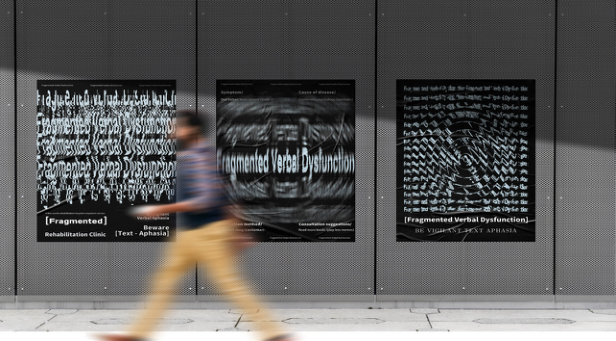
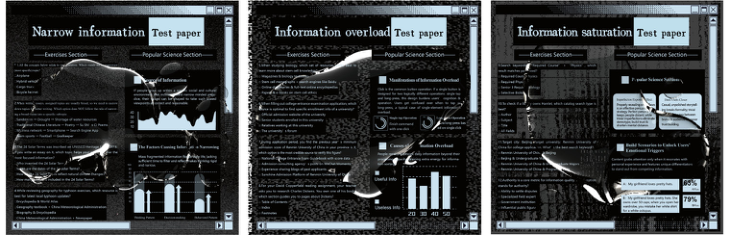
The first is the conceptual poster and public communication module (See Figure 1). Based on a dark digital interface, the posters create visual pressure through high-contrast typography, horizontal information bars, pixelated fractures and blurred figures. They are placed in exhibition halls, bus stops and subway spaces, allowing users to encounter “language warnings” during daily movement. Public space is not merely a display environment, but a metaphorical field of fragmented media life: users meet the work while commuting, waiting and browsing quickly, which corresponds to short- video-style information consumption.
Figure 1: Conceptual poster and public communication module.
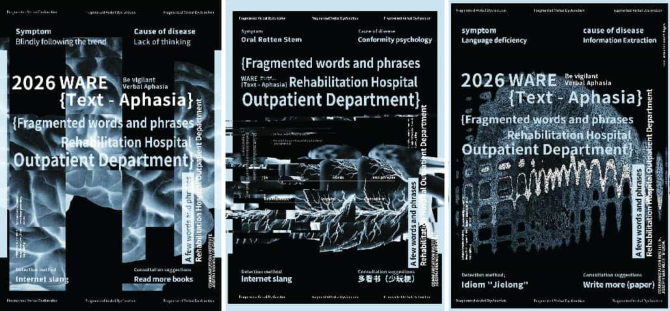
The second is the medical-record-inspired visual diagnosis module (See Figure 2). The work borrows visual vocabularies such as medical records, examination reports, outpatient forms and warning signs to construct the narrative of a “text aphasia rehabilitation clinic”. The brain corresponds to comprehension and memory; the mouth corresponds to expression and speech; the heart corresponds to emotion and social motivation. These organ images are processed as X-ray images, scanning diagrams and data slices, making language degradation perceptible as a “symptom” of the digital media age. This medical metaphor is not intended to create fear, but to prompt users to re-examine habitual online expression as a problem worth checking.
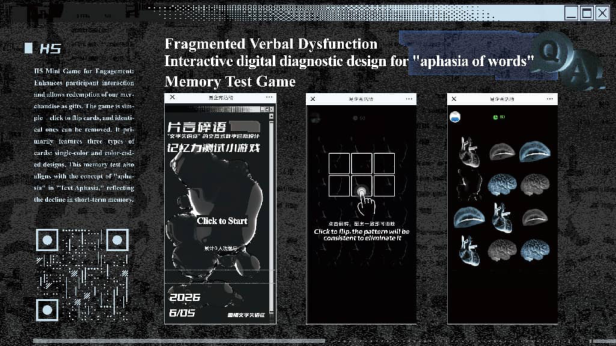
The third is the H5 interactive mini-game module (See Figure 3). After scanning the QR code, users enter a mobile interface titled “memory-test game” and then take part in an elimination-game-like interaction. The game objects include the brain, mouth, heart and fragmented textual symbols. Users identify and eliminate matching graphics within limited time or steps. This mechanism turns rapid recognition, a typical behavior in online contexts,
210 Zong and Jin into an ironic experience: the faster users eliminate symbols, the more they perceive that linguistic symbols are being compressed and replaced. The result page uses diagnosis-like prompts to encourage users to reflect on whether they over-rely on internet slang, memes and short expressions.
Figure 3: H5 interactive mini-game module.
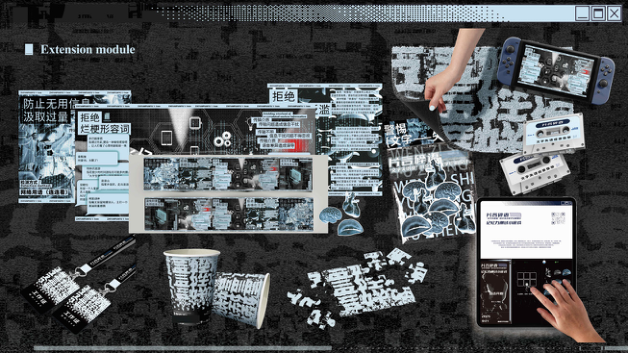
The fourth is the peripheral media and communication extension module (See Figure 4). The visual system is applied to manuals, case cards, stickers, textiles, paper cups, cassette tapes and tags, forming a communication pathway from flat display to tactile objects. The manual adopts a fold-out structure and presents common online expression problems such as “avoiding useless information overload” and “rejecting empty meme adjectives”. The case cards reinforce the diagnostic narrative through the format of “symptom- cause-detection method-consultation suggestion”. Through the distribution and carrying of physical objects, the work transforms public display into personal memory cues.
Figure 4: Peripheral media and communication extension module.
Fragmented Verbal Dysfunction: Interactive Communication Design 211 USER TESTING AND EVALUATION METHODS Participants and Procedure
To evaluate the communicative effectiveness of the design system, this study proposes a formative user-testing method. Participants are university students aged mainly between 18 and 25 who frequently use social media and short- video platforms. This group is a major user group of internet slang, memes and short-video information, while also facing relatively high demands for textual and academic expression. It is therefore appropriate for preliminary evaluation. The test contains four stages. The first is a pre-test expression task, in which participants describe an emotional or social scene image in no more than 100 Chinese characters or equivalent short text. Expression length, complete- sentence ratio, use of internet slang and semantic richness are recorded. The second stage is system experience: participants view the conceptual posters, read the medical-record-inspired visual information and scan the QR code to enter the H5 game. The third stage is a post-test expression task, in which participants describe another image of similar difficulty, allowing comparison of language organization before and after the experience. The fourth stage consists of questionnaire and interview feedback on visual comprehension, emotional impact, interaction engagement, memory retention and reflection on expression habits (See Figure 5).
To prevent misunderstanding of the work as a medical diagnostic tool, participants are informed that “text aphasia” is used in this paper as a cultural metaphor and communication issue. The purpose of the test is not to judge individual language ability, but to examine whether interactive communication design can draw attention to language-use habits.
Figure 5: Questionnaire and interview feedback.
Evaluation Indicators and Data Analysis The evaluation indicators include both quantitative and qualitative components. The quantitative part uses a five-point Likert scale with five dimensions:
(1) Visual comprehension, measuring whether users understand the problems indicated by fragmented typography, mosaic effects and medical-record metaphors;
as tension, alertness, reflection or discomfort; (3) Interaction engagement, measuring whether the H5 game increases interest and sustained attention; (4) Memory retention, measuring whether users remember the main visual
symbols and core theme after the experience; (5) Expression reflection, measuring whether users become aware of their dependence on internet slang and memes (See Table 2).
Table 2: Five-layer design framework for language awareness.
Emotional impact Self-report adjectives Whether warning and reflection are triggered Completion and observation Whether H5 improves participation Interaction engagement
Memory retention Recall of symbols Whether core message is remembered Expression reflection Questionnaire + text
comparison
Whether users notice expression habits The qualitative part adopts semi-structured interviews. Core questions include whether participants recognize the phenomenon of text aphasia, which visual element most strongly triggers reflection, whether the H5 game makes them feel involved in a “diagnosis”, and whether the work may influence their subsequent expression habits. Interview data will be coded through thematic analysis into themes such as media-dependence awareness, perception of language poverty, visual anxiety, participatory memory and willingness to repair expression. Pre- and post-test texts are compared from three perspectives: sentence completeness, including subject-predicate-object structure and logical connectors; lexical diversity, including the richness of adjectives, verbs and affective words; and the proportion of internet slang, meaning whether simplified online terms replace specific description. As the project remains a design prototype evaluation, data analysis focuses on descriptive statistics and qualitative interpretation rather than overstating causal effects.
DISCUSSION AND LIMITATIONS Discussion of Design Value
The main value of this study lies in transforming language weakening in digital communication into an experiential visual and interactive system. Compared with a single public-service poster, Fragmented Verbal Dysfunction connects public-space display, medical-record-inspired narrative, mobile game interaction and peripheral media into a relatively complete communication pathway. Users are first attracted by strong visual symbols in public spaces,
Fragmented Verbal Dysfunction: Interactive Communication Design 213 then enter the H5 game through a QR code, and finally review themselves through diagnosis-like feedback. This process corresponds to the concern of Human Factors in Communication of Design in AHFE, namely the relationship among humans, information and media: design not only transmits information, but also shapes attention, understanding, emotion and behavioral intention.
From the perspective of Cognitive Load Theory, the work does not simply reproduce information overload. Instead, it uses controlled visual interference to make users aware of overload itself. Mosaic typography, fractured characters and dense information bars intentionally create reading difficulty, allowing viewers to experience how fragmented information interferes with comprehension. The medical-record metaphor transforms abstract expression degradation into “checkable” symptoms, reducing the threshold for understanding the issue. The elimination mechanism of the H5 game turns symbolic recognition into bodily participation, strengthening the mnemonic anchor of reflection.
The design also avoids over-medicalizing text aphasia. Hospitals, organs and medical files are used only as communication metaphors. Their purpose is to create distance and alertness toward everyday expression habits. Compared with directly criticizing users for “poor expression”, the diagnostic narrative more easily frames the issue as an observable, discussable and repairable phenomenon.
Limitations This study still has several limitations. First, the design remains at the prototype and exhibition stage, and the interaction depth, data-recording function and personalized feedback mechanism of the H5 game require further development. Second, the proposed user test mainly targets university students, and its adaptability to groups with different ages, occupations and media-use habits has not yet been verified. Third, text aphasia as a cultural metaphor is context-dependent; its interpretation may vary across languages, cultures and social platforms. Fourth, the work focuses mainly on awareness raising and short-term reflection, and cannot yet demonstrate stable improvement in long-term textual expression ability.
In addition, visual disturbance design must balance impact and readability. If the noise, mosaic and fragmented typography are too intense, users may be unable to understand the message; if the interference is too weak, the warning effect may be reduced. Future iterations should therefore use A/B testing to adjust visual complexity, ensuring that the design creates cognitive pause without becoming ineffective reading obstruction.
CONCLUSION This paper addresses the weakening of expression under the concept of text aphasia in digital media environments and presents the interactive communication design system Fragmented Verbal Dysfunction. Grounded in Cognitive Load Theory and informed by studies of mediated message processing, social language cognition, visual metaphor and gamification, the study explains how fragmented information in short-video and
214 Zong and Jin social media environments may influence users’ attention allocation and language awareness. Through conceptual posters, medical-record-inspired interfaces, organ metaphors, dynamic mosaics, public-space applications and an H5 game, the project transforms an abstract language problem into a visible, participatory and reflective communication experience. The study suggests that human-factor-oriented communication design can function not only as information delivery, but also as a tool for cognitive awareness. It attracts attention through visual impact, lowers the threshold of understanding through metaphor, increases participation through interaction and triggers self-review through feedback text. For Human Factors in Communication of Design, this paper offers a design case that integrates social language issues, digital media behavior and interactive visual systems.
Future work will proceed in four directions. First, the user-testing sample will be expanded to compare users with different majors, ages and media-use intensities. Second, natural language processing will be integrated into the H5 system to automatically analyze lexical diversity, syntactic complexity and the proportion of internet slang in pre- and post-test texts. Third, the feedback mechanism will be optimized so that diagnosis results move from fixed text to personalized suggestions, such as reading recommendations, writing exercises and expression-reconstruction tasks. Fourth, the transferability of this design framework will be explored in other digital communication issues, such as information anxiety, dependence on online affective expression and cognitive narrowing under algorithmic recommendation.
In the long term, Fragmented Verbal Dysfunction aims to become an open language-awareness communication tool. It does not ask users to completely reject online language, but reminds them to pay attention to linguistic layers, logic and emotional expression beyond communicative efficiency. Only when design helps users see the relationship between themselves and media can communication design truly enter the cognitive and behavioral level emphasized by human factors research.
REFERENCES Alruwaili, R.F. (2025). Scroll immersion and short-form video use: Predictors of attention, memory, and fatigue among Saudi social media users. Acta Psychologica, 258, 105674. Baddeley, A. (1992). Working memory. Science, 255(5044), 556–559. Bai, Q., Dan, Q., Mu, Z., and Yang, M. (2019). A systematic review of emoji: Current
research and future perspectives. Frontiers in Psychology, 10, 2221. Boutet, I., LeBlanc, M., Chamberland, J.A., and Collin, C.A. (2021). Emojis influence emotional communication, social attributions, and information processing. Computers in Human Behavior, 119, 106722. China Daily. (2019). Most say language skills deteriorating in cyber age: survey.
China Daily, 22 March 2019. Deterding, S., Dixon, D., Khaled, R., and Nacke, L. (2011). From game design elements to gamefulness: Defining gamification. Proceedings of the 15th International Academic MindTrek Conference, 9-15. Hassenzahl, M., Diefenbach, S., and Goeritz, A. (2010). Needs, affect, and interactive
products: Facets of user experience. Interacting with Computers, 22(5), 353-362. Lakoff, G., and Johnson, M. (1980). Metaphors We Live By. Chicago: University of Chicago Press.
Fragmented Verbal Dysfunction: Interactive Communication Design 215 Lang, A. (2000). The limited capacity model of mediated message processing. Journal
of Communication, 50(1), 46-70. Lee, J., and Boling, E. (2007). The effects of visual metaphor and cognitive style for mental modeling in a hypermedia-based environment. Interacting with Computers, 19(4), 614-629. Li, P., and Jeong, H. (2020). The social brain of language: Grounding second language
learning in social interaction. npj Science of Learning, 5, 8. Mayer, R.E. (2009). Multimedia Learning. 2nd ed. Cambridge: Cambridge University Press. Reuters Institute. (2025). Digital News Report 2025. Oxford: Reuters Institute for
the Study of Journalism. Sweller, J. (1988). Cognitive load during problem solving: Effects on learning.
Cognitive Science, 12(2), 257-285. Xinhuanet. (2019). Xinhua News Agency, 21 March 2019. Yan, T., Su, C., Xue, W., Hu, Y., and Zhou, H. (2024). Mobile phone short video use negatively impacts attention functions: An EEG study. Frontiers in Human Neuroscience, 18, 1383913. Yu, T., Wei, C., Na, M., and Alam, S.S. (2026). Enhancing media literacy to combat
information fragmentation in digital short video platforms: A cross-sectional study. Scientific Reports, 16, 203.
LISTED IN THE AHFE DIGITAL BOOKSTORE CATALOGUE
Explore the complete digital volume
Human Factors in Communication of Design
Read this individual research paper free through the original publisher, or explore the full digital proceedings book.
ISBN 978-1-964867-92-2
Explore this ISBN in the AHFE Bookstore ↗Listed in the July 2026 bookstore catalogue; search by ISBN to confirm current availability · Digital book purchase optional