Mehrun-nisa Raja, Halil Erhan (2026). D-GAM: An Adaptable Gamification Framework for Enhancing Public Participation in Built Environment Design. In: Human Factors in Architecture, Sustainable Urban Planning and Infrastructure. AHFE Open Access, vol. 229, pp. 138–148. https://doi.org/10.54941/ahfe1007962
Public engagement is central to decision-making in built-environment design, yet traditional participation methods are often limited in reaching diverse audiences or sustaining meaningful involvement. Gamification offers potential to support stakeholder engagement by introducing game-like elements that can guide participation and clarify user actions. However, many existing platforms rely on fixed, system-level implementations of gamification, limiting their ability to respond to the varying contexts and expectations of different design projects. Given the diversity of built-environment initiatives, more adaptable approaches are needed to support participation across projects and stakeholder groups.This work introduces D-GAM, a flexible gamification framework designed to support public participation in built-environment design processes. Rather than prescribing a fixed set of features, D-GAM is a platform-agnostic, project-level framework that allows gamification elements—such as rewards, progress tracking, and feedback—to be configured to meet specific project needs. Grounded in Self-Determination Theory, the framework emphasizes motivation through structured participation, recognition of user contributions, and clear interaction cues. To illustrate its adaptability, we present a scenario focused on social participation and community interaction. The scenario demonstrates how D-GAM can be operationalized within a design review context. Together, the framework and scenario establish a conceptual foundation for future prototype development, visual implementation, and empirical user studies to examine, in greater depth, usability, engagement, and participation outcomes.
Public engagement is essential in the built-environment design process, ensuring alignment with community needs. Traditional methods such as town hall meetings and surveys often fail to sustain participation and to capture diverse perspectives (Arnstein, 1969). Digital tools, including web and mobile applications, have emerged to enhance engagement but often fail to sustain it over the long term (Nabatchi & Leighninger, 2015; Rowe & Frewer, 2005). Gamification, which incorporates game mechanics into non- game contexts, shows promise in enhancing motivation across sectors such as healthcare and education (Deterding et al., 2011; Hamari et al., 2014).
D-GAM: An Adaptable Gamification Framework for Enhancing Public Participation 139 Reward and progress tracking can effectively motivate user participation (Zichermann & Cunningham, 2011). Fitness apps and e-learning platforms exemplify successful gamification strategies (Huotari & Hamari, 2017; Werbach & Hunter, 2012), highlighting the potential for improving public involvement in design processes. Recent studies have focused on interactive tools such as augmented reality (AR) to enhance public engagement by allowing users to explore design alternatives in real-world environments (Chang et al., 2012; Hamari et al., 2016). AR applications improve spatial understanding but often fail to maintain engagement beyond initial usage (Wang & Sun, 2011; Schnädelbach, 2010). Integrating game mechanics into these tools could enhance motivation for sustained user engagement, leading to better-informed decisions.
To address these limitations, the past two decades have seen a growing interest in digital engagement tools, including web-based platforms, participatory GIS, digital surveys, and, more recently, mobile apps and immersive technologies. These tools offer the potential for asynchronous input, broader geographic reach, and more interactive feedback mechanisms. For example, digital maps allow users to annotate geographic areas of concern, and visualization tools can help laypeople better understand and critique urban proposals.
Despite advancements in both analog and digital participation methods, several challenges remain. Many systems face challenges that hinder effective engagement. Often, motivation fades after initial interactions due to limited feedback loops or a lack of clear value for participants. Complex planning documents or proposals that are rich in data can discourage users unfamiliar with professional jargon or formats. Additionally, these systems tend to support only one-way feedback, collecting responses without encouraging dialogue, exploration, or reciprocal learning. They also frequently lack personalization, failing to consider differences in user expertise, interests, or local knowledge. Moreover, participants seldom see how their contributions affect outcomes, which diminishes their perception of impact. These gaps highlight a need for more interactive, motivational, and user-centred engagement strategies— particularly those that can foster ongoing, iterative participation.
Based on the conceptual approaches and identified gaps, we propose a flexible gamification framework (D-GAM). Its flexibility lies in its implementation across system and project levels, with the aim of increasing public participation through sustained motivation. Following the introduction of D-GAM, a scenario illustrates how it can be adapted and implemented in a specific context, thereby demonstrating its flexibility and addressing the diverse motivations of participants in contributing to the discourse on built- environment alternatives. This is important because the tools must adapt to the changing contexts or conditions specified in the designs and should not be used only to collect feedback. Thus, we aim to help participants not only understand the design data but also reflect on the designs, recognize their potential, while keeping them engaged throughout the process. We aim to offer designers and researchers a practical reference for integrating motivational mechanisms into online participation systems, while laying the groundwork for future prototype development and user-based evaluation.
Gamification, broadly defined as the use of game elements in non-game contexts, has emerged as a promising approach to address some of these challenges. Grounded in theories of motivation—particularly Self- Determination Theory (Deci & Ryan, 2020), Operant Conditioning (Skinner, 1963), and Flow Theory (Csikszentmihalyi, 1990)—gamification seeks to enhance user experience by appealing to intrinsic drives such as curiosity, mastery, autonomy, and social connectedness. In practice, gamification involves incorporating features such as points, badges, leaderboards, progress indicators, levels, and challenges into applications or processes. When used intentionally, these elements help guide participation, recognize user effort, and provide clear and timely feedback—functions that are often missing from conventional public participation tools.
In the context of urban planning and public engagement, several digital tools have experimented with gamification. For example, projects such as Foldit (Foldit, 2008), Community PlanIt (Gordon, 2012), and Participatory Chinatown (Gordon, 2010) have employed game mechanics to elicit citizen input on scientific problems or local planning scenarios. While these tools have demonstrated potential, they also have limitations. For example, game elements are often superficial and fail to align with deeper engagement goals. Competitive structures can undermine collaboration, particularly in civic contexts. Many tools remain technologically inaccessible or require guided facilitation, and feedback loops between user input and decision outcomes are typically weak. Nonetheless, these experiments highlight a critical insight: gamification can enhance participation when it supports exploration, feedback, and shared understanding, rather than merely tracking points or ranking users.
D-GAM: A FLEXIBLE GAMIFICATION FRAMEWORK In this section, we describe the structure of D-GAM and explain why it is a flexible framework for integration into the domain of public engagement in built environment design. D-GAM is envisioned as a gamified approach to participatory design processes. The primary aim is to provide adaptability across different project types and scopes, each with its own design data and engagement goals. Unlike conventional approaches, in which a gamification framework and its mechanisms are uniformly applied across the entire platform at the system level, D-GAM explicitly decouples gamification from the system for project-based integration. This approach allows its schema to be tailored to specific project goals and varying design data, thereby supporting the configuration of gamification mechanisms that promote meaningful participation and engagement.
D-GAM was built on four concepts: Project, Feedback, Reward and User, which are interrelated schemas combining to achieve the flexibility required, allowing for the selective use, replacement, or scaling of components without disrupting the overall structure. Each concept, such as Reward, Feedback, or Project, is designed to evolve independently. By ‘independently,’ we mean, for example, that the reward logic may be modified or expanded across different reward mechanisms without affecting the other components of the project, such as how feedback or the project is reviewed. The framework’s
D-GAM: An Adaptable Gamification Framework for Enhancing Public Participation 141 non-prescriptive structure allows each project to define its own gamification parameters. One project may emphasize Surprise Rewards to promote exploratory participation, while another may rely solely on Fixed Rewards to sustain consistency. This adaptability aims to ensure that the same schema can be reused and reconfigured across diverse project environments, making it both scalable and contextually responsive.
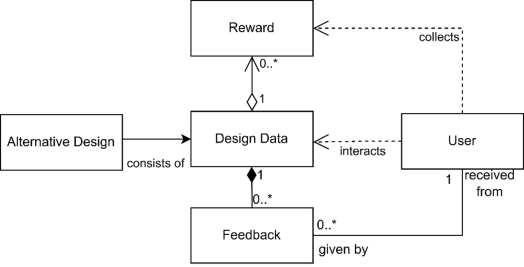
The overall framework connects all components into a unified conceptual model. It depicts how Design Data operates as the central node that links all others: users interact with Design Data, provide feedback on it, and receive rewards for their interactions (Figure 1). Alternative Designs serve as alternatives to the design data and can be categorized as entry points to the system. This framework demonstrates the flexible nature of gamified participation:
1. Users engage with design alternatives (Project Schema). 2. They provide feedback and reactions (Feedback Schema). 3. Their engagement generates points and rewards (Reward Schema). 4. The cycle reinforces continued participation, stored in their engagement profile (User Schema).
Figure 1: D-GAM integrates the user, project, feedback, and reward schemas into a unified gamification framework.
The framework’s flexibility lies in its functionality, because it operates at the project level; the schema can be deployed independently within any given participatory project, such as urban redevelopment, architectural proposal, or neighbourhood planning, or even as simple as planting a new Christmas tree in your neighbourhood, without changing or restructuring the entire system. Each project can be configured with specific reward logic, feedback mechanisms, and design data structures, allowing the schema to scale or adapt to the project. This flexibility ensures that gamification is not imposed uniformly but is customized to support each project’s goals, stakeholders, and data types.
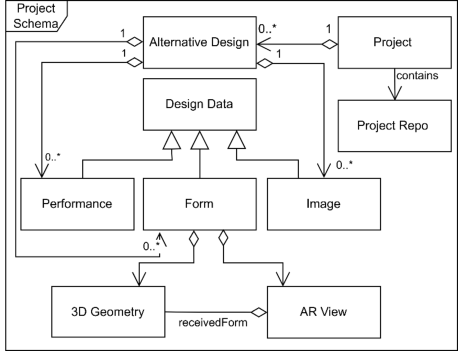
Project Schema The Project Schema serves as the framework’s structural core (Figure 2). It represents how design information, both spatial and performance-based, is organized and visualized. Each Project contains multiple Alternative
142 Raja and Erhan Designs, each with its own set of Design Data. The Project Repository stores and manages these alternatives, serving as a central data source that maintains traceability across all project instances. This allows users and designers to review, compare, and evaluate different design iterations within a project.
The Design Data is grouped into three representational modes: Visuals, Form (geometry), and Performance Data. These allow participants to explore design alternatives through various modes of visualization, making complex spatial and performance data accessible and interactive. The Performance Data component contains design-specific data, whereas the Form component includes 3D Geometry and an AR View. Additionally, the link between 3D Geometry and AR view is such that AR visualization is enabled by the received 3D models, allowing users to experience the design models in immersive, in situ contexts.
The schema’s multiplicity illustrates its flexibility and scalability: a single Project can contain multiple Alternative Designs, each Alternative Design can include several representations of Design Data, and each Design Data instance can be associated with multiple performance metrics or forms. This interconnected structure ensures that changes in one element—such as updating an alternative or performance parameter—are reflected across the system without redundancy.
Figure 2: Project Schema Framework represents how a project is structured through alternative designs and associated design data, including performance, form, images, and 3D/AR views.
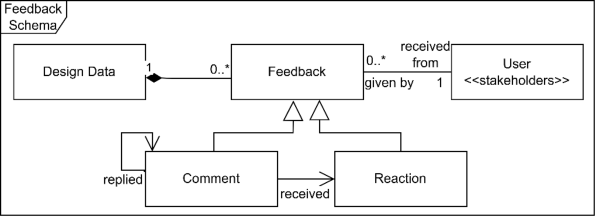
Feedback Schema The Feedback Schema models how participants communicate their perceptions and evaluations, ensuring that the system captures both detailed qualitative insights and quick responses (Figure 3). The Feedback is classified into Comment and Reaction, which accommodate different levels of engagement. Comments provide users with a space for in-depth feedback, while Reactions allow for quicker, more intuitive responses that still capture the user’s meaningful engagement and sentiment.
D-GAM: An Adaptable Gamification Framework for Enhancing Public Participation 143 Feedback is linked to a User and to the project’s Design Data. This relationship reflects the overall participatory logic of the schema, which is that the user’s role is to provide feedback, and feedback is received by the users, and the feedback is associated with the Design Data of a particular Alternative Design, showcasing that feedback can only exist if there is a project’s design data to review.
The Comment also supports a reply mechanism, allowing one comment to connect to another and enabling threaded discourse through its reflexive relationship. This feature encourages dialogue and collaboration, as users can respond to and build upon each other’s ideas. These relationships together ensure that all feedback remains traceable to both its author and its design context, making contributions accountable, meaningful, and eligible for reward.
Figure 3: Feedback Schema illustrates how user feedback, including comments and reactions, is associated with design data and contributed by stakeholders.
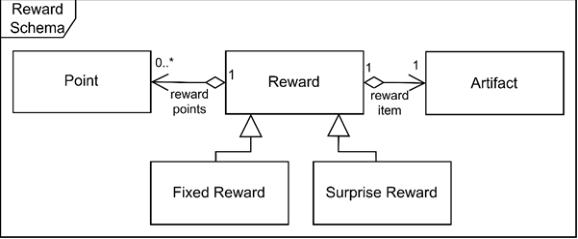
Reward Schema The Reward Schema is the motivational layer that translates user engagement into tangible, trackable rewards. The structure is built to support both intrinsic and extrinsic motivation.
The Reward Schema is classified into two types: Fixed Reward and Surprise Reward (Figure 4). Both the fixed and surprise rewards inherit the same core properties of a reward, but have different triggering instances/value/logic/rules. This structural choice supports both consistent participation (through Fixed Rewards) and exploratory behaviour (through Surprise Rewards) by varying the predictability of the incentive. Furthermore, rewards consist of Points (a measurable value that also helps track user progress) and Artifacts (the actual rewards granted for participation). Artifacts may take various forms, such as badges, tangible gift items (e.g., vouchers, gift cards), or other physical incentives.
This combination ensures that engagement is both quantifiable through points and meaningful through rewards that provide motivation, recognition, or real-world value. The multiplicity in this schema reflects the flexible relationship between entities: a single reward may correspond to multiple points earned across different interactions, while each artifact is uniquely associated with a single reward instance. Similarly, a user can accumulate multiple rewards over time, each associated with specific design-data evaluations.
Figure 4: Reward Schema illustrates the relationships among points, rewards, and reward artifacts, including both fixed and surprise reward types within the gamification framework.
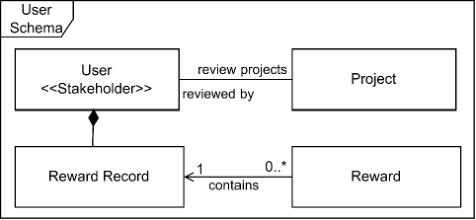
User Schema The User Schema defines stakeholder participation within the framework, capturing how each participant engages with projects and accumulates progress over time (Figure 5). The core User entity is bi-directionally linked to Projects, allowing the system to record which projects a user has reviewed and, conversely, which users have participated in each project. This relationship supports the user’s activity history and engagement scope (Project Repository). Each user is also associated with a Reward Record, which serves as a personalized history and repository for all earned rewards. This record depends on the user’s profile and stores specific reward details, which link back to the Reward Schema. Conceptually, the schema helps clarify the user’s active role in engaging with the platform. This positions the participant as a crucial and active contributor in the process of reviewing the alternatives.
Figure 5: User Schema: how stakeholders interact with projects and how earned rewards are stored and managed through a user’s reward record.
APPLICATION SCENARIO SOCIAL PARTICIPATION AND COMMUNITY INTERACTION Following the introduction of D-GAM, we present a scenario illustrating how the framework can be realized in a mobile app (Table 1). The scenario aims to explore whether the framework’s flexibility can support public participation goals. It is presented as a detailed narrative describing how
D-GAM: An Adaptable Gamification Framework for Enhancing Public Participation 145 participants interact with the gamified environment, provide feedback, and earn rewards based on their engagement. Our goal is to assess how it may offer a gamified project evaluation that adapts to varying contexts and stakeholder needs.
Table 1: An overview of gamification rewards as implemented.
Table available in the original PDF paper.
Reward Reward Attached Interaction Required for Reward
Reward Type Up to 10 Points Discourse Fixed Reward
User replies to at least two comments posted by others.
(Comments and Replies)
The scenario focuses on encouraging users to engage with one another through ongoing conversations within the platform. Participation in this scenario involves activities such as posting comments, reacting to others’ input, and contributing to reply chains, thereby enabling users to engage in shared discussions rather than acting individually. Rewards are designed to be earned through interaction, when users engage with at least two other participants. This scenario draws on the feedback, reward, and user components of the gamification framework to support community-oriented participation and sustained social interaction.
Context The project entails designing a new school building on 32nd Avenue, with three proposed alternatives (C-1, C-2, C-3). The designers seek to understand user opinions by engaging the community through their feedback channel. Their goal is to foster a dialogue among community members regarding the design proposal. By encouraging participants to respond to one another’s feedback, they aim to gather a broad range of perspectives. The reward system involves a fixed reward based on individual interactions within the feedback channel.
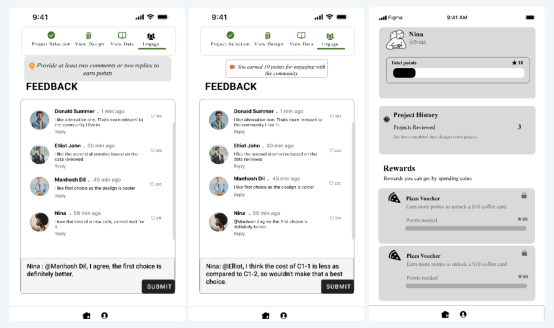
Persona Nina is a 41-year-old resident who prefers participating through discussion rather than through visual or technical exploration alone. She feels more confident expressing her thoughts when she can see, respond to, and build on others’ opinions. Nina begins by selecting the project and then navigates the different exploration phases. Nina explores the design data (form and data view). She notices that her progress bar advances upon completion of certain tasks, but no points or rewards are gained. Nina then moves to the Feedback Channel. In the feedback channel, a notification appears to earn points: “Interact with 2+ more people.” (Figure 6. L-Left). Upon viewing the notification, she decides to reply to User A regarding the proposal. The system registers Nina’s reply as an interaction, but the reward condition (interacting with 2+ people) has not yet been met. Nina then reads a separate comment posted by User B and posts a new comment that directly addresses User B’s comment. The system detects that Nina has now interacted with two
146 Raja and Erhan distinct users (User A and User B). The reward condition is met. A notification appears: “You earned 10 points for engaging with the community.”(Figure 6. L-Middle). Nina then navigates to her profile to view her progress and status (Figure 6. L-Right).
Summary This scenario demonstrates how social interaction can be encouraged through incorporating dedicated rewards in the discourse channel. By rewarding interaction with multiple unique users through comments and replies within the Discourse Channel, the system allows us to understand the opinions of the people through a collaborative approach and shifts the feedback from isolated to collective dialogue. Through dialogue, feedback collected is a representative of the community’s sentiment regarding the project and making this approach particularly effective in projects that seek shared decision-making.
Figure 6: The app utilizing D-GAM shows a notification condition for earning points, prompting the user to reply to another user (lower left). Upon replying with another comment to fulfill the condition, a notification appears indicating that 10 points have been earned (lower middle). The user can view their rewards in the profile section (lower right).
CONCLUSION
Building on existing gaps and leveraging gamification as an additional layer of motivation, this work presents D-GAM, a flexible gamification framework designed to support public participation in the review of built environment designs. Overall, the framework allows a given gamification configuration to be reinterpreted and reassembled for different projects without requiring complete reengineering of the system.
It facilitates incremental modification and extension and, because it is used at the project (content) level, can be customized to each project’s specific context. This feature makes D-GAM not just a gamification framework but also a design approach that can adapt to the changing needs of participatory processes in the built environment.
We also demonstrate D-GAM’s realization through a scenario and the framework’s applicability across system-to-project-level approaches. The scenario highlights that social participation and community interaction are motivated by custom-configured gamification mechanisms. Our contributions focus on establishing a clear model of the framework and scenario to guide future implementations. The framework and scenario together provide a foundation for future work, in which interactive prototypes, visual representations, and empirical user studies can be introduced to explore, in detail, usability, engagement, and participation outcomes.
ACKNOWLEDGMENT
This work was supported by the Social Sciences and Humanities Research Council (SSHRC), Insight Development Grant, Canada [430-2024-00741] and ethics approval from Simon Fraser University [30003098].
The authors declare that GenAI Grammarly was used for editorial support.
REFERENCES
Arnstein, S. R. (1969). A ladder of citizen participation. Journal of the American Institute of Planners, 35(4), 216–224. Chang, K.-E., Wu, L.-J., Weng, S.-L., & Sung, Y.-T. (2012). Embedding game-based
problem-solving phases into problem-based learning to improve students’ learning performance and motivation. Computers & Education, 63, 77–86. Csikszentmihalyi, M. (1990). Flow: The psychology of optimal experience. Harper & Row. Deterding, S., Dixon, D., Khaled, R., & Nacke, L. (2011). From game design elements
to gamefulness: Defining gamification. In Proc. of the 15th Int. Academic MindTrek Conference: Envisioning Future Media Environments (pp. 9–15). ACM. Foldit. (2008). Foldit: A protein puzzle game. https://fold.it/ Gordon, E. (2010). Participatory Chinatown. Engagement Lab. https://engagementlab.
work/research/projects/participatory-chinatown/ Gordon, E. (2012). Community PlanIT. Engagement Lab. https://engagementlab.
work/research/projects/community-planit/ Hamari, J., Koivisto, J., & Sarsa, H. (2014). Does gamification work? A literature review of empirical studies on gamification. In Proceedings of the 47th Hawaii International Conference on System Sciences (pp. 3025–3034). IEEE.
148 Raja and Erhan Hamari, J., Shernoff, D. J., Rowe, E., Coller, B., Asbell-Clarke, J., & Edwards, T.
(2016). Challenging games help students learn: An empirical study on engagement, flow, and learning in video games. Computers in Human Behavior, 54, 170–179. Huotari, K., & Hamari, J. (2017). A definition for gamification: Anchoring gamification in the service marketing literature. Electronic Markets, 27(1), 21–31. Nabatchi, T., & Leighninger, M. (2015). Public participation for 21st-century
democracy. John Wiley & Sons. Rowe, G., & Frewer, L. J. (2005). A typology of public engagement mechanisms.
Science, Technology, & Human Values, 30(2), 251–290. Ryan, R. M., & Deci, E. L. (2020). Intrinsic and extrinsic motivation from a selfdetermination theory perspective: Definitions, theory, practices, and future directions. Contemporary Educational Psychology, 61, 101860. Schnädelbach, H. (2010). Adaptive architecture: A conceptual framework. In Proc.
of the SIGCHI Conf. on Human Factors in Computing Systems (pp. 313–322). ACM. Skinner, B. F. (1963). Operant behavior. American Psychologist, 18(8), 503–515. Wang, Y., & Sun, J. (2011). Game reward systems: Gaming experiences and social meanings. In Proceedings of the 5th International Conference on Digital Game and Intelligent Toy Enhanced Learning (pp. 1–8). IEEE. Werbach, K., & Hunter, D. (2012). For the win: How game thinking can revolutionize
your business. Wharton Digital Press. Zichermann, G., & Cunningham, C. (2011). Gamification by design: Implementing game mechanics in web and mobile apps. O’Reilly Media.
LISTED IN THE AHFE DIGITAL BOOKSTORE CATALOGUE
Explore the complete digital volume
Human Factors in Architecture, Sustainable Urban Planning and Infrastructure
Read this individual research paper free through the original publisher, or explore the full digital proceedings book.
ISBN 979-8-950676-05-5
Explore this ISBN in the AHFE Bookstore ↗Listed in the July 2026 bookstore catalogue; search by ISBN to confirm current availability · Digital book purchase optional