Cunxin tao, Ying Cao, Peiyao Cheng (2026). The Inheritance and Innovation of Blue Calico Culture Driven by AIGC: Exploring the Generative AI Design Framework and Craft Visualization. In: Human Factors in Communication of Design. AHFE Open Access, vol. 216, pp. 171–181. https://doi.org/10.54941/ahfe1007635
Chinese Blue Calico is a representative form of traditional Chinese handcrafted textile printing and dyeing and has been recognized as an important item of intangible cultural heritage. It is particularly renowned in regions such as Nantong in Jiangsu Province and Tongxiang in Zhejiang Province. The craft employs resist-printing techniques and natural crackle effects to produce exquisite patterns imbued with auspicious cultural meanings, exhibiting distinctive aesthetic and cultural value. However, the design of calico patterns and the creation of three-dimensional artifacts constitute a technically complex process with high aesthetic demands. This process typically requires long-term training and a profound understanding of traditional craftsmanship, which has, to some extent, limited the broader dissemination and sustainable transmission of Blue Calico culture. To address these challenges, this study proposes an AI-assisted approach that leverages AIGC technologies to facilitate the dissemination of Blue Calico culture, provide creative support for cultural inheritors, and enable the visualization of traditional craftsmanship. First, we conduct a comprehensive investigation into the role of artificial intelligence in the Blue Calico craft, identifying core techniques, pattern typologies, and cultural connotations to explore potential opportunities for AI integration. Subsequently, by optimizing cultural annotations and training parameters, we develop an AI-driven framework termed “AI Calico.”
Blue Calico is a traditional Chinese textile printing and dyeing craft with a long history (Ou et al., 2017). It is typically produced on cotton fabric using natural indigo dye, with patterns created through resist printing using carved stencil plates (He & Tao, 2025). The production process includes stencil carving, paste application, dyeing, and paste removal. During repeated dyeing and drying, fine cracks form naturally in the paste layer, creating irregular textures known as a “natural imprint.” This feature gives Blue Calico high visual recognize ability and aesthetic value (Sun et al., 2024). Its characteristic “white motifs on a blue ground” often depict folk symbols
and daily imagery, such as Phoenix Playing with Peonies and Five Blessings Embracing Longevity, which express wishes for prosperity, longevity, and harmony. Regional styles further shape its visual language. Nantong Blue Calico in Jiangsu Province is known for structured and framed compositions, while works from Tong xiang in Zhejiang Province reflect the Jiangnan water-town landscape through poetic themes such as Hundred Children and Fishing Boats at Dusk. Since the 1950s, Blue Calico has regained public attention and was listed as a National Intangible Cultural Heritage of China in 2006. Owing to its distinctive techniques and cultural symbolism, it holds an important position in traditional Chinese textile art.
Despite its cultural value, Blue Calico production relies heavily on manual skills and long-term experience, resulting in long production cycles and high technical barriers. Designers must balance pattern design, form composition, and cultural meaning, and errors at any stage can affect final quality. In modern society, industrial and digital production methods have reduced the number of skilled artisans, making it difficult for younger designers to engage with the craft and limiting sustainable transmission(He & Tao, 2025). Recent developments in digital media and generative artificial intelligence offer new possibilities for traditional crafts. While some digital methods improve efficiency at the cost of cultural depth, AIGC technologies enable automated image and pattern generation and have been applied to crafts such as cloisonné, Su embroidery, and Dunhuang murals (Xie, 2022; Gîrbacia, 2024). However, AI models still face challenges in fully capturing the material logic and cultural semantics of Blue Calico. To address these issues, this study proposes an AI-driven design framework called AI Calico, which uses natural-language input and a LoRA-fine-tuned Stable Diffusion model to generate design concepts that preserve key aesthetic features while improving efficiency and creative flexibility.
RESEARCH BACKGROUND AND RELATED WORK This section reviews Blue Calico and related research to support an understanding of its craft characteristics and digital transformation. It focuses on four aspects: the characteristics of Blue Calico, its inheritance and development, the evolution of artificial intelligence, and the application of AI in Chinese traditional culture.
Comprehensive Study of Blue Calico Blue Calico is a traditional cotton printing and dyeing craft that produces refined patterns through stencil making, paste application, dyeing, and paste removal. Each stage requires precise manual control of color absorption, texture clarity, and pattern edges, which together define its material quality and artistic value. By organizing stable visual and technical features, structured knowledge can be formed to support digital preservation and design innovation (Sun et al., 2024).
Traditionally, cotton fabric and natural indigo are used as core materials. Resist paste is applied through carved stencils, followed by indigo dyeing and paste removal. During dyeing, natural cracks form in the paste layer, creating
The Inheritance and Innovation of Blue Calico Culture Driven by AIGC 173 irregular “ice crackle” textures that have become a distinctive visual feature. Typical patterns include plants, animals, and folk symbols such as phoenixes, peonies, fish, and bats (Ye et al., 2015).
These motifs often use symmetry, repetition, and positive–negative space, reflecting folk aesthetic logic and cultural symbolism. Beyond decoration, Blue Calico carries social and cultural meaning. It reflects everyday life and value systems in southern China and preserves collective memory and regional identity (Zhou et al., 2022). Previous studies emphasize that its protection should address both technical processes and embedded cultural narratives.
Inheritance and Development of Blue-Printed Fabric Recent research on Blue-Printed Fabric mainly examines historical development, production techniques, and digital innovation. Wang et al (2020). applied an improved DCGAN to redesign traditional patterns by integrating modern graphic features. He (2022) proposed a style transfer method based on an enhanced CycleGAN to improve texture and color quality in generated images. Yu et al (2022). evaluated pattern recognition methods on the NtBC dataset and reported a 93.8% accuracy using ResNet-50, demonstrating the effectiveness of deep learning in pattern classification. These studies indicate that the key challenge lies in preserving craft characteristics and cultural meaning while introducing modern design methods. Digital and AI-based tools provide new possibilities to reduce technical barriers and support creative expansion, which motivates the approach adopted in this study.
Development of Artificial Intelligence Technologies Artificial intelligence initially relied on rule-based systems and symbolic reasoning, which showed limited adaptability in complex environments. With increased computing power and data availability, machine learning and deep learning became dominant approaches. Convolutional neural networks advanced image analysis, while recurrent models supported sequence and language tasks (LeCun et al., 2015). Generative models further expanded AI capabilities. Generative Adversarial Networks introduced adversarial learning for data distribution modeling (Goodfellow et al., 2014). Diffusion models improved image quality and stability through iterative noise removal (Ho et al., 2020). Large language models extended generative ability to text and multimodal content through large-scale training. These advances support creative generation, early design exploration, and complex semantic learning (Spennemann, 2024).
Applications of Artificial Intelligence in Chinese Traditional Culture Artificial intelligence is increasingly applied in the documentation, preservation, and innovation of Chinese traditional culture. Image recognition and classification support digital archiving of cultural artifacts, while generative models enable pattern creation and style learning in crafts such as embroidery, ceramics, murals, and textiles (Garozzo et al., 2021). In China, AIGC technologies are used in heritage education, exhibition design,
and digital storytelling. Controlled model training enables the reproduction of traditional visual styles and cultural symbols, while interactive AI tools allow non-experts to participate in cultural creation (Li et al., 2025). These applications highlight AI’s role in supporting the balance between tradition and innovation in cultural practices.
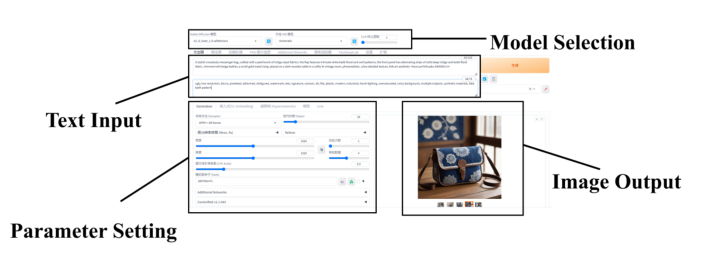
USER INTERFACES OF AI CALICO The production of Blue Calico is a complex process that integrates technical craftsmanship with artistic design. Designers must coordinate pattern composition, texture, color, and production methods to achieve two- or three- dimensional outcomes. This craft depends heavily on manual labor and long production cycles, which limits design efficiency and cultural dissemination in contemporary contexts. To address these limitations, this study proposes an AI-assisted design system, AI Calico. The system integrates generative AI technologies, including Stable Diffusion, LoRA, and ControlNet, to support digital visualization and creative generation of Blue Calico designs. By embedding traditional visual features into the generative process, AI Calico reduces technical barriers while improving design efficiency and expressive diversity. Stable Diffusion WebUI is adopted as the system control platform (Figure. 1). The interface simplifies model operation and integrates key functions such as text-to-image generation, image refinement, and model loading, providing a practical environment for creative exploration and system deployment.
Figure 1: Stable Diffusion Web - UI interface.
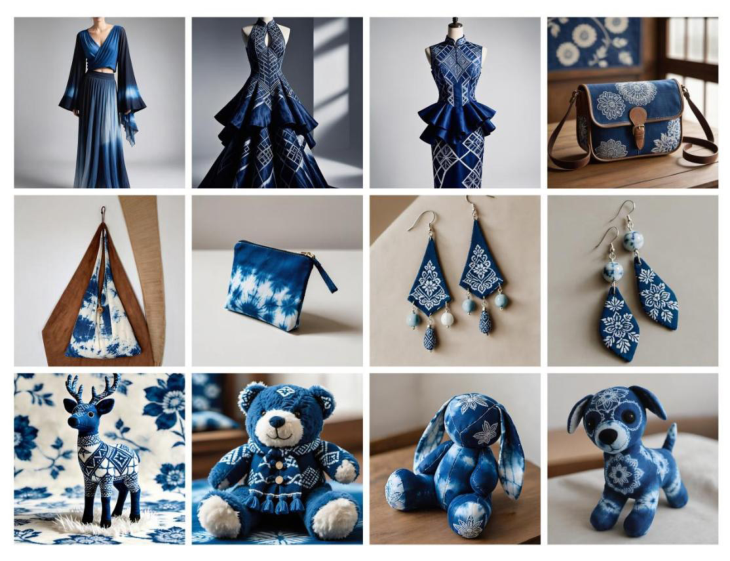
Text-to-Image (T2I) Divergent Generation One of the core functions of the AI Calico system is an intelligent image generation module based on Text-to-Image (T2I) diffusion models (Figure 2). T2I diffusion models generate images by learning a gradual denoising process in latent space, which allows the model to reconstruct high-quality visual outputs that correspond to given textual descriptions.
The Inheritance and Innovation of Blue Calico Culture Driven by AIGC 175 Through this mechanism, the model establishes a semantic mapping between natural language prompts and visual features, enabling the generation of images with specified styles, structures, and content.
In traditional Blue Calico design, early-stage ideation requires extensive manual reference collection, which is time-consuming and experience- dependent. Within the system, designers can input concise textual prompts related to the creative task, including product type, pattern style, structural form, thematic concepts, or cultural imagery. Based on these inputs, the T2I module generates multiple semantically consistent image candidates in a short time. This approach enables designers to explore a wide range of visual directions without extensive manual intervention and supports rapid iteration at the concept development stage.
The system also allows flexible adjustment of generation parameters, such as image resolution, output quantity, and style-related controls. During the generation process, AI Calico applies LoRA-fine-tuned models that embed the distinctive visual characteristics of Blue Calico, ensuring that the generated results remain aligned with traditional aesthetic features. The output images can be used as visual references or as intermediate design materials for subsequent stages, such as pattern refinement, compositional optimization, and cultural symbol extraction. Through the T2I divergent generation function, AI Calico enables an efficient transition from textual ideation to visual representation and provides intelligent support for the digital innovation of Blue Calico design.
Figure 2: The T2I generation.
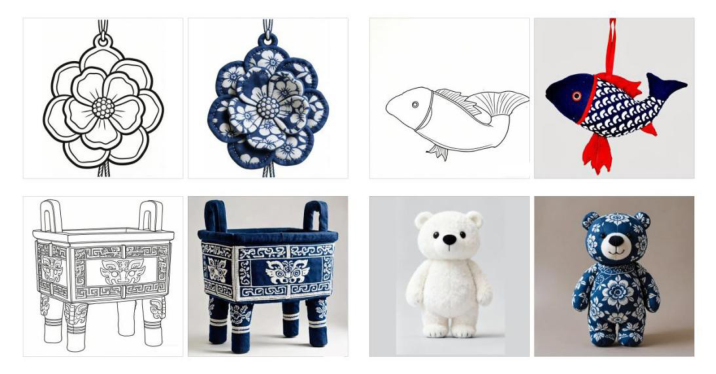
Image-to-Image (I2I) Iterative Generation Another core function of the AI Calico system is Image-to-Image (I2I) iterative generation, which extends the capabilities of the Text-to-Image model by introducing greater control over structure and visual transformation (Figure 3). This function supports personalized redesign based on existing visual references and enables designers to refine or reinterpret images through controlled generative processes. The I2I module integrates the ControlNet plugin to achieve structure-aware image generation. ControlNet is a conditional network built on diffusion models that preserves key structural information from an input image, such as contours, spatial layout, and overall composition. At the same time, it guides the model to apply target visual styles and texture features during generation. This mechanism allows the system to maintain structural consistency while enabling stylistic modification, thereby balancing visual stability and creative transformation. In practical use, designers upload a reference image and adjust the image weight parameter according to specific design goals. Higher weight values lead to outputs that closely follow the original image in terms of composition and detail, while lower values allow greater variation and stylistic reinterpretation. Once the generation process begins, AI Calico combines the specified parameters with LoRA-fine-tuned models to perform style transfer and pattern reconstruction. The resulting images reflect the visual characteristics and craft features of Blue Calico while retaining the structural foundation of the reference image.
This module supports multi-round iterative refinement, allowing designers to gradually optimize visual outcomes through repeated adjustments. It provides a controllable workflow that balances creative flexibility with traditional visual logic.
Figure 3: The example of I2I iteration process of sketches to renderings.
The Inheritance and Innovation of Blue Calico Culture Driven by AIGC 177 Workflow of AI Calico
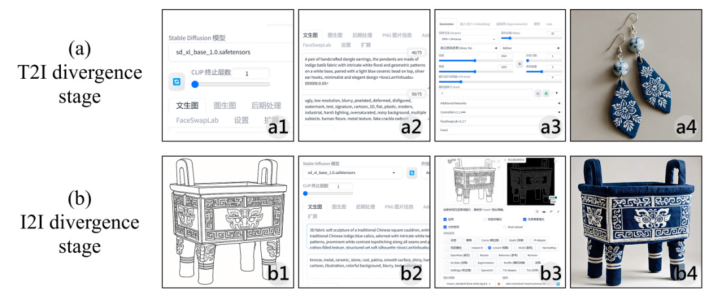
The overall workflow of AI Calico is illustrated using the design of Blue Calico earrings as an example (Figure 4). The process includes three stages: T2I divergent generation, I2I iterative generation, and result selection. In the T2I stage, designers input keywords such as “Blue Calico patterns” or “ethnic decorative elements,” and the system generates multiple design proposals for exploration. In the I2I stage, sketches or reference images are uploaded for further refinement using structural constraints and style adaptation. In the final stage, designers select suitable outputs and perform additional adjustments as needed. The final stage is the result selection and output stage. Designers review the generated image sets and select suitable results based on specific design goals.
Figure 4: In the Text-to-Image (T2I) divergence stage, users can carry out the following steps: (a1) select the T2I function, (a2) enter the corresponding prompts, (a3) tweak the image generation parameters, and (a4) check the final generated outputs. In the Image-to-Image (I2I) iteration stage, the process involves: (b1) uploading a design sketch or reference picture, (b2) inputting specific prompts, (b3) adjusting the ControlNet configurations, and (b4) reviewing the generated image results.
IMPLEMENTATION OF BLUE CALICO GENERATION Implementation of Blue Calico Generation
This section describes the implementation of the AI Calico system. The system combines Stable Diffusion with LoRA fine-tuning to capture and reproduce the visual style and artistic characteristics of Blue Calico through deep learning. The objective is to train a domain-specific LoRA model capable of generating high-fidelity images that reflect representative Blue Calico patterns. The implementation consists of three main steps: (1) collecting and preprocessing Blue Calico images to construct a dedicated training dataset; (2) fine-tuning the diffusion model using the LoRA algorithm to learn characteristic visual features; (3) deploying the trained model within the Stable Diffusion framework to support image generation and creative applications.
This pipeline provides a technical basis for the digital reproduction and intelligent generation of Blue Calico designs.
Data Collection and Preprocessing Data Collection
High-quality images paired with accurate textual descriptions are required for LoRA training. This study collected Blue Calico samples including traditional motifs, finished products, and texture details, with corresponding captions to ensure clear text–image alignment. The dataset covers styles from different regions, periods, and design variations. To enhance reliability and cultural authenticity, images from museum catalogues, academic publications, and intangible cultural heritage monographs were included. Samples with low resolution, duplication, or weak stylistic features were removed through manual screening. After filtering, 73 representative images were retained as the final training dataset.
Image Preprocessing All images were processed using a standardized preprocessing pipeline to improve training stability and convergence. The procedures focused on maintaining visual consistency while preserving key pattern features and included resolution normalization, noise reduction, color correction, and visual enhancement. As Stable Diffusion XL (SDXL 1.0) operates at a resolution of 1024 × 1024 pixels, all images were resized to this standard using Adobe Photoshop and ComfyUI workflows. Cropping, proportional scaling, and padding were applied to preserve central composition and avoid distortion. Additional adjustments such as contrast enhancement and tonal balancing further improved image clarity.
Label Optimization To improve semantic accuracy, automatic captions generated by the CLIP model were supplemented with manual refinement. Automatic annotations often fail to fully describe the complex patterns and cultural meanings of Blue Calico, leading to vague or incomplete semantics. A structured labeling scheme was therefore introduced, describing images across multiple dimensions including visual appearance, perspective, color composition, and pattern content. This approach enables clearer representation of motif types, layout features, symbolic elements, and stylistic traits. By combining automated captioning with manual optimization, the final dataset more accurately reflects the visual logic and cultural characteristics of Blue Calico, providing stronger guidance during LoRA training and improving stylistic consistency in generated results.
The Inheritance and Innovation of Blue Calico Culture Driven by AIGC 179 Model Training and Optimization
Learning Rate Optimizer The learning rate optimizer determines how model parameters are updated during training. In this study, AdamW8bit was selected for LoRA fine- tuning based on training stability, memory efficiency, and computational cost. AdamW decouples weight decay from gradient updates, which helps reduce overfitting and improves generalization. This is particularly suitable for Blue Calico datasets, where sample size is limited and stylistic consistency is critical. The 8-bit implementation further reduces GPU memory usage by storing optimizer states in lower precision, enabling high-resolution training at 1024 × 1024 under constrained hardware conditions. Despite reduced precision, AdamW8bit maintains stable convergence behavior comparable to standard AdamW. Therefore, it was adopted as the optimizer for the Blue Calico LoRA model.
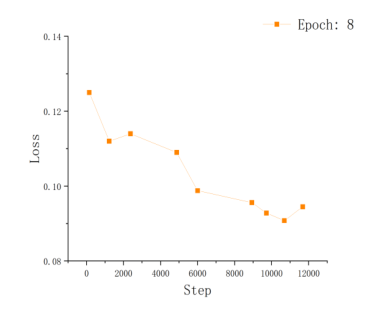
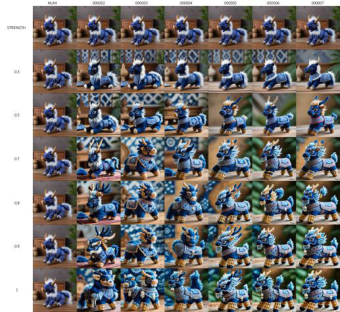
Model Training Procedure The number of training steps directly affects model performance. Too few steps lead to insufficient learning, while excessive steps increase the risk of overfitting. In this study, the total number of LoRA training steps was calculated using Equation (1), which considers the number of images, repeat value, epochs, and batch size to balance learning adequacy and generalization. The repeat value controls how often each image is sampled during training. Given the smalsl dataset size and strong stylistic features of Blue Calico, the repeat value was set to 20 to enhance feature learning without increasing dataset scale. The dataset contained 73 images, with a batch size of 1 and 4 training epochs. Regularization images were introduced to improve generalization. Training loss decreased steadily during optimization (Figure 5), indicating stable convergence. Additional evaluation using the XYZ Plot script (Figure 6) showed increasing alignment between generated results and reference images as training progressed, confirming improved fidelity and stylistic consistency.
Figure 5: The loss value for model.Figure 6: The XYZ plot script.
CONCLUSION
This study demonstrates the potential of AI Calico to support the design and dissemination of Blue Calico patterns using generative AI technologies. By integrating AIGC models with traditional craft knowledge, the system facilitates the visualization of cultural motifs, reduces technical barriers, and supports creative exploration. User studies indicate that AI Calico can enhance both aesthetic and functional aspects of design, offering a new pathway for digital innovation in traditional crafts. However, further work is needed to improve model generalization, expand the dataset, and refine semantic annotations to better capture complex stylistic and cultural features. Extending the framework to other traditional crafts could transform AI Calico into a versatile tool for the preservation and innovation of intangible cultural heritage. By bridging technology and cultural practice, AI Calico represents a promising approach for the sustainable digital evolution of traditional design knowledge.
ACKNOWLEDGMENT
This work was supported by Guangdong Philosophy and Social Sciences Foundation (Grant no. GD25YYS18).
REFERENCES
Garozzo, R., Santagati, C., Spampinato, C., & Vecchio, G. (2021). Knowledge-based generative adversarial networks for scene understanding in Cultural Heritage. Journal of Archaeological Science: Reports, 35, 102736. Goodfellow, I. J., Pouget-Abadie, J., Mirza, M., Xu, B., Warde-Farley, D., Ozair,
S., ... & Bengio, Y. (2014). Generative adversarial nets. proceedings of the 27th international conference on neural information processing systems-volume 2. NIPS’14. MIT Press, 2672–2680. Gîrbacia, F. (2024). An analysis of research trends for using artificial intelligence in cultural heritage. Electronics, 13(18), 3738.
The Inheritance and Innovation of Blue Calico Culture Driven by AIGC 181 He, J., & Tao, H. (2025). Applied research on innovation and development of blue
calico of Chinese intangible cultural heritage based on artificial intelligence. Scientific Reports, 15(1), 12829. He, J., & Tao, H. (2025). Applied research on innovation and development of blue calico of Chinese intangible cultural heritage based on artificial intelligence. Scientific Reports, 15(1), 12829. He, J., & Tao, H. (2025). Applied research on innovation and development of blue
calico of Chinese intangible cultural heritage based on artificial intelligence. Scientific Reports, 15(1), 12829. Ho, J., Jain, A., & Abbeel, P. (2020). Denoising diffusion probabilistic models.
Advances in neural information processing systems, 33, 6840–6851. LeCun, Y., Bengio, Y., & Hinton, G. (2015). Deep learning. nature, 521(7553), 436–444. Li, X., Lin, J., & Zhang, X. (2025). Dynamic transmission and innovative
transformation of cultural heritage: Generative artificial intelligence practices based on cultural cognitive models. Applied Sciences, 15(23), 12651. Ou, B. Y., Ye, H. G., & Li, B. (2017, February). Study on the Origin of Nantong Blue Calico. In 2017 2nd International Conference on Humanities and Social Science (HSS 2017) (pp. 263–267). Atlantis Press. Spennemann, D. H. (2024). Generative artificial intelligence, human agency and the
future of cultural heritage. Heritage, 7(7), 3597. Sun, K. K., Huang, J. W., Yuan, Y. Y., & Chen, M. Y. (2024). Classification and recognition of the Nantong blue calico pattern based on deep learning. Journal of Engineered Fibers and Fabrics, 19, 15589250241270618. Sun, K. K., Huang, J. W., Yuan, Y. Y., & Chen, M. Y. (2024). Classification and
recognition of the Nantong blue calico pattern based on deep learning. Journal of Engineered Fibers and Fabrics, 19, 15589250241270618. Wang, Y., & Fu, R. (2020, July). Research on the regenerated design of blue calico based on computer image processing. In International Conference on Human- Computer Interaction (pp. 428-438). Cham: Springer International Publishing. Xie, J. (2022). Innovative design of artificial intelligence in intangible cultural
heritage. Scientific Programming, 2022(1), 6913046. Ye, H. G., Ou, B. Y., Li, Q., & LI, B. (2015, December). Study on the Relationship between Nantong Blue Calico and Paper-Cut Art. In 2nd Annual International Conference on Social Science and Contemporary Humanity Development (pp. 173-177). Atlantis Press. Yu, X., Zhang, L., & Shen, M. (2022, July). Nantong blue calico image dataset
and its recognition. In 2022 IEEE Congress on Evolutionary Computation (CEC) (pp. 1–7). IEEE. Zhou, S., Fu, K., Chu, Y., & Li, Y. (2022, November). A Study on the Learning Effectiveness of Serious Games in the Intangible Cultural Heritage: –A case study of Nantong Blue Calico in China. In Proceedings of the 2022 6th International Conference on Education and E-Learning (pp. 81–87).
LISTED IN THE AHFE DIGITAL BOOKSTORE CATALOGUE
Explore the complete digital volume
Human Factors in Communication of Design
Read this individual research paper free through the original publisher, or explore the full digital proceedings book.
ISBN 978-1-964867-92-2
Explore this ISBN in the AHFE Bookstore ↗Listed in the July 2026 bookstore catalogue; search by ISBN to confirm current availability · Digital book purchase optional