Zhiyu Zhao, Yu Gu (2026). Digital Cultural and Creative Customization of Intangible Cultural Heritage under Human-AI Collaboration: A Case Study of Yunnan Tile-Cat. In: Human Factors in Communication of Design. AHFE Open Access, vol. 216, pp. 299–310. https://doi.org/10.54941/ahfe1007646
While Artificial Intelligence Generated Content (AIGC) provides new pathways for the digital innovation of intangible cultural heritage (ICH), current applications often lack a critical methodological framework and view users as passive consumers. To address this gap, this study centers on a key research question: compared with the traditional model where users only passively receive or give feedback on ICH cultural and creative products, how can the human-AI co-creation model empower ordinary users without professional design skills to take the initiative in creating and reinterpreting ICH? The paper focuses on the Yunnan Tile-Cat (Wamao), a unique regional architectural ornament and an endangered intangible cultural heritage, and builds a simple working demo to show how the idea works. Through a formative evaluation, the study examines a dual collaborative workflow. The AI + designer phase speeds up cultural data integration and visual conceptualization. Subsequently, the AI + user mechanism enables public participation through real-time 2D to 3D modeling and AR interaction. This collaborative approach productively reduces creative barriers and improves cultural identity. The findings add to design knowledge by showing that, while AI democratizes creative participation, human designers must actively intervene to overcome AI's semiotic limitations in culturally sensitive settings.
Digital cultural and creative (DCC) products are now a core driver transforming the traditional cultural and creative sector, as digital technologies reshape the global industry. By bringing together new digital tools, DCC products bridge traditional culture and modern creativity, making cultural storytelling more dynamic and opening up fresh ways to reinterpret cultural value. Despite all this progress, sharing intangible cultural heritage (ICH) online still feels stuck. Most efforts stop at surface-level interaction, focusing on broadcasting information rather than inviting people to truly engage and participate (Zhang et al., 2023).
This study selects the Yunnan Tile-Cat (Wamao), an iconic architectural ICH item from southern China, as its case study for three core reasons.
300 Zhao and Gu Traditionally, tile-cats sit right on top of old-style roofs and they’re way more than just decoration (Meng & Yu, 2023). It is a powerful physical expression of local ethnic beliefs, blending ancestral totem worship with everyday hopes for family safety and prosperity (Luo et al., 2024). However, this culturally significant symbol faces two challenges. Its physical form is at risk, which is held back by remote locations, slow handmade production, and a growing gap between traditional craftsmanship and today’s tastes. Moreover, its existing digital dissemination falls into the aforementioned superficial trap, failing to translate its strong cultural connotations into interactive, resonant experiences for the public.
Therefore, this study explores how AI and non-expert users can co-create tile-cat cultural products together. Traditional cultural and creative production relies heavily on professional craftsmanship and technical expertise, which systematically excludes the general public from the core creative process. In contrast, participatory design theory advocates for empowering non-expert users as co-creators of cultural value, rather than passive end consumers (Sanders & Stappers, 2008). However, this conceptual ideal remains difficult to implement due to the high technical threshold of AI-driven creative production. AIGC tools make it possible for ordinary people to redesign tile- cat images without learning professional software.
Accordingly, this study proposes a human-AI co-creation model as the core theoretical framework for ICH digital innovation. To implement this model, the authors develop a two-stage collaborative workflow, which consists of an AI + designer pre-design calibration phase and an AI + user participatory co-creation phase. This paper also presents the systematic design and formative evaluation of a custom-built interactive demo. This design procedure allows for a critical analysis of the dual-stage collaborative workflow. The AI + designer phase, which unpacks both the efficiency gains and inherent semiotic limitations of AI in culturally sensitive ICH translation. Furthermore, the AI + user phase, which empirically assesses how the model reshapes non-expert users in ICH reinterpretation.
THE APPLICATION OF AI AND SEMIOTIC REFLECTION IN DIGITAL CULTURAL AND CREATIVE DESIGN PROJECTS AI-Assisted in Project Conceptualization and Preliminary Development
In the preliminary stage of this study, designers can use generative AI to address the core challenge of high time cost in cultural information collection and market research for ICH design. General-purpose AI models with big data analysis capabilities can rapidly integrate historical records of ICH from ancient literature, public sentiment from social media, and market preference data from online retail platforms. It greatly improves the efficiency of pre- design conceptualization (Zhou et al., 2024; He, 2024).
Beyond efficiency improvement, AI also helps avoid wrong information of early-stage design work. Using algorithms, AI can filter out false information to improve the efficiency of conceptualization during the early design stage (Akhtar et al., 2023). AI helps designers rapidly synthesize large amounts of
Digital Cultural and Creative Customization of Intangible Cultural Heritage 301 user information to achieve accurate matching between users and products (Yang et al., 2024). This AI-assisted preliminary work can build a complete, culturally accurate knowledge system and clear user demand framework for the project, which provides solid support for the mid-term visual design and subsequent user co-creation phases.
AI-Assisted Generation of Effect Pictures in Mid-Term Stage The mid-term stage centers on AI-assisted effect image generation. AI image generation technology modifies the core creative workflow. By relying on AI algorithms, designers can automatically generate high-quality images based on specified styles and reference materials (Liu et al., 2024). This AI-powered intelligent design system compresses the process from creative concept to visual output into an instant feedback loop. When receiving semantic commands, the system accesses an extensive design material database, analyzes core visual elements including color schemes and structural ratios, and generates initial draft images. Designers and AI then collaborate to review, screen and refine design concepts to complete the main design direction (Zhao, 2025).
This AI system allows for more flexible input methods beyond text input, such as line drawings, semantic annotations, and pose parameters. Beyond plain-text generation commands, designers can upload line-drawing sketches, annotate semantic maps. For example, they can specify a 45-degree top- down viewing angle or detachable modular structure. Or they can input pose parameters such as dynamic tension manifestation or symmetrical aesthetic composition to guide the algorithm to generate more accurate base models. Meanwhile, AI is constantly pushing the limits of design, which ranges from realistic to abstract, and from local cultural symbols to entirely new visual languages. This gives designers more creative freedom than ever. It also makes it easier to deliver personalized designs for real-world projects.
Semiotic Tensions and AI-Assisted Generation in Late Stage Following the initial generation and iteration of visual concepts, the project enters the late stage of digital product development. In this phase, AI provides technical support for reconstructing the modern expression method of cultural symbols. Its practical application still meets a critical bottleneck: the lack of accuracy in the translation of cultural symbols (Zhao & Zang, 2024). Therefore, drawing on Charles Sanders Peirce’s triadic semiotic theory, this study will framee the Yunnan Tile-Cat as a complete semiotic system. The physical tile-cat artifact and its embedded folk cultural connotations constitute the object. The AI-generated visual models and patterns serve as the representamen and sign vehicle. Users’ understanding of the tile-cat’s folk beliefs and cultural meanings, together with their personalized creative interpretations, form the interpretant (Chandler, 2007).
Based on this framework, a fundamental semiotic limitation of generative AI is revealed when processing culturally encoded ICH symbols. AI only operates at the level of the representamen. It can efficiently replicate the visual form and geometric outline of the tile-cat, but cannot decode the deep cultural connotations of the object, nor can it actively construct the interpretant that
302 Zhao and Gu carries the folk beliefs of blessing, protection, and household safety. This means AI often misinterprets cultural details, in both 2D images and 3D models. For example, it turns the whisker pattern which symbolizes warding off evil into a plain decorative line.
In 2D visual design, AI frequently misinterprets the tile-cat’s culture-bearing details. For example, it can accurately reproduce the tile-cat’s triangular ears, curved back, and open-mouth shape, but often misinterprets the whisker pattern, which is an element symbolizing exorcism and auspiciousness in folk culture, as a plain decorative line, thereby stripping the open-mouth form of its sacred connotation of guarding the house and praying for fortune.
These semiotic biases are additionally increased in AI-generated 3D models, which form the core basis for the subsequent user co-creation phase. When generating 3D tile-cat models, AI still exhibits consistent interpretive deviations. While it can rapidly produce preliminary 3D prototypes via tools like Tripo AI, it often simplifies or distorts 3D structural details that carry core cultural connotations. For example, flattening the tile-cat’s curved ridge structure that symbolizes steady fortune, or standardizing the custom facial details that reflect regional ethnic differences.
These challenges fully expose the inherent limits of AI in culturally sensitive ICH design, and validate the necessity of a standardized collaborative workflow: AI generation, manual calibration, and semiotic reinterpretation. In this study, designers will use AI to complete the initial generation of 2D visuals and 3D prototypes, then conduct secondary validation and calibration of the cultural elements’ visual representation based on semiotic theory. This human-AI collaborative approach offsets AI’s technological limitations using designers’ cultural decoding capabilities, striking a critical balance between accurate symbolic representation and refined artistic expression. More importantly, this calibrated, culturally accurate 2D and 3D prototype framework lays a solid basis for the subsequent AI + user co-creation phase, assuring that users’ personalized creations remain rooted in the authentic cultural connotations of the tile-cat.
AI+MODEL DIGITAL CULTURAL AND CREATIVE CUSTOMIZATION OF YUNNAN TILE-CAT AI + Designer Preliminary Stage of Design Project
During the project conceptualization stage, the authors utilized Kimi AI. Using an efficient question-posing and data integration mechanism, they quickly sifted through a large amount of literature resources. Historical information was extracted from ancient texts, while popular opinion trends and creative demands were uncovered from social media platforms. Additionally, market preferences were gathered from e-commerce data. By utilizing the efficient information integration capabilities of AI, the authors conducted in-depth market research. Therefore, similar competing product cases were carefully organized, and the current demand structure of the cultural and creative market was thoroughly examined.
Furthermore, through the analysis of cultural and creative design and the market preferences regarding tile-cat using the Doubao AI tool, the
Digital Cultural and Creative Customization of Intangible Cultural Heritage 303 authors have also identified that the current demands of users predominantly converge on the aspects of customizability and the participatory nature of cultural and creative products. AI-based data analysis techniques were employed to conduct simulated analyzes of data such as users’ browsing histories, purchase records, and social engagements. Additionally, leveraging AI tools, the authors identified the characteristic information of potential users, including age, gender, geographical location, hobbies, and interests. This method precisely identified the clustering features of user preferences.
Based on this, an AI-assisted online pilot questionnaire was conducted to explore target users’ demands related to universal cultural design and products. The questionnaire was distributed online, and respondents were informed that all data would be used solely for this study, ensuring the strict confidentiality of their personal information and responses. An anonymous option was included to improve the authenticity and reliability of the data. The authors received 34 anonymous responses, mainly from young adults and cultural enthusiasts aged 18 to 35. This survey is clearly described as a formative evaluation aimed at gathering initial findings rather than reaching definitive conclusions. This specific group was chosen because they represent the main target audience for emerging digital cultural products. The results identified major challenges in current ICH dissemination, mainly regarding interactivity and memory retention.
The results showed that 70.5% of respondents found existing ICH dissemination insufficiently interactive, and 67.7% could not retain cultural knowledge after passive viewing. Another 23.5% felt the cultural expression was too abstract. Therefore, the design of tile-cat digital products should avoid depending heavily on hard knowledge. Based on this, the authors embedded core cultural knowledge of the tile-cat into interactive nodes, rather than presenting it through one-way text boards, to change passive knowledge reception into active learning. 88.2% of participants preferred dynamic knowledge triggering during interactions, so the authors designed the UI to display the tile-cat’s historical origin, craftsmanship, and symbolic meaning only when users trigger corresponding interactive actions, such as moving the tile-cat model.
50.0% supported a hybrid model combining interactive knowledge popularization with separate text boards. This suggests users want an engaging experience while maintaining the flexibility to independently access deeper information. Consequently, the dissemination of tile-cat culture should center on highly interactive digital design. Integrating knowledge directly into the interactive process provides an entertaining educational experience. Providing concise textual explanations as supplements accommodates multiple learning habits and directly addresses the previous criticisms of abstract presentations and limited interactivity.
In order to better promote digital cultural and creative products featuring the tile-cat (Wamao), the authors designed a conceptual interactive demo that can generate cultural and creative works. This design consists of two parts: digital screen interaction and AI-assisted cultural and creative customization. Using Touch Designer technology, users can interactively control the movement of the tile-cat. At key moments, relevant cultural
304 Zhao and Gu background information about the tile-cat is displayed, allowing users to interact with it and learn about intangible cultural heritage. Additionally, users can interact with pre-made graphic tile-cats and AI tools built into the interface. By actively participating in the product design process, they can personally sketch and modify details, adding their own creativity and ideas to tile-cat cultural and creative products.
Moreover, by integrating the results of the questionnaire survey with the market preference analysis, it was revealed that younger users tend to show a stronger inclination towards purchasing tile-cat themed cultural and creative products featuring modern design aesthetics and fashionable elements. In contrast, older users prioritise the traditional symbolism and craftsmanship value of tile-cat. This finding further underscores the necessity of involving users in the design and customization process.
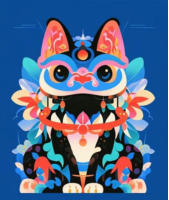
AI + Designer Mid-Term Stage of Design Project When using Doubao AI tool, designers can input prompts such as tile- cat graphic picture and illustration style. Subsequently, the AI can rapidly generate multiple effect drawings of the tile-cat. Regarding the style selection of tile-cat, the AI encompasses both traditional and modern styles. It can distinguish between the structural framework of tile-cat including the head- to-body ratio and limb dynamics, and the style-related attributes such as color saturation, pattern density, and texture coarseness. During the AI-assisted generation process, the basic morphological aspects of the ridge beast are first identified to ensure its recognizability. Then, the design transfer module is invoked. Based on the authors’ idea, various images of the cat-tile were iteratively generated. When generating a design with an ancient and elegant charm, the AI extracts the rhythmic lines of Fine brushwork painting. If aiming to transform it into a trendy toy style, the color-clashing schemes and spontaneous brushstrokes of Pop Art are introduced (See Figure 1). This approach gives designers a broader range of possibilities for the design of tile-cat’s visual image.
Figure 1: Tile-Cat graphic picture under human-AI collaboration.
AI + User Late Stage of Design Project AIGC has the potential to stimulate the creativity of the general public, thus enabling their broad participation in the cultural and creative innovation of tile-cat. This concept is consistent with the core principle of human-AI
Digital Cultural and Creative Customization of Intangible Cultural Heritage 305 interaction guidelines proposed by Amershi et al., which emphasizes that AI systems should augment human abilities rather than replace human control, and support users’ active participation in the creative process (Amershi et al., 2019). Recognizing machine learning as a new design material requires designers to rethink user participation (Dove et al., 2017). Regarding the design of tile-cat conceptual device, users are no longer simply passive consumers but have transformed into co-creators of cultural and creative products. Traditional rendering processes demand a substantial amount of time and a high level of professional skills in areas such as painting. As a result, it has been virtually impossible for the general public to engage in the design of cultural and creative works. However, AI has effectively addressed the issue of enabling users to customize their own unique cultural and creative products, even in the absence of professional design expertise. This innovative model of human-AI collaboration not only caters to users’ needs for personalized products but also infuses new impetus into the inheritance and development of tile-cat.
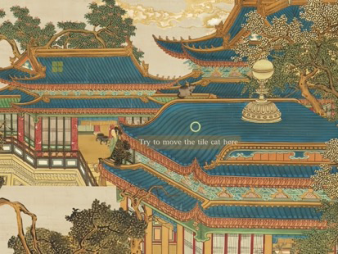
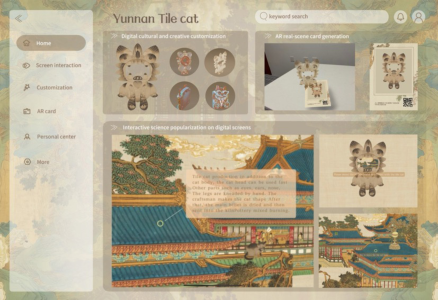
Based on the findings of the pilot questionnaire survey, the majority of users express a preference for an approach that combines enjoyable interactions with knowledge dissemination, as opposed to a forced feeding of information. Consequently, on the user interface (UI) design of the demo, knowledge popularization is continuously integrated with tile-cat related interactions. The knowledge popularization encompasses aspects such as the historical origins of tile-cat, its manufacturing techniques, and the symbolic meanings of different types of tile-cat. On the interface, information such as ‘Try to move the tile cat here’ will appear (See Figure 2). Users can then follow the guide to move tile- cat, which in turn triggers nodes for reading relevant content, thereby enabling them to acquire multiple knowledge about tile-cat.
Figure 2: UI of Tile-Cat conceptual interactive demo.
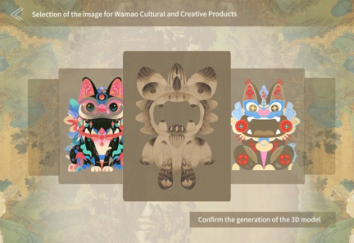
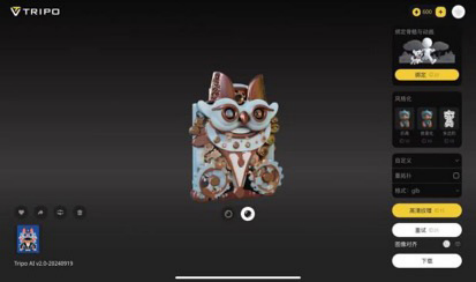
By means of the Tripo AI integrated within the conceptual device, users are enabled to generate 3D models in accordance with their individual preferences based on choosing the tile-cat graphic designs which pre-designed by the authors (See Figure 3). This process allows them to create their own exclusive cultural and creative products such as refrigerator magnets (See Figure 4). The cultural and creative products generated by users differ depending on the diverse keywords provided and the distinct styles they select. Furthermore,
306 Zhao and Gu Users are able to print photos of the customized cultural and creative works. Subsequently, through these photos, users can establish contact with third- party production agencies to print their individualised physical cultural and creative products. This mechanism enables participants to be more actively engaged in the entire experience of the intangible cultural heritage interactive device. By achieving a sense of accomplishment, users are motivated to share their experiences, which in turn facilitates the broader dissemination of the intangible cultural heritage of tile-cat both online and offline.
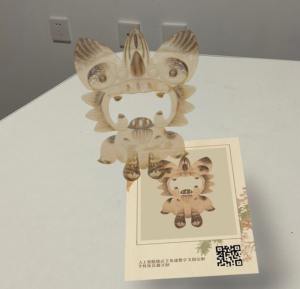
Users are also able to select their favoured preset designs from the AR card library preset by the system. Whether it is the classic AR card adorned with traditional eaves end tile patterns or the trendy toy style AR card integrating pop color blocking elements, all are available for printing. Merely by scanning the card with a mobile phone, users can make the preset image of the tile-cat instantly emerge from the card (See Figure 5). Users can not only capture the interesting moments of the AR tile-cat to create emoticons but also take group photos with the virtual tile-cat placed on the palm or shoulder. This real-time interaction that combines the virtual and the real breaks the static limitations of traditional cultural and creative products. It endows each operation with a sense of freshness. Moreover, it enables users to obtain more immersive and engaging experiences.
Figure 5: AR card example.Figure 6: Home page of the device.
Formative Evaluation and Proof of Concept This study employed an interview method based on high-fidelity interactive prototype demonstrations. The authors recruited five participants for the formative evaluation, including two university students and two young professional designers, and one cultural and creative product enthusiast, all aged 18–35, which is consistent with the core target audience of this study. To explicitly address conceptual limitations, this qualitative process is reframed as a formative evaluation functioning as a proof of concept to yield preliminary design principles rather than definitive widespread conclusions. Through systematically presenting a complete design plan that included interface processes (See Figure 6), AI-generated effect simulations, and AR interaction scenarios, the authors guided them to understand each step of their potential as co-creators. To structure the interview analysis more systematically, the evaluation framework measures outcomes across three dimensions: ease of use, perceived creativity, and cultural connection. The interview method aimed to explore their expectations of the device’s usability, satisfaction with the participation process, and whether they could perceive a connection to the tile-cat culture through this design.
308 Zhao and Gu Regarding ease of use, the interview results showed that all participants could clearly understand the core interaction logic of the device through the prototype demonstration. They generally found the entire design process intuitive and attractive. Participants operated without guidance and did not encounter obvious technical obstacles. Most users were able to complete drag-and-drop editing on their first attempt. Additionally, through Tripo AI, 2D tile-cat images were transformed into 3D models and personalized fridge magnet designs were generated. One participant expressed appreciation for the 2D-to-3D conversion process: ‘Seeing my designed 2D tile-cat turn into a 3D, rotatable model is a very attractive magic moment. I’m looking forward to seeing the final physical cultural product.’ This indicates that the AI-driven workflow has good understandability and a low perceived operational threshold in design.
In terms of perceived creativity and user satisfaction, participants highly praised the personalized and creative space provided by the design. They noted that selecting style keywords to generate a unique tile-cat, and then interacting with and photographing it via AR creates a powerful value loop, delivering strong satisfaction and enjoyment. The application of AR and AI technology did not weaken cultural perception. Instead, it enhanced the audience’s interest and identification with intangible cultural heritage due to its modernity and interactivity. This strong sense of ownership and creative experience was widely regarded as a key driving force for the desire to share.
Concerning cultural connection, the interviews revealed the design’s great potential in establishing a perceived cultural connection. Participants commented that embedding knowledge popularization into interaction nodes in a natural, user- friendly way avoided the dullness of traditional museum information boards. One participant said, ‘If someone just read this cultural knowledge to me, I would probably forget it immediately. But if I am trying to make my tile-cat design more authentic, I actively look up its stories and meanings. That’s when I really feel a personal connection to it. AI and AR here are like bridges, they make the ancient culture playable, approachable, and ownable.’
In conclusion, the authors initially verified the feasibility of the AI-assisted cultural product generation device design concept in terms of user experience. Participants not only had positive expectations for the usability of the interaction process, but also showed a strong desire for personalized creation at the emotional and value levels. They also recognized the unique value of this innovative model in promoting understanding and emotional resonance with intangible cultural heritage.
CONCLUSION
Taking the endangered Yunnan Tile-Cat as the case study, this paper proposed and verified a two-stage human-AI collaborative workflow tailored for ICH digital cultural and creative customization: the AI + designer phase, where AI improves the efficiency of cultural data integration, visual generation and 3D prototype production, while human designers conduct semiotic calibration to address AI’s inherent interpretive bias of cultural symbols in both 2D
Digital Cultural and Creative Customization of Intangible Cultural Heritage 309 images and 3D models. And the AI + user phase, where instant 2D-to-3D modeling and AR interaction lower the technical threshold of creative production, enabling ordinary users without professional design skills to complete personalized ICH creation independently.
The findings from the formative evaluation confirm that this workflow not only enhances users’ creative autonomy and participation satisfaction, but also fosters their deep cultural identification with the tile-cat heritage through active creation and reinterpretation. Theoretically, based on the Yunnan Tile-Cat case study, this research explores the core positioning of AI in ICH design, and provides a reference for refining the conceptual framework of human-AI collaborative cultural and creative design. For future research, the authors will expand the user research sample to cover groups of different ages and cultural backgrounds, to verify the universality of the proposed workflow across more diverse user scenarios.
REFERENCES
Akhtar, P. et al. (2023). Detecting fake news and disinformation using artificial intelligence and machine learning to avoid supply chain disruptions, Annals of Operations Research, 327(2), pp. 633–657. Available at: https://doi.org/10.1007/ s10479-022-05015-5 Amershi, S. et al. (2019). Guidelines for human-AI interaction, in Proceedings of the
2019 CHI Conference on Human Factors in Computing Systems. Glasgow, UK: Association for Computing Machinery (ACM), pp. 1–13. Available at: https:// doi.org/10.1145/3290605.3300233 Chandler, D. (2007). Semiotics: The Basics. London: Routledge. Dove, G. et al. (2017). UX design innovation: Challenges for working with machine learning as a design material, in Proceedings of the 2017 CHI Conference on Human Factors in Computing Systems. Denver, USA: Association for Computing Machinery (ACM), pp. 278–288. Available at: https://doi. org/10.1145/3025453.3025739 He, D. (2024). Generative AI, enterprise competitive pathways, and industrial
organization structures, Seeker, (05), pp. 61–71. Available at: https://link.cnki. net/doi/10.16059/j.cnki.cn43-1008/c.2024.05.007 Liu, A. et al. (2024). Review on the progress of the AIGC visual content generation and traceability, Journal of Image and Graphics, 29(06), pp. 1535–1554. Available at: http://txtx.cjig.cn/jig/ch/reader/view_abstract.aspx?file_no=240003&flag=1 Luo, Y. et al. (2024). The intangible cultural heritage of Yunnan Tile-
Cat incorporated into aesthetic education research, Art Education Research, (08), pp. 68–70. Available at: https://kns.cnki.net/kcms2/article/ abstract?v=m07J8nP_wCE8loatgbiihPLOpwZTR8A6dV-burhbEFsE8lWPwo CgZDNnCOR6uparafAIlkSi1cbt6qI_I0X3tMNN2usdZBhsCxsiy5EeoPm4_ Y7RW_exI-2vRIBXXyQXfQ1V3_dt7ceDwdHYKVIsqmEabT-XG_ GA4iY42PacqkVfYWZpb-13WA==&uniplatform=NZKPT&language=CHS Meng, J. & Yu, L. (2023). The divine beast on the roof ridge: The Yunnan Tile Cat, Creation, 31(11), p. 2. Available at: https://kns.cnki.net/kcms2/article/abstract?v=m07J8nP_ wCH5x3ALeOTHsUzMgAWImXsunZSl_VLk47n1XH2KZfmIivPpKM- 2NiD5MlYztM6h7XARf_cn25NqFJNCpAM5FP0a10d2Tvoe3yq1h4A4twH_ XsRFhbVOE6VYZH_PY97sYocrQOYXZAh5w7azvohHRb6flqaRuFmA9Je_ JjvbLZ0anw==&uniplatform=NZKPT&language=CHS
310 Zhao and Gu Sanders, E.B.N. & Stappers, P.J. (2008). Co-creation and the new landscapes of design, CoDesign, 4(1), pp. 5–18. Available at: https://doi. org/10.1080/15710880701875068 Yang, M. et al. (2024). Service matching model of users’ personalized demands based
on AIGC, Packaging Engineering, 45(20), pp. 109–119+182. Available at: https:// link.cnki.net/doi/10.19554/j.cnki.1001–3563.2024.20.009 Zhang, F. et al. (2023). Review of digital cultural and creative product design, Packaging Engineering, 44(12), pp. 1–15+117. Available at: https://link.cnki.net/ doi/10.19554/j.cnki.1001–3563.2023.12.001 Zhao, W. & Zang, X. (2024). Design of cultural and creative products based on
the combination of Peirce semiotics and AIGC, Packaging Engineering, 45(10), pp. 116–126. Available at: http://packjour.ijournals.cn/bzgcysb/ch/reader/view_ abstract.aspx?file_no=20241013&flag=1 Zhao, Z. (2025). Multimedia interaction design model of local culture in human-AI collaborative environment, in Proceedings of the International Conference on Human-Computer Interaction. Cham: Springer, pp. 229–245. Available at: https:// link.springer.com/chapter/10.1007/978-3-031-93160-4_15 Zhou, T. et al. (2024). Research on users’ switching intention of information
seeking: From search engines to generative AI, Library and Information Service, 68(3), pp. 49–58. Available at: https://link.cnki.net/doi/10.13266/j.issn.0252– 3116.2024.03.005
LISTED IN THE AHFE DIGITAL BOOKSTORE CATALOGUE
Explore the complete digital volume
Human Factors in Communication of Design
Read this individual research paper free through the original publisher, or explore the full digital proceedings book.
ISBN 978-1-964867-92-2
Explore this ISBN in the AHFE Bookstore ↗Listed in the July 2026 bookstore catalogue; search by ISBN to confirm current availability · Digital book purchase optional