Qige Xu (2026). Innovative Design of Wuxi Wedding Embroidery and the Classic Chinese Animation: The Golden Conch Based on AIGC. In: Human Factors in Communication of Design. AHFE Open Access, vol. 216, pp. 249–258. https://doi.org/10.54941/ahfe1007641
The preservation and innovation of intangible cultural heritage present significant challenges, while AI technology offers new opportunities for its protection and inheritance. Nevertheless, when AI technology is applied to the integrated design of intangible cultural heritage and classic animation IPs, issues such as misinterpretation of cultural symbols, distortion of traditional patterns, and separation from the original context, referred to as "de-contextualization" problems, are prone to occur. This makes it arduous to achieve the precise integration of the characteristics of intangible cultural heritage and classic art styles. This paper delves into the application of AIGC in the integration of Wuxi Wedding Embroidery patterns and the domestic animation IP The Golden Conch. By establishing a multimodal dataset, conducting LoRA model training, and leveraging ComfyUI-assisted generation, an AI-assisted design closed-loop workflow is developed. This workflow encompasses "extraction of intangible cultural heritage cultural genes – construction of a multimodal fusion gene library – cross-media translation and encoding of cultural symbols – generation of the AIGC workflow – implementation of design results and value extension". This research can offer practical references for the contemporary activation and digital dissemination of intangible cultural heritage patterns, as well as provide ideas and paradigms for the innovative design of classic domestic animation IPs.
Against globalization and modernization, intangible cultural heritage (ICH) faces multiple challenges (Bortolotto & Ubertazzi, 2023). Its inheritance and innovation constitute a core task for the creative transformation and innovative development of China’s outstanding traditional culture (Lazaro Ortiz de Madariaga, 2022). As a national ICH inscribed in China’s fifth batch, Wuxi Wedding Embroidery is plagued by broken craft inheritance, shifting aesthetic preferences and insufficient market development. Its folk connotations and exquisite craftsmanship remain unfamiliar to modern audiences, calling for innovative carriers suited to contemporary communication.
250 Xu Against such backdrop, AI is increasingly adopted in ICH preservation, especially for high-quality image generation. Rooted in Bayu, Wuxi Wedding Embroidery is closely tied to local wedding customs. Local girls learn embroidery to make dowries for their future marriage, a millennia-old tradition (Jiang, 2023). They embed wishes for marriage and family into embroidery patterns, embodying local people’s blessings for happy wedlock. Centered on marriage and lifelong companionship, the classic animation IP The Golden Conch depicts the romance between the Conch Maiden and a hardworking young man who overcome hardships for a happy marriage. Its romantic interpretation of sincere love matches the embroidery’s wedding theme perfectly (Pu, 1995). Such thematic consistency enables natural cultural integration: the animation provides narrative support for the embroidery’s wedding culture, while the embroidery grounds the animation’s romance in authentic folk customs.
Originating from Ningchang Ancient Town of Wuxi, Chongqing, the embroidery dates back to the ancient Wuxian Kingdom in the Yao-Shun era. Blending Bayu and Chu cultures, it spreads across Chongqing, Shaanxi and Hubei and bears distinctive southwest regional cultural features. Popular along China’s southeast coast and the Yangtze River Basin, The Golden Conch shares the same Yangtze cultural circle with Bayu. Their inclusive regional cultures and plain folk customs create natural aesthetic resonance, removing integration barriers and enabling seamless visual combination. The IP helps the embroidery break geographic restrictions, and the embroidery deepens the animation’s cultural connotation for mutual empowerment.
Besides, classic domestic animation IP owns cross-age audiences and mature visual communication systems. It builds popular, youth-oriented channels for Wuxi Wedding Embroidery to break ICH’s regional and group barriers and reach the general public (Samoylova, 2002).
Accordingly, this study takes Wuxi Wedding Embroidery and The Golden Conch as research subjects to explore AIGC’s application in their integrated design, form standardized design procedures, tackle cultural fidelity challenges in ICH-IP integration, and deliver replicable practical modes for living heritage inheritance and domestic animation IP innovation.
Current Situation and Challenges of Wuxi Wedding Embroidery as an Intangible Cultural Heritage Known alternatively as Ba Embroidery or Daning River Embroidery, Wuxi Wedding Embroidery originated in the Guangxu reign of the Qing Dynasty. Evolving from patchwork decoration into a distinctive ornamental system, it was inscribed on China’s Fifth National ICH List in 2021. A cultural treasure blending Bayu, Wu and salt civilizations, it stands as a typical folk art of the Yangtze River Basin featuring unique pick-stitch craftsmanship, modular patterns and profound wedding-themed connotations.
Wuxi Wedding Embroidery is trapped in multiple inheritance bottlenecks. The traditional apprenticeship system fails to align with modern education, breaking the skill inheritance chain. Its core inheritors average over 65 years old, with young practitioners under 35 accounting for less than 10%,
Innovative Design of Wuxi Wedding Embroidery and the Classic Chinese Animation 251 highlighting severe generational gaps (Liu & Wang, 2023). Meanwhile, its conventional aesthetics diverge sharply from modern demands. Rigidified patterns and application forms poorly adapt to contemporary tastes and diversified application scenarios, steadily reducing its appeal among younger generations. Furthermore, it lacks market transformation and innovative capacity: most existing designs merely duplicate primitive patterns without in-depth integration with classic IPs, and no mature, replicable AIGC-driven innovative design paradigm has been established.
Development of Chinese Animation IPs Chinese domestic animation forms a system blending national features and contemporary connotations, centered on classic IPs of the China Animation School from Shanghai Animation Film Studio and inheriting the essence of Chinese folk art. However, modern transformation of contemporary domestic animation IPs is hindered by vague cultural cores and superficial innovation; in-depth integration with ICH is required for breakthroughs (Han & Wang, 2025). Released by Shanghai Animation Film Studio in 1963, the paper-cut animation The Golden Conch was directed by Wan Guchan, dubbed the Father of Chinese Paper-cut Animation. Adapted from Ruan Zhangjing’s poetic fairy tale and derived from the folk tale Snail Maiden, it combines paper-cut and shadow puppetry with frame-by-frame shooting and stands as a landmark work of the China Animation School (Luo & Wu, 2025). Its consistent core of love and marriage aligns with public expectations for wedlock and underpins its integration with ICH. Differing from the original text focusing on diligence, the animation shapes a folklore-rich romantic story: a fisherman saves and nurtures a golden conch three times. Moved by his diligence, the conch turns into a maiden to live with him. The Sea Goddess arranges three trials to test his loyalty. His faithfulness wins a happy ending, embodying the pursuit of loyal marriage and laying emotional and narrative groundwork for incorporating wedding-related ICH elements (Wu, 2015).
As a pivotal IP rooted in Chinese folk art, modern domestic animation IPs commonly face homogenization and shallow development due to inadequate ICH integration and cannot satisfy contemporary audiences. The animation’s marriage plot lacks sufficient foreshadowing. Wedding folk customs could have been embedded when the protagonists first meet for cultural hints (Wu, 2015), yet only daily trivialities are presented, making the sudden marriage plot unnatural and leaving no reasonable scenes for ICH insertion. In addition, folk art is used simplistically: the production overemphasizes paper-cut visuals without combining other folk arts, restricting diversified presentation of ICH and complementary artistic advantages. Its outdated communication modes lack systematic ICH-integrated design and carriers for living heritage. Weak IP-ICH linkage wastes complementary strengths and lands the classic IP in common modernization predicaments of domestic animation.
AIGC provides new technical approaches for the modern activation of ICH through powerful visual expression and algorithm adaptation, enabling precise digital translation and innovative communication of ICH elements to break inheritance and audience constraints (Tian & Li, 2023). AIGC exhibits distinct advantages in the integration of ICH and classic IPs. Based on the Stable Diffusion model, LoRA (Low-Rank Adaptation) lightweight fine-tuning effectively learns ICH pattern features and achieves accurate style transfer. The modular ComfyUI workflow simplifies pattern digital collection, style adaptation and innovative reconstruction, supporting batch generation and rapid iteration. It reduces design costs and solves core pain points in cultural and creative development (Tian & Li, 2023).
CULTURAL SYMBOLS OF WUXI WEDDING EMBROIDERY AND CHINESE ANIMATION IP Wuxi Wedding Embroidery
As the core craft of Wuxi Wedding Embroidery, its patterns reflect local folk culture and lifestyles. Based on literature review and inheritor interviews, their classification and features are listed in Table 1 (Zhou et al., 2025).
Table 1: Classification and cultural connotation of Wuxi Jiahua patterns.
Table available in the original PDF paper.
Pattern Name Illustration Pattern Characteristics Cultural Implication Floral & Fauna Patterns (Lotus, Carp, Phoenix, etc.)
Innovative Design of Wuxi Wedding Embroidery and the Classic Chinese Animation 253 Chinese Animation IP (Image Composition)
The Golden Conch adopts flat paper-cut styling for characters and scenes without realistic perspective. Crisp outlines and contrasting color blocks shape its figures, among which the Conch Maiden and fisherman stand out vividly (Table 2).
Table 2: Correspondence between core scenes and plot of the golden conch.
Table available in the original PDF paper.
Time Core Scene Story Description Photo 00:00- 02:15 Blue Sea surface, Coral Fairy Island Dreamy ocean, young fisherman, rescue golden conch, careful nursing, fishing village
12:13- 14:50 Seaside fishing village
Acquaintance, daily life together, fishing, waiting by shore, singing on waves, three-year peaceful life, fishing village, warmth, serenity, marriage foundation 14:50- 17:12 Meadow Intimacy among flowers, affectionate couple, journey for beloved
This study uses literature review to consolidate studies on Wuxi Wedding Embroidery, domestic animation IP innovation and AIGC-driven ICH design, clarifying theoretical basis, research constraints and research direction. Semi-structured interviews with 2 municipal inheritors and 5 ICH scholars obtain pattern connotations, craft features and IP artistic traits to improve extraction precision. Semiotic analysis distills core symbols for cultural coding and cross-media translation. A multimodal dataset is established for LoRA training and AIGC workflow development. Repeated generation and dynamic revision yield integrated designs. Expert assessment and audience feedback verify effectiveness to form a full research closed loop.
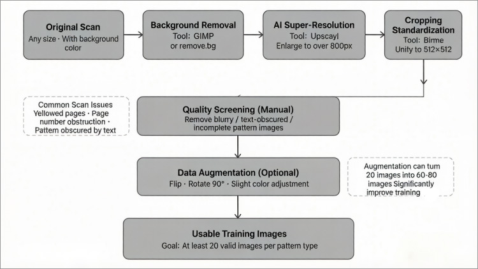
Dataset Drawing on mature dataset construction schemes from existing ICH-AIGC integration studies, this research builds a standardized multimodal fusion dataset to cut data sorting costs at the feature extraction stage (Levin & Belov, 2024). Dataset materials derive from online resources and offline physical collection. All embroidery patterns and animation materials are digitized and normalized to a uniform 512 × 512 pixel resolution for subsequent processing (Fig. 1).
Figure 1: Flowchart of preprocessing for Wuxi Jiahua pattern LoRA training dataset.
This study builds a Wuxi Wedding Embroidery ICH database from open online resources and HD shots of inheritor-authorized embroidery samples. It includes 120 classic high-definition images covering core patterns. Per interviewed experts’ advice, each image is labeled with historical and symbolic metadata to ensure cultural accuracy and reusability (Table 3).
scenes
directly
corresponding to
wedding scenes
Date Notes
Type Collection
Scanning 2025-01-15 Core symbol of wedding
Scanning 2025-01-15 Most narrative,
Quality Material
5 Document
4 Document
Document Image
Wuxi
Wedding
Flower Atlas
P115
Wuxi
Wedding
Flower Atlas
P108
Annotation Source
wuxi_jiahu
embroidery, double
happiness symbol,
xi character pattern,
cross-stitch folk art,
wedding ceremonial
decoration, red color
palette, flat chinese
calligraphic motif,
bridal auspicious
symbol
wuxi_jiahu
embroidery,
wedding sedan chair
motif, narrative
folk pattern,
cross-stitch style,
wedding procession
symbolism, red
festive palette,
detailed folk
illustration, chinese
traditional wedding
art
double happiness
character, auspicious
symbol, weddings, new
marriage, joy, wedding
dresses, decoration
wedding sedan chair
pattern, traditional
wedding procession,
delicate patterns,
Wuxi Wedding Flower
embroidery, narrative
patterns
System Folk Custom Meaning LoRA Training
Color
Cross-
stitch
Color
Cross-
stitch
Subcategory Color
Happiness
Pattern
Sedan Chair
Pattern
Category Pattern
Symbols Double
Symbols Wedding
Table 3: Standardized LoRA Annotations of wedding-themed patterns: Wuxi Wedding Embroidery × The Golden Conch
Table available in the original PDF paper.
Image No. Pattern
WX_
AUS_001 Auspicious
AUS_002 Auspicious
WX_
Centered on cultural fidelity, efficient generation and dynamic optimization, the proposed AIGC workflow adopts Stable Diffusion as the base model with LoRA fine-tuning (Gokaslan et al., 2024) and Midjourney, forming a closed loop: material import → model training → parameter configuration → generation optimization → result export (Table 4).
Table 4: Flowchart of standardized preprocessing for dataset.
Table available in the original PDF paper.
Training parameters for integrated modeling of Wuxi Wedding Embroidery patterns and The Golden Conch paper-cut style are listed in Table 4. Total training lasts around one hour to secure generative precision (Table 5).
Table 5: Core LoRA training parameters for integrated styling of Wuxi wedding embroidery and the golden conch paper-cut art.
Table available in the original PDF paper.
LR SchedulerW
Noise Offset
Conv Alpha
Text Encoder LR
LR Restart Cycles
Persistent DataLoader Workers
LoCon Conv Dim
Approx Training Time 1 2 0.1 4 0.1 1h
0.0002 cosine_with_ restarts
Resolution Batch
LR UNetLR
Dataset Size
Size
Max Epochs
Network Dim
Network Alpha
Clip skip
Save Every N Epochs
200 512x512 2 8 2 64 2 1 0.0002 0.0002
Innovative Design of Wuxi Wedding Embroidery and the Classic Chinese Animation 257 To avoid overfitting and underfitting, Dataset Size = 200 and Max Epochs = 8 balance sample adequacy and training efficiency. Targeting stylistic fusion and lightweight training, Network Dim = 64 and Network Alpha = 2 reconcile style transfer and generalization. Learning rate is set to 0.0002 for precise alignment of cultural features. Remaining parameters are refined via comparative tests to boost training stability and detail, striking an optimal balance between content fidelity and efficiency.
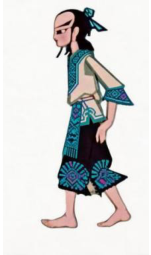
RESULT ANALYSIS Using the established AIGC workflow, this study completes innovative integrated design of Wuxi Wedding Embroidery and The Golden Conch and outputs character costume works (Fig. 2).
Before After
Figure 2: Renderings of integrated costume design.
CONCLUSION
This research expands generative AI in ICH-domestic animation IP integration and proposes an AIGC design paradigm for heritage-motif and classic IP fusion, offering new insights into digital ICH preservation and innovation. It delivers practical solutions for living inheritance of Wuxi Wedding Embroidery and modern renewal of The Golden Conch IP, inspiring cultural and creative industries.
258 Xu Future research shall optimize model parameters and datasets to improve generation quality and diversity, deepen cultural interpretation and interdisciplinary collaboration among inheritors, designers and AI engineers for sustainable heritage preservation and communication. Further application expansion and industrial transformation can realize dual promotion of cultural and commercial values of ICH.
REFERENCES
Bortolotto, C., & Ubertazzi, B. (2023). Intellectual property as a blind spot in the UNESCO convention for the safeguarding of the intangible cultural heritage. International Journal of Heritage Studies, 29(10), 1128–1140. Gokaslan, A., et al. (2024). CommonCanvas: Open diffusion models trained on
creative-commons images. In Proceedings of the IEEE/CVF Conference on Computer Vision and Pattern Recognition (pp. 8250–8260). Han, J. L., & Wang, G. (2025). From White Snake: Origin to Ne Zha: Devil incarnate: Visual reconstruction of paper-cut aesthetics in Chinese animation. Journal of Arts Studies, 2, 50–54. Jiang, W. N. (2023). Research on Wuxi Jiahua embroidery techniques (Master’s
thesis). Chongqing University, Chongqing, China. Lazaro Ortiz de Madariaga, C. J. (2022). The UNESCO convention for the safeguarding of the intangible cultural heritage: A critical analysis. International Journal of Cultural Policy, 28(3), 327–341. Levin, O., & Belov, Y. S. (2024). A study on the application of using Hypernetwork
and low rank adaptation for text-to-image generation based on diffusion models. In 2024 6th International Youth Conference on Radio Electronics, Electrical and Power Engineering (REEPE) (pp. 1–5). IEEE. Liu, S. J., & Wang, Y. D. (2023). Diversified integration: Inheritance dilemmas and innovative development paths of Wuxi Jiahua in the modern context. Tiangong, 12, 48–52. Luo, P. Y., & Wu, D. Z. (2025). Logical dimensions and path expansion of the modern
transformation of traditional cultural IP: Analysis based on Chinese animation films from 2015 to 2025. Cultural Innovation Comparative Study, 9(36), 53–57. Pu, M. T. (1995). The beautiful and touching fairy tale narrative poem: Ruan Zhangjing’s Golden Conch. Friends of Language Teaching, 6, 41. Samoylova. (2002). Intertextuality studies (Shao, W. Trans.). Tianjin People’s
Publishing House. Tian, H. R., & Li, F. (2023). Research on cultural and creative design based on memetics theory and AIGC technology. Design, 8(4), 7. Wu, Z. C. (2015). Adaptation art of the animated film Golden Conch. Great Stage,
7, 49. Zhou, L., Jin, Y. T., Li, F., et al. (2025). Construction of AIGC paradigm for Wuxi Jiahua pattern generation. Textile Science and Technology Progress, 47(8), 1–5, 32.
LISTED IN THE AHFE DIGITAL BOOKSTORE CATALOGUE
Explore the complete digital volume
Human Factors in Communication of Design
Read this individual research paper free through the original publisher, or explore the full digital proceedings book.
ISBN 978-1-964867-92-2
Explore this ISBN in the AHFE Bookstore ↗Listed in the July 2026 bookstore catalogue; search by ISBN to confirm current availability · Digital book purchase optional