Jiayi Zhang (2025). Ancient poetry imagery based on AIGC and Kansei Engineering Research for Visual Translation Strategy. In: Ergonomics In Design and Kansai Engineering. AHFE Open Access, vol. 170, pp. 215–225. https://doi.org/10.54941/ahfe1006183
Chinese ancient poetry and verse culture has a long history. It not only reflects the unique emotional expression and aspiration of the creators in different historical periods, becoming an artistic presentation of individual emotions and ambitions, but also constructs a cultural symbol and symbolic system with oriental aesthetic characteristics through rich imagery elements. This research uses web crawler technology to collect 360 classic ancient poems and verses, invites experts to form a focus group for text analysis and extract key imagery elements of ancient poetry and verses, and then classifies them into Mountain and Climate, Animal and Plants, Cultural and Artifacts Classes. A 5-level scale questionnaire survey is used to screen out 20 high-frequency imagery elements. Midjourney is used to conduct a pre-experiment on the imagery elements and generate the A version of the element library. After improving the parameters and adding the "cultural anchoring" parameter, the B version of the element library is generated. Subsequently, the emotional words used by the creators in the ancient poetry and verses to express emotions are collected, and the B version of the AIGC-generated images are scored and evaluated through semantic matching using the seven-point semantic differential method. The matching degree between the images and the original text imagery is quantitatively compared by drawing the imagery scale diagram. The AIGC-generated ancient poetry and verse imagery element library through the study of sensuous engineering can convey semantics and emotions that conform to cultural attributes, thereby providing feasible strategies for the visual translation of ancient poetry and verses by AIGC.
The “Great Preface” of the Book of Songs states: “Poetry is the expression of one’s aspirations. When in the heart, it is called aspiration; when expressed in words, it is called poetry.” Ancient poetry and verse, which have endured for thousands of years, are treasures in the repository of traditional Chinese culture. They carry the thoughts and wills of ancient Chinese literati, inscribe rich cultural genes, and continue the thousand-year- old literary heritage of the Chinese nation (Zhou et al., 2023). With the development of digital humanistic era communication media, ancient poetry and verse have gradually moved from being solely “textbook materials” to diverse channels such as variety shows, movies, and short videos. While
preserving the conveyance of emotional and artistic connotations, they have entered the lives of the general public in more accessible and understandable forms. Under traditional methods, the learning and dissemination of ancient poetry and verse require a large amount of video, audio, and image materials, but the cost of content development is high and the cycle is long. However, generative AI can produce high-quality creative content almost without human intervention. The emergence of AIGC has provided new opportunities for the production and dissemination of digital content related to ancient poetry and verse culture (Cai et al., 2023).
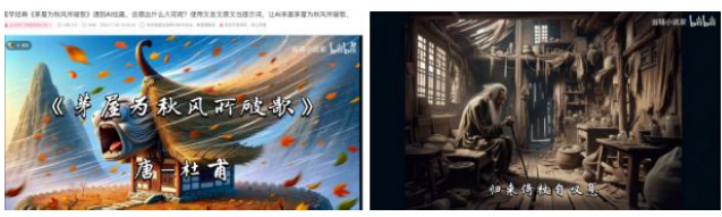
In the current field of digital content creation, AIGC technology has been widely applied to various media platforms, generating a large number of exquisite works that visually present the scenes and artistic conceptions of ancient poetry. However, taking the AIGC ancient poetry videos on the Bilibili video platform as an example, although some of the visuals are popular among the public for their humor and visual impact, they still have certain limitations in accurately and deeply conveying the original imagery and cultural connotations of ancient poetry, as shown in Figure 1, “The Hut Broken by Autumn Wind”. Therefore, how to add a “cultural anchoring” parameter to generative AI to enhance the accuracy and depth of the visual translation of ancient poetry imagery elements has become an urgent problem to be solved in this study.
Figure 1: AIGC-generated content of “The Hut Broken by Autumn Wind” on the Bilibili.
ANCIENT POETRY CULTURE FROM THE PERSPECTIVE OF AIGC In the process of recording and reflecting the evolution of traditional Chinese culture and various categories of Chinese literature and art, poetry has always been a dominant comprehensive cultural phenomenon, greatly influencing other literary and artistic genres and broader Chinese culture. The masterpieces of ancient poetry have been disseminated through books, textbooks, mass media, schools and other memory carriers and venues. Through the passage of time and accumulation, they have become shared emotional experiences and cognitive prototypes among the members of the Chinese nation and gradually developed into a powerful cultural gene of the Chinese nation (Fan and Yang, 2023). “Ancient poetry has stories that can move, amaze or sadden people. The stories of the poets and the allusions in the poems are equally captivating” (Huang, 2018). In ancient
Ancient Poetry Imagery Based on AIGC and Kansei Engineering Research 217
poetry, the construction and shaping of imagery undoubtedly constitute the artistic core of creation. When depicting things in poetry, these elements are no longer merely reflections of objective reality but are infused with the poet’s personal emotions and thoughts, embodying the creator’s emotional world and spiritual pursuit. The transformation from concrete images to abstract artistic conceptions reflects the artistic realm of “poetry and painting intertextuality”, that is, the profound aesthetic of “poetry within painting, painting within poetry”.
The concept of “imagery” has a long history in China. As early as in the “Zhouyi · Xici”, the ideas of “observing objects to take images” and “establishing images to convey meanings” were mentioned. This concept has been borrowed and developed in the field of ancient poetry. In poetry, the “images” have transformed from the images of the hexagrams to specific natural images. The creation of imagery through specific images to express profound meanings has always been the charm of ancient poetry. In “Words on the Human World in Poetry”, Wang Guowei deeply explored the “imagery” in poetry and proposed the concept of “artistic conception”, believing that the beauty of poetry lies in the creation and application of imagery to construct a spiritual realm beyond direct perception. Zhu Guangqian also discussed imagery in “On Beauty”, emphasizing the relationship between emotion and imagery in artistic creation and arguing that the imagery in art is the concretization of emotion and will. In “Thoughts on a Still Night”, Li Bai, a poet of the Tang Dynasty, chose imagery elements such as the bed, moonlight, and frost to create a scene of cold and quietness and construct the artistic conception of missing his hometown. Thus, it can be concluded that imagery is not only a writing technique in ancient poetry but also transcends simple visual description to reach a spiritual realm where emotion and thought are highly integrated.
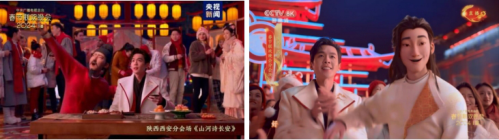
In the digital spread of ancient poetry culture, the deep integration of ancient poetry with modern media has created new ways for it to reach younger people. For example, TV shows like “Chinese Poetry Conference” and “Everlasting Classics” have effectively spread knowledge of ancient poetry through interesting formats, guiding audiences to explore the historical and cultural background of the poetry and sparking public enthusiasm for classical literature. Additionally, the popular 2023 animated film “Three Thousand Miles of Chang’an” innovatively used ancient poetry - centered storytelling, cleverly combining the life stories of figures like Li Bai and Gao Shi with classical poetry’s charm. While showing the beauty of poetry, it also looked into the poets’ inner worlds. Later, in the 2024 CCTV Spring Festival Gala’s Xi’an program, “Poetry of the Mountains and Rivers, Chang’an”, the film’s Li Bai character returned to Chang’an, leading contemporary audiences in poetry recitation and expression of emotions through poetry. This program, with its unique cultural and artistic aspects, received widespread social attention and praise, as shown in Figure 2.
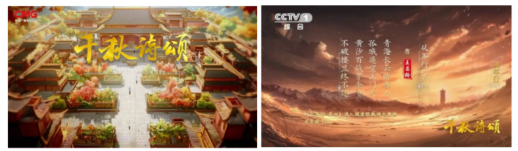
Another successful case of the combination of ancient poetry culture and AIGC technology is the animated series “Thousand Years of Poetic Praise”, as shown in Figure 3. This series has been broadcast on CCTV-1 since 2024 and has released its third season so far. The animation tells the birth of each
218 Zhang
work in the form of a story, delving into the real experiences of the poets who created them a thousand years ago and the details of the works’ creation, presenting a comprehensive picture of the brilliance of ancient poetry. By applying AI technology, the series transforms the artistic conception of ancient poems into visual and tangible artistic images, presenting the unique beauty and cultural connotations of ancient poetry to the audience. The empowerment of ancient poetry by AIGC technology in “Thousand Years of Poetic Praise” is a perfect integration of modern technology and China’s excellent culture (Zhang, 2024), which also provides an important reference for this study - through the reasonable application of AIGC technology, excellent cultural works in line with the artistic conception of poetry can be created, and the application of artificial intelligence in the field of humanities and art will continue to expand and deepen.
Figure 2: 2024 CCTV Spring Festival Gala “Poetic Chang’an: Mountains and Rivers”.Figure 3: China’s first AI animated film of ancient poetry, Thousand Years of Poetic Praise.
THE APPLICATION OF AIGC IN THE VISUAL TRANSLATION OF ANCIENT POETRY IMAGERY In “Poetic Style”, Tang Dynasty poet Wang Changling divided the experience realms of poetry into three levels: the realm of objects, the realm of emotions, and the realm of artistic conception (Hu and Wang, 2000). In this study, extracting imagery elements from ancient poetry refines the realm of objects, while AIGC technology and sensibility engineering research further restore the cultural anchoring framework of the realms of emotions and artistic conception.
Extraction of Imagery Elements in Ancient Chinese Poetry The extraction of imagery elements in ancient poetry used both online and offline data collection methods. First, the study used web crawler technology to collect relevant text materials about Tang and Song poetry
Ancient Poetry Imagery Based on AIGC and Kansei Engineering Research 219
from current mainstream poetry promotion platforms and social media. A total of 360 pieces of text information related to ancient poetry were sorted out and summarized, covering representative works from the Tang and Song Dynasties to ensure the representativeness and diversity of the research materials. Next, the author recruited eight postgraduate students from different disciplinary backgrounds, including Chinese language and literature, literature, design studies, and computer science, to form a focus group. The group members referred to multiple poetry appreciation books and conducted a detailed element analysis of the 360 pieces of ancient poetry texts through group discussions. They extracted over 93 imagery elements of ancient poetry and classified them into categories such as Mountain and Climate, Animal and Plants, and Cultural and Artifacts. To assess the relevance and representativeness of the extracted imagery elements from ancient Chinese poetry, the author designed a “Survey Questionnaire on the Relevance of Imagery Elements in Ancient Chinese Poetry”. The questionnaire used a 5 - point scale evaluation method and invited 30 respondents familiar with ancient Chinese poetry culture to participate in the evaluation. By collecting and analyzing the evaluation data of the respondents on the imagery elements, the study calculated the selection frequency and the average relevance of each imagery element. Finally, based on the selection frequency and occurrence frequency, 20 imagery elements with high selection frequency and high occurrence frequency in the three categories were selected, as shown in Table 1.
Table 1: 20 high-frequency imagery elements in ancient Chinese poetry.
Generate Imagery Elements of Ancient Poetry Using AIGC Midjourney, as a creative collaborative system based on semantic understanding and specialized in image processing, provides unique design solutions through interaction and iteration (Chen et al., 2023). Its procedural design steps are: receiving the designer’s instructions, decoding them via big data algorithms, and presenting multiple digital visual solutions (Lu et al., 2024). Currently, many AIGC - generated ancient poetry works follow this process: first, using large language models like ChatGPT to translate and process ancient poetry, extracting key elements such as “characters”, “imagery”, “space”, and “atmosphere” as object descriptions. Then, adding fixed - style template prompts and inputting these into image - generation software like Midjourney to present ancient poetry in a digital visual form. However, this process is somewhat limited by its reliance on prompts, making it hard for users to freely combine imagery elements and achieve creative breakthroughs. This study aims to make AIGC - generated ancient poetry imagery elements not just a technical reproduction of visuals, but also allow users to freely combine these elements by creating a culturally anchored library of ancient poetry imagery. This way, users can visualize the poetry culture in their hearts through AIGC, achieving more innovative and personalized visual translations of ancient poetry.
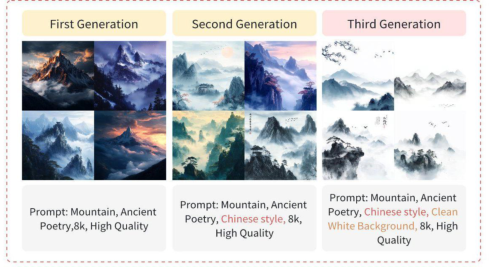
Figure 4: Pre-experimental process of image generation.
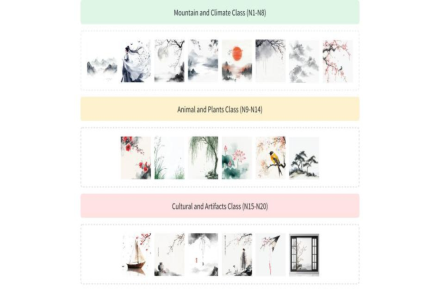
The N1-N20 elements were generated in order based on a pre - experiment formula. After a second round of image screening, we obtained the A version of the ancient poetry imagery element library (see Figure 5). During the A version image experiment, the overall style was relatively stable, but some issues arose: (1) Strange characters appeared. Midjourney created odd, meaningless Chinese characters during generation, which affected the images’ aesthetics and professionalism. (2) Automatic imagery combination occurred. Even when single elements were specified, the AI might automatically combine many unmentioned elements to achieve the “ancient poetry” and “Chinese style” in the instructions (e.g., mixing wind (N2) with people or trees). (3) Over - realism of elements was a problem. For elements like the
Ancient Poetry Imagery Based on AIGC and Kansei Engineering Research 221
moon (N3), sun (N4), wine (N16), and windows (N20), the AI sometimes made them too realistic or added complex extras, losing the original artistic feel. (4) The generation of elements was uneven. Mountains (N1), rain (N6), willows (N11), lotus (N12), and orioles (N13) had better results, while spring (N8) and flowers (N9) used similar colors/elements too much, requiring many attempts and screenings for good results. Due to time and context, the generation of human - related and material imagery was weaker, needing more attempts and screenings (e.g., windows (N20) looked too modern).
Figure 5: A version of ancient poetry image element library.
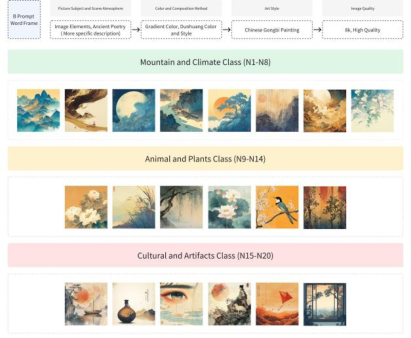
In Midjourney’s image - generation practice, the advanced prompt formula is set as “subject of the picture + scene atmosphere + subject behavior + composition method + artistic style + image quality”. The B - version experiment is based on this framework to set parameters. For example, taking N1 as an example, its prompt parameters are specifically set as “mountain (N1), ancient poetry, scattered peaks, blue - green gradient, Chinese meticulous painting, Dunhuang color style, 8k, High Quality”, and N1 - N20 are generated in sequence to build the B - version image element library, as shown in Figure 6. During the B - version experiment, the problem of excessive realism of image elements was effectively avoided due to the constraint of the “meticulous painting” keyword. However, there are still some random combinations of image elements; although more detailed element descriptions have been added, the generation effect of humanistic and artifact image elements is not satisfactory. But in ancient poetry, image elements usually do not appear alone. In this experiment, more emphasis is placed on exploring the degree of restoration of “atmosphere” and “scene” by image elements. Therefore, some flaws in the generation details do not affect the advancement of subsequent exploration.
The focus group once again discussed the A and B versions of the ancient poetry imagery element library, focusing on three dimensions: image quality, artistic style, and diversity of imagery elements. In terms of image quality, Version B had better clarity, more accurate colors, and richer details than Version A. The colors in Version B were more lifelike, creating a stronger visual impact, while Version A had issues like poor clarity and color
222 Zhang
deviation. Regarding artistic style, Version B not only accurately reproduced the traditional Chinese artistic style but also incorporated modern aesthetic elements, forming a unique artistic style. In contrast, Version A was relatively monotonous, mainly focusing on the traditional ink - wash style, which might cause audience fatigue. As for the diversity of imagery elements, Version B was more flexible and diverse in combining different elements according to the artistic conception and emotional needs of the ancient poetry, forming unique combinations. Version A, on the other hand, had limited variety and combination methods of imagery elements, which might affect the audience’s understanding and feeling of the ancient poetry’s artistic conception. In summary, the experimental results of Version B will be used for subsequent sensory engineering research, aiming to more deeply explore the emotional connotations and cultural value of AIGC’s reproduction of ancient poetry imagery elements.
Figure 6: B version of ancient poetry image element library.
RESEARCH ON THE KANSEI ENGINEERING OF IMAGERY ELEMENTS IN ANCIENT CHINESE POETRY BASED ON AIGC From channels such as poetry appreciation books, poetry websites, related literature, and interviews, 325 adjectives describing emotions, scenes, moods and other sensuous aspects were selected. Through cluster analysis, 189 image words were obtained after eliminating words with similar meanings. By inviting 15 experts and scholars with a background in design to group and screen the collected words, representative sensuous adjectives of each group were extracted from the lower-level word groups. From the 189 sensuous adjectives, 36 adjectives were extracted, and after re-grouping and matching antonyms, 12 groups of sensuous image adjectives were finally obtained (Table 2), providing a basis for the subsequent use of the seven-point semantic differential method for semantic matching and scoring evaluation of images.
Ancient Poetry Imagery Based on AIGC and Kansei Engineering Research 223
For this perceptual image evaluation experiment questionnaire, a semantic differential 7-point scale with images featuring elements of the B version of ancient poetry imagery was presented to the subjects. The perceptual values were 3, 2, 1, 0, −1, −2, and −3 respectively, and the relationship between each symbolic element and the perceptual image was established. The subjects of this questionnaire survey were design major postgraduates who were interested in ancient poetry. The subjects scored each sample from N1 to N20 based on their perceptual cognition. A total of 35 questionnaires were distributed.
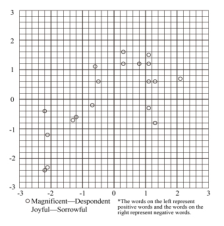
According to the data results obtained by the semantic difference method, the average of 20 samples is taken, and then the image scale map is drawn, and the “heroic - melancholy” is marked as the positive and negative axes of X, and the “joyful - sad” is marked as the positive and negative axes of Y axis. (9) In Table 5, the mean values of N1 in “grand - melancholy” and “happy - sad” are 2.1 and 0.7, so the coordinates of N1 are (2.1, 0.7) and N1-N20 are the same, as shown in Figure 7.
Next, the remaining 10 pairs of sensory words will also be labeled with sample positions using this method. (Due to space limitations, only the first two pairs are shown here). After observing the imagery scale chart, it can be found that the pairs “Magnificent - Despondent” and “Joyful - Sorrowful” have 8 samples in the first quadrant, “Inspirational - Ironic” and “Affectionate - Determined” have 11 samples in the first quadrant, “Thoughtfulness - Sadness” and “Beautiful - Bad” have 14 samples in the first quadrant, “Leisurely - Busy” and “Elegant - Secular” have 13 samples in the first quadrant, “Lively - Lonely” and “Sympathetic - Indifferent” have
224 Zhang
6 samples in the first quadrant, and “Delicate - Rugged” and “Prosperous - Simple” have 9 samples in the first quadrant. Therefore, most of the imagery elements in the B version of the ancient poetry can restore the poetic imagery, and the order of restoring the “artistic conception” is as follows: Thoughtfulness - Sadness, Leisurely - Busy, Inspirational - Ironic, Delicate - Rugged, Magnificent - Despondent, Lively - Lonely.
ANCIENT POETRY IMAGERY BASED ON AIGC AND KANSEI ENGINEERING FOR VISUAL TRANSLATION STRATEGY (1) During the generation process, it is crucial to clarify and innovate artistic styles. In the visual translation of ancient poetry imagery, the first step is to accurately set the artistic style. By analyzing the cultural background, emotional tone, and artistic characteristics of the ancient poetry, and combining the powerful data processing and pattern recognition capabilities of AIGC technology, we can select a style theme that highly matches the poetry from a large number of artistic style samples. For example, in the B - version experiment, the style theme of “meticulous painting” was set. In practice, we can boldly try to combine elements of different styles to create unique visual effects. For example, combining “Dunhuang style” with “Matisse colors” can give the generated images a brand - new artistic look, opening up a new artistic realm for the visual translation of ancient poetry imagery. (2) It should explore the cultural connotations and provide detailed texture descriptions for different types of imagery elements. For Cultural and Artifacts Class imagery, we should explore their cultural significance and historical context and add more specific descriptions. Take the “kite” as an example. We can not only describe its appearance, such as its shape, material, and texture, but also add its status and symbolic meaning in traditional Chinese culture, such as representing longing and distance. This allows the audience to feel a deeper cultural background when appreciating the visual images. AIGC technology can highly restore the grandeur and vastness of mountains and rivers, the unpredictability of climate, and integrate them with surrounding natural elements and ecological relationships for imagery of landscapes, climate, animals, and plants. For instance, when depicting a “river”, AIGC technology not only shows the surging river water but also incorporates elements like trees, boats, and birds on the riverbank, forming a complete ecosystem picture. This enables the audience to more fully experience the natural scenery described in ancient poetry. (3)The combination and application of imagery elements should follow the logic and emotions of the poetry. Since most imagery elements in poetry appear in combination, we can use literary analysis methods to deeply analyze and accurately grasp the poetic logic and emotional main line of ancient poetry during the description process. By analyzing the structure of the verses, rhetorical devices, and emotional expression, we can clarify the logical relationship and emotional connection between each imagery element. For example, in Li Bai’s “Bring in the Wine,” the lines “Don’t you see the Yellow River’s water comes from the sky, and rushes to the sea and never returns.” Through AIGC technology, we can combine the surging of the Yellow River,
Ancient Poetry Imagery Based on AIGC and Kansei Engineering Research 225
the unceasing flow of water, and the vastness of the sea to create a grand natural landscape. At the same time, combining the emotions of time passing and life being short expressed in the verses, AIGC technology can integrate the spectacular scene of the Yellow River water falling from the sky with the dynamic process of rushing into the sea, showing an irreversible momentum.
CONCLUSION
As the poem says, “People today don’t see the moon of ancient times, but the moon today once shone on ancients.” This study combines ancient poetry’s “imagery elements” with AIGC technology, developing strategies for AIGC’s application in traditional culture. These strategies include clarifying artistic styles, exploring cultural meanings, and combining imagery elements based on poetic logic and feelings. It offers references for using AIGC in visual translations of ancient poetry.The study has some shortcomings. Although the strategy of combining imagery elements was explored, there’s still much to improve. For example, balancing the relationships between elements in the combination process needs more research. Also, the scoring in Kansei engineering can be more diverse. Future research can introduce more evaluation dimensions, like cultural background and historical context, to make the selection and application of imagery elements more scientific.
REFERENCES
Cai, X., Chen, Q., & Zhang, J. (2023). Design and implementation of VR experience system for Chinese ancient poetry culture co - created by AI. Journal of Publishing Science, (04), 80–88. Chen, Y., Fang, Q., Xiong, Z., et al. (2023). Opportunities and challenges of
ChatGPT and MJ in home design. Furniture and Interior Decoration, 30(12), 51–55. Fan, M., & Yang, B. (2023). Digital space and cultural memory: The dissemination and presentation of ancient poetry in Douyin short videos. Hunan Social Sciences, (06), 126–134. Hu, W., & Luo, Q. (2000). Wang Changling Collection Chronicle Notes. Chengdu:
Bashu Books. Huang, Z. (2018). Interesting things hidden in ancient poetry [M]. Beijing: China Rule of Law Publishing House. Zhang, Z. (2024). AIGC empowering ancient poetry: The integration of millennia-
old texts and modern audiovisual. World of Sound Screen, (18), 59–61. Zhou, S., Gao, J., Zhang, Q., & Shi, Y. (2023). Research on the multidimensional knowledge recombination and visualization of poetry resources from the perspective of cultural genes: A case study of tea culture. Library and Information Work, (16), 111–123.
LISTED IN THE AHFE DIGITAL BOOKSTORE CATALOGUE
Explore the complete digital volume
Ergonomics In Design and Kansai Engineering
Read this individual research paper free through the original publisher, or explore the full digital proceedings book.
ISBN 978-1-964867-46-5
Explore this ISBN in the AHFE Bookstore ↗Listed in the July 2026 bookstore catalogue; search by ISBN to confirm current availability · Digital book purchase optional