Xinyi Jing, Lu Zhang (2025). User Information Behavior from the Perspective of Information Context: Optimizing User Experience Within Text-to-Image AIGC Platforms. In: Usability and User Experience. AHFE Open Access, vol. 194, pp. 264–275. https://doi.org/10.54941/ahfe1006689
The rapid expansion of text-to-image AIGC platforms has led to a transformation of user experience and changed user information behavior. This paper presents a grounded theory analysis of information behavior in the context of a text-to-image AIGC platform. We conducted an operational test on ERNIE bot, set two different text-to-image operation situations, task and non-task. Through the operation observations and semi-structured interviews of tested users, we analyze the influencing factors of user experience and establish an information behavior model of the text-to-image AIGC platform. It was found that the information behavior flow is affected by information context. In task-oriented situation, user's information demand is clear, which can be divided into three stages: information demand, information processing and information utilization, and the information behavior flow goes through a cycle in the information processing stage. In interest-driven situation, the user information demand goes through a process from ambiguity to clarity, and the whole process of user information behavior presents a dynamic adjustment cycle pattern. The findings provide a strategic reference for user experience optimization of AIGC platforms.
With the emergence of AIGC platforms, cross-modal content generation technology, represented by text generation image, has been widely used. In essence, the user’s actions on the text-to-image AIGC platforms are informational behaviors. Information permeates human behavior, including decision-making and problem solving in everyday life (Sonnenwald, 1999). Wilso (1997) first proposed the concept of “information behavior”, which in a broad sense refers to the behaviors of individuals or groups in obtaining, processing and using information environment, reflecting how individuals interact with information, adapt to the information environment and utilize information resources. Text-to-image AIGC platform subverts the user’s image creation mode: users input Prompt words, get real-time content feedback with parameter adjustment, and optimize information organization and information behavior mode in dynamic adjustment and
User Information Behavior From the Perspective of Information Context 265
feedback (Li et al., 2023). Therefore, from the perspective of information behavior, this paper studies the relationship between user operation process and experience influencing factors of text-to-image AIGC platforms, so as to improve the usability and user experience of the platform.
Context is an important condition and variable for the study of information behavior. Some studies have focused on mobile reading context (Wu, 2021), temporal context (Liu, 2021), and Zhao and Deng (2018) to compare the information search methods of formal and informal learning contexts. The discussion of context deepens the theory of information behavior and guides the practice of user experience design. In this study, text-to-image AIGC was used as the constant environmental condition and context as the variable to compare user information behavior in different operating situations. Grounded theory is the main method of information behavior research. The existing research extracts user qualitative text information through grounded theory, extracts user information behavior and user experience influencing factor concepts through three- level coding, and obtains the relationship between information behavior and experience factors, providing references for user interface design and website architecture optimization.
This study selected ERNIE bot, a text-to-image AIGC platform to compare user information behavior flow in task and non-task situations, and adopted grounded theory to analyze user information behavior characteristics of text- to-image AIGC and build corresponding information behavior model, so as to improve the platform information service level and use experience.
RESEARCH DESIGN In this study, task and non-task operation situations were set up for control experiments. The method of product operation experiment combined with semi-structured interview was adopted to reduce the error caused by single questionnaire and index.
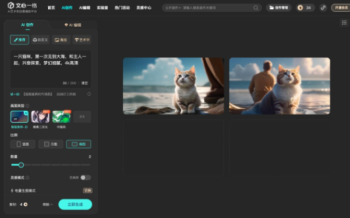
Figure 1: The interface of ERNIE bot.
We chose ERNIE bot (produced by Baidu) as the experimental platform, and the interface is shown in Figure 1, mainly for the following reasons: 1) Stability: Compared with the platform that requires registration of foreign accounts, ERNIE bot is more friendly to domestic users and has a stable
266 Jing and Zhang
network. 2) Ease of use: No need to master complex prompt word writing rules, only through natural language interaction can generate pictures, suitable for users without AIGC experience. 3) Powerful: Based on Baidu ERNIE large model, support cross-mode generation, fast generation speed.
Participants Through questionnaire screening, 13 participants were recruited to participate in the offline operation experiment. The participants met the following conditions: strong learning ability and able to clearly describe the operating experience. The participants were 21–27 years old and had different professional backgrounds. The AIGC experience of the participants is shown in Table 1.
Table 1: Text-to-image AIGC usage background of participants.
Table available in the original PDF paper.
Experience Frequency of Use Proficiency Experienced 69% None 38% Low 38% Inexperienced 31% Once or twice a 46% Medium 47%
week Three to five 8% High 15% times a week
More than 5
8%
times a week
Procedure The experimental process is shown in Figure 2. First, the participants were given 5 minutes to familiar with the operations of ERNIE bot. After that, the participants were free to complete and specify the generation of images within 10 minutes. After completing the operation, the participants answered the corresponding questions and described their experience during the operation.
Figure 2: Procedure of the experiment.
Figure available in the original PDF paper.
Data Collection Each participant should be interviewed for no less than 10 minutes. The interview contents focus on the overall user experience, operational behavior and feeling differences in different task situations, combined with the actual operation and emotional performance of the participants during the experiment, flexibly supplement the content of questions. Finally, a total of 33,685 words of interview texts were collected, and the recording was transcribed and manually reviewed. The interview outline is shown in Table 2.
User Information Behavior From the Perspective of Information Context 267
Table 2: The interview outline.
Table available in the original PDF paper.
Category Question No AIGC experience The experience of first-time using text-to-image AIGC. Is it easy to generate images through the platform? Have AIGC experience What are the similarities and differences between
ERNIE bot and AIGC platforms you used before? Is past experiences with AIGC helpful for this operation? Common Whether the ERNIE bot produces your desired image? Describe the operational experience of the non-task
situation. Describe the operational experience of the task situation. Whether the two operating experiences are different? The problems that you encountered during the
operation. The part that takes more time and energy, describe feelings. Attitude changes during the operation. Feelings during the operation. The most joyful part during the operation. The saddest part during the operation. Based on behaviors in the
The reason of unique operational behaviors.
operation
The reason of unique emotional expressions. The reason of error responds.
Data Analysis A total of 192 raw data statements, from interviews were analyzed to extract initial concepts. After excluding 5 non-relevant concepts and 26 data points from 2 in-depth users, we identified 37 initial concepts and 13 subcategories.
The axial coding process builds upon open coding to induce relationships among subcategories. By reviewing the literature and extracting concepts, 8 main categories have been identified. The specific details are presented in Table 3.
Table 3: Open coding results statistics and spindle coding results table.
Table available in the original PDF paper.
Initial Concepts Subcategories Main Categories A1 Server Stability Issues; System Failure Service Failure A2 AI Rendering Model Defects; (Li, 2020; Zhao, 2023; (Yany and S.A.M.,
(Wu and Zhao, 2022) A37 Active Rejection Behavior. Utilization Abandonment (Li, Lei and Cui, 2021)
Table 4: Part of the original statement coding process.
Table available in the original PDF paper.
Part of Raw Data Statements Initial Concepts It might be because I’ve run the experiment too Server Stability Issues many times, and the server crashed.
I think the interface should at least have some
Ambiguous Operation
guidance.
Guidance The constant training process is really annoying
Negative Emotional Reactions
to me.
But I get super excited waiting for the results, like
Positive Expectancy
it’s a surprise box or something!
I feel like I can’t just use it directly; it’s more of a
Compromised Adoption
reference for ideas.
Limited Tool-Based Utilization
Behavior When I’m making a PPT or need some decent images, I can use it. But I still have to watch out for low-quality pictures.
The specific connotation of the subcategory is as follows: 1) System Failure: Due to information system limitations, specifically AIGC model’s limited understanding, result in generated images not matching the description. 2) Retrieval Failure: Information retrieval failure, including unsuccessful prompts and complete task failure, occurs when inadequate prompts prevent obtaining desired images. 3) Interface Layout: The arrangement of interface operation bars. 4) Interface Operation Guidance: Prompts for operational functions during the image generation process. 5) Image Generation Limitations: Platform-related functionalities failing to meet image requirements. 6) Content Generation Constraints: Generated content not satisfying user demands. 7) Emotional Experience: User experience throughout interactions on the platform. 8) User Expectations: User expectations regarding generated content following their information needs. 9) Task Requirements: Information requirements based on interests and task contexts. 10) Personal Needs: Information requirements influenced by personal aesthetic preferences. 11) Personal Needs: Information requirements influenced by personal aesthetic preferences. 12) Information Structuring: Users’ methods for organizing prompt words according to their
270 Jing and Zhang
needs. 13) Information Adjustment: Users’ behaviors in adjusting prompt words based on feedback from generated images. 14) Proactive Acceptance: Users actively recognizing AIGC’s capability in text-to-image generation and expressing willingness to use it. 15) Passive Acceptance: Users acknowledging limitations within AIGC text-to-image generation but still considering its potential usage. 16) Passive Acceptance: Users acknowledging limitations within AIGC text-to-image generation but still considering its potential usage. 17) Direct Utilization: Users directly utilizing platform-generated images for work or creative purposes. 18) Moderate Utilization: Limited usage by users who regard these outputs more as references than definitive solutions. 19) Utilization Abandonment: Users perceiving that currently generated images by AIGC lack commercial or inspirational value.
Selective coding represents the final stage of grounded theory, wherein categories are integrated and core categories are identified to analyze their relational structure. Ultimately, 3 core categories—information environment, dynamic emotions, and information behavior—are synthesized to construct a model of information behavior within the context of AIGC. The specific details are presented in Table 5.
Table 5: Attributes and dimensions analysis.
Table available in the original PDF paper.
Core Category Attributes Dimensions Information environment Service Failure User Factors — System Factors User Interface Evaluation High Interface Evaluation
Comprehensive
— Low Interface Evaluation Experience of Text-to-Image Functionality Functionality — Functional Deficiencies Dynamic Emotions User Expectations Positive Expectations —
Negative Expectations Emotional Experience Positive Experience – Negative Experience Information behavior Information Needs Positive Experience –
Negative Experience Information Processing Interest-Driven – Task-Driven Information Acceptance Proactive Acceptance —
Passive Acceptance Information Utilization Direct Utilization — Neutral Utilization — Abandonment of Utilization
RESULTS
This study constructs a mechanism model for the influence of user information behavior in the context of AIGC based on grounded theory,
User Information Behavior From the Perspective of Information Context 271
revealing the role of situational factors in shaping information behavior and dynamic emotions. The research findings indicate that:
Firstly, situational contexts determine information behavior and affect the evolution of dynamic emotions, with significant differences observed in the processes and emotional expressions under task-oriented versus interest- driven situations.
Secondly, situational factors exert their influence on information behavior and emotions through three main aspects: 1) User information needs arise from contextual circumstances, exhibiting dynamic regulatory characteristics under interest-driven situations; 2) Information processing follows an “Organization-Evaluation-Adjustment” cyclical mechanism, where users decide on strategies for utilizing or adjusting information by comparing their needs with output results; 3) Both situational contexts and operational environments jointly regulate dynamic emotions.
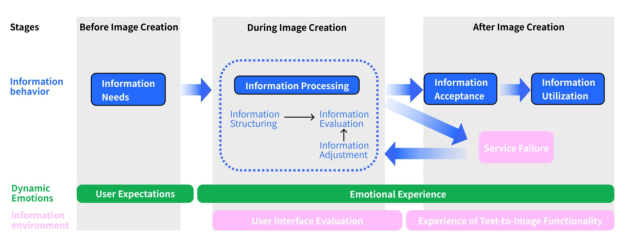
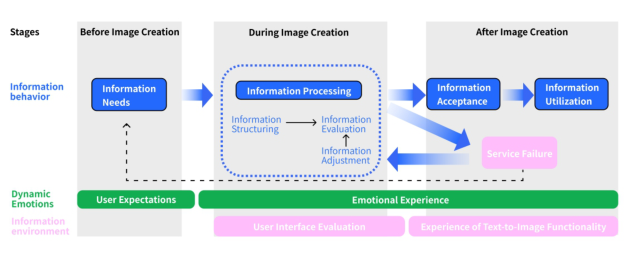
Furthermore, this study proposes an information behavior model under dual contexts of tasks and interests (Figure 3 and 4), elucidating the “Demand-Processing-Utilization” dynamic cycle characteristic within AIGC environments. It confirms that interactions between operational environments and situational contexts significantly impact emotional states.
272 Jing and Zhang
DISCUSSION
The information behavior of AIGC users can be categorized into three stages: demand generation (before image creation), processing (during image creation), and acceptance and utilization (after image creation). In task- oriented contexts, information needs are clearly defined with high precision requirements for content; thus, the organization of prompts emphasizes logical coherence and normative expression. Conversely, in interest-driven contexts, needs gradually become clearer through the interaction process, leading to a more subjective organization of prompts.
There exists a differentiation between active and passive modes of information acceptance: active recipients regard AIGC as a creative tool and delve deeply into its application methods, while passive recipients focus on its limitations and cautiously reference the results. The manner in which information is utilized is influenced by task demands, generation quality, and individual habits, resulting in three dimensions: direct utilization (as an outcome), neutral utilization (as auxiliary reference), and abandonment of use (when quality does not meet standards).
Dynamic emotional evolution permeates the entire process. Interface design, functional performance, and information matching collectively impact emotional experiences—matching demands elicits positive emotions while discrepancies lead to feelings of frustration. Compared to the tension experienced in task-oriented contexts, interest-driven situations are more conducive to maintaining user relaxation.
CONCLUSION
This paper takes the ERNIE bot as a case study to explore user information behavior on AIGC platforms in different contexts. Based on the conclusions drawn above, we derive research insights from two perspectives: users and information service providers, and propose corresponding strategies.
The proficiency of users in describing prompts logically and their understanding of AIGC model training are directly related to the outcomes of information evaluation. Therefore, to mitigate failures in retrieval and service caused by improper information handling or prompt usage, it is essential for users to enhance their personal information literacy. Users should systematically master the logic of AIGC terminology and principles of image composition, thereby reducing ineffective interactions through precise expression of needs, minimizing cycles of information behavior, and improving image generation efficiency.
User interface evaluation and functional experience on text-to-image AIGC platforms can impact user dynamic emotions through both direct and indirect pathways. Consequently, information service providers should implement optimization strategies across three levels within these two dimensions. From a technical perspective, algorithms should be upgraded to enhance language comprehension and image generation quality while reinforcing platform stability; from an experiential standpoint, improvements should be made in novice guidance systems, warning mechanisms for prohibited terms, and interface layout—integrating cultural
User Information Behavior From the Perspective of Information Context 273
context to enhance localization; finally, from an intelligent dimension perspective, developing a prompt recommendation system could lower user learning costs. This paper emphasizes that dynamic emotions experienced by users are directly influenced by platform functionalities alongside interface designs—therefore it is imperative that platforms enhance service quality via dual pathways involving technological upgrades as well as optimizations ultimately achieving precise alignment between user needs and AIGC capabilities.
ACKNOWLEDGMENT
The authors would like to thank associate professor Shi of Jiangnan University for her guidance and thanks to all those who supported and participated in this study.
REFERENCES
Altaffaq H. A. H. A., Bin I. B., Azhar A. R., et al. (2022) ‘User Expectation and Benefits of Implementing Artificial Intelligence in the UAE Energy Sector’, Journal of Applied Engineering Sciences, 12(1), pp. 1–10. Ben W., and Jiqun L. (2023) ‘Investigating the role of in-situ user expectations in
Web search’, Information Processing and Management, 60(3). Chen X. H., Liu H., Xiong J. B., et al. (2019) ‘User Selection Incentive Mechanism for Task-Oriented Mobile Crowd Sensing’, Computer Applications, 39(08), pp. 2310–2317. Chen, G. H. and Shi, H. M. (2024) ‘Characteristics and Influence Mechanism of
Emotional Experience for Self-driving Tourists on Sichuan-Tibet Southern Route’, Journal of Tourism Research, pp. 1–29. Fouroudi, P., Kitchen, J. P., Marvi, R. et al. (2020) ‘A bibliometric investigation of service failure literature and a research agenda’, European Journal of Marketing, 54(10), pp. 2575–2619. Hairu, Y., Minghan, C., Yongfeng, D., et al. (2023) ‘How does interactive
virtual reality enhance learning outcomes via emotional experiences? A structural equation modeling approach’, Frontiers in Psychology, 13:1081372. Huang M. (2000) ‘Initial Exploration of User Information Systems: Discussing User-Oriented Information Processing’, Library and Information Work, (10), pp. 38–41. Huang, K., Cheng, Z. Q., Li, J. J. et al. (2018) ‘Research on User Coping Effects Based
on OPAC Retrieval Failure Questions’, Library Science Research, (07), pp. 64–75. doi:10.15941/j.cnki.issn1001-0424.2018.07.010. Ji, Y. H., Li, C. T., Luo, X. M. et al. (2024) ‘Optimization Design of Human-Machine Interface Layout in Ship’s Cockpit Based on Human Factors Engineering’, Journal of Shanghai Jiao Tong University, pp. 1–20. Li, B. et al. (2023) The Technical Features and Aromorphosis of Artificial Intelligence
Generated Content (AIGC), Documentation, Information & Knowledge, 40(01), pp. 66–74. doi:10.13366/j.dik.2023.01.066. Li, H. (2020) Analysis of the Causes and Countermeasures of Information System Project Failure, Electronic Technology & Software Engineering, (17), pp. 43–44. Li, S., Lei, T. and Cui, Z. (2021) ‘Mechanism and Model of User Dropout Behavior
in Weak-Tie Social Media from the Perspective of the Self’, Modern Information, 41(3), pp. 52–59.
274 Jing and Zhang
Li, X. and Xu, K. (2022) ‘Research on Dynamics and Development Trends of Information Behavior in China’, Information Science, 40(6), pp. 185–193. Lin Q., Yang Y. L. (2011) ‘Interpretation of Information Organization in New
Information Environment’, Library and Information Work, 55(12), pp. 118–121. Liu, C. Yang, Z. Wang, X. (2021) Research on Information Behavior and Experience of Undergraduate Assignment Based on Time Context, Information Studies: Theory & Application, 44(10), pp. 110–118. doi:10.16353/j.cnki.1000– 7490.2021.10.015. Liu J. Y., Wang X. Y., Liu C. (2023) ‘Learning-oriented Search Information Behavior
Concept Map Construction and Research Outlook’, Information Theory and Practice, 46(4), pp. 44–52. Liu, N. and Wang, J. (2020) ‘Experimental Study on Dynamic Prompt Information Characteristics in Mobile Navigation Interfaces’, Electromechanical Products Development and Innovation, 33(05), pp. 45–48. Meng G. H., Liu C. (2021) ‘Exploration of the Relationship between College
Students’ Personal Academic Information Organization Behavior and Academic Procrastination’, Library and Information Work, 65(22), pp. 85–95. doi:10.13266/j.issn.0252 -3116.2021.22.009. Meng Y. P. (2022) ‘Research on Online Guidance Strategy Design from the Perspective of Information Processing Models’, Journal of Jining Normal University, 44(05), pp. 25–28. Qiu J. P., Chen L. C., Zhang Y. J., et al. (2014) ‘Personal Demand Prediction
Algorithm Based on Social Network’, Computer Applications and Software, 31(02), pp. 263–265+306. Song, S. J., Zhao, Y. X., Zhu, Q. H. (2023) ‘From ELIZA to ChatGPT: Evaluation of AI Generated Content Credibility in Human Intelligence Interaction Experience’, Information Data Work, 44(04), pp. 35–42. Sonnenwald, D. H. (1999) Evolving perspectives of human information behavior:
Contexts, situations, social networks and information horizons, in Taylor Graham eBooks. http://arizona.openrepository.com/arizona/bitstream/10150/ 105189/1/isic98%2bpaper.pdf Steephen, J. E. (2013) ‘HED: A Computational Model of Affective Adaptation and Emotion Dynamics’, IEEE Transactions on Affective Computing, 4(2), pp. 197–210. doi:10.1109/T-AFFC.2013.2. Sun, X., Pei, Z., Zhang, C., Li, G., and Tao, J. (2021) ‘Design and Analysis
of a Human-Machine Interaction System for Researching Human’s Dynamic Emotion’, IEEE Transactions on Systems, Man, and Cybernetics: Systems, 51(10), pp. 1–12. Wang, K. F. and Huang, K. (2019) ‘Research on the Influencing Factors of Digital Library User Retrieval Failure’, Library and Information Work, 63(11), pp. 25–34. doi:10.13266/j.issn.0252–3116.2019.11.003. Wilson, T. D. (1997) Information behaviour: An interdisciplinary perspective,
Information Processing & Management, 33(4), pp. 551–572. https://doi.org/ 10.1016/s0306-4573(97)00028-9. Wu, D. and Zhao, Y. (2022) ‘Exploratory Research on Senior Tourists’ Information Behavior from the Perspective of Active Aging’, Journal of Beijing Institute of Technology (Social Sciences Edition), 24(6), pp. 146–158. Wu, H. (2021) Research on Mobile Reading User Behavior Based on the Perspective
of Situational Interaction, Information Research, (06), pp. 40–45. Xia, Y. G. and Pan, J. J. (2009) ‘Research on Library Service Failure and Attribution Based on User Perspective’, Library Forum, 29(03), pp. 124–126+58.
User Information Behavior From the Perspective of Information Context 275
Xu, K. Y. and Ding, J. (2008) ‘Research on the Evaluation of User Interfaces in University Digital Libraries’, Information Science, (05), pp. 740–743. Yany, G. and S. A. M. (2021) ‘Service Failure and Recovery at the Crossroads:
Recommendations to Revitalize the Field and its Influence’, Journal of Service Research, 24(3), pp. 323–328. Yao, L. and Zhang, H. (2024) ‘Model Construction and Empirical Research on the Influencing Factors of AIGC User Dropout Behavior’, Journal of Library and Information Science in Agriculture, 36(5), pp. 79–92. Yao, Y. and Xu, T. C. (2018) ‘Research on the Structural Model for Evaluating User
Experience in Mobile Libraries’, Journal of the National Library of China, 27(05), pp. 32–43. doi:10.13666/j.cnki.jnlc.2018.05.004. Zhang, Y. (2024) ‘Research on Influencing Factors of AIGC User Dropout Behavior from the Perspective of Configuration’, Journal of Library and Information Science in Agriculture, 36(5), pp. 79–92. Zhao J. (2003) ‘Dynamic Student Modeling Research Based on Cognitive Theory
and Random Openness Testing’, Computer Engineering and Applications, (34), pp. 95–98. Zhao, Y. W. (2023) ‘Exploration of Smart Library Information System Construction’, International Public Relations, (03), pp. 28–30. doi:10.16645/j.cnki.cn11-5281/ c.2023.03.020.
LISTED IN THE AHFE DIGITAL BOOKSTORE CATALOGUE
Explore the complete digital volume
Usability and User Experience
Read this individual research paper free through the original publisher, or explore the full digital proceedings book.
ISBN 978-1-964867-70-0
Explore this ISBN in the AHFE Bookstore ↗Listed in the July 2026 bookstore catalogue; search by ISBN to confirm current availability · Digital book purchase optional