Shasha Li, Zhongzhen Lin (2023). Navigation interface design for agricultural e-commerce: an empirical study. In: Human-Centered Design and User Experience. AHFE Open Access, vol. 114, pp. 205–210. https://doi.org/10.54941/ahfe1004237
The purpose of this study was to investigate the effects of visual information layout format on users' experiences when browsing a mobile e-commerce interface for agricultural products across different ages. The effects of different agriculture product layouts (side-by-side vs. list), and age (younger group vs. older group) on user satisfaction, purchase intention, and preference were assessed by 2x2 between-subjects and within-subjects mixed ANOVA. The study utilized a convenience sampling method, a total of 36 participants were invited and asked to complete satisfaction, purchase intention, and preference scales after they completed four manipulative tasks. The results of the study showed that the form of product layout did not have a significant effect on the participants' purchase intention, whereas there was a significant interaction effect between the young and the old in terms of satisfaction and preference.
Agricultural E-commerce has become an important way to buy everyday food in China. Through mobile apps, people are able to easily purchase all types of produce and enjoy the convenience of having it delivered to their doorstep in as little as 30 minutes after placing an order. Today, both young and old are becoming accustomed to and relying on mobile apps for their produce. However, there are still many shortcomings in interaction design, especially in the use and layout patterns of the navigation interface. The interface navigation system is very important for the purchase of agricultural prod- ucts e-commerce, which supports this entire shopping process, and plays a very important role in whether people quickly buy the desired products, and whether they continue to use the application. And the design and elements that are closely related to the interface navigation, web page design, search options, and graphical layout may greatly influence the customer base of any e-commerce website (Modi & Singh, 2023). Furthermore, a comparative analysis between the younger and older demographics is essential to compre- hend the variations between these groups, enabling targeted design strategies to be employed. In order to ensure that this e-commerce application truly
meets the needs of its diverse users, further research and improvements are essential in the field of interaction design for interface navigation systems.
Several researchers have studied the impact of e-commerce platform business models on customer behavior, attitudes, and perceptions from a managerial perspective. For example, Huddleston et al. (2009) investigated how store attributes such as product assortment, price, quality, and service affect satisfaction across different store formats. Meanwhile, Thomas (2013) explored the link between customer loyalty, satisfaction, and store image and demonstrated that store image positively affects customer loyalty through customer satisfaction. Also, in some studies conducted on agricultural prod- ucts, Wang et al. (2022) analyzed consumer preferences for agricultural brands and the interaction effects in an e-commerce environment. Schol- ars have studied quality and safety issues of fresh produce, website design, and website service quality (Cai et al., 2018), or examined the impact of e-commerce platforms on customer satisfaction (Liu & Kao, 2022). In addi- tion, some researchers have delved into the technical aspects, focusing on building reliable e-commerce system models or establishing robust informa- tion systems (Zhu et al., 2021). Wang et al. (2010) explored the impact of online formal aesthetics and aesthetic sensibilities on consumer-perceived quality of online services and satisfaction during service encounters. Affandy et al. (2018) argue that layout, navigation menu design, and other visual com- ponents enhance the overall presentation of a website and these are referred to as the visual appeal of a website. Although several scholars have conducted studies related to agricultural products and website visualization, however, there are very few studies exploring the interface interaction design perspec- tive for mobile agricultural e-commerce, and much less attention has been paid to layout formats and the experience of consumers of different ages.
This study will start from the perspective of interface design, involving human-computer interaction (HCI), human factors, information design, and other research fields, to explore how the navigation interface interaction of agricultural products e-commerce affects the user experience (including user satisfaction, preference, purchase intention, etc.) of users of different age groups, and then to propose interface design solutions applicable to users of different age groups. The results of this study are expected to expand the scope of application and the use of agricultural products e-commerce, thus contributing to the sustainable development of the agricultural products retail industry in the future.
RESEARCH EXPERIMENT The methodology of this study was to collect quantitative data through exper- imental manipulation. The convenience sampling method was used in this study, a total of 36 participants including 18 younger age group (18-35) and older age group (50+) were invited. A 2x2 mixed ANOVA was used to assess the effect of different products layout form (side-by-side, list), and different age (younger and older) on user satisfaction, purchase intention and preference. Participants were first required to manipulate four tasks, which were Task 1: search for “yogurt” in the navigation bar; Task 2: search for
Navigation Interface Design for Agricultural E-Commerce: An Empirical Study 207
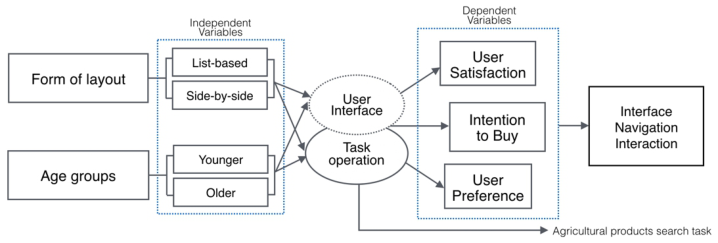
“watermelon” in the navigation bar; Task 3: search for fresh “milk” in the navigation bar and pick a bottle to put into the shopping cart; and Task 4: search for “lettuce” in the navigation bar and pick a handful to put into the shopping cart. The operational tasks are set on the basis of the food that peo- ple buy on a regular basis. And complete a 7-point “Likert scale”to determine user satisfaction, purchase intention and preference.The research framework is shown in Figure 1. The operating device provided to the participants for this study was iPhone 14 plus, iOS version 16.0.1.
Figure 1: Research framework of this study.
RESULTS OF THE STUDY This study analysed the obtained results using a two-way mixed factorial analysis of variance (ANOVA) experiment. The main effects of each variable and the interaction with layout form and age were also analyzed using the SPSS software program. Significance was further analysed through post hoc tests (pairwise comparison).
Based on the results from the two-way ANOVA shown in Table 1. The results revealed that the interaction effect of user satisfaction between layout form and age showed a significant difference (F(1,34) = 6.216, P = 0.018 < 0.05). However, the main effect of layout form and age showed no significant difference.
The interaction effect of user preference between layout form and age showed a significant difference (F(1,34) = 4.196, P = 0.048 < 0.05). However, the main effect of layout form and age showed no significant difference.
The interaction effect of user preference between layout form and age showed a significant difference, while the main effect of layout form and age showed no significant difference.
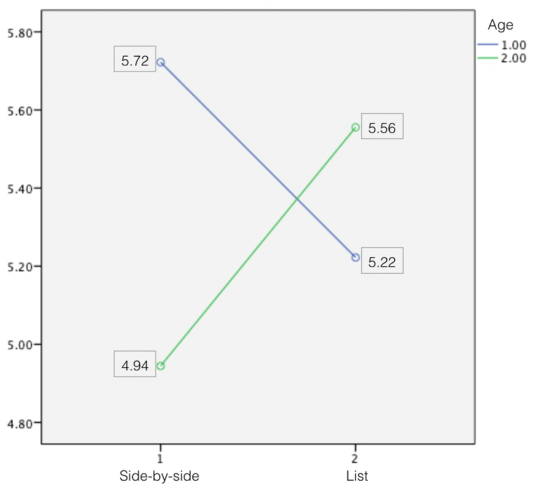
The interaction effects results depicted in Figure 2 reveal noteworthy trends. In the case of the side-by-side format, the data underscores that sat- isfaction levels were notably higher among the younger group (M = 5.72, SD = 0.96) compared to the older group (M = 4.94, SD = 1.47). Conversely, for the list format, the opposite was true, with the older group being slightly more satisfied (M = 5.56, SD = 1.15) than the younger group (M = 5.22,
208 Li and Lin
SD = 1.26). In essence, it can be deduced that the side-by-side format res- onated significantly better with the younger group as opposed to the older group.
Table 1. Two-way ANOVA for layout form.
Table available in the original PDF paper.
Dependent Variables Source SS DF MS F P η2 User Satisfaction Layout form 0.056 1 0.056 0.062 0.805 0.002 Age 0.889 1 0.889 0.421 0.521 0.012 Layout form × Age 5.556 1 5.556 6.216 0.018* 0.155 User Preference Layout form 0.222 1 0.222 0.343 0.562 0.010 Age 2.722 1 2.722 1.535 0.224 0.043 Layout form × Age 2.722 1 2.722 4.196 0.048* 0.110 Intention to Buy Layout form 0.681 1 0.681 1.078 0.307 0.031 Age 0.347 1 0.347 0.550 0.463 0.016 Layout form × Age 0.347 1 0.347 0.550 0.463 0.016
Equation reproduced from the original PDF.Figure 2: The interaction effects of user satisfaction. (Note: Age 1 represents younger age group and Age 2 represents older age group.)
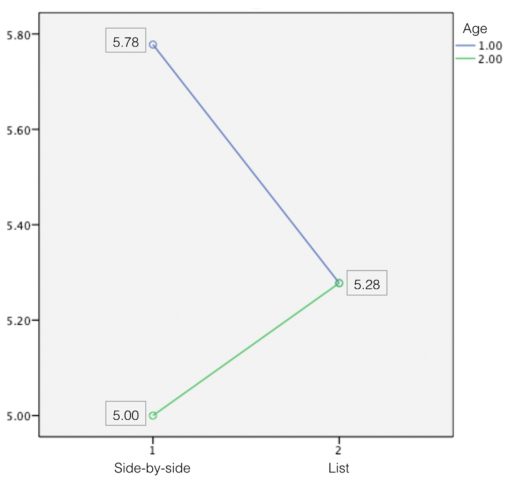
The findings from the analysis of interaction effects, as illustrated in Figure 3. When examining the side-by-side format, it becomes evident that the preference levels of the younger group were notably higher (M = 5.78, SD = 1.11) compared to the older group (M = 5.0, SD = 0.97). In contrast, in terms of list format, a convergence was observed: the preference of the younger group (M = 5.28, SD = 1.23) coincided with that of the older group
Navigation Interface Design for Agricultural E-Commerce: An Empirical Study 209
(M = 5.28, SD = 1.07). In short, it can be inferred that the side-by-side for- mat found greater favour among younger individuals, marking a significant preference disparity between different age groups.
Figure 3: The interaction effects of user preference. (Note: Age 1 represents younger age group and Age 2 represents older age group.)
CONCLUSION
This study aims to investigate the relationship between user satisfaction, pref- erences, and purchase intentions in operating agricultural e-commerce appli- cations, considering different product layouts and age groups. Specifically, we will examine the impact of varying product layouts on user satisfaction, preferences among different age groups regarding product layouts, and the potential influence of these factors on user purchase intentions. Through in- depth analysis, our goal is to uncover the interactions among these variables, providing valuable insights for the optimization of agricultural e-commerce applications. Drawing from the outcomes of the experiments, several design recommendations have been formulated to enhance the interaction design of the navigation interface in agricultural e-commerce. This study suggests the following three interaction design recommendations for the navigation interface: side-by-side forms of interface interaction are not recommended for older users. For younger users, side-by-side interface interactions may be a good design choice. In terms of purchase intention, both young and old peo- ple may not be affected by the product layout form. The results and design recommendations of this study have implications for design programs con- ducted by different age groups and serve as a research base for future in-depth studies on e-commerce in agricultural products.
210 Li and Lin
ACKNOWLEDGMENT
This study was supported by the Basic Research Fund of Guangzhou Munic- ipal Science and Technology Bureau [Grant No. 2023A04J1668].
REFERENCES
Affandy, H. B., Hussain, A., & Nadzir, M. M. (2018, September). Web visual design principle used in public universities website design. In AIP conference proceedings (Vol. 2016, No. 1). AIP Publishing. Cai, L., He, X., Dai, Y., & Zhu, K. (2018, September). Research on B2B2C
E-commerce website design based on user experience. In Journal of Physics: Conference Series (Vol. 1087, No. 6, p. 062043). IOP Publishing. Huddleston, P., Whipple, J., Mattick, R. N., & Lee, S. J. (2009). Customer satisfaction in food retailing: comparing specialty and conventional grocery stores. Interna- tional Journal of Retail & Distribution Management, 37(1), 63–80. Liu, X., & Kao, Z. (2022). Research on influencing factors of customer satisfaction
of e-commerce of characteristic agricultural products. Procedia Computer Science, 199, 1505–1512. Modi, N., & Singh, J. (2023). Understanding online consumer behavior at e-commerce portals using eye-gaze tracking. International Journal of Human– Computer Interaction, 39(4), 721–742. Thomas, S. (2013). Linking customer loyalty to customer satisfaction and store
image: a structural model for retail stores. Decision, 40(1-2), 15–25. Wang, E., Liu, Z., Gao, Z., Wen, Q., & Geng, X. (2022). Consumer preferences for agricultural product brands in an E-commerce environment. Agribusiness, 38(2), 312–327. Wang, Y. J., Hernandez, M. D., & Minor, M. S. (2010). Web aesthetics effects
on perceived online service quality and satisfaction in an e-tail environment: The moderating role of purchase task. Journal of Business Research, 63(9-10), 935–942. Zhu, Z., Bai, Y., Dai, W., Liu, D., & Hu, Y. (2021). Quality of e-commerce agricultural products and the safety of the ecological environment of the origin based on 5G Internet of Things technology. Environmental Technology & Innovation, 22, 101462.
LISTED IN THE AHFE DIGITAL BOOKSTORE CATALOGUE
Explore the complete digital volume
Human-Centered Design and User Experience
Read this individual research paper free through the original publisher, or explore the full digital proceedings book.
ISBN 978-1-958651-90-2
Explore this ISBN in the AHFE Bookstore ↗Listed in the July 2026 bookstore catalogue; search by ISBN to confirm current availability · Digital book purchase optional