Thomas Weinhauser, Sophie Steinmaßl, Andreas Eursch (2023). Exploiting the innovation potential of medium-sized mechanical engineering companies through the practical application of agile methods. In: Creativity, Innovation and Entrepreneurship. AHFE Open Access, vol. 74, pp. 17–26. https://doi.org/10.54941/ahfe1003301
HM Hochschule München University of Applied Sciences, Department of Mechanical, Automotive and Aeronautical Engineering/ Field of Product Development, Munich, 80335, Germany ↗
Innovations have become a decisive competitive advantage. Companies must find ways to develop and establish new and, above all, suitable products, and processes even faster. Added to this are the ever-increasing product complexity, continuously rising customer requirements and a great deal of uncertainty due to constantly and sometimes radically changing market requirements. For this reason, agile methods are now being discussed even among established and successful companies in the classic mechanical and plant engineering sector to increase innovative strength and flexibility. However, due to the traditionally rather conservative orientation of the processes, the existing agile models quickly reach their limits. To combine the advantages of conventional and agile product development, hybrid process models are used, which are, however, mostly very complex and thus lose an essential advantage, the simplicity in application. The use of these models even requires a high degree of methodological competence, which medium-sized companies rarely have compared to large companies. To nevertheless make the advantages of agile models available to medium-sized companies and thus enable them to exploit their high innovation potential, a simple process model is required. The solution developed specifically for this purpose combines the simplicity of agile process models with the long-term planning of conventional models. It was developed in cooperation with a medium-sized mechanical engineering company, or its processes and requirements, which is active in the field of hydraulics. A survey of the company's development managers revealed that there is a need to adapt the existing procedure for generating innovations. However, new procedures must be introduced gradually, function in parallel with the established procedure, and be reversible if necessary. Therefore, the focus is on uncomplicated entry of developers into the application of agile methods. The model assumes no prior knowledge of agile methods and can therefore be easily applied to individual projects. It allows companies an easy entry into agile product development of physical products without having to adapt basic process flows and interfaces. The unique selling point of the model is the strict separation of the agile and plan-driven elements. Guided by simple rules, processes, roles and basic principles, the hybrid process model is quick and easy to understand. The development team is decoupled from the planning process and can focus on the product, its incremental iterative development, and the creative problem-solving process. To serve the company's interfaces and coordinate the long-term planning process, a planning team is used to plan milestones, stages, and sprints for the development team. The practicality and the ease of application of the agile elements in the development team were demonstrated in a pilot project. The consistent application of the model results, among other things, in improved communication in the development team, a rapid response to changes of any kind, and avoids waste due to context changes, waiting times, the unnecessary distribution of knowledge and information, and the costly procurement of information. The extent to which the consistent application of the model improves effectiveness and efficiency in product development projects cannot be conclusively clarified. To determine these factors, hybrid and conventional development projects must be monitored and compared.
In recent years, economic conditions have dramatically changed. Disasters such as political conflicts, the corona pandemic and financial crises have had a profound impact on the functioning of the economic system and the maintenance of supply chains. Globalization has also increased dependencies between different regions and countries, meaning that conflicts in one region
can have impacts on other parts of the world. This has resulted in compa- nies needing to quickly adapt to new challenges and change their business practices to survive. However, beyond these conflicts, companies are facing new challenges as market demands change quickly, products become more complex and customer expectations rise. Only companies that are able to quickly respond to changes and develop innovative products will succeed in this environment. In this context, medium-sized companies often have diffi- culties. The German machinery and plant engineering sector is of particular interest in this regard, as the economy here is shaped by a large number of medium-sized companies that are represented worldwide and often lead the world market.
It is therefore of great importance that medium-sized companies are able to adjust quickly to changes not only in Germany, but globally, and develop innovative products in order to succeed.
State of the Art To tackle the dynamic changes of the environment and respond flexibly to changes, process and product innovations are necessary (Gausemeier et al. 2019). Agile methods promise solutions here, even in the field of product development. They have been successfully used in software development for over two decades. The use of agile methods in the development of physi- cal products has also been intensified in recent years (Nicklas et al. 2021).
However, pure agile process models encounter limitations in the develo- pment of physical products. Due to the need for early capacity, quality, and production planning, long-term planning of the development is necessary. Unlike digital products, physical products often face strict quality require- ments and require specific approvals. They have much more complex supply chains as many suppliers are involved. These requirements can already impact the early phases of product development and it is therefore necessary to make a longer-term plan regarding capacity, quality, and production to avoid later changes or delays. In addition, production-related aspects must be considered during the design phase, which requires early collaboration with suppli- ers and manufacturing partners. It is also important to keep an eye on the availability of necessary components and resources. All these factors require long-term planning to ensure a smooth implementation and successful mar- ket introduction of the product. For these reasons, agile methods have been integrated into traditional, plan-driven processes and combined into hybrid approaches (Heimicke et al. 2020). This, in turn, leads to extensive pro- cess models that are only partially practical due to their complexity and require a high level of method knowledge. In particular, small and medium- sized enterprises often lack the method competence and capacities to train and integrate complex methods into their business processes and establish them comprehensively (Gaubinger 2021). The present work focuses on redu- cing the complexity of hybrid process models. It was created in cooperation with HAWE Hydraulik SE, a typical representative of the German SME. The company successfully produces hydraulic components and systems, but still feels the need to increase the innovation potential and flexibility in product development.
Exploiting the Innovation Potential 19
Expert Survey To best adapt the integration of agile methods to the requirements of the company, the situation within the company was analysed first. The inno- vation potential lies in the employees of the company. In this context, 14 managers from the development department were interviewed digitally and anonymously. Although about 2/3 of the respondents have five or more years of experience in product development, 62% reported having little to no expe- rience with the application of agile methodologies. Similar to the results of the study by Nicklas et al. (2021), the most experience is with the Scrum, Kan- ban, and Design Thinking methodologies. The respondents expect the use of agile methods to increase flexibility, enabling quick reactions to changes in the environment, increase project efficiency and effectiveness, and improve communication within the development team. The main requirements of the respondents for integrating agile methods are the practicality of the metho- dology, ease of integration into day-to-day operations, and the combination of agility and long-term planning.
To prevent extensive models from being used without specific adaptation and without achieving the expected results, a simple, individually adapted approach is needed.
Core Factors for Acceptance of a Method One of the key success factors in introducing new processes and procedures is employee acceptance. For this reason, particular focus is placed on their requirements when developing the hybrid approach. According to Heimicke et al. (2021), the core factors for acceptance in integrating agile models are the clarity of the method, discipline in its application, and the adaptability of the model to projects and company structures.
Consequently, the goal must be to develop a method that remains simple to apply despite its high adaptability, is quickly understandable even with low method competencies among employees and enables disciplined imple- mentation. To create high acceptance for the model and still integrate the benefits of agile methods into the development process, a targeted selection of methods is made. It should be noted that in most small and medium- sized technical companies, there is a traditional culture and employees are more sceptical of process changes (Gaubinger 2021). For this reason, the developed model places emphasis on the associated changes being carried out step by step. Selected decision criteria for the use of agile methods show the opportunities that arise for each individual project, giving the employee the opportunity to decide based on a standardized evaluation, for or against the hybrid approach. Agile and plan-driven elements are strictly separated in the hybrid approach model, allowing for consistent implementation of the model without interfering with the existing, overarching process. The goal of this separation is to introduce agile methods without making structural interventions in the familiar and established company structure. This should especially reduce the threshold for switching from plan-driven to hybrid approaches.
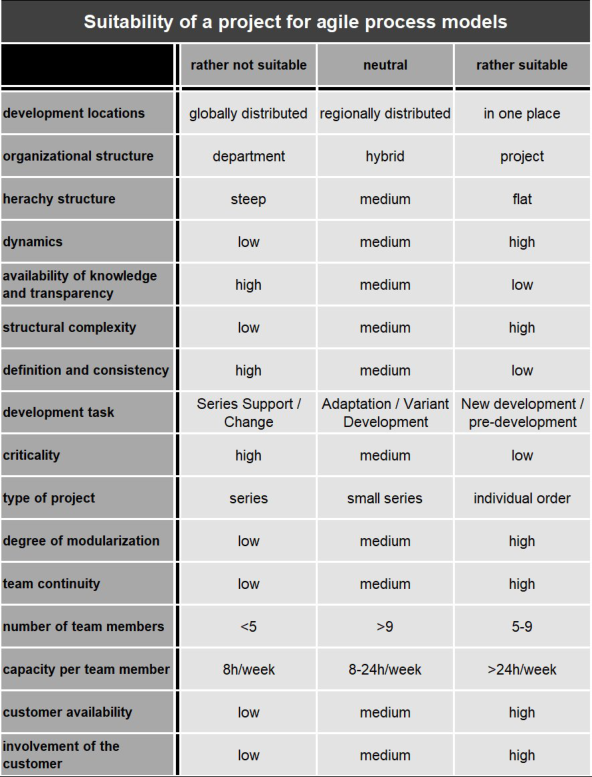
Criteria for Projects Suitable for Agile Handling The strength of agile methods is particularly evident in a dynamic deve- lopment environment. To facilitate and objectify the selection of suitable processes, a criteria catalog based on extensive literature research has been developed (Figure 1). It supports executives and project managers in choo- sing the right approach model, making the decision more transparent and objective.
The evaluation matrix indicates the tendency of projects to be suitable for agile processing. The criteria are divided into the four categories of com- pany, project, team, and customer. The company, its organizational culture, the local distribution of development locations, and especially the hierarchy structure provides the framework for agile work. The project-related factors have the greatest impact on the suitability of a development task. As agile
Figure 1: Evaluation matrix based on (Welge and Friedrich 2011; Klein 2016; Hruschka 2009).
Exploiting the Innovation Potential 21
approaches are designed for complex development tasks, the complexity of the development project is a crucial criterion. The other project-related crite- ria affect the simplicity of implementing an agile approach. The composition and experience of the team is a decisive factor for the successful implementa- tion of agile teamwork. The more experienced the team is, the more capable it is to make decisions independently and the more efficient it is (Lindemann 2009). The performance of the development team is particularly important in the agile environment because the team is assigned increased decision-making authority and autonomy. The available capacity of the team members for the project also affects the effectiveness of teamwork. The fewer projects are being worked on in parallel, the less time is wasted due to context switching and the longer team members work simultaneously on the project, which in turn increases efficiency. Agile approaches are particularly suitable for pro- jects with a few employees in teams of up to 10 people. Teams should at least consist of enough people to create synergies in terms of creativity and error correction. In the implementation of agile approaches, the customer is involved in the product development process. He checks the development progress in regular intervals, provides feedback and thus has influence on the further proceedings (Klein 2016). To ensure this close cooperation, the participation and availability of the customer is essential. The customer can be the end user or the (internal) client.
Lean Hybrid Framework for SME For the development of the Lean Hybrid Framework (LHF), established agile methods, the implementation of agile values, and the principles of Lean Deve- lopment were analysed. The strengths of agile approaches are deliberately used, so that despite a lean integration, a comprehensive improvement of the process can be achieved.
Project-related roles facilitate the implementation of the agile approach in the LHF. The roles of Product Owner, Development Team, and Scrum Master or Agile Coach, taken from the Scrum Framework, allocate responsibilities and authorities in the agile environment (Schwaber and Sutherland 2020). Unlike in the Scrum Framework, the role of the Product Owner is replaced by an interdisciplinary planning team, consisting of employees with the fre- quently used roles of Project Manager, Product Manager, and Project Leader. Representatives of these roles consider the project from the perspectives of market, technology, and project. In an industrial environment, the described roles are a permanent part of a project team, making the council quickly actionable and deployable.
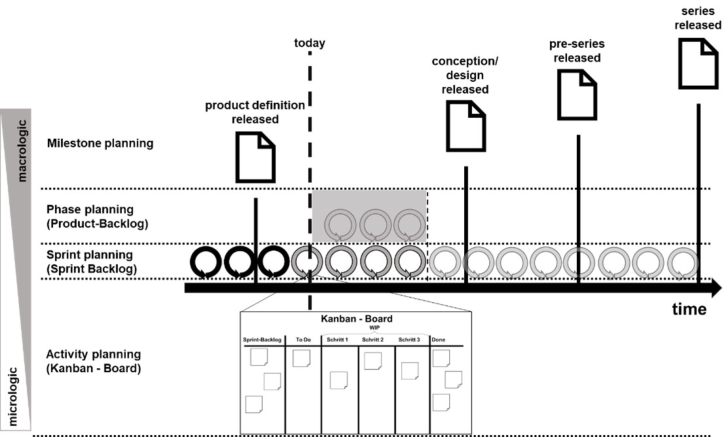
The artifacts of increment and product backlog, known from the Scrum Framework, were expanded in the LHF with signal cards. The application is implemented using the Kanban principle on the Kanban Board (Epping 2011). The flow of a development project must be separately considered at diffe- rent levels of granularity (Lindemann 2009). In the LFH, particular emphasis is placed on the fact that at the highest level, a sequential, plan-driven chara- cter remains. Thus, a long-term planning is maintained. At the same time, an incremental-iterative approach is applied at the underlying level (Figure 2).
Figure 2: Flowchart of the Lean Hybrid Framework for SME.
Milestones mark the end of project phases and can serve as high-level deci- sion points. The planning team is responsible for milestone planning. The development team does not have any involvement with the milestones. All mandatory documents defined for achieving the milestones must be timely transferred by the planning team to the sprint planning. The link between the long-term goals of milestone planning and those of sprint planning is the stage planning. It always considers a period of about three months and defines the specific goals of the upcoming sprints. The planning team forms increments from the signal cards in the product backlog, which are defined as the goal of the sprint. Thus, stage planning also falls within the respon- sibility of the planning team. At the sprint planning level, full-fledged agile work begins. Sprint planning is conducted by both the planning team and the development team. Essentially, the elements of sprint planning, daily mee- ting, sprint, review, and retrospective are taken from the Scrum Framework, and are carried out according to its rules. The lowest level of planning is activity planning. Here, the processing of signal cards and thus the work process during the sprint is planned on the Kanban board. The goal of acti- vity planning is to have all signal cards in the sprint backlog completed and thus a finished increment created by the end of the sprint at the latest. Activity planning is carried out exclusively by the development team, or by the person processing a signal card, in close coordination with the development team. The implementation of the results desired on the signal cards is therefore left to the developers. They are responsible for successful implementation.
The available tools of the company are fully incorporated into the LHF. This applies both to the software tools used to create all documents necessary for product development, as well as to the project management tool and the Gantt diagram used in it. To support the agile work technique Kanban, the Kanban board is introduced as another tool. This visualizes the value chain
Exploiting the Innovation Potential 23
in the development team. For this purpose, signal cards, as a representation of the requirements, are drawn through the phases, which are represented in the Kanban board as columns. The Kanban board is applied according to the description by (Epping 2011). It is the central agile work technique in the approach model. The Kanban board is also implemented in the existing project management tool.
Indicators and Control Variables The use of agile methods is not expected to result in a sudden improve- ment. Rather, the agile methods create the framework for the individual optimization of processes within the company. In addition to optimizing team collaboration, the top goal is to achieve an uninterrupted flow of value, resul- ting in a short lead time. To achieve this, all queues must be identified first. The process is then controlled by the control variables WIP limit and batch size (Epping 2011; Reinertsen 2009).
The Kanban board is used in the LHF to identify the process and any queues, which can be resolved by adjusting local capacity and batch size or setting work-in-progress limits. The process-related batch size and review batch size is controlled by the sprint duration. By adjusting the sprint dura- tion and creating different increment sizes, batch sizes can be varied. From a batch creation perspective, reducing transaction costs through automated tests, rapid prototyping methods, 3D, and VR models is especially important for small batches.
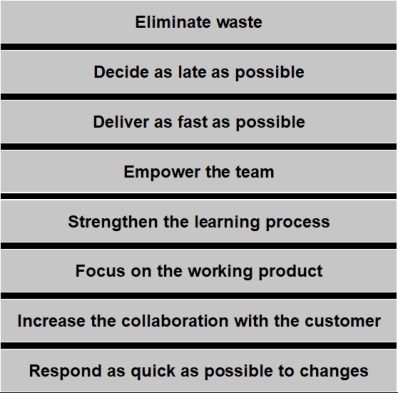
Value System and Core Principles Despite the lean application of agile principles and methods, the value systems of the Agile Manifesto and Lean Development are implemented. The imple- mentation is described based on the eight basic principles defined for the implementation of the LHF (see Figure 3).
Figure 3: Core principles of Lean Hybrid Framework for SME based on (Epping 2011; Reinertsen 2009; Schwaber and Sutherland 2020).
Eliminate Waste The LHF aims to eliminate waste, which is the central goal of the lean philoso- phy. It does so by promoting close collaboration with the customer to expose additional functional scopes that do not add value. Waste caused by exces- sive multitasking is controlled using a Kanban board and WIP limits. Scrum events promote efficient exchange of knowledge and information between the planning team and the development team. The sprint backlog centralizes all technical information relevant to the sprint, reducing the time lost due to context switching. Early discovery of development errors and faulty decisi- ons is ensured through short feedback cycles in reviews. Waiting times caused by missing decisions and information are prevented by clearly defining signal cards in the sprint backlog. Excessive planning is prevented by defining the scope of planning activities and questioning them critically in retrospectives. Documentation is kept to a minimum by defining the desired outcome on each signal card.
Decide as Late as Possible Deliberately delaying decisions is practiced in all agile methods and is the main reason for flexibility. This approach makes sense in product develo- pment for several reasons. In the LHF, this is implemented by dividing the development project into sprints, dividing the product backlog into signal cards with different levels of concretization, and limiting WIP in the Kanban board. Through the iterative development loops, the requirements, meaning the desired outcomes on the signal cards, are only defined immediately before the sprint begins by the planning team and stored in the sprint backlog.
Deliver as Fast as Possible The fast delivery refers to both the final product and each individual task necessary for product development. The goal is to minimize the processing time of each task, thus minimizing the overall processing time (Epping 2011; Reinertsen 2009). In the LHF, fast delivery is achieved through the Kanban board and the timed delivery of increments in sprint cycles. WIP limits are established at the Kanban board, which speeds up the processing of each task. Additionally, by breaking down the product into product increments, each increment is delivered faster.
Empower the Team In agile approaches, many decision-making powers are fully delegated to the development team. This increases the sense of responsibility of team members and, consequently, their motivation to achieve excellent results (Negri 2019). In addition to increasing decision-making powers, the team is strengthened in the agile world primarily through autonomous, self-organized work. The strengthened team morale is the primary factor for the success of agile approaches (Negri 2019; Cooper and Sommer 2018). In the development team, there are no hierarchies, it works self-organized and autonomous, and decides independently what and how to proceed. The daily meeting pro- motes communication, planning, and problem-solving within the team. At
Exploiting the Innovation Potential 25
the Kanban board, the team decides which signal cards will be processed by whom and when. The work is not explicitly given by the manager, but taken by the team, as the planning team makes all the information for processing the sprint transparent in the sprint backlog.
Strengthen the Learning Process Agile approaches strengthen the learning process, particularly through short feedback cycles, self-organized teams, the timed delivery of increments, and goal-oriented performance. This realizes human learning processes: learning through conditioning, learning from models, and learning through insight. In the LHF, the feedback cycles are depicted by the elements of review and retrospective. The timed delivery is depicted by sprints in which increments are created, and goal-oriented performance is depicted by short-term, very specific goals formulated in the form of signal cards.
Focus on the Working Product The product represents the result of product development. The success of product development can only be measured by the result, in other words by the product. In the LHF, a usable, functioning increment is created at regular intervals. It can be checked and tested and represents the intermediate result of a sprint. It is the element that is evaluated by the customer and the planning team in the review and is therefore the prerequisite for feedback.
Increase the Collaboration With the Customer To know the value of the product from the customer’s perspective and to iden- tify all value-adding properties, it is necessary to involve the customer during the entire product development process. This is achieved through regular customer feedback and regular sprint reviews, in which the customer and the planning team evaluate the current state of the product. The cooperation between the customer and the planning team is strengthened by close com- munication and a shared understanding of the goal. The goal is to create a product that meets the customer’s needs and expectations in a sustainable and economically viable way.
Respond as Quick as Possible to Changes The ability to quickly respond to changes is what sets all agile approaches apart. It is the result of all the previously described principles, particularly the late decision making and processing of small task packages in incremental- iterative sprints.
CONCLUSION
The Lean Hybrid Framework (LHF) for SME balances between plan-driven and agile planning by creating short-term plans while still accommodating long-term planning needs. The framework is easy to implement, even for small and medium-sized companies, and the development team works com- pletely agile, increasing the innovation potential of the company. The method
has been demonstrated to be practical in a pilot project but requires further validation through scientific evaluation of two similar projects, one using the conventional approach and the other using the LHF for SME.
ACKNOWLEDGMENT
We sincerely thank HAWE for their support and encouragement in the preparation of this scientific paper. Special thanks go to Prof. Dr.-Ing. Andreas Eursch and Dr.-Ing. Sophie Steinmaßl, whose insights and dedication made this work possible. This collaboration has been a remarkable learning experience.
REFERENCES
Cooper, Robert G./Sommer, Anita Friis (2018). Agile–Stage-Gate for Manufacturers.
Research-Technology Management 61 (2), 17–26. Epping, Thomas (2011). Kanban für die Softwareentwicklung. Berlin, Heidelberg, Springer Berlin Heidelberg. Gaubinger, Kurt (2021). Hybrides Innovationsmanagement für den Mittelstand in
einer VUCA-Welt. Vorgehensmodelle – Methoden – Erfolgsfaktoren – Praxisbei- spiele. Berlin, Heidelberg, Springer Berlin Heidelberg. Gausemeier, Jürgen/Dumitrescu, Roman/Echterfeld, Julian/Pfänder, Tomas/Steffen, Daniel/Thielemann, Frank (2019). Innovationen für die Märkte von morgen. Strategische Planung von Produkten, Dienstleistungen und Geschäftsmodellen. München, Hanser. Heimicke, J./Chen, R./Albers, A. (2020). AGILE MEETS PLAN-DRIVEN – HYBRID
APPROACHES IN PRODUCT DEVELOPMENT: A SYSTEMATIC LITERA- TURE REVIEW. Proceedings of the Design Society: DESIGN Conference 1, 577–586. Heimicke, Jonas/Kaiser, Steffen/Albers, Albert (2021). Agile product development: an analysis of acceptance and added value in practice. Procedia CIRP 100, 768–773. Hruschka, Peter (2009). Agility kompakt. Tipps für erfolgreiche Systementwicklung.
2nd ed. Heidelberg, Spektrum Akademischer Verlag. Klein, Thorsten (2016). Agiles Engineering im Maschinen- und Anlagenbau. Dissertation. München, Techn. Univ. Lindemann, Udo (2009). Methodische Entwicklung technischer Produkte. Metho-
den flexibel und situationsgerecht anwenden. 3rd ed. Berlin, Heidelberg, Springer Berlin Heidelberg. Negri, Christoph (Ed.) (2019). Führen in der Arbeitswelt 4.0. Berlin, Heidelberg, Springer Berlin Heidelberg. Nicklas, Simon J./Michalides, Marvin/Atzberger, Alexander/Weiss, Stefan/Paetzold,
Kristin (2021). Agile Entwicklung physischer Produkte 2021. Eine Studie zum aktuellen Stand in der industriellen Praxis während der COVID-19-Pandemie. Neubiberg, Universitätsbibliothek der Universität der Bundeswehr München. Reinertsen, Donald G. (2009). The principles of product development flow. Second generation lean product development. Redondo Beach, Calif, Celeritas. Schwaber, Ken/Sutherland, Jeff (2020). Der Scrum Guide. Der gültige Leitfaden für
Scrum: Die Spielregeln. Scrum. Available online at https://scrumguides.org/docs/s crumguide/v2020/2020-Scrum-Guide-German.pdf. Welge, M/Friedrich, C. S (2011). Integration von agilen Methoden in der Systementwicklung. In: Maik Maurer/Sven-Olaf Schulze (Eds.). Tag des Systems Engineering. Komplexe Herausforderungen meistern. München, Hanser.
LISTED IN THE AHFE DIGITAL BOOKSTORE CATALOGUE
Explore the complete digital volume
Creativity, Innovation and Entrepreneurship
Read this individual research paper free through the original publisher, or explore the full digital proceedings book.
ISBN 978-1-958651-50-6
Explore this ISBN in the AHFE Bookstore ↗Listed in the July 2026 bookstore catalogue; search by ISBN to confirm current availability · Digital book purchase optional