Mikael Wahlströma, Hannu Karvonena, Eija Kaasinena, Petri Mannonenb (2022). Designing for Future Professional Activity – Examples from Ship Bridge Concept Design. In: Advances in Ergonomics In Design, Usability & Special Populations: Part II. AHFE Open Access, vol. 19. https://doi.org/10.54941/ahfe1001238
This paper proposes a design approach for generating radical design concepts for professional activity. The approach includes analysis of domain-specific work activity, user-experience goals setting as well as work domain and technology trend foresight. The intention of the approach is that the concept solutions reflect the existing means and professional recourses applied in work activity, the potential benefits of future technology, and the existing and future challenges particular to a certain work domain. This approach is exemplified with a ship command bridge design case in which future bridge concepts were generated for three ship types: tugboats, platform supply vessels, and cargo ships. Several subject-matter expert interviews and observations were conducted for gathering understanding required to generate the concept ideas. From the existing user-centred design approaches, our approach combines elements of experience design, co-design, and contextual design, but includes certain features for the purpose of creating radical instead of incremental design solutions, the latter typically being the result of user-centred design. These features include, futurology, generation of broad systems usability design goals with Core-Task Analysis method, reformulation of user-experience goals into themes, stories, or personas, and co-design in the end of the concept design process.
When designing for industrial work, it is typically pertinent that the generated design ideas support the existing aims of the industrial workers. This is because when designing for work activities, rather than for consumers, the aim of activity is usually fixed. Whereas consumers may engage into activities that are wholly new for them, such as, new games or health diets, industry workers serve some basic needs and goals, such as, habitation, energy, security, healthcare, production, or logistics. When it comes to the shipping industry, for example, one may assume that shipping will continue to serve its current main mission, the circulation of goods through the oceans of the world. All this implies the usefulness of studying the existing work activities when designing for industry professionals: the design solutions should correspond with the existing aims of activity. In other words, user-centred design (Gould & Lewis, 1985), in which the needs, wants, and capabilities of the users are taken into account, would be justified.
It is notable, however, that user-centredness in design has been criticised for not providing new types of design solutions with the potential to surprise the people and offer them new possibilities (Norman & Verganti, 2014). Indeed, it typically offers users what they knew they wanted as the design solutions respond to the issues identified by the users (Keinonen, 2009). In other words, studying users’ activities and needs does not seem to provide new kinds of radical or revolutionary innovations because the solutions correspond too closely with the existing models of activity or “user paradigms”. Assumedly, when developing work-related innovations, users do not know all the forthcoming technical possibilities or trends. In addition, they may be too closely fixed to current practises to ideate radical changes. It is thus thought that user studies predominantly provide incremental or evolutionary design solutions, that is, mere modifications to pre-existing designs. Yet, new kinds of design solutions would be those having the greatest potential in providing business advantage by significantly enhancing or modifying the existing work activities. One may thus identify a pertinent problem to be solved: how to generate design solutions that would both 1) support the existing activities of professional workers and 2) surprise the users with innovativeness by providing new possibilities? Assumedly, applying a design approach that solves this problem yields a possibility for positive renewal of industries.
The design approach presented here aims at addressing the problem above. It is based on the following procedures:
1) Reformulation of user study findings in such a manner that sufficient “distance” to the findings is achieved – this allows that study findings do not “directly dictate” the design solutions, thus allowing radical design.
2) Technology trend and future foresight – this allows future orientated design solutions.
3) Co-design and co-evaluation after creating the initial design ideas – this allows increased quality and specification of design ideas.
In the following, we will exemplify each of the procedures with a bridge ship concept design case. In the design assignment, as indicated by the industry partner Rolls-Royce with whom the concepts were generated, the aim was that these solutions would stimulate the overall field of maritime operations by providing future-orientated ship bridge alternatives. The aim was that the concepts would be user-orientated in the sense that they would have to be accepted and appreciated by mariners with hands on practical knowledge of maritime activity, but they would also have to provide radically new types of solutions. It was agreed, however, that maritime legislation would not have to be taken into consideration: we aimed at providing alternatives of possible futures instead of strictly accommodating to existing realities. The aim was that the design concepts would represent the ship bridges of the year 2025. Three ship types were considered, these being tugboats, platform supply vessels (PSV), and cargo ships.
Overall, the design approach resembles “contextual design” (Beyer & Holtzblatt, 1998), “experience design” (Hassenzahl, 2010), and “co-design” (Sanders & Stappers, 2008), because it is based on 1) studying the work context, 2) user-experience goal-setting, and 3) collaborative design with the users, respectively. The difference to these approaches is the purposeful aim for future orientation and radical design. Additionally, we use a specific analysis method called Core-Task Analysis (Norros, 2004; Norros 2013) for making sense of professional activity. We will contrast our design approach against these approaches in the discussion section of this paper.
MEANS FOR RADICAL YET USER-ORIENTATED DESIGN SOLUTIONS Reformulation of user study findings
As has been discussed elsewhere (Wahlström et al., under review), creating “reasoned departure” to user study findings can be the means for avoiding the phenomenon of designers being “trapped within the current paradigms” (Norman & Verganti, 2014). In other words, we propose that in the preliminary phases of design, the design indications drawn from the users’ explications should be meaningful but also purposefully broad. The broadness allows that the users’ ideas do not dictate the creative process of design too directly and specifically. This is important, because this facilitates creation of ideas that are new for the users. In practice, the idea is that user activity is modelled and understood rather than that users’ ideas are directly applied as design indications.
Second means for creating radical design ideas on the basis of studying users is focusing on the user experience rather than on the product features; this approach draws from user-experience design (Hassenzahl, 2010). User- experience design serves the purpose that users’ ideas do not translate into product ideas directly. With the transition from users’ opinions, to user experience goals and from there to design solutions a distinctive “gap” between the users’ ideas and the design ideas exists. Once again, this allows that the user studies do not inhibit radical design by directly dictating the design idea creation.
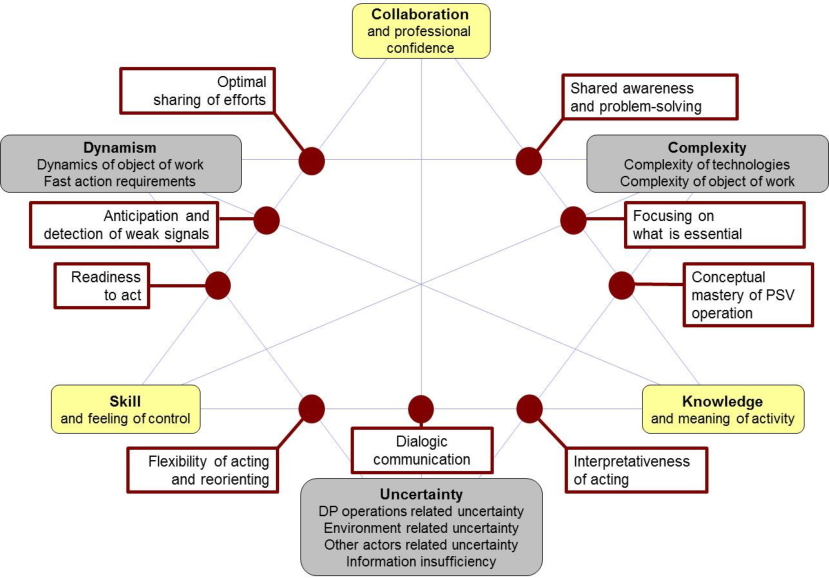
Product use can be conceptually divided into entailing instrumental and non-instrumental qualities (Mahlke, 2005). Instrumental refers to the utilitarian aspects such as usefulness and ease of use, and non-instrumental to the emotional and experiential aspects of product use. Similarly, in design, the aim can be a certain feeling, such as feeling of comfort, or it can be certain practical task, such as, efficient communication between individuals. We assume that Core-Task Analysis (Norros, 2004; Norros 2013) is a useful method for distinguishing instrumental task and activity related design goals for certain work domain and in a systemic level. This is because in studying risk- intensive work it has been used to identify interconnected elements influencing the way in which the aims of certain work activity have been achieved, these identified issues including elements relating to the work activities, the tools used, and the work environment in general. In other words, we assume that CTA method is useful for identifying pertinent systems usability issues in doing user-experience design. According to the CTA model, challenging and safety-critical work activity entails generic control demands related to 1) dynamism (i.e., temporal demands, such as the need to make quick decisions), 2) complexity (i.e., multiple, reciprocally connected influencing elements, such as weather, technology, and human behaviour), and 3) uncertainty (i.e., unexpectedness of events, which implies that decisions must be made with insufficient information). In addition, the CTA model assumes three basic features of work activity to be the means (i.e., resources) with which these control demands are managed: 1) skill, 2) knowledge, and 3) collaboration. Work activity can be analysed by examining how these control demands and resources connect one with another; the connections found are called “core-task demands” of the particular work domain. The core-task demand findings represent both enacted (i.e., as expressed in the interviews or observed by the researchers) and potential (i.e., as inferred or suggested by the researchers or interviewees) ways in which the control demands are addressed. In this way, an “analytical grid” of these interrelations is formed (see Figure 1); the interrelations can be used as indications of the instrumental user-experience and system usability goals as was done in the ship-bridge design case. The model can be visualised in both pictorial (Figure 1) and tabular (Table 1) format. Figure 1 and Table 1 present the core-task demands, which were identified when PSV operations were by studied us for the purpose of concept design ideation.
Figure 1. The core-task demands of PSV operation. The model includes control demands (the dark grey boxes), means of managing them (the light yellow boxes), and the associated core task demands (the dark red dots); see Table 1 for more detailed descriptions of the core-task demands in PSV operation.Table 1: Descriptions of the core-task demands of PSV operation. The table includes control demands in the left column (the dark grey boxes), means (i.e., resources) of managing the control demands in the top row (the light yellow boxes), and the core-task demands (the dark red texts) and their descriptions.
Table available in the original PDF paper.
We propose that the systems usability issues, which influence user experience in a functional level and can be distinguished with CTA-method, can be directly applied as useful design indications. In addition, however, we believe that feeling-related (non-instrumental) user-experience goals may benefit from another kind of re- formulation of data. Reflecting design that applies user-experience personas (Cooper, 1999) or stories (Carroll, 2000), one may assume that the goal of designing for a certain emotion is not as such sufficiently inspirational for the designers. The stories and user-experience personas (i.e., fictional characters representing certain target demographic) help the designers to grasp the abstract emotion-related ideas by offer them a human face (Pruitt & Adlin, 2006).
Somewhat similarly, feeling-related findings were reformulated into an inspirational theme in our ship-bridge design case. A general finding was that the feeling of togetherness (i.e., unity) is important for the mariners at embodied, cognitive, and social levels. At the embodied level, the mariners operate the vessel with the intuitive feel in their bodies of how the boat interacts with the environment as the boat rocks on the waves and how it reacts when it is being manoeuvred in different conditions. At the cognitive level, the mariners have a profound understanding of the features of the environment and the vessel. At the social level, they feel a strong social unity among the crew; they spend 24 hours a day together in the vessels. Because “feeling of togetherness” is in itself a fairly abstract idea to be applied in design, an inspirational theme reflecting this non-instrumental user-experience goal was generated in our case study. The name of the theme was “being one with the ship and the sea”, and it served as a reference to what the mariners’ should feel like with the help of the design solutions.
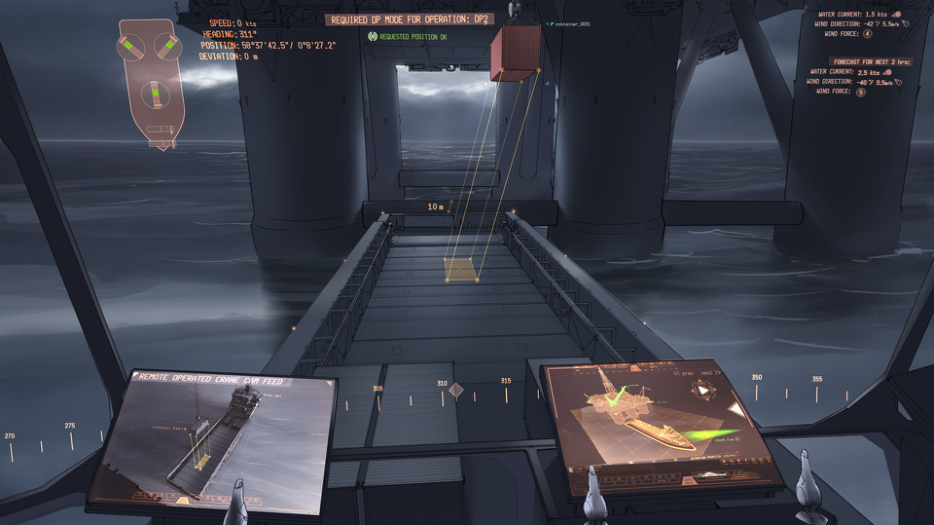
Augmented Crane Operations Concept (see Figure 2) exemplifies the design theme and the use of CTA-model in design: it reflects enhanced feeling of unity between the ship operator and the environment and it addresses some of the identified system usability issues. The aim in the concept was to generate a solution that would support the creation of collaborative understanding during container lifting operations at rigs. The rigs have a container crane that is used when a PSV is positioned at its correct place. Currently the collaboration between the crane and support vessel operator is mostly conducted with radio communication. The concept idea was that the PSV operator would see exactly the same view (bottom left display in Figure 2) as the rig crane operator sees from his cabin and vice versa. Furthermore, the PSV operator would see where the container was supposed to be landed in the aft-deck – this presentation would take place augmented reality lines on a heads-up display (see the middle part in Figure 2). The rig crane operator would also have this same view in his rig cabin. Assumedly, by all these supportive systems, a certain feeling of unity between self and environment could be increased: the operators would be more aware of one another’s view to the situation. This concept design solution draws from the core-task demands “shared awareness and problem-solving” and “dialogic communication” (Table 1) identified in the core-task analysis of PSV operator work.
Parallel to conducting user studies we were studying technology, maritime, and general societal trends. Visions of new user interaction tools were especially of interest as it was seen that they might change work processes by providing new possibilities. Trends in marine industry shed light to what kinds of vessels there might be in the future, where they operate, and for what purposes. All these issues affect the work on ship bridges. Our aim was to create shared understanding within the project group of relevant trends. Project participants studied relevant future studies from their own viewpoint and presented the results to the rest of the group.
A consulting company carried out a study on emerging interaction technologies. Explored user experience technologies included personal projection, large display areas, deformable devices, wearable devices, gestures, tangible user interfaces, hover sensing, tactile feedback, touch input, brain-computer interaction, augmented reality, heads-up displays, motion simulators, gaze tracking as well as speech, ambient sound, bio signal, and implanted user interfaces. For each technology, pros and cons were assessed, as well as technology readiness.
Maritime transportation and technology trends were analysed by a researcher focused on this area and by the company participant Rolls-Royce. The most important trends were: 1) globalization of markets (increased competition), 2) environmental concerns (need to reduce emissions and risk), 3) exhaustion of natural resources (quest for new sources and need to reduce consumption), and 4) navigation in arctic conditions (new shipping lines around the Arctic are gradually opening).
General trends dealt with future users in particular. Trends were identified based on forecasts by Frost & Sullivan (2010), Gartner Research (2009), JWT Intelligence (2012), and Frog (2012). These general trends covered, e.g., silence and minimalism as counter forces for information, media, and technology overflow, ubiquitous and embedded computing as well as values of currently young adults.
These trends were discussed in a workshop in which the user study findings were also reviewed. The elaboration took place in several ways including voting and group discussions. At the workshop the trends were presented each on one paper sheet on the wall. The workshop participants were asked promote their favourite trends and after that, each participant could give five votes to the trends. Even if the ranking list of the trends was of interest, more important result was the process that engaged the participants to consider the trends and to discuss them. Group discussions were conducted on specific themes that emerged in the discussion. These themes included, for example, the following:
- What if there would be no joysticks? Could operations be conducted with other kinds of tangible objects?
- What if there were no separate screens? Instead of screens, the needed information could be presented on a head-up display integrated to the bridge’s windows or on AR glasses worn by the operator.
- Data overflow on the bridge; how could this be reduced?
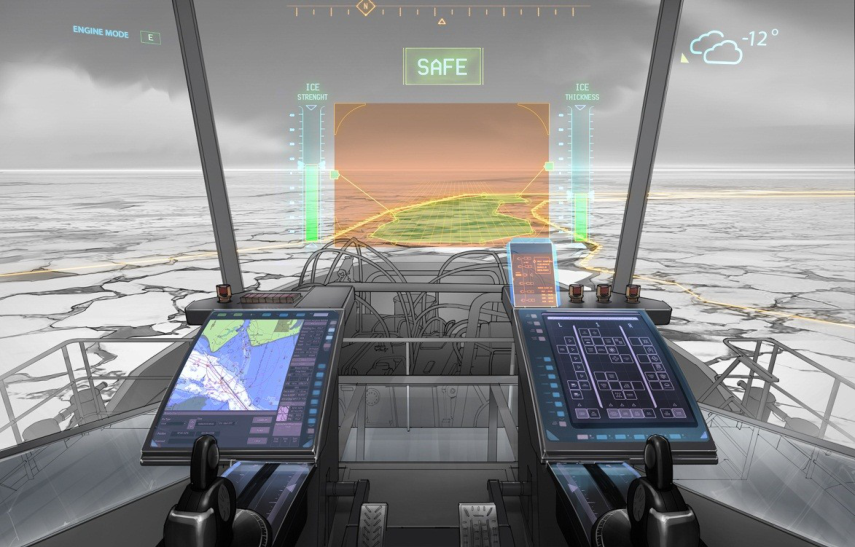
Several design concepts reflect the trend workshop. One example of these is the Sea-ice Analyzer Concept (see Figure 3), which was designed for tugboats and cargo ships. Capability to operate in arctic conditions was one of the main maritime domain trends and therefore we aimed at enhancing these operations with novel technologies. Indeed, in icy sea conditions, it can be difficult to know whether a ship is able to break the ice in front of it, especially amid darkness. The intent of the concept is to assist in this estimation: the thickness and strength of the ice around the vessel are calculated, and the computer estimates whether it is possible for the ship to proceed. This information is presented on a large HUD.
Co-design and co-evaluation One might immediately think that designing together with the users is not beneficial for generating radical design solutions. This is because, by definition (Norman & Verganti, 2014), radical design ideas are those that provide users with wholly new kinds of activities – one cannot assume that these new kinds of possibilities could be easily imagined by users submerged to the existing modes of work in their daily lives. During making of future ship bridge design solutions, however, it was found that applying co-design and expert user evaluation in the end of the concept design process is beneficial in promoting radical design. This is, firstly, because, the notion that the preliminary design solutions will be evaluated by the expert end users liberates the designers to imagine potentially “bad” design solutions; it does not matter if some of the design solutions do not yield potential as the experts will reduce these non-functional or uninteresting solutions from the overall repertoire of design ideas. The diminished self-criticism allowed by this knowledge helps in generating more ideas faster – and eventually, as there will be many ideas, there will also be solutions appreciated by the actual users. The future ship bridge design case produced several design ideas that were rejected by the end-users and therefore were not further refined.
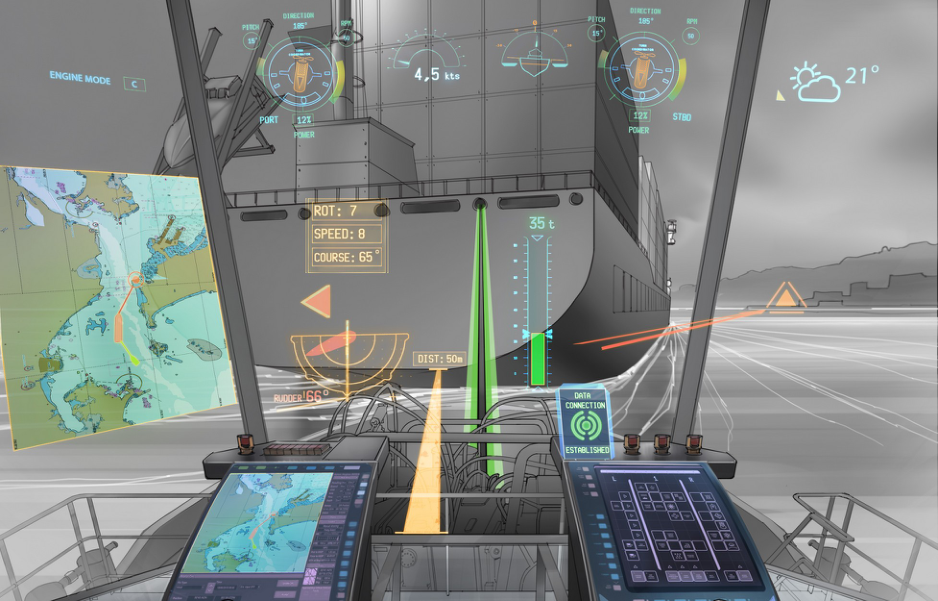
The second way in which expert users provide beneficial design input is by refinement of design ideas. A good example of this is the Intelligent Towing Concept. The initial idea was that a head-up display would provide presentation of combination of tug ship together with the tugged ship (as visible in the left map box on Figure 4). We had found out that when a tug pushes or tows another vessel it is not always self-evident where the other vessel starts to rotate and head to – to assist in estimating this, the bridge would indicate the forces influencing the pushed or towed ship. When discussed with the actual tugboat operators, however, the concept idea was further developed. It was explicated that actually the tugboats and the escorted cargo ships often share tugging relevant information via radiophone. The tugboat operator asks for relevant information from the cargo ship crew, such as, rate of turn (ROT), speed and course. An immediate design implication of these accounts was that the Intelligent Towing concept would also include direct presentations of these verbal exchanges. In other words, a direct data link between the vessels would provide the tugboat with indications of ROT, speed, rudder direction, and course of the cargo ship (see the yellow box and the yellow half-circle in the centre of Figure 4).
In the future ship bridge design case the initial concept solutions were presented for the expert users with pictures and user scenarios. The creation of scenarios itself was an iterative and collaborative process. We first imagined certain kinds of scenarios and then discussed these with certain users. If the scenarios seemed plausible they were applied when the concepts were discussed with a larger selection of users. The Intelligent Towing concept, for example, was explained to the users with a scenario in which the rudder of the tugged ship gets jammed thus steering the boat to an unwanted direction; in a situation like this communication between the two boats is essential.
Figure 5 presents the overall workflow of the design approach suggested in this paper. The approach is based on the following premises, which are present in the figure. First, it is assumed that it is useful to distinguish the challenges and strengths involved in the activity that the design solution is to serve; this can be done by studying users (Step 1 in Figure 5) and with Core-Task Analysis (Step 2). We believe that it is beneficial if the design solutions draw from and support these existing strengths that reflect professionalism and human capabilities. Assumedly, the existing industry professionals are likely to view the design solutions positively if the solutions allow the user to apply his/her existing potential and/or provide support for actual challenges at work – that is, if the so-called system usability design goals are addressed (Step 3a); these goals can then be arranged visually, for example, to a tabular format as visible in Table 1 (Step 4a). Furthermore, we assume that it is beneficial if the design solutions reflect the most important emotion related elements related to the work domain, that is, issues, such as, work identities and emotionally laden ideals. We do not suggest a specific method for this, but instead, encourage considering intuitively the overall analysis of interview and observation findings; empathy is needed for deriving emotional user experience goals from the different accounts of professionals (Step 3b). Reformulation of data into the broad functional goals and to emotion-related stories, themes and/or user personas (Step 4b) allows certain “distance” to user data, which is necessary for radical design. Furthermore, the design solutions should not only address the existing domain specific challenges but also the future challenges and needs (Step a). This further assures that the design solutions are future orientated, which, again, allows more radical design alternatives. The future studies should include technology foresight (Step b1), industry domain-related foresight (Step b2) as well as studies of general trends and future values within society (Step b3); these future studies may take place parallel with user studies. Overall, these procedures lay foundation for initial design ideas (Step 5), which, for the purpose user- evaluations can be visualized or otherwise prototyped; it might be beneficial if these visualizations are embedded into user scenarios (that is, stories) for the purpose that the users may more easily imagine themselves applying the concept solutions (Step 6). With these means co-creation and co-evaluation takes place; by considering the solutions with the users the better ideas can be distinguished from the worse and the selected ones can be further developed (Step 7). This ultimately leads to the final concept design solutions (Step 8).
2. Core-Task Analysis
3a. System usability goals 5. Initial design ideas
a. Future studies b2. Industry domain related design aims
8. Final design ideas b3. Identification of emerging societal values
Figure 5. Overall workflow for generating radical concept design ideas The approach presented in Figure 5 reflects some existing design approaches, contextual design (Beyer & Holtzblatt, 1998) in particular. Contextual design assumes that good design solutions are achieved through profound understanding of the use (or work) context. The idea is that so-called “contextual inquiry” precedes the actual design process. This includes studying the work or use context that the new design is to serve. The methods include interviews and observations: a shared understanding of the content of work is developed with the users. Overall, Notess (2005) summarizes contextual design by suggesting that it features the following four principles: First is the assumption that data on work activity is largely contextual and therefore it is the actual work context that is to be
Figure available in the original PDF paper.
studied. Second principle is that designers should work in partnership with users as experts. Third, contextual design applies visualizations, that is, the findings of contextual inquiry are presented with diagrams for the purpose of aiding the design process. Fourth principle, iteration, implies that the design process is not entirely linear but includes paper prototypes that may lead to further refinement of the product. The approach presented in Figure 5 is largely in line with these principles of contextual design. Some notable differences to the contextual design approach exist, however, these serving the purpose of generating radical design ideas.
Firstly, the design approach presented by us applies the CTA method as the means for analysing the contextual inquiry data. Typically CTA has been applied for the purpose of studying varying work contexts, such as, nuclear power plant (Norros, 2004) and metro train (Karvonen et al., 2011) operation, without the explicit purpose of providing the studied domains with new design solutions. There are, however, elements in the method that make it usable for providing indications for radical design. This is because the method can be used to generate broad design goals. The pinpointed “core-task demands”, that is, the ways in which the found control demands and resources connect one with another, can be seen as design goals. These broad design goals can be considered as system usability goals, that is, ideas on how the overall work system, including the users, the environment, the technologies used, could and should function together. Furthermore, the method provides visualizations of the findings while a common assumption in design studies (Findeli, 2001; Schön, 1992) is that visual representations are especially beneficial in design activity. In our experience, the visual models aid in conceiving and communicating the model and the findings in actual design work.
Secondly, the approach suggested by us emphasizes the importance of considering “user experience” in design. This, in turn, reflects approach called “experience design”. It suggests that the user experience instead of products should be in the foci of design (Hassenzahl, 2010). “User experience goal driven design” (e.g., Karvonen et al., 2012; Koskinen et al., 2013), in turn, is more specific in suggesting that “user-experience goals” should be defined in the very beginning of the design process. In other words, the designers should, in principle, first choose what kind of activity or emotion should be supported with the design and after this product related design ideas would be generated. This, indeed, might allow “thinking outside box” as the design process is not tied-up to the existing product when considering the future design. Both the CTA-derived systems usability goals and the feeling-related non-instrumental user experience goals steer the design focus from the pre-existing product to potential future activity of workers. As has been suggested elsewhere (Wahlström et al., under review) user studies may provide basis for radical innovations if the study findings are re-formulated to models, goals, or themes in a manner such that sufficient “distance” to the findings is achieved. This would imply that the study findings do not “directly dictate” the design solutions but provide broad but justified design indications. These assumptions are in line with Hekkert et al. (2003) as they propose that innovative product design can be achieved by first abandoning presuppositions about the product and then developing the product by formulating “three visions”. First is a vision of user and the context of use; this is then advanced to an interaction vision, which states how the user interacts with the product, and finally to a product vision. Their approach arguably forces designers to free themselves from apparent restrictions or requirements and, instead, encourages looking for desirable possibilities. The Hekkert et al. approach also includes that the designer empathizes with the future user, but the user is not involved in the design process. They state that in this way undesirable constraints resulting from the user fixations on familiar solution directions are avoided.
Indeed, design by empathetic understanding of users has been a common theme in the design literature. Leonard and Rayport (1997) introduced empathic design as a complementary approach to marketing research, contributing to the flow of ideas that still need further testing. When a company representative explores their customers’ worlds with the eyes of a fresh observer, the company can redirect existing organizational capabilities to new markets. Wright et al. (2008) remind that good experience-centred design requires designers to engage with the users and their culture in rich ways in order to understand how the users make sense of technology in their lives. Kouprie and Sleeswijk Visser (2009) propose a framework for empathy in design, formulated as “stepping into and out of the user’s life”. Based on psychological literature, they distinguish two components of empathy: affective and cognitive. The affective component includes emotional response, feeling and identifying with the user: “becoming the user”. The cognitive component includes understanding, perspective taking, and imaging the other: “staying beside the user”. Sleeswijk Visser (2009) emphasizes that knowing the users’ world is important for designer motivation, and stories are good tools to contribute to this understanding. Successfully communicated user information provides empathy and inspiration for product ideas.
Third way in which our design approach differs from typical contextual design is by emphasizing the inclusion of future studies in deriving design indications. Future foresight is addressed in innovation management literature and as a separate field but it seldom is included in design or user-centered design literature. Design literature usually relies on brainstorming and reframing methods and approaches for creating novel ideas and breaking free from current constraints (e.g. Krippendorf, 2006). Understanding of technology and societal trends can however be crucial for the product or company success. For example, Christensen (1997) has identified multiple cases of existing market leaders failing to understand the effect of emerging technologies. Overall, our approach reflects technology research of Nieminen and Mannonen (2005) and more general trend analysis of Salovaara and Mannonen (2005). Nieminen and Mannonen suggest that separate technology research should be included into user- centered concept development projects for tying the design ideas to meaningful level of technology. Salovaara and Mannonen, in turn, try to balance the future-orientation and user-centeredness requirements of concept development by dividing the design supporting information into information on upcoming changes, i.e. trends in society and working life, and stabile context features. Our future foresight was wider than pure technology review in also covering general trend analysis.
Fourthly, similarly as contextual design, our approach accepts the usefulness of working together with the users in design. Concepts of “participatory design”, “co-creation”, and “co-design” have been used in the design literature. These concepts have varying meanings but, following the interpretation by Sanders and Stappers (2008), co-creation refers to any creative act involving more than one individual while co-design is refers to co-creation in a design process specifically. Participatory design, in turn, can be seen as a North European based design movement that views the user as a partner in design process. We embrace the message implied by these concepts, but suggest that users should be involved only after the generation of the initial design ideas. This is for the purpose of creating radical design ideas, that is, because the aim is to create solutions not yet imagined by the users. In other words, users should be involved two phases of concept design: in the beginning as informants on the work domain and in the end as co-designers evaluating and enhancing the initial design concepts.
In sum, the contribution of this paper is a design approach that might provide design ideas that are “fairly radical” yet grounded to the actual activity and work domain specific needs. As arguably visible in the ship bridge design solutions presented in this paper, the approach has worked us. Future studies, however, would be needed to confirm the usefulness of the approach more generally.
ACKNOWLEDGEMENTS
This study is part of the research and development programme User Experience and Usability in Complex Systems (UXUS), which is one of the research programmes of the Finnish Metals and Engineering Competence Cluster, FIMECC.
The authors would like to thank all those who have provided input to the design of future ship bridges and to this article, these being Leena Norros (VTT), Iiro Lindborg (Rolls-Royce), Jussi Lehtiniemi (Troll VFX), Zhang Daoxiang (Aalto University), Göran Granholm (VTT), Frøy Birte Bjørneseth (Rolls-Royce), and Karno Tenovuo (Rolls-Royce) among others.
REFERENCES
Beyer, H., Holtzblatt, K. (1998), “Contextual Design: Defining Customer-Centered Systems”. San Francisco: Morgan Kaufmann Carroll, J. (2000), “Making Use: Scenario-Based Design of Human-Computer Interactions”. Cambridge, MA: MIT Press. Cooper, A. (1999), “The inmates are running the asylum”. Indianapolis: Morgan Kaufmann. Christensen, C.M. (1997), “The Innovator’s Dilemma; When New Technologies Cause Great Firms to Fail”. Boston, MA: Harward Business School Press. Findeli, A. (2001), “Rethinking design education for the 21st century: Theoretical, methodological and ethical discussion”,
Design Issues Volume 17 No. 1. Frog (2012), 12 Tech Trends That Will Define 2012, Selected By Frog's Design Minds. Fast Company Website: http://www.fastcodesign.com/1668912/12-tech-trends-that-will-define-2012-selected-by-frogs-design-minds Frost & Sullivan (2010), World's Top Global Mega Trends to 2020 and Implications to Business, Society and Cultures. Frost &
Sullivan Company Website: http://frost-apac.com/download/megatrends.pdf Gartner Research (2009), A Day of Your Life, 2028. Gartner Company Website: https://www.gartner.com/doc/933312/day-life- Gould, J., Lewis, C. (1985), “Designing for usability: key principles and what designers think”, Communications of the ACM Volume 28 No. 3. Hassenzahl, M. (2010), “Experience design: Technology for all the right reasons”, Synthesis Lectures on Human-Centered
Informatics Volume 3 No. 1. Hekkert, P., Mostert, M., Stompff. G. (2003), “Dancing with a machine: a case of experience-driven design”, in: Proceedings of the 2003 international conference on Designing pleasurable products and interfaces (DPPI '03). New York, NY: ACM. JWT Intelligence (2012), 10 trends for 2012 & 100 things to watch for 2012. JWT Intelligence Company Website: http://www.jwtintelligence.com/2011/12/100-things-to-watch-in-2012/ Karvonen, H., Aaltonen, I., Wahlström, M., Salo, L., Savioja, P., Norros, L. (2011), “Hidden Roles of the Train Driver: A
Challenge for Metro Automation”, Interacting with Computers Volume 23 No. 4. Karvonen, H., Koskinen, H., Haggrén, J. (2012), “Defining user experience goals for future concepts. A case study”, in: Proceedings of 7th Nordic Conference on Human-Computer Interaction (NordiCHI2012), UX goals 2012 Workshop – How to Utilize User Experience Goals in Design?. Tampere, Finland: TUT Publication series. Keinonen, T. (2009), “Immediate and remote design of complex environments”, Design Issues Volume 25 No. 2. Koskinen, H., Karvonen, H., Tokkonen, H. (2013), “User Experience Targets as Design Drivers: A Case Study on the
Development of a Remote Crane Operation Station”, in: Proceedings of 31st European Conference on Cognitive Ergonomics (ECCE2013), Toulouse, France: ECCE. Kouprie, M., Sleeswijk Visser, F.S. (2009), “A framework for empathy in design: Stepping into and out of the user's life”, Journal of Engineering Design Volume 20 No. 5. Krippendorff, K. (2006), “The Semantic Turn; A New Foundation for Design”, New York, NY: Taylor & Francis. Leonard, D., Rayport, J.F. (1997), “Spark innovation through empathic design”, Harvard Business Review Volume 75. Mahlke, S. (2005), “Understanding users' experience of interaction”, in: Proceedings of the 2005 annual conference on
European association of cognitive ergonomics (EACE '05). Athens, Greece: University of Athens. Notess, M. (2005), “Using Contextual Design for Digital Library Field Studies”, in: Proceedings of ACM/IEEE-CS Joint Conference on Digital Libraries workshop Studying digital library users in the wild: theories, methods, and analytical approaches. Denver, CO: ACM. Norman, D.A., Verganti, R. (2014), “Incremental and radical innovation: Design research versus technology and meaning
change”, Design Studies Volume 30 No. 1. Norros, L. (2004), “Acting under uncertainty: The core-task analysis in ecological study of work”, Espoo, Finland: VTT Publications. Norros, L. (2013), “Developing human factors/ergonomics as a design discipline”, Applied Ergonomics Volume 45 No. 1. Nieminen, M.P., Mannonen, P. (2005) “User-Centered Product Concept Development”, in: International Encyclopedia of
Ergonomics and Human Factors (2nd Ed.), Karwowski, Waldemar (Ed.). pp. 1728-1732 Salovaara, A., Mannonen, P. (2005), “Use of future-oriented information in user-centered product concept ideation”, in: IFIP TC13 International Conference on Human-Computer Interaction (Interact 2005), Lecture Notes in Computer Science Volume 3585. Springer-Verlag. Sanders, E., Stappers, P. (2008), “Co-creation and the new landscapes of design”, CoDesign: International Journal of
CoCreation in Design and the Arts Volume 4 No. 1. Schön, D. (1992), “Designing as reflective conversation with the materials of a design situation”, Research in Engineering Design Volume 3 No. 3. Sleeswijk Visser, F. (2009), “Bringing the everyday life of people into design”, Doctoral dissertation. TU Delft Website:
http://www.narcis.nl/publication/RecordID/oai:tudelft.nl:uuid:3360bfaa-dc94-496b-b6f0-6c87b333246c Wahlström, M., Karvonen, H., Norros, L., Jokinen, J., Koskinen, H. (under review), ”Radical Innovation by Theoretical Abstraction – a Challenge for Design Anthropologists”, Manuscript in peer-review. Wright, P., Wallace, J., McCarthy, J. (2008), “Aesthetics and experience-centered design”, ACM Transactions on Computer-
Human Interaction Volume 15 No. 4.
LISTED IN THE AHFE DIGITAL BOOKSTORE CATALOGUE
Explore the complete digital volume
Advances in Ergonomics In Design, Usability & Special Populations: Part II
Read this individual research paper free through the original publisher, or explore the full digital proceedings book.
ISBN 978-1-4951-2107-4
Explore this ISBN in the AHFE Bookstore ↗Listed in the July 2026 bookstore catalogue; search by ISBN to confirm current availability · Digital book purchase optional