Grainne Tyrrell, Donna Curley, Leonard O' Sullivan, Eoin White (2024). Comparing Perceptions of Human Factors - Priorities of Cardiologists and Biomedical Engineers in the Design of Cardiovascular Devices. In: Health Informatics and Biomedical Engineering Applications. AHFE Open Access, vol. 142, pp. 107–115. https://doi.org/10.54941/ahfe1005076
This study aimed to understand perceptions of Human Factors (HF) within the Product Development Process (PDP) of catheter-based cardiovascular therapies. Attitudes of biomedical engineers were compared to those of the clinicians who use these devices. The main objectives were to:1.Determine how Engineers and Cardiologists perceive HF impact on user experience.2.Gain an understanding of how various design factors affect the user experience. 3.Identify Engineers’ familiarity with HF resources and understand what HF data they seek during the PDP.By identifying and later filling data gaps and barriers to optimise design, these findings can improve how HF is implemented during the PDP, leading to improved user experience and better patient outcomes.MethodsData were gathered from 57 Biomedical R&D Engineers and 20 Interventional Cardiologists via questionnaires and semi-structured interviews. An online form was distributed at an internal medical device company Global Catheter Summit during November 2023 targeting engineers with experience developing catheter-based devices. Data from Cardiologists were gathered across two in person events between February and April 2024. Parameters to gauge specialty and experience were gathered from both cohorts (Engineers & Interventional Cardiologists). Quantitative data were gathered in Excel and statistically analysed using SPSS. Qualitative data was thematically analysed using NVivo. DiscussionThe results highlighted that the Engineers’ priorities in the PDP differ from the prioritised needs of the Cardiologists, but both groups identified grasps/manipulations as important factors influencing user experience. Engineers focused on the factors specific to the device itself – they believe the device is what the user cares most about, however, the Cardiologists ranked the impact of having multiple operators and what surgical access site is being used highly, pointing to the importance of considering use scenario and environment. 75% of Engineers strongly agreed with the statement “I feel user centred design is important when developing a new product”, indicating that project teams place value on HF activities but there are several challenges in implementing these. Engineers often struggle to find the data and expertise they need to implement HF activities in a meaningful and impactful way, without compromising on timeline, budget, and other product development activities. Of those who identified themselves as R&D or Design Engineers 69% (N=33) struggled to find the data they wanted. User specific and context specific data, torque strength and dynamic force data were highlighted as key gaps in user data. Differences in priorities further underlines the need for user centred design, and implementation of an iterative design approach which engages the end user from design conception, to design implementation, and beyond.ConclusionOverall, both Engineers and Cardiologists respect the impact of HF on the optimisation of user interaction. They agreed on the need for further innovation to improve user experience for CBCD. Priorities of Biomedical Engineers during the design process differed from the prioritised needs of Cardiologists when using devices, however both cohorts felt manipulations required to operate devices is an important factor to consider during design. The Engineers reported a paucity of specific user related data regarding handle interaction in this field. There is a need for easily accessible literature reporting upon user force data for dynamic motion (i.e. torque, push and pull); force data for female users, and general human body measurements that are applicable to device design. This data can serve as an indicator of where academia and industry should focus their research efforts to improve the implementation of HF, and ultimately optimise the user experience.
HF has a major role in optimising user interactions with biomedical devices such as CBCD. A mismatch between device design and the user leads to increased strain and heightened cognitive load, which can put the user at greater risk of developing musculoskeletal disorders and can increase use- related medical errors (Zenati et al., 2020). HF aims to mitigate use related errors by ensuring design considers the users’ capabilities and limitations (AAMI, 2018). Catheters are tubular medical devices that are inserted into a patient’s vasculature. CBCD oftentimes have a long interventional catheter and a handle with multiple functions, alongside other secondary device inter- faces. Catheter-based cardiovascular procedures display a range of novel actuation mechanisms due to the varied diameters, shapes and materials of specialised devices and tools.
Anthropometric data such as height and strength are imperative to the design of devices which are user friendly. Availability and applicability of user data are immensely important to Engineers who design these devices. (Dianat et al., 2018) highlighted a paucity of user data for specific occu- pations, including the field of interventional cardiology. There is a lack of specific HF data which is applicable to CBCD in leading design guidance such as AAMI HE75 (AAMI, 2018) and I.S. EN 62366–1 (IEC, 2015). HE75 has detail on optimal bench height for ‘Light work’ or ‘Heavy work’ tasks, however, due to the variability of procedural tasks and tools, there are times in a procedure where both precision and force are required at once. This cre- ates an obvious design conflict and with-it associated challenges concerning posture and positioning for cardiologists (Epstein et al., 2018). Torquing, angling, pushing, and pulling of devices of varying shapes and diameters require many manipulative actions to be performed. The conditions under which these are performed, such as upper limb orientation, grasp type and working height, have a large impact on the users comfort and the forces required of them (Maleki-Ghahfarokhi et al., 2022). Specifically in relation to physical CBCD interaction, there are user force data in HE75; however, there are gaps related to user demographics, handle design types, and data on specific grasp types. HF activities are an FDA requirement in the biomed- ical industry, notably since the adoption of the guidance ‘Applying Human Factors and Usability Engineering to Medical Devices’ which was issued in 2016. Due to this relatively recent implementation in PDP, there is room for improving how these activities are established within design processes in the biomedical industry.
Therefore, the aims of this study are as follows:
1. Determine how Engineers and Cardiologists perceive HF impact on user experience. 2. Gain an understanding of how various design factors affect the user experience. 3. Identify Engineers’ familiarity with HF resources and understand what HF data they seek during the PDP.
METHOD
Participants Data were gathered from Biomedical Engineers and Cardiologists via ques- tionnaires and semi-structured interviews. To target the Engineer cohort an online questionnaire was distributed to attendees of the Global Catheter Sum- mit 2024. Inclusion criteria for Engineers required having some involvement in the product development of catheter-based cardiovascular devices. To tar- get the Cardiologist cohort, attendees of internal Medtronic clinician summits were invited to participate in the study. Data from Cardiologists were gath- ered during two separate summits held onsite in February and April 2024. Inclusion criteria for the Cardiologist cohort was to be a practicing clinician
Comparing Perceptions of Human Factors 109
in the field of cardiology and to have experience in at least one of the fol- lowing procedures: Transcatheter Aortic Valve Implantation (TAVI), Mitral Valve Repair (MVR) or Percutaneous Coronary Intervention (PCI).
Data Acquisition A questionnaire with gated consent was designed. This survey comprised of four sections:
Section 1 gathered basic demographic information.
Section 2 used a Likert scale to assess perceptions of HF impact on user experience.
Section 3 used a Likert scale to assess how various factors affect the user experience.
Section 4 delved into Engineers familiarity with HF and what HF data they sought during the PDP.
Engineers completed all 4 sections while Cardiologists completed Sec- tions 1, 2 and 3 (i.e. they did not answer questions on seeking HF data). Participants were only prompted to answer sections for which they had experience. Each section had comment sections in which participants were encouraged to provide open text entries to offer insights into their rat- ings. Due to time restrictions associated with gathering data from clinical specialists, a mixed methods approach was used to gather data from the Car- diologists. This included the use of an online questionnaire completed on site, followed up by semi-structured interviews which prompted participants for further comments on the questions included in the survey. Interviews were transcribed and anonymised. The study was ethically approved by The University of Limerick’s Faculty of Science and Engineering Ethics Board.
Data Analysis Quantitative data were gathered in Microsoft Excel and statistically analysed using IBM SPSS Statistics Version 29.0.1.0 to determine how participants ranked the impact of various factors on user experience. A 5-point Lik- ert scale was used to rate data and based on these results the individual aspects within each section of the questionnaire were then ranked. Engi- neers’ and Cardiologists’ responses for Section 2 and 3 were compared using a Mann Whitney-U non-parametric test. Thematic analysis was performed on the data using NVivo 14 to gain further insight into participants percep- tions, identify barriers to implementing HF activities, and to understand why participants chose certain rankings.
RESULTS
Participant Demographics 57 Biomedical Engineers and 20 Cardiologists participated in the study. Table 1 outlines the demographic information of the participants.
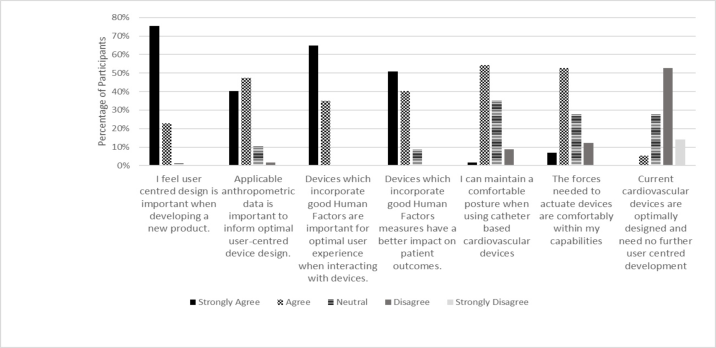
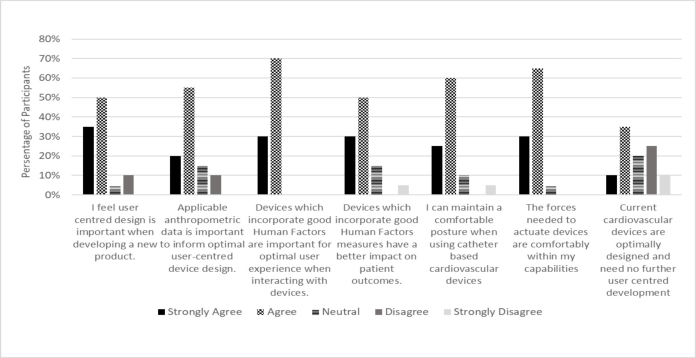
Questionnaire Section 2 - User Experience For the 7 above statements, a two-tailed Mann Whitney-U test at 95% confi- dence was conducted. Across 7 questions, 2 were found to be not significant at p<0.05. These were: Q2 “Applicable anthropometric data is important to inform optimal user-centred device design” (p = 0.084) and Q4 “Devices which incorporate good Human Factors measures have a better impact on patient outcomes” (p = 0.99). 75% of Engineers strongly agreed with the statement “I feel user centred design is important when developing a new product”. Both cohorts either strongly agreed or agreed that devices which incorporate good HF are important for optimal user experience when inter- acting with devices. One Cardiologist strongly disagreed that “Devices which
Comparing Perceptions of Human Factors 111
incorporate good Human Factors measures have a better impact on patient outcomes.” This was an outlier. 12% of Engineers claimed that actuation forces were outside of their comfort limits. No Cardiologists identified any issue with actuation forces in the survey. 35% of Cardiologists and 67% of Engineers either disagreed or strongly disagreed that current cardiovascular devices are optimally designed and need no further user centred development.
Section 3 - Factors Influencing User Experience Both cohorts ranked “grasps and hand manipulations required” high in terms of influence of user experience (Cardiologist ranking- 2nd; Engineer ranking- 1st). Thereafter, Cardiologists expressed lower regard for factors related to device design such as placement of touchpoints and actuation forces when compared to the Engineer cohort who ranked these second and third respectively, as shown in Table 2.
Table 2. Ranked importance of factors that influence the user experience.
Table available in the original PDF paper.
Ranking Cardiologist Engineer
1OR bench height
1 No. of operators required Grasps/hand manipulations required 2 Grasps/ hand manipulations required Placement of touchpoints/actuation points 3 Access point for elected procedure Actuation forces 4 Actuation forces Number of operators required 5 Placement of touchpoints/actuation points 6 Device handle shape Grooves/texture of device 7 Optimal OR bench height Access point for elected procedure 8 Device handle material Device handle material 9 Layout of other OR equipment Layout of other OR equipment 10 Grooves/texture of device
1Operating Room. Due to survey error engineers did not have the option to rank device handle shape.
Across all 10 factors, 2 results were statistically significant at p < 0.05. These were placement of touchpoints/actuation points (p = 0.0058) and layout of other OR equipment (p = −3.96).
Section 4 - Engineers Familiarity With HF and Data Sought During PDP 58% of Engineers have sought user data and struggled to find what they wanted. Of those who identified themselves as R&D or Design Engineers 69% (N = 33) struggled to find the data they wanted. 14% were ‘very famil- iar’ with the Human Factors standard HE75, 39% were ‘somewhat familiar’ and 47% were ‘not familiar’ at all.
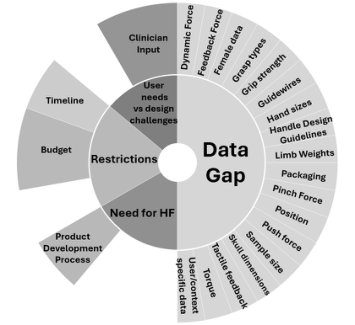
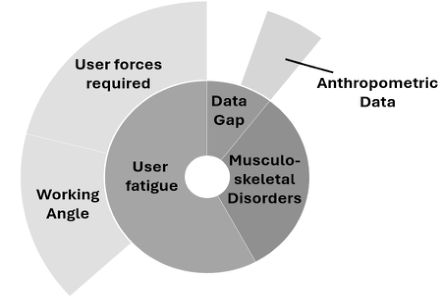
Thematic Analysis Thematic analysis was performed on the interview data. Figure 3 and 4 out- line the themes and subthemes identified for Engineers and Cardiologists respectively. Table 3 displays themes and quotes for Engineers, and Table 4 for Cardiologists.
Figure 3: Thematic analysis of engineers responses.Figure 4: Thematic analysis of cardiologists responses.
Theme References Engineer Quotes Lack of user data to inform device design 45 “I’ve found it particularly challenging to find data on female users in the data”. “How hard is a physician willing push/pull?” “Torque able to be comfortably applied by a typical user to turn different size device handles”. Need for HF Activities
18 “I strongly believe the human factors is very important when it is about designing a medical equipment. I still see this is often underestimated”. Restrictions for timeline and budget
13 “The challenge lies in meeting human factors requirements without destroying a projects budget and schedule”.
Theme References Cardiologist Quotes User Fatigue 11 “At [a higher angle] you notice the fatigue quicker” Musculo-skeletal Disorders
6 “I worry as I get older that my joints will be sore”. “Sometimes I feel some pain (here) from pinching”. Device Forces 6 “Interaction between force applied by operator and force produced by device is for me a bit of a black box - Anthropometry could be useful in this application”
DISCUSSION
The results highlighted that the Engineers’ priorities in the PDP differ from the prioritised needs of the Cardiologists, but both groups identified grasp- s/manipulations as important factors influencing user experience. In certain cases, such as comfortable user forces for device handle torquing and push- ing/pulling thin catheters and guidewires, HE75 and similar standards are limited in their applicability to cardiovascular devices. Grasp taxonomies have been conducted for day-to-day tasks (Krebs and Asfour, 2022), amongst other areas, but there is a lack of research into the manipulations used by cardiologists intraoperatively. Engineers seem to be focused on the factors specific to the device itself – they believe the device is what the user cares most about, however, the Cardiologists ranked the impact of having multiple operators and what surgical access site is being used highly, pointing to the importance of considering use scenario and environment.
Engineers placed value on HF activities, but it is apparent that some par- ticipants perceive HF as a potential threat to other product development activities. They identified barriers to accessing necessary data and exper- tise they need to implement HF activities in a meaningful and impactful
way, without compromising on schedule and budget. A small portion of feedback suggested negative outlook towards HF activities, including argu- ments that HF can overcomplicate things, and that user centred design can sometimes outweigh patient-centred design. Considering all stakeholders in the design process is important, and using interventions that prioritise user empathy during product development, such as Design Thinking and human- centred design, can nurture innovation that can elevate both user and patient experience (Babione et al., 2015).
User specific and context specific data, upper limb torque strength and dynamic force data were all highlighted as key gaps in design guidance data. While no Cardiologist stated that they found actuation forces of devices uncomfortable in the questionnaire responses, one female participant com- mented during interview that she could not complete a certain task for a given device due to the user forces required. She stated that if she were the primary operator she would have to ask her second operator to control the device during this task. This highlighted the lack of female strength data in the literature which are used in designing CBCDs.
A theme of trying to weigh up users’ needs versus the complication of implementing multiple functions into CBCD design was frequently reported. Sometimes multifunctional devices can create issues with two differing func- tions being inconsistent with one another and creating difficulties in design. Differences in priorities further underlines the need for user centred design, and implementation of an iterative design approach which engages the end user from design conception, to design implementation, and beyond.
CONCLUSION
Overall, both Engineers and Cardiologists respect the impact of HF on the optimisation of user interaction. They agreed on the need for further innova- tion to improve user experience for CBCD. Priorities of Biomedical Engineers during the design process differed from the prioritised needs of Cardiolo- gists when using devices, however both cohorts felt manipulations required to operate devices is an important factor to consider during design. The Engineers reported a paucity of specific user related data regarding handle interaction in this field. There is a need for easily accessible literature report- ing upon user force data for dynamic motion (i.e. torque, push and pull); force data for female users, and general human body measurements that are applicable to device design. This data can serve as an indicator of where academia and industry should focus their research efforts to improve the implementation of HF, and ultimately optimise the user experience.
ACKNOWLEDGMENT
This research project is supported by the Irish Research Council and Medtronic Structural Heart and Aortic Human Factors Department via the IRC Enterprise Partnership Scheme [grant no. EPSPG/2022/192]. The authors also wish to acknowledge the support of the Health Research Institute, University of Limerick.
Comparing Perceptions of Human Factors 115
REFERENCES
AAMI (2018) 2009(R2018) AAMI HE75 Human factors engineering—Design of medical devices, United States: AAMI - Assoc. for adv. of Medical Instrument. Babione, J., Gill, M., Santana, M. J., Skora, K., De Grood, C., Penman, C., Panjwani,
D., De Grood, J., Kaufman, J., Ghali, W. and Sargious, P. (2015) ‘Integrating patient-centered research methods within user-centered design: a patient-centered digital care plan’, Quality of Life Research, 24, 87–88. Dianat, I., Molenbroek, J. and Castellucci, H. I. (2018) ‘A review of the methodology and applications of anthropometry in ergonomics and product design’, Ergonomics, 61(12), 1696–1720. Epstein, S., Sparer, E. H., Tran, B. N., Ruan, Q. Z., Dennerlein, J. T., Singhal, D. and
Lee, B. T. (2018) ‘Prevalence of Work-Related Musculoskeletal Disorders Among Surgeons and Interventionalists A Systematic Review and Meta-analysis’, Jama Surgery, 153(2), available: https://dx.doi.org/10.1001/jamasurg.2017.4947. IEC, I. (2015) ‘62366-1: 2015 Medical Devices—Part 1: Application of usability engineering to medical devices’, International Electrotechnical Commission (IEC), Geneva. Krebs, F. and Asfour, T. (2022) ‘A Bimanual Manipulation Taxonomy’, IEEE
Robotics and Automation Letters, 7(4), 11031–11038, available: https://dx.doi .org/10.1109/LRA.2022.3196158. Maleki-Ghahfarokhi, A., Azghani, M. R. and Dianat, I. (2022) ‘Effects of handle characteristics of manual hand tools on maximal torque exertions: a literature review’, International Journal of Occupational Safety and Ergonomics, 28(3), 1387–1402, available: https://dx.doi.org/10.1080/10803548.2021.1896139. Zenati, M. A., Kennedy-Metz, L. and Dias, R. D. (2020) ‘Cognitive engineering to
improve patient safety and outcomes in cardiothoracic surgery’, in Seminars in thoracic and cardiovascular surgery, Elsevier, 1–7.
LISTED IN THE AHFE DIGITAL BOOKSTORE CATALOGUE
Explore the complete digital volume
Health Informatics and Biomedical Engineering Applications
Read this individual research paper free through the original publisher, or explore the full digital proceedings book.
ISBN 978-1-964867-18-2
Explore this ISBN in the AHFE Bookstore ↗Listed in the July 2026 bookstore catalogue; search by ISBN to confirm current availability · Digital book purchase optional