Jose Laparra Hernández, Adrian Morales Casas, Mathieu Feuilliade, Xavier Bonjour, Armel Jimenez, Vanessa Jimenez, Luis Sánchez Palop, José Francisco Serrano Ortiz, José Manuel Rojas, Andrés Soler (2024). Augmented Reality Eyewear with ophthalmic correction for mainstream applications, overcoming acceptance barriers through Human Factors Plan. In: Health Informatics and Biomedical Engineering Applications. AHFE Open Access, vol. 142, pp. 31–39. https://doi.org/10.54941/ahfe1005068
Although more than 80% of human interactions with the world transit through our eyes and most daily activities require hands-on interaction, none of the current AR technologies and designs, mainly from the USA and Asia, has unlocked the essential combination of human-centred needs, technical requirements and market and society acceptance. Massive adoption, especially for extensive population usage, faces significant bottlenecks: insufficient optical quality, low visual, vestibular, cognitive and social comfort, and missing integrated ophthalmic correction or device aesthetics; the only way to enhance AR visual experience.EU POPULAR project is developing the first generic Augmented Reality Eyewear (ARE) platform covering the broadest range of users and use cases in a professional context, leisure or daily life, including personal ophthalmic correction. The ordinary-looking glasses will be comfortable, accessible and aesthetically appealing, making them suitable for all-day use. Moreover, privacy and security issues will be covered to ensure user, stakeholders, and society acceptance. The differential factors will be its compactness and invisible technology, optical quality, ultra-low power consumption and long operation times, integrating cost-efficiency aspects.To achieve this challenging aim, IBV has defined a Human Factors (HF) Plan covering visual comfort, vestibular comfort, mental fatigue, ease of use, freedom of movement, emotional reaction, risk of exclusion and societal acceptance. The HF Plan was defined in 3 sprints: 1) gather needs, risks analysis and conceptual design, 2) design, develop and iterative tests `process, from scratch and dummy prototypes to 4 functional prototypes (combining white/back or colour AR and without/with ophthalmic correction, 3) Final Validation in actual conditions along representative use cases. The HF Plan will be supported by a Social Science and Humanities Advisory Board and aligned with MDR protocols and processes.ARE acceptance and global scalability will be demonstrated in 3 realistic use case scenarios, outdoor sports, healthcare and logistics, as the first step to massive market deployment. The validation in real situations will include innovative methodologies to real-time asses of mental status to balance the loss of attention/distraction and cognitive overload, using eye tracking patterns and physiological response analysis.
Our societies digitalise at a high pace for most human activities: com- munication, healthcare, working, learning, manufacturing, sports, driving, entertainment and many other occupations embed humans in a world of dig- ital connections, triggering the design of many smart devices (Kraus et al., 2021). Beyond smartphones, tablets & smartwatches, the smart eyewear category carries the promise of becoming an indispensable wearable and a promi- nent medium of interaction, which appears even more compelling when it comes to augmented reality (AR): more than 80% of our interactions with the world transit through our eyes and most of the AR features (real-time images, text overlay, etc.) engage our vision. Furthermore, AR’s ultimate usage requires a smooth, hands-free user interface. Yet massive adoption, particularly for extensive population usage, faces major bottlenecks: insuffi- cient optical quality, low visual and ergonomic comfort, missing integrated ophthalmic correction or device aesthetics.
The future success of Augmented Reality Eyewear (ARE) relies on a society-aligned digital technology transformation that should be simply rooted into the essentials of everyday eyeglasses, should they be prescription glasses, that are medical devices worn daily by almost half of the world pop- ulation, or protective glasses (sun, screens…): lightweight with thin lenses, aesthetic and fashionable, with perfect transparency, individually adapted optical correction and optical power design, and fit for any visual usage or environments, i.e., for any visual distance and any changing light exposure indoors and outdoors.
The current AR technologies and designs, mainly from the USA (and Asia), have yet to unlock this essential combination of human-centred features and technical requirements, which is the only way to provide an accept- able AR visual experience and empower end-users. This is why AR devices have remained confined in niche professional applications markets, where users may compromise with expensive, bulky devices that do not fit into the consumer eyewear category.
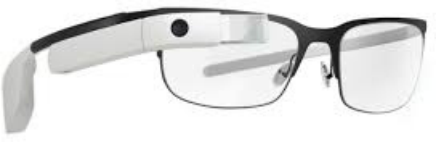
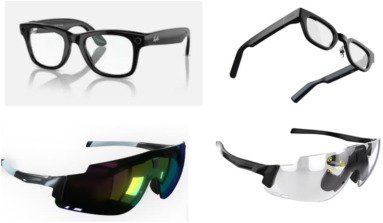
During the last decades, several solutions related to extended reality, such as brilliant glasses, have failed market uptake due to several reasons such as privacy concerns, lack of comfort, non-aesthetic appeal or reduced number of practical mainstream applications, among others (Zhang et al., 2023). One clear example is the Google Glasses launched over ten years ago (Yu et al., 2016).
Figure 1: Previous attempts to market uptake of smart glasses.
Augmented Reality Eyewear With Ophthalmic Correction for Mainstream Applications 33
POPULAR FRAMEWORK POPULAR EU project (https://popular-project.eu/) (01/2024-01/2027) looks to jump over these barriers and allow the market widespread in the massive way of smart glasses for eXtended Reality (XR) applications from healthcare to mainstream usage.
POPULAR aims to develop the first generic Augmented Reality Eyewear (ARE) platform covering the broadest range of users and use cases in pro- fessional contexts, leisure, or daily life. The ordinary-looking glasses will provide visual, wearable, vestibular, and social comfort, making them suit- able for all-day use, including personal ophthalmic correction. Significant innovations are related to compactness and invisible technology, optical qual- ity, ultra-low power consumption and long operation times, and integrating cost-efficiency.
Social Science and Humanity (SSH) factors will be considered in all project stages using a dual approach with an interplay between Human human- driven design and multidisciplinary system engineering through iterative prototype testing.
POPULAR will develop all critical components, namely ultra-low power microdisplay with related optics and electronics, innovative Holographic Lens Mirror, and application software, and integrate them into eyewear pro- totypes. Demonstration will be achieved by performing end-user tests with the prototypes in 3 realistic use case scenarios: outdoor sports, healthcare, and logistics.
The consortium is a unique combination of cross-functional experts repre- senting the entire value chain. It comprises ten partners from 4 EU countries, including four research and academic centres, three industrial companies, 2 SMEs, and three use-case partners. In addition, an Advisory Board of stake- holders and ethics experts will guide the POPULAR consortium during the main steps of the project.
The innovation provided by the project offers a unique chance for the European industry to become a leader in the growing market of ARE, build- ing on its worldwide leadership in the Eyewear industry and its strong R&D and Innovation capabilities. Through the project demonstrations and the continuous support of the Advisory Board, guidelines covering user, design, market and societal requirements will be developed, supporting deployment in real scenarios.
POPULAR global objective is to develop for the first time a generic AR device that caters to the broadest range of users, either in daily life or professional context, and provides a seamless AR experience with more excellent visual, wearable, vestibular and social comfort, thanks to unobtru- sive, lightweight, ordinary-looking and made-to-order prescription glasses. To achieve this, the following objectives have been defined:
Develop ultra-low power and high-luminance RGB colour OLED microdisplay devices, optimised for their integration with the holographic lens mirror and manufacturable on MOD’s existing OLED deposition line.
Develop a high-performance holographic material and design and fabri- cate customisable holographic lens mirrors compatible with any type of
corrective lenses (clear lens, sun or photochromic tint, myopic or hyper- opic or progressive lenses), with, for the wearer, a comfortable vision of a contrasting virtual image adapted to his visual acuity, without disturbance of real-world vision or eye glow.
Perform eyewear system integration with enhanced AR performance (1000 cd/m2 RGB colour), reduced size (<8mW).
Create societal acceptance and motivate stakeholders and users for adop- tion, reaching >80% acceptance of potential users, including people with disabilities and older persons; 90% user satisfaction.
Demonstrate at TRL5 the short-term deployment potential and scalabil- ity of the proposed solutions/prototypes validated in realistic scenarios, especially in healthcare, logistics and outdoor sports sectors.
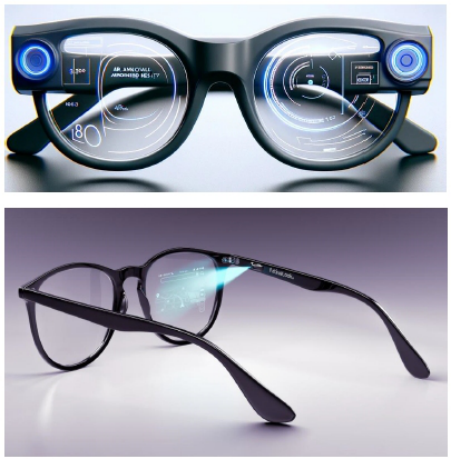
Figure 2: Examples of how it could look like to test with users during the first phases.
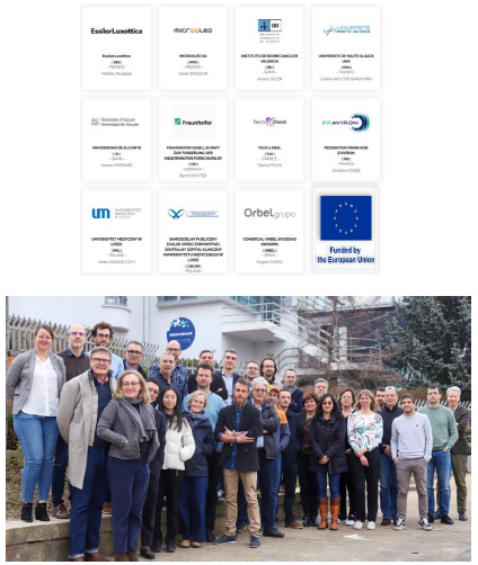
To implement this ambitious project, there is a dedicated team composed of 10 partners: EssilorLuxottica (coordinator), MICROOLED, Instituto de Bimecanica de Valencia, Université de Haute-Alsace, Universidad de Ali- cante, Fraunhofer, Tech2Heal, Fédération Française d’Aviron, Universytet Medyczny w Lodzi and Comercial Orbel.
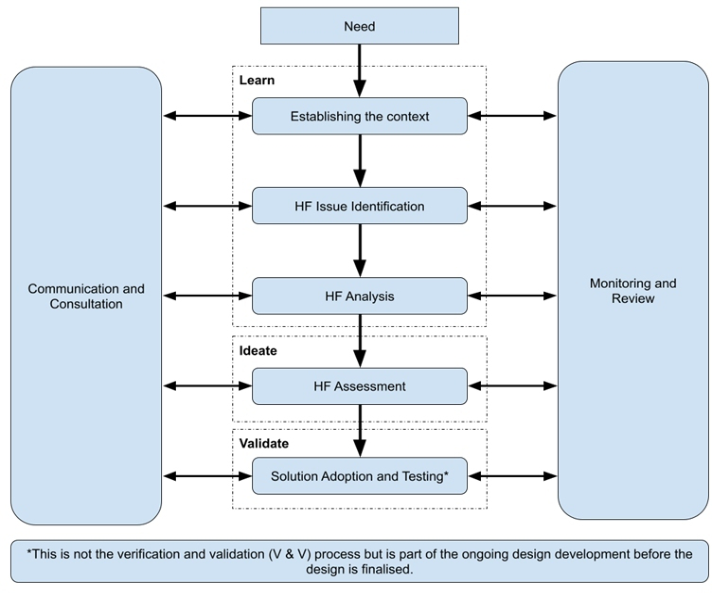
HUMAN FACTORS PLAN We have defined a Human Factors Plan, aligned with the CE mark pro- cess in the case of smart eyewear with ophthalmologic correction (Class I of Medical Device), to ensure a smooth, fast and minimised costs process that fits with uses needs and enhanced market and society acceptance (Morales et al., 2023). Moreover, it allows us to detect risks from the early stages and prioritise and select the key functionalities.
Augmented Reality Eyewear With Ophthalmic Correction for Mainstream Applications 35
Figure 3: Diagram of HF plan integrated along with design and development of intelligent eyewear.
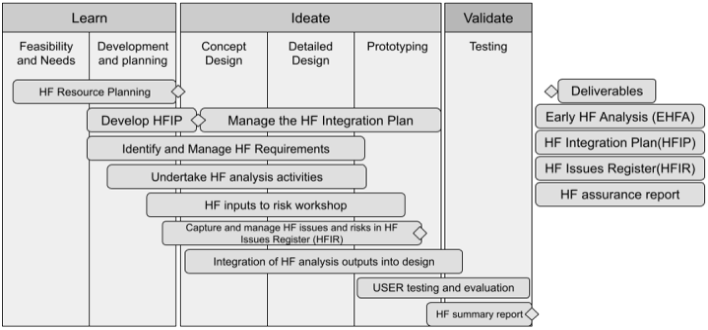
Figure 4 shows the distribution of the tasks along the 3 phases, from needs detection to each iteration between design/development and validation.
Figure 4: Preliminary Gannt along the 3 phases to show sequence and overlap.
In the case of intelligent eyewear, it appears three human factors are expected to be critical: visual comfort, mental workload and acceptance
related to privacy not only of the own users but of other people around them (Rauschnabel et al., 2022).
USE CASES, FROM HEALTHCARE TO MAINSTREAM USE In the initial phase of concept design definition, in-depth interviews were con- ducted with various project partners directly involved in the use cases. These initial interviews played a crucial role in shaping potential use case devel- opment by identifying key issues, prioritising information, and obtaining feedback on challenges and critical considerations. Although the informa- tion pertained to varied backgrounds and potential end-users, some problems could be analysed in a cross-sectional manner, applicable to the development and application of the three different possible use cases, detailed as follows:
Logistics sector: Emphasizing picking preparation as an intensive potential use and inventory realisation as a more targeted activity.
Healthcare sector: training purposes in surgical environments simulating actual practices.
Sports sector: Focusing on rowing training applications for both profes- sional, amateurs and visually impaired people PHASE 1- LEARN. PRELIMINARY RESULTS
This phase has just started, with three main activities: Internal workshop to understand technical boundaries, transmit the importance of Human Fac- tors Plan and user involvement and detail primary Use Cases needs and expectative; benchmark analysis, based on previous ARE knowledge from EssilorLuxottica and MICROOLED and human factors key on ARE from IBV; and an internal survey and external survey to start to prioritise needs and functionalities and a better understanding of market barriers.
Benchmark Firstly, based on the partners’ experience, a benchmark analysis of current solutions and future trends was done. While previous solutions were bulky and not appealing, they started to eyewear similar to traditional glasses (lightweight, aesthetic, combined projectors and sensors, from monochro- matic to colour microdisplays, etc.) but without ophthalmologic correction.
Figure 5: Smart glasses examples: Meta, INMO Go and ActiveLook (MICROOLED).
Augmented Reality Eyewear With Ophthalmic Correction for Mainstream Applications 37
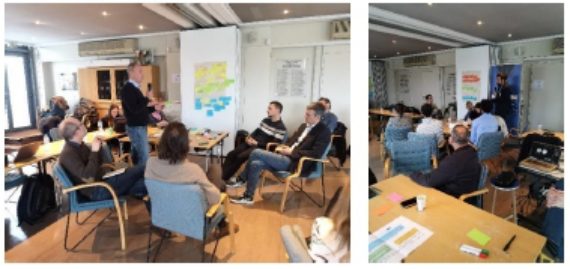
Consortium Workshop and Survey The session was planned actively, incorporating individual and group activi- ties to foster critical thinking and participation. Over 30 participants joined the workshop, split into four working groups. These groups were pre- assigned based on participants’ profiles and expertise to ensure diverse representation in each one. The session, lasting about an hour, was led by IBV researchers. Key aspects covered in the workshop included:
What stoppers, barriers and weaknesses might we face in relation to the interaction between human products and product development in these early stages?
Engaging in debates about values, strengths, and current success factors.
Listing recommendations and improvements for the future.
Creating and prioritising a list of functionalities and barriers for defining use cases.
Figure 6: Images of the workshop performed during the kick-off.
Users Survey In this research phase, we will gather information from a larger sample of potential end users through an online survey. This survey aims to get an ini- tial assessment and acceptance of the AR glass concept we are developing. Targeting the right end users in the three application areas is crucial: logistics, sports and healthcare. It is also necessary to overcome cultural and social dif- ferences so that the survey will be conducted in 5 European countries: Spain, France, Germany, Poland and Italy.
Thus, the initial plan is to obtain n = 150 participants per country. For each of the potential application areas, n = 50 participants will be considered. In total, we plan to get 750 responses. This sample is sufficiently robust to detect statistically significant differences. Sociodemographic data (gender, age, etc.) will also be considered in the sample distribution.
NEXT STEPS AND EXPECTED IMPACTS The following steps are the following:
Gather and process all data as a starting point for the Learn Phase.
Perform user tests with solutions similar to the current MICROOLED device or other commercial solutions (to be determined).
Perform a co-creation session to generate the first conceptual designs of the Ideation Phase.
Validate conceptual designs with potential users, stakeholders and experts.
It should be highlighted that four versions will be developed combin- ing two factors: 1) Monochromatic and colour, and 2) non-corrected and prescription lenses.
Following Lean methodology, this iterative approach will allow progres- sive selection and testing of the most suitable functionalities for each use case and user, allowing enhanced market deployment due to the balance of users’ needs, technical barriers and device cost.
ACKNOWLEDGMENT
This project has received funding from the European Union’s Horizon Europe research and innovation programme under grant agreement No 101135770. This publication reflects the views only of the author, and the Commission cannot be held responsible for any use which may be made of the information contained therein.
The authors would like to thank all partners of Popular Consortium (Figure 7).
Figure 7: Kick-off meeting of POPULAR project with all consortium partners.
Augmented Reality Eyewear With Ophthalmic Correction for Mainstream Applications 39
REFERENCES
Morales Casas, A., López Vicente, A., Solano-García, L., & Laparra, J. (2023). Three sprints from zero to innovative medical device in 16 months: Benefits of combin- ing Human Factors and Agile. 14th International Conference on Applied Human Factors and Ergonomics (AHFE 2023). https://doi.org/10.54941/ahfe1003047 Rauschnabel, P. A., Felix, R., Hinsch, C., Shahab, H., & Alt, F. (2022). What is XR?
Towards a Framework for Augmented and Virtual Reality. Computers in Human Behavior, 133, 107289. https://doi.org/10.1016/J. CHB.2022.107289 Yu, J., Ferniany, W., Guthrie, B., Parekh, S. G., & Ponce, B. (2016). Lessons Learned From Google Glass: Telemedical Spark or Unfulfilled Promise? Surgical Innovation, 23(2), 156–165. https://doi.org/10.1177/1553350615597085 Zhang, Z., Bai, E., Joy, K., Ghelaa, P. N., Adelgais, K., & Ozkaynak, M. (2023).
Smart Glasses for Supporting Distributed Care Work: Systematic Review. JMIR Medical Informatics, 11(1), e44161. https://doi.org/10.2196/44161
LISTED IN THE AHFE DIGITAL BOOKSTORE CATALOGUE
Explore the complete digital volume
Health Informatics and Biomedical Engineering Applications
Read this individual research paper free through the original publisher, or explore the full digital proceedings book.
ISBN 978-1-964867-18-2
Explore this ISBN in the AHFE Bookstore ↗Listed in the July 2026 bookstore catalogue; search by ISBN to confirm current availability · Digital book purchase optional