Amparo López-vicente, Adrian Morales Casas, Carlos Atienza, Raquel Marzo Roselló, Jose Laparra (2024). Citizen Science Applied Health Care: Active involvement of clinicians and patients in co-creating health products, services and environments. In: Health Informatics and Biomedical Engineering Applications. AHFE Open Access, vol. 142, pp. 21–30. https://doi.org/10.54941/ahfe1005067
Citizen science, involving the public in scientific processes alongside researchers, offers promise for health research and collaborative health management. This participatory approach engages laypersons in knowledge production, yielding insights unattainable through traditional methods. This article highlights citizen science's practical contributions to healthcare, advocating for its role in reshaping the healthcare model. Drawing from four recent projects, it emphasises the importance of professional and patient involvement in solution development. These experiences underscore the need for rigorous criteria identification and early-stage involvement to ensure project success.Recommendations to advance citizen science in health management include extending value-based health principles to product development, diversifying participant profiles, integrating citizen scientists into early research phases, leveraging technology for data collection, and ensuring methodological rigour. These suggestions aim to enhance the effectiveness of citizen science in addressing health challenges and fostering collaborative innovation in healthcare.The future of social and healthcare services must actively include citizens and professionals throughout the process to humanise these services, enhancing health products, services and environments.
Citizen science involves the active participation of the general public in sci- entific research tasks, fostering collaboration between scientists and citizens to generate new knowledge for both science and society (Vohland et al., 2021). In this approach, citizens’ contributions are recognised primarily in evaluation. One notable opportunity in health is the potential for patients to contribute their health data for research and hypothesis generation based
on shared experiences (Den Broeder et al., 2018). While these citizen sci- ence endeavours present significant opportunities, it is crucial not to overlook the role of users (professionals and patients) as key stakeholders throughout the research process. They play pivotal roles in identifying needs, concep- tualising solutions, and participating in testing during the initial phases (López-Vicente, 2017).
Increasingly, there are instances of research that involve the participation of citizens. Some studies point out that the participation of user organi- sations and associations in research corresponds to better results (Hickey et al., 2018). Combining multiple methods, empirical materials, perspectives, and observers from social sciences is a strategy that adds rigour, scope and depth to any investigation (Denzin & Lincoln, 2005). These methodologies are underpinned by methodological advancements emerging from the design field (Sanders & Stappers, 2014). The adoption of participatory, collabora- tive, and co-creation methodologies is gaining momentum, paralleling the increasing involvement of the public in collective decision-making processes, notably within the social innovation domain (European Commission, 2013).
Nevertheless, projects characterised by extensive collaboration remain uncommon within scientific and health-related domains. Most citizen science initiatives rely solely on participation in the collection and, occasionally, the analysis of observations on a large scale (Kullenberg & Kasperowski, 2016).
Therefore, value-based healthcare describes healthcare designed to focus on quality care, provider performance and the patient experience. The “value” in value-based care refers to what an individual values most (Porter & Teisberg, 2006). This approach requires citizen science to consider health professionals and citizens or patients as critical agents.
This article aims to underscore the application of social innovation, value- based health, and participatory research to citizen science. Incorporating many methodological advances allows citizens to be involved in research and development activities, providing a future in tune with society, its needs, and its expectations. To achieve these objectives, references are raised, such as the investigation-action research (Love et al., 2011; McIntyre, 2007; Muller, 2003), the citizen and their quality of life as an objective of development (Sen, 2000; Osterlaken, 2008); the inclusive research (Barton, 2005); and the social and ethical value of the products and services (Van der Hoven, 2005, 2007; Newell & Gregor, 2000). Specifically, the contributions of co-creation (Sanders & Stappers, 2008) are presented. Co-creation is included in the ini- tial explorations to determine what will be designed. These questions require tools to help users express themselves through metaphors and associations, sometimes revealing delicate and irrational motives. Creative and projective methods offer these forms of expression (Shedroff, 2003).
BACKGROUND
Insights gathered from the four health and quality of life projects offer valu- able lessons for structuring co-creation activities in citizen science projects related to health. These lessons harmonise with collaborative citizen science endeavours (Bonney, 2009).
Citizen Science Applied Health Care: Active Involvement of Clinicians 23
The first project, the European project ABC, Advanced BNCI Communica- tion, funded by the European Commission (call FP7-ICT-2011-7), developed a communicator concept that integrated health functions, environmental control and emotion management, in addition to the associated functions themselves, to alternative and augmentative communication to people with dyskinetic cerebral palsy. The project aimed to develop new forms of com- munication for children with cerebral palsy through an open interface that different input devices can control. The first year was allocated to needs detec- tion, idea generation, conceptual development, and validation. Three user profiles that traditionally participate in this type of research participated: professionals, family members and users (people with dyskinetic cerebral palsy). This way, the applied methodology has been triangulated, and the information obtained has been validated.
The second project, AI3cord (funded by the Strategic Cooperation Projects programme of the Valencian Innovation Agency-AVI), has allowed us to gen- erate a technological platform that, through the use of IoT devices and data analysis techniques based on AI, is capable of remotely, dynamically and minimally intrusive evaluation of new indicators aimed at monitoring and preventing frailty in older people. In the first phase, five doctors, two social workers and eight older people with chronic diseases participated in the iden- tification of system requirements and functionalities. AI3cord promotes an effective healthy ageing model, which allows for preventing and delaying the onset of the disease, as well as the loss of capabilities and autonomy that lead to states of earlier dependency. This project opens the doors to its applica- tion in addressing other chronic pathologies or ailments that can benefit from remote and non-invasive monitoring technology.
The third project, Equilin project, promoted by the Emergency Centre 061 of the Andalusian Health Service and funded by the European Regional Development Fund (ERDF) through the Pluri-regional Operational Program of Spain 2014-2020, aid granted by the Ministry of Science and Innovation through the FID program “Promotion of Innovation from Demand”, its pur- pose was to design an integrated device with connectivity, transmitter and receiver of data and records with the Emergency Coordination Centres and Health Emergencies and that would guarantee clinical safety for patients and professionals, that would be low weight, and that would represent a new scenario in the provision of health care in the extra-hospital environment. Nine health professionals participated in imagining solutions for recording vital signs without physical contact, which facilitated this activity for emer- gency teams, providing their vision and ideas about the design, currently on a TRL7.
The last project, the “Strategies and models for the improvement of security, functionality and user experience in birth centres” (GVA. INNEST/2023/93) within the Programme of Strategic Projects in Cooper- ation, financed by the European Union in the framework of the European Regional Development Fund (FEDER) Comunitat Valenciana 2021-2027, is the most recent project, which develops a strategic framework that allows for the incorporation of requirements and innovations to improve the quality of maternal and neonatal care and resources in the birth process, from a unit
led by midwives. To this end, different lines of work and research are estab- lished with all the actors involved in implementing a pilot centre, considering the values described in the European Standards for Birth Centres. A large group of women, midwives, designers, and architects, among others, actively participate in all the research activities. The co-creation session focused on collaboratively generating a proposal for spaces for the birth centre of the future, considering women’s needs and expectations, which raises awareness in the design of proposals.
METHODOLOGICAL STRATEGY The purpose of the co-creation stage in these projects is to detail how the participants imagine and want the product/service/environment to be, consid- ering its features, aesthetics and use (How I want it / what it should convey / how I use it and when). The application of the co-creation techniques starts by reflecting on the previous results of current needs and problems based on dis- cussion groups or interviews, among others. Besides, its objectives are, first, to generate ideas and proposals for using the product/service/environment under development. Second, ideas should be developed that are associated with the features and functionalities it should have. Third, ideas for using the product/service/environment should be developed. Fourth, identify the values and images the product/service/environment should transmit. Next, detail ideas associated with potential situations using the product/service/en- vironment. Last, associate the product/service/environment with expectations through examples of other products, values, associated ideas, etc.
The techniques used in the different studies have been Context mapping (Sleeswijk-Visser et al., 2005) and storyboarding (Crothers, 2013) (only in the ABC project). For people with cerebral palsy (ABC project, Lopez-Vicente et al., 2013), an adapted Context mapping was applied, focusing on devel- oping awareness notebooks (Visser et al., 2005). Here, awareness is the first phase of the user intervention, part of the recognition of users as experts in their individual experiences, and its development is based on the belief that all people can project and express their needs, desires and aspirations through the use and interpretation of visual stimuli. The exercises consisted of associating ideas and exemplifying situations that provided solutions to the needs raised graphically and allowing specific elements to be identified for the design of the communicator.
Before the co-creation sessions, the needs and demands related to the topic of the study were reflected on and generated debate. In all projects, interviews, observations or discussion groups were conducted to identify the information necessary to address the co-creation processes with guarantees.
The methodologies used must be adapted to the profiles of participants, generating support and awareness materials that facilitate contributions, such as photographs and inspiring images, construction materials such as plas- ticine or cardboard, and materials designed for this type of session, such as Lego Serious Play.
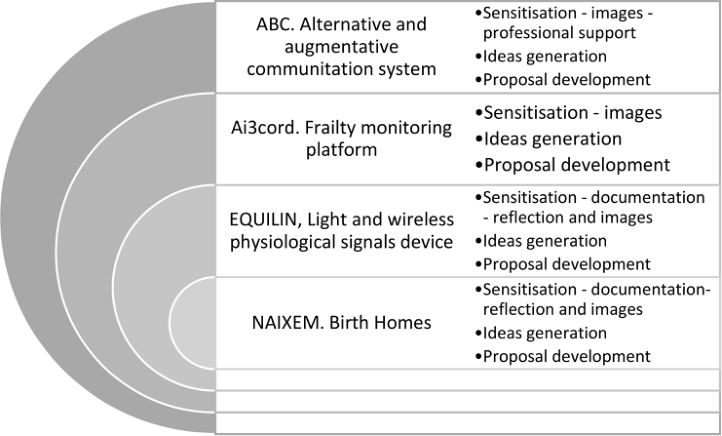
Each methodological proposal is shown in Figure 1:
Citizen Science Applied Health Care: Active Involvement of Clinicians 25
Figure 1: Methodology scheme.
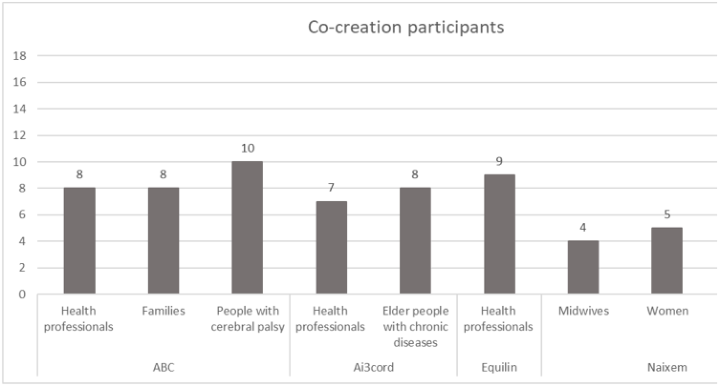
Sample Description According to some authors, the sample sizes in qualitative techniques range between six and ten users (Crothers, 2013; Visser et al., 2005; Salminen, 2008). In the studies, a minimum of nine participants are proposed, and a minimum of four participants are chosen by the group, as shown in the sample description in Figure.
Figure 2: Sample description.
RECOMMENDATION AND GOOD PRACTICES The development of these projects has allowed us to identify some recom- mendations and good practices related to the planning and execution of co-creation sessions in the health field.
Planning First, it is essential to anticipate the participants’ expectations, define the objectives, schedule, and times dedicated to each activity, and determine the form of work (group, individual...) and expected contributions.
The session must be planned and documented with simple and descrip- tive language, use examples and different ways of stating the challenges to be addressed, use support materials to encourage reflection and, above all, have the advice of direct care professionals to define the session. These pro- fessionals know the most appropriate way to present each situation to the group.
The schedules proposed in the sessions with patients and health profes- sionals should adapt to their schedules and routines; if possible, they should be carried out in the care centre where they usually meet or work (a familiar environment improves trust). Furthermore, the rooms used must guarantee the visual contact of the participants.
Participants Selection A minimum sample size of 6 users should be planned, eight if it is more than one population segment. An optimal sample would be between 8 and 15 participants in the co-creation sessions. However, depending on the scope of the research, participatory processes involving a more significant number may be proposed.
The selection of participants based on their contact networks, which implies collaboration with hospitals or patient associations, guarantees that the sample will be available, compliance with inclusion criteria and the motivation required for these interventions.
Methodology and Implementation of Co-Creation Workshops The sessions must have a moderator who provides clear guidelines for the ideation and development of proposals. Session times must also be regulated, adapting them to the times required by users; sessions between one and two hours are recommended. In some cases, in profiles of participants with diffi- culties in communication or attention, the session can be divided into shorter periods to avoid exhaustion.
It is recommended that continuous advice be provided to the participants during their contributions, helping them define the ideas, providing feed- back on their contributions, and motivating a positive climate in which the different ideas are incorporated into the proposals without criticism.
Managing expectations with participants is essential; we cannot guarantee that the final development will respond to all their demands, mainly when we deal with complex pathologies and novel technologies that have not been tested before.
Citizen Science Applied Health Care: Active Involvement of Clinicians 27
It is essential to study the composition of the groups of participants; the mixed presence of patients and health professionals can lead to giving up the demands in favour of the healthcare professionals’ proposals, considering their more significant experience and knowledge.
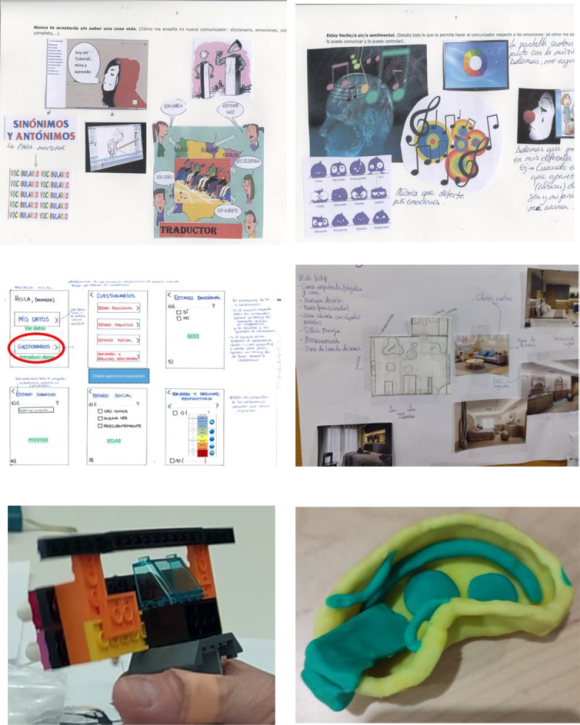
Orientation of Results Based on the participation of citizens or professionals outside of design, the results obtained in the co-creation sessions reflect the expectations and demands at the level at which their knowledge allows them, in the form of mock-ups, schemes or basic constructions. (Figure 3). In subsequent stages of these sessions, developers and designers must work to make the propos- als tangible into a solution that will be validated, iteratively, by patients and healthcare professionals. Carrying out these sessions means improving accep- tance since the solution will contain the demands of the groups that will be the future users.
Figure 3: Examples of results obtained along co-creation sessions of each project.
CONCLUSION
In the four case studies analysed, we have verified that the contributions of patients and direct care health professionals have provided results of great value for ongoing research. Their experience makes them highly qualified agents for identifying the functionalities and benefits that products, services or environments must provide. Furthermore, deep knowledge of the processes allows them to provide relevant keys to the forms of use, quickly identifying elements to avoid and enhance. These studies show that relevant actions can be proposed with reduced resources.
Firstly, holding sessions with many participants presents significant organ- isational difficulties. It is impossible to reflect or accompany the teams of co-creators as in smaller sessions. The results can be affected, reaching a lower level of detail by not having advice and guidance. On the other hand, work- ing with patients may imply functional diversity, which will require adapting methodologies to the users’ capabilities. Finally, healthcare professionals are usually very clear about what they expect from development, which some- times limits options or presents restrictions on disruptive proposals that the research team may expect.
These learnings should motivate methodological challenges, which prepare the field of collaborative citizen science to address health management from the value-based health approach. It is recommended that these milestones be achieved.
(a) to expand the approach of value-based health and humanised care to the development of environmental health and the development of health products and devices, (b) increase the diversity of people who are citizen scientists, considering any patient profile and their environment (family and companions) as qual- ified people to participate in these processes, key agents with capacity for decision making, critical capacity and idea generation capacity,
(c) increase the integration of citizen scientists in research phases, mainly in the early stages in which strategies are identified and solutions are defined, (d) take advantage of emerging technologies that allow citizen scientists to collect health-relevant data and
(e) promote the rigour of citizen participation methods, assuming inherent realities such as biases and difficulties in adapting methodologies to different population groups.
ACKNOWLEDGMENT
This article and its contributions have been possible thanks to the following projects:
“Advanced BNCI Communication” financed by the European Union in the Seventh Framework Programme, called FP7-ICT-2011-7);
AI3cord funded by the Strategic Cooperation Projects programme of the Valencian Innovation Agency-AVI;
“Light Intervention Equipment for Health Emergencies” promoted by the Emergency Centre 061 of the Andalusian Health Service and funded by
Citizen Science Applied Health Care: Active Involvement of Clinicians 29
the European Regional Development Fund (ERDF) through the Pluri- Regional Operational Program of Spain 2014-2020, aid granted by the Ministry of Science and Innovation through the FID program “Promotion of Innovation from Demand”;
“Strategies and models for the improvement of security, functionality and user experience in birth centres” (GVA. INNEST/2023/93) within the Pro- gramme of Strategic Projects in Cooperation, financed by the European Union in the framework of the European Regional Development Fund (FEDER) Comunitat Valenciana 2021–2027.
Specifically, thanks to the involvement of the Hospital La Plana de Vil- larreal, Hospital General de Valencia, Fisabio, Universitat Politécnica de Valencia, AVAPACE, Centro de Emergencias 061 de la Junta de Andalucía, women and mothers, midwives, older adults, architecture students, people with cerebral palsy and their families, doctors, nurses, health technicians, social workers, psychologists, physiotherapists and educators, who have provided us with essential knowledge in research.
REFERENCES
Barton, L. (2005). Emancipatory research and disabled people: Some observations and questions. Educational Review, 57(3):317–327. Bonney R. et al., Public Participation in Scientific Research: Defining the Field and
Assessing Its Potential for Informal Science Education, CAISE, 2009. Crothers, B. (2013). Storyboarding & UX–Part 1: an introduction. Johnny Holland. Den Broeder, L., Lemmens, L., Uysal, S., Kauw, K., Weekenborg, J., Schönenberger, M., et al. (2017). Public health citizen science; perceived impacts in citizen sci- entists: A case study in a low-income neighbourhood in the Netherlands. Citizen Science: Theory and Practice, 2(1), 7. https://doi.org/10.5334/cstp.89. Denzin, N. K. and Lincoln, Y. S. (2005). The Sage handbook of qualitative research.
Sage. European Commission (2013). Guide to social innovation. Technical report. Hickey, G., Richards, T., & Sheehy, J. (2018). Co-production from proposal to paper.
Nature, pp. 562, 29–31. Kullenberg, C., & Kasperowski, D. (2016). What is citizen science?–A scientometric meta-analysis. PloS one, 11(1), e0147152. López-Vicente, A., Laparra-Hernández, J., et al. (2013). ABC System: A New Com-
municator Concept for People with Cerebral Palsy. In Assistive Technology: From Research to Practice (pp. 1033–1038). IOS Press. López-Vicente, M. A. (2017). La participación de personas con discapacidad en proyectos de I+ D+ I. Buenas prácticas para la inclusión de personas con parálisis cerebral discinética en procesos de innovación (Doctoral dissertation, Universitat de València). Love, P. E., Edwards, D. J., Irani, Z., & Sharif, A. (2011). Participatory action
research approach to public sector procurement selection. Journal of Construction Engineering and Management, 138(3):311–322. McIntyre, A. (2007). Participatory action research, volume 52. Sage Publications. Muller, M. J. (2003). Participatory design: the third space in HCI. Human-computer interaction: Development process, 4235:165–185. Newell, A. F. and Gregor, P. (2000). “User sensitive, inclusive design”-searching for a
new paradigm. In Proc.2000 conference on Universal Usability, pp. 39–44. ACM.
Oosterlaken, I. (2008). Product innovation for human development. A capability approach to designing for the bottom of the pyramid (Working paper of Delft). Porter, M. E., & Teisberg, E. O. (2006). Redefining health care: creating value-based
competition on results. Harvard Business Press. Salminen, A.-L. (2008). European research related to assistive technology for disabled children. Technology and Disability, 20(3):173–178. Sanders, E. and Stappers, P. J. (2008). Co-creation and the new landscapes of design.
Co-design, 4(1):5–18. Sanders, E.., and Stappers, P. J. (2014). Probes, toolkits and prototypes: three approaches to making in codesigning. CoDesign, 10(1), 5–14. Sen, A. (2000). El desarrollo como libertad. Gaceta Ecológica, (55):14–20. Shedroff, N. (2003). Research methods for designing compelling experiences. Design
Research: Methods and Perspectives, pages 155–163. Van den Hoven, J. (2005). Design for values and values for design. Information age, 4:4–7. Van den Hoven, J. (2007). ICT and value-sensitive design. In The information soci-
ety: Innovation, legitimacy, ethics and democracy in honour of Professor Jacques Berleur SJ, pages 67–72. Springer. Visser, F. S., Stappers, P. J., Van der Lugt, R., and Sanders, E. B. (2005). Context mapping: experiences from practice. CoDesign, 1(2):119–149. Vohland, K., Land-Zandstra, A., Ceccaroni, L., Lemmens, R., Perelló, J., Ponti,
M.,... & Wagenknecht, K. (2021). The science of citizen science (p. 529). Springer Nature.
LISTED IN THE AHFE DIGITAL BOOKSTORE CATALOGUE
Explore the complete digital volume
Health Informatics and Biomedical Engineering Applications
Read this individual research paper free through the original publisher, or explore the full digital proceedings book.
ISBN 978-1-964867-18-2
Explore this ISBN in the AHFE Bookstore ↗Listed in the July 2026 bookstore catalogue; search by ISBN to confirm current availability · Digital book purchase optional